

Most marketers think audience segmentation means splitting a list by age and zip code. That misses the point entirely. Audience segmentation is the strategic process of dividing your customer base into distinct groups based on shared characteristics, so every message you send actually resonates with the person receiving it. Done well, it transforms scattered marketing spend into precise, high-converting campaigns. Done poorly, it produces a spreadsheet of labels that nobody activates. This article gives you the full picture, from definition to execution.
Table of Contents
- Key takeaways
- What audience segmentation actually means
- Types of audience segmentation
- Benefits of segmentation for your business
- How to segment your audience effectively
- My take on segmentation after years in the field
- How 16wmediagroup helps you activate your segments
- FAQ
Key takeaways
| Point | Details |
|---|---|
| Segmentation is not targeting | Segmentation divides audiences; targeting chooses which segments to pursue; personalization customizes the message. |
| Demographics alone fall short | Combining behavioral and psychographic data creates segments that are stable, reachable, and truly actionable. |
| Segments must be operational | If your CRM and messaging platforms cannot act on a segment, it exists only on paper and drives zero results. |
| Naming segments too early backfires | Define segments by measurable criteria and behavior patterns first, then assign names once the data confirms the group. |
| Segmentation improves every channel | Email, paid media, podcasts, and local advertising all perform better when powered by well-defined audience segments. |
What audience segmentation actually means
The audience segmentation definition you’ll find in most textbooks is straightforward: divide a broad audience into smaller groups that share meaningful characteristics. But that framing skips the part that matters most, which is why you are dividing them and what you plan to do next.
Segmentation is the first stage in a three-part model. Segmentation, targeting, and personalization are distinct stages, and confusing them is one of the most common mistakes in marketing. Segmentation analyzes and categorizes your audience. Targeting decides which categories are worth pursuing given your budget, goals, and capabilities. Personalization shapes the actual message for each targeted group. Skipping the sequence, or blurring the lines between steps, is how campaigns end up feeling generic despite the data investment behind them.
For a segment to be worth building, it needs to clear four bars. Ask yourself whether the group is observable (you can actually measure it), meaningful (the members behave differently from others), accessible (you can reach them through a specific channel), and stable (the group will hold together long enough to justify the effort). Segments lacking these qualities often fail to translate into real marketing workflows, no matter how tidy they look in a report.
Pro Tip: Before investing in sophisticated segmentation tools, audit what data you already have in your CRM. Most businesses are sitting on enough behavioral and transactional signals to build three to five highly useful segments without buying a single new data source.
Types of audience segmentation
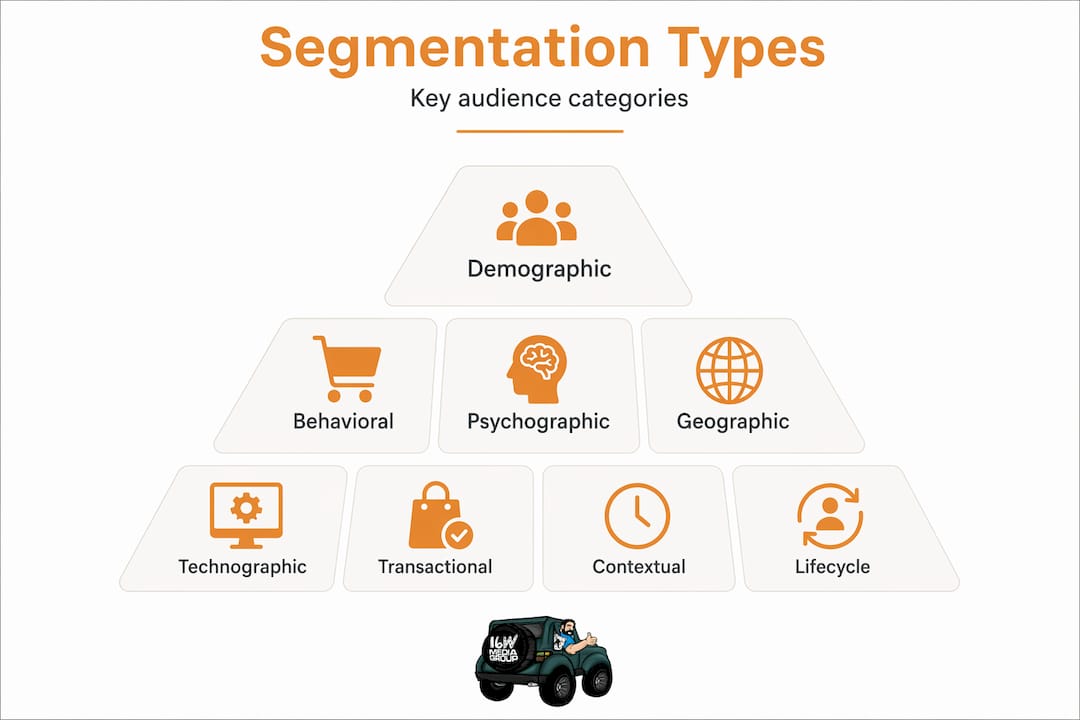
Understanding the types of audience segmentation gives you options. Not every business needs all eight types, but knowing what exists helps you pick the right criteria for your goals.
The eight main types are demographic, behavioral, psychographic, technographic, transactional, contextual, lifecycle, and predictive segmentation. Here is a comparison of the core four and when to use them:
| Type | Data used | Best marketing application |
|---|---|---|
| Demographic | Age, income, gender, occupation | Broad channel selection, product positioning |
| Geographic | Location, region, neighborhood type | Local advertising, community-based campaigns |
| Psychographic | Values, interests, lifestyle, opinions | Brand storytelling, content marketing |
| Behavioral | Purchase history, site visits, email opens | Retargeting, lifecycle emails, loyalty programs |
Beyond the core four, a few specialized types are worth understanding:
- Technographic segmentation groups people by the devices, platforms, and software they use. A SaaS company targeting mobile-first users runs very different campaigns than one targeting desktop enterprise buyers.
- Lifecycle segmentation separates new leads from repeat buyers from at-risk customers. Each lifecycle stage demands a different conversation entirely.
- Predictive segmentation uses historical patterns to forecast future behavior, like identifying customers likely to churn before they actually leave.
- Transactional segmentation focuses on purchase frequency, average order value, and recency. This is the engine behind most loyalty and win-back campaigns.
The most effective segmentation strategies combine two or three types rather than relying on one. A local Tampa restaurant, for example, might layer geographic segmentation (residents within five miles) with behavioral data (frequent lunch buyers) and psychographic signals (health-conscious eaters). That combination produces a segment you can actually talk to with a specific message through a specific channel, rather than a generic local audience that needs a generic ad. For advertising to specific neighborhoods, layering these types makes the difference between a campaign that converts and one that just runs.
Benefits of segmentation for your business
The benefits of audience segmentation go well beyond “better targeting.” When segments are built correctly, they change how the entire business makes decisions.

The most immediate payoff is relevance. When your message matches the actual situation of the person reading it, engagement climbs. Segmented email campaigns consistently outperform unsegmented blasts on every metric that matters, including open rates, click-through rates, deliverability scores, and revenue per send. This is not a marginal improvement. The gap between a segmented and non-segmented email program is often the difference between a campaign that pays for itself and one that erodes your list.
Beyond campaign performance, segmentation surfaces insights that inform product and marketing decisions well outside of any single campaign. When you notice that one behavioral segment has a dramatically higher lifetime value than another, that finding should reshape your acquisition strategy, your pricing model, and your customer service priorities.
Here is a practical summary of what segmentation unlocks:
- Higher conversion rates from more relevant messaging
- Lower ad spend waste by excluding non-fit audiences
- Stronger customer loyalty from communications that feel personal
- Clearer data for product development and service design
- Better forecasting because segment-level trends are more predictable than aggregate trends
Pro Tip: Avoid creating too many segments too quickly. Five well-defined, operational segments will consistently outperform twenty poorly validated ones. More segments mean more content variants to produce and more complexity to manage across every channel.
How to segment your audience effectively
Knowing the theory is one thing. Building segments your team can actually use requires a process. Here is how to do it right.
- Start with the data you have. Pull your CRM records, email engagement data, website analytics, and purchase history. You are looking for natural behavioral patterns before you impose any framework on the data.
- Identify observable differences. Which customers buy frequently versus once? Which ones open every email versus none? Which ones convert through organic search versus paid social? These behavioral differences are the raw material of useful segments.
- Define inclusion criteria before naming segments. Prematurely naming segments constrains your thinking and leads to forcing data into pre-existing labels. Let the measurable patterns determine the groups, then name them once the criteria are clear.
- Validate that segments are reachable. A segment only has value if your messaging systems can differentiate it. Email and marketing platforms need to be able to trigger or suppress content based on segment membership. If your CRM cannot export the segment cleanly, it will not drive results.
- Test with one channel first. Run your new segmentation logic through email or a single paid social campaign before applying it across every channel. Measure engagement differences across segments before scaling.
- Review and update segments quarterly. Behavioral patterns shift. A segment that was stable six months ago may have fragmented or merged with another group. Segments need to remain stable enough to justify ongoing investment, so schedule regular audits.
For local businesses especially, building a personalized media plan depends entirely on having clean, validated segments. Without them, you end up paying for reach that does not convert.
Pro Tip: When integrating segmentation into your CRM, use behavioral triggers rather than static tags whenever possible. A tag that says “interested in fitness” goes stale. A trigger based on “visited the fitness product page three times in 30 days” stays current automatically.
My take on segmentation after years in the field
I have watched more segmentation projects fail than succeed, and the failure mode is almost always the same. Teams spend weeks building beautiful audience taxonomies with clever persona names and rich demographic profiles. Then they hand it off to the media or email team and nothing actually changes in the campaigns. The segments live in a deck, not in the platform.
What I have learned is that actionability is everything. A segment is only as good as what your systems can do with it. Before you ask “how should we define our segments,” ask “what can our CRM and ad platforms actually differentiate today?” Build from that constraint outward, not the other way around.
I have also seen too many marketers treat segmentation as a destination. It is not. It is infrastructure. Once you have segments working in your campaigns, the real work is using them to get smarter. What does one segment value that another does not? Where do they consume media differently? Those answers are where genuine competitive advantage lives.
The trend toward data privacy, including cookie deprecation and tighter regulations, is making first-party behavioral data more valuable than ever. Businesses that invested in building real segmentation from owned data sources are in a dramatically better position than those who relied on third-party data to do the work. If you have not started building that foundation, 2026 is the year to start.
— Mike
How 16wmediagroup helps you activate your segments
Once your segments are defined, the next challenge is reaching them through the right channels at the right moment. That is exactly where most businesses need a partner who understands both the media and the audience.
16wmediagroup works with local businesses and growth-focused brands to translate segmentation strategy into real campaigns across digital media, podcasts, community publications, and traditional advertising. Whether you are targeting affluent neighborhoods in Tampa or building lifecycle campaigns for repeat buyers, the team at 16wmediagroup builds local advertising campaigns that are grounded in audience data from the start. If you are ready to stop running generic ads and start reaching the specific people most likely to buy, explore the full media and branding services at 16wmediagroup and find out how a tailored media plan can put your best segments to work.
FAQ
What is the audience segmentation definition?
Audience segmentation is the process of dividing a broad customer base into smaller groups that share meaningful characteristics, so marketing messages can be tailored to each group’s specific needs and behaviors.
How is segmentation different from targeting?
Segmentation identifies and categorizes distinct audience groups, while targeting is the separate decision about which of those groups to focus your marketing resources on. Personalization then customizes the message for the chosen segments.
What are the main types of audience segmentation?
The core types are demographic, geographic, psychographic, and behavioral segmentation. Advanced types include technographic, lifecycle, transactional, and predictive segmentation, each suited to different marketing goals and data sources.
Why do demographic segments alone fall short?
Demographics provide a surface-level picture that often produces groups too broad to reach with specific messages. Adding behavioral and psychographic data creates segments that are stable, accessible, and genuinely different from one another in ways that change how you should market to them.
How do you know if a segment is ready to use?
A segment is ready when it meets four criteria: it is observable through available data, meaningful in that members behave differently from non-members, accessible through at least one channel, and stable enough to justify ongoing investment. If your CRM or email platform cannot act on it, it is not ready yet.