
For local referral-led businesses, Nextdoor and your local Chamber of Commerce deliver the highest-trust connections. For professional reach and thought leadership, LinkedIn wins. For events and in-person momentum, Meetup and Eventbrite are the clearest choices. Here is the fast-scan verdict across all the top alternatives worth your time:
- LinkedIn — best for B2B thought leadership and professional reach beyond your zip code
- Facebook Groups — best for hyper-local community engagement and word-of-mouth
- Nextdoor — best for neighborhood-level referrals and local service discovery
- Meetup — best for building in-person groups and recurring community events
- Eventbrite — best for ticketed events, workshops, and driving new-audience attendance
- Reddit — best for niche industry conversations and organic brand visibility
- Shapr — best for one-on-one professional introductions in a swipe-style format
- Townsquared — best for private, trust-based local business communities
- Google Business Profile — best for local search visibility and review-driven referrals
- Yelp — best for consumer-facing service businesses that live and die by reviews
- Local Chamber of Commerce — best for structured referral networks and civic credibility
One more signal worth naming: if you have tested two or three of these platforms for 60–90 days and still cannot point to a consistent lead source, a managed local media campaign often outperforms any platform on its own. More on that at the end.
Table of Contents
- How these Alignable alternatives compare at a glance
- Detailed profiles: what each platform actually does for local SMBs
- How to choose the right platform for your business
- How real small businesses use these platforms week by week
- Key Takeaways
- When a platform alone won’t move the needle
- Local media as a predictable alternative to platform-only networking
- Selected sources and further reading
How these Alignable alternatives compare at a glance
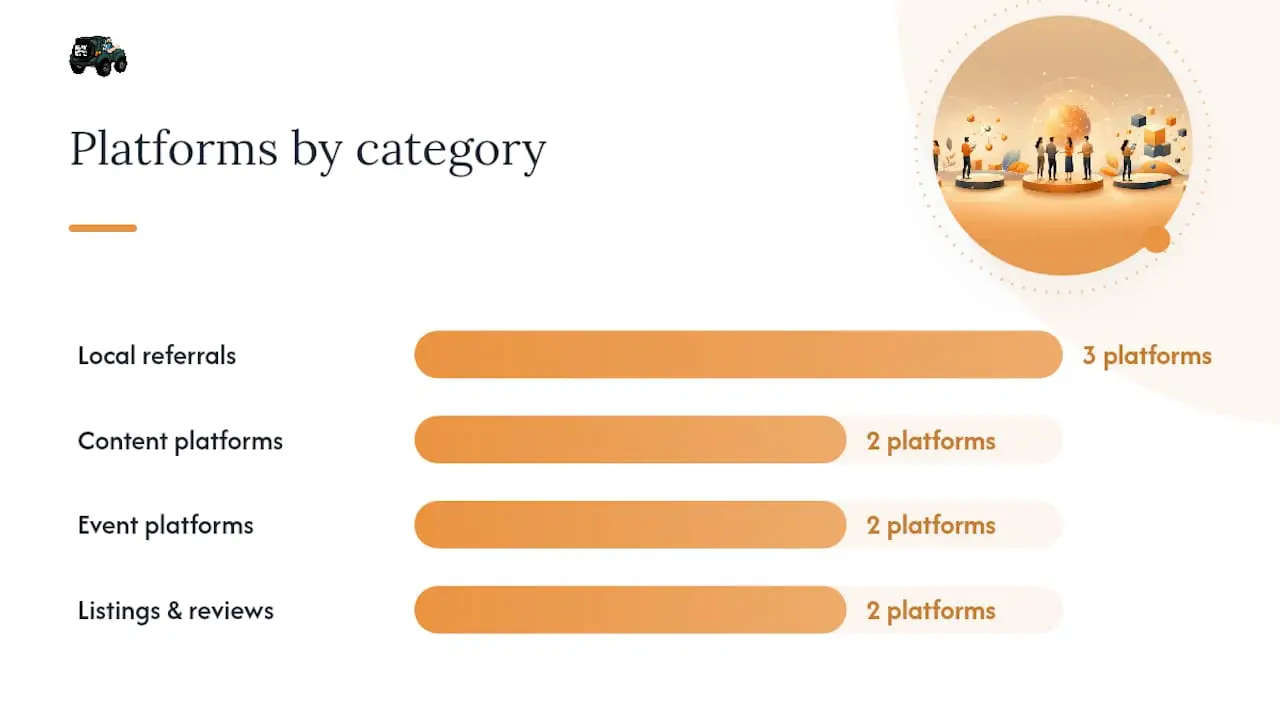
The biggest practical split in this group is between referral-focused platforms (Nextdoor, Chamber, Townsquared) and content-driven platforms (LinkedIn, Reddit). The first group surfaces you to neighbors and local buyers; the second builds authority with a professional or enthusiast audience that may extend well beyond your city. Event-driven platforms (Meetup, Eventbrite) and listings/review platforms (Google Business Profile, Yelp) sit in their own lanes entirely.
When vetting any platform, check three trust signals before committing: whether pricing is transparent and a free tier exists, how active local conversations are in your specific market, and whether the platform has real moderation so spam does not drown out genuine connections.
| Platform | Best for (goal) | Free tier / cost | Local vs. national reach | Primary networking style | Key features for SMBs | How it generates referrals/leads |
|---|---|---|---|---|---|---|
| B2B thought leadership | Free + Premium tiers | National/global | Content + connections | Business pages, articles, groups | Content shares, DMs, recruiter/partner intros | |
| Facebook Groups | Community word-of-mouth | Free (ads optional) | Hyper-local to national | Groups + posts | Events, groups, Marketplace | Group recommendations, post shares |
| Nextdoor | Neighborhood referrals | Free + paid business posts | Hyper-local | Neighborhood feed | Business pages, neighbor reviews | Neighbor recommendations |
| Meetup | In-person community | Free to join; organizer ~$24/mo | Local to regional | Events + groups | RSVP tools, recurring events | Attendee relationships, follow-up |
| Eventbrite | Ticketed events | Free for free events; fees on paid | Local to national | Event listings | Ticketing, email tools, analytics | Attendee lists, post-event follow-up |
| Niche visibility | Free | National/global | Subreddit discussions | AMAs, niche communities | Organic traffic, DMs, brand mentions | |
| Shapr | 1-on-1 introductions | Free + Shapr Pro | Local to national | Swipe-match networking | Profile matching, in-app messaging | Direct introductions, meeting requests |
| Townsquared | Private local biz network | Free (invite-based) | Hyper-local | Private community posts | Verified local members, moderated feed | Peer referrals, local vendor connections |
| Google Business Profile | Local search discovery | Free | Hyper-local | Listings + reviews | Reviews, posts, Q&A, maps | Search-driven inbound calls and visits |
| Yelp | Consumer review discovery | Free + paid ads | Local to regional | Listings + reviews | Review management, ads, messaging | Review-driven inbound leads |
| Local Chamber | Structured referrals + civic trust | Membership fees vary | Local | Events + directories | Directory listings, ribbon cuttings, referral groups | Member-to-member referrals, event leads |
Detailed profiles: what each platform actually does for local SMBs
LinkedIn’s strength over Alignable is breadth: you can reach decision-makers, journalists, and potential partners far outside your local market. The free tier covers profile creation, connection requests, and basic posting. Premium tiers unlock InMail credits and advanced search filters. LinkedIn integrates natively with HubSpot, Salesforce, and most major CRMs, which is a real advantage over Alignable’s manual export workflow. The mobile app is polished and actively maintained. The downside for purely local service businesses: the feed rewards content volume, so you need a posting habit to stay visible.
Compared to Alignable: LinkedIn trades local referral depth for national professional reach and far better content tools.
Facebook Groups
A well-run local Facebook Group can become the most active business community in your city, and it costs nothing to join or post. The platform’s event tools, Marketplace integration, and sheer user base make it hard to ignore. The challenge is moderation: without a dedicated admin, groups fill with spam quickly. Facebook’s business page tools connect to Meta Ads Manager, so paid amplification is a natural next step. Mobile experience is strong. No CRM integration out of the box, but Zapier bridges most gaps.
Compared to Alignable: Facebook Groups offer far more local consumer reach; Alignable skews toward B2B owner-to-owner referrals.
Nextdoor
Nextdoor is the closest thing to a digital neighborhood bulletin board, and for home services, real estate, and local retail, that specificity is its superpower. Business owners can claim a free Business Page, collect neighbor recommendations, and post to local feeds. Paid “Local Deal” posts extend your reach to adjacent neighborhoods. The platform’s moderation is community-enforced, which keeps conversations relatively clean. CRM integration requires third-party tools. The Semrush competitor data confirms Nextdoor as one of the highest-traffic alternatives in the Alignable competitive set.
Compared to Alignable: Nextdoor reaches consumers directly; Alignable focuses on business-to-business owner connections.
Meetup
Meetup’s value is recurring in-person community. You can join existing groups for free or pay roughly $24 per month to organize your own. For a local business, hosting a monthly workshop or networking breakfast through Meetup builds a warm audience that knows your face before they ever visit your website. The platform’s RSVP tools and automated reminders reduce no-shows. Mobile app is solid. No native CRM sync, but attendee email lists can be exported.
Compared to Alignable: Meetup is event-first and in-person-first; Alignable is digital-referral-first.
Eventbrite
Eventbrite handles ticketing, registration, and post-event follow-up better than any other platform on this list. Free events cost nothing to list; paid events incur a percentage-based fee. The attendee data you collect is genuinely yours, which makes post-event email sequences straightforward. Eventbrite integrates with Mailchimp, HubSpot, and Salesforce. The mobile app supports on-site check-in. For retailers, consultants, or service businesses running workshops, Eventbrite turns a one-time event into a repeatable lead-generation machine.
Compared to Alignable: Eventbrite is purpose-built for events and audience capture; Alignable has no comparable ticketing or attendee-data tools.
Reddit rewards genuine expertise. Post a helpful answer in the right subreddit (r/smallbusiness, r/Entrepreneur, a local city subreddit) and you can drive meaningful traffic to your website without spending a dollar. The audience skews younger and more skeptical than Alignable’s, so overt self-promotion backfires fast. No CRM integration, no business pages, no review tools. Think of Reddit as a long-game content channel, not a quick-referral engine.
Compared to Alignable: Reddit offers organic brand visibility at scale; Alignable is a structured referral network with no equivalent content discovery.
Shapr
Shapr works like a professional networking app with a swipe interface: you set your goals and industry, and the algorithm surfaces relevant connections nearby. The free tier gives you a limited number of daily swipes; Shapr Pro removes those limits. It integrates with LinkedIn for profile import. The mobile-first design makes it genuinely easy to use on the go. Activity levels vary sharply by city, so check whether your market has an active user base before investing time here. SaaSHub’s alternatives list includes Shapr among the more niche but well-reviewed options in this category.
Compared to Alignable: Shapr is one-on-one introduction-focused; Alignable centers on community referral posts and business-to-business Q&A.
Townsquared
Townsquared is a private, invite-only network for local business owners, which means the signal-to-noise ratio is unusually high. Members are verified, conversations stay local, and the feed does not compete with consumer content. It is free to join where available. The tradeoff is limited geographic coverage: Townsquared is not active in every U.S. market. If it operates in your city, it is worth prioritizing. No public pricing tiers, no native CRM integration.
Compared to Alignable: Townsquared is more tightly moderated and private; Alignable has broader national coverage.
Google Business Profile
Stat to know: Google Business Profile is free, and a fully optimized profile directly influences how often your business appears in local “near me” searches, which account for a significant share of high-intent local queries.
Every local business should claim and optimize a Google Business Profile before joining any networking platform. Reviews, posts, photos, Q&A, and your hours all feed Google’s local ranking algorithm. The profile integrates with Google Ads for paid amplification. No CRM sync natively, but most CRMs pull Google review data via API. The TrustRadius competitor listing consistently places Google Business Profile among the highest-impact tools for local SMBs.
Compared to Alignable: Google Business Profile drives inbound search traffic; Alignable drives outbound peer referrals between business owners.
Yelp
Yelp’s power is concentrated in consumer-facing categories: restaurants, salons, contractors, healthcare, and home services. A free business listing gets you into Yelp’s search results; paid advertising boosts placement. Review management tools let you respond publicly to feedback. Yelp’s mobile app is widely used by consumers, which matters for discovery. The platform’s ad costs can climb quickly, so set a clear budget ceiling before activating paid features.
Compared to Alignable: Yelp is consumer-review-driven; Alignable is peer-referral-driven between business owners.
Local Chamber of Commerce
A Chamber membership delivers something no app can replicate: in-room credibility. Ribbon cuttings, referral breakfast groups, and directory listings put your name in front of other business owners who are actively looking to refer. Membership fees vary widely by market, from under $200 to over $1,000 annually. The GTM Directory’s analysis notes that structured referral networks like Chambers often produce higher-trust referrals than digital-only platforms, particularly for complex B2B services. No app, no CRM integration, but the relationships tend to stick.
Compared to Alignable: A Chamber is offline-first and relationship-deep; Alignable is digital-first and broader in geographic reach.
How to choose the right platform for your business
Work through these questions before committing to any platform:
- Does it integrate with your CRM? — Alignable’s lack of native CRM integrations is a known friction point; confirm any alternative connects to HubSpot, Pipedrive, or your tool of choice.
Red flags to avoid: hidden fees that appear only after signup, local feeds with posts older than two weeks, no mobile app, no way to export contacts or leads, and platforms that cannot tell you how many active members exist in your specific city.
Pro Tip: Before testing any platform, build a simple landing page with a clear offer and a form. Connect it to your CRM. Every platform test should funnel traffic to that page so you can measure actual lead quality, not just connection counts. A lead-generation-ready web presence makes every platform experiment measurable.
How real small businesses use these platforms week by week
Three goal-based use cases show how the platforms map to real business types.
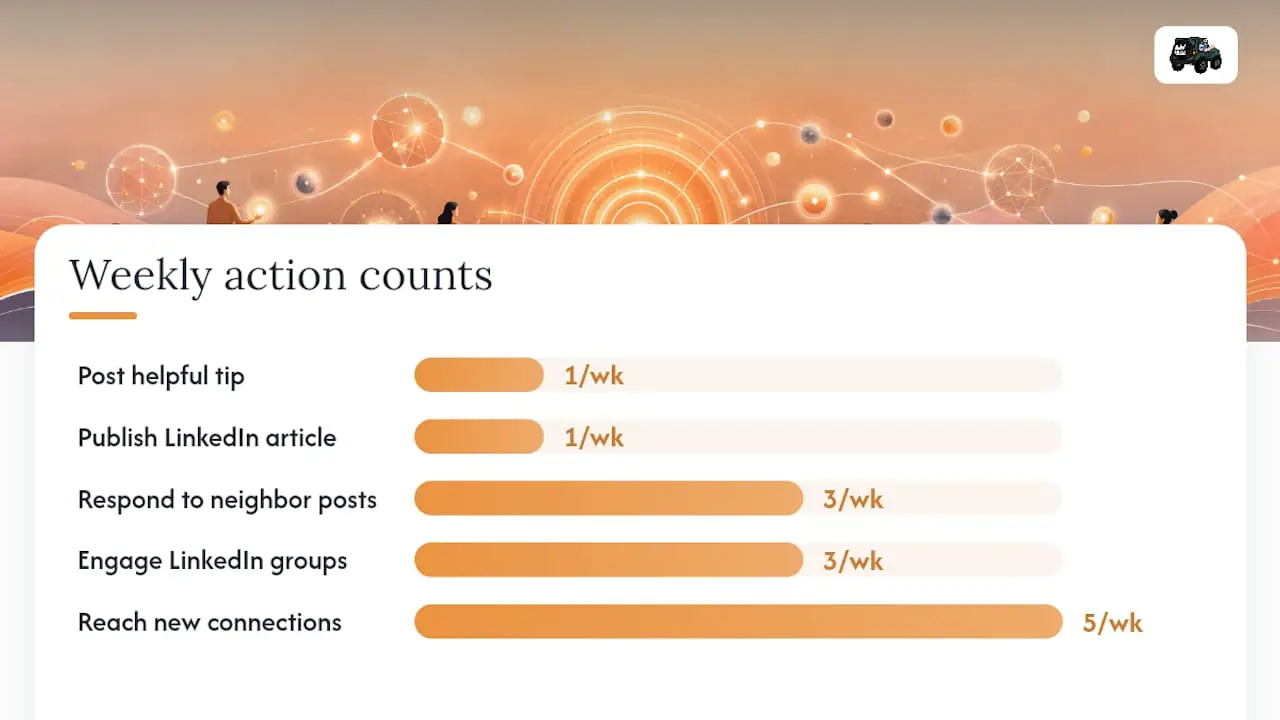
Referral-driven local service (plumber, landscaper, insurance agent): Claim your Google Business Profile and Nextdoor Business Page on day one. Ask every satisfied customer for a Google review. Post a helpful tip on Nextdoor once a week. Join the local Chamber and attend one event per month. This combination covers search discovery, neighbor trust, and in-room credibility simultaneously.
Event-driven retailer (boutique, fitness studio, specialty food shop): List your next workshop or tasting on both Meetup and Eventbrite. Use Eventbrite’s attendee email list for a post-event follow-up sequence. Create a Facebook Group for repeat customers and post event previews there weekly.
Thought-leadership B2B service (consultant, agency, financial advisor): Publish one LinkedIn article per week and engage in three relevant LinkedIn Group discussions. Contribute genuinely helpful answers in one or two relevant Reddit communities monthly. Track which posts drive profile visits and inbound messages.
| Day | Action | Platform | Metric to track |
|---|---|---|---|
| Monday | Post one helpful tip or question | LinkedIn or Facebook Group | Impressions, comments |
| Tuesday | Respond to 3 neighbor posts or reviews | Nextdoor or Google Business Profile | Response rate, new followers |
| Wednesday | Reach out to 5 new connections | LinkedIn or Shapr | Accepted connections |
| Thursday | Promote upcoming event | Meetup or Eventbrite | RSVPs |
| Friday | Review new leads in CRM; follow up | Your CRM | Leads entered, meetings booked |
Track four metrics during any 30-day platform trial: new contacts added, referral conversations started, meetings booked, and leads that enter your CRM. If none of those numbers move after 30 days of consistent effort, the platform is not the right fit for your market or goal.
Pro Tip: When a new connection agrees to a call, send a calendar link within 24 hours. Connections that go cold after a week rarely convert. Speed is the variable most small business owners underestimate.
Key Takeaways
The single most important decision is matching platform to goal: referral-focused platforms serve local service businesses best, while content-driven platforms serve B2B professionals seeking national visibility.
| Point | Details |
|---|---|
| Match platform to goal | Referrals → Nextdoor or Chamber; thought leadership → LinkedIn; events → Meetup or Eventbrite; reviews → Google Business Profile or Yelp. |
| CRM integration matters | Alignable lacks native CRM sync; prioritize alternatives that connect to HubSpot, Pipedrive, or your existing tool. |
| Free tiers exist everywhere | Every platform on this list offers a free entry point — test before committing to a paid tier. |
| Local activity density decides ROI | A platform with low local membership in your market will underperform regardless of its national reputation. |
| 16wmediagroup as the non-platform route | When platforms underdeliver after 60–90 days of testing, 16wmediagroup’s managed local media campaigns offer predictable, trackable lead flow as a direct alternative. |
When a platform alone won’t move the needle
Here is a pattern worth naming plainly: most small business owners cycle through two or three networking platforms, collect connections, and still cannot point to a consistent source of new clients six months later. The platforms are not broken. The problem is usually one of three things: low local audience density, no system for converting connections into conversations, or a business that genuinely needs broader market visibility rather than peer-to-peer referrals.
The Paperbell review of Alignable makes a useful distinction: high-trust local referrals tend to come from offline relationships and structured referral groups, while content-led platforms suit brand visibility and reaching professional audiences. That split maps directly to what I see in practice. A plumber does not need a LinkedIn article strategy. A management consultant does not need to post on Nextdoor. Matching the channel to the business model is the whole game.
My honest recommendation: give any platform a genuine 60-day test with a real landing page, a CRM tracking every lead, and a consistent posting or engagement habit. If you cannot show a measurable uptick in referral conversations or inbound inquiries after that window, the platform is not your primary growth lever. That is the signal to invest in a local media plan instead: community publishing, podcast placement, regional advertising, or a combination that puts your brand in front of your actual buyers repeatedly and measurably. Platforms are a supplement to that kind of presence, not a replacement for it.
Local media as a predictable alternative to platform-only networking
Networking platforms are worth testing, but they share one structural limit: your visibility depends entirely on how often you show up and how active the local community is. For businesses that need consistent, trackable lead flow, that variability is a real cost.
16wmediagroup builds local media campaigns that put your brand in front of high-value buyers through community magazines, podcast placements, regional advertising, and co-op programs — channels that work whether or not you posted this week. The full services overview covers media planning, traditional and digital placements, and local publishing. If you want a step-by-step starting point, the media planning checklist walks you through exactly how to build a local campaign that generates measurable results. For businesses ready to move from platform experiments to a real media plan, contact 16wmediagroup to start the conversation.
Selected sources and further reading
These sources were chosen for editorial credibility, platform-specific accuracy, and relevance to U.S. small business owners evaluating networking alternatives. Each one is worth a direct read if you want to go deeper on a specific platform or comparison.
- What Is Alignable? Honest Review, Pricing & Alternatives (2026)
- Best Alignable Alternatives (2026) | The GTM Directory
- Top 10 Alignable Alternatives & Competitors in 2026
- Top 10 Alternatives to Alignable for Small Business Networking – Sparkupbiz
- Alignable Alternatives & Competitors – SaaSHub
- Top 6 alignable.com Alternatives & Competitors
- Alignable Product Competitors – TrustRadius
- alignable.com