

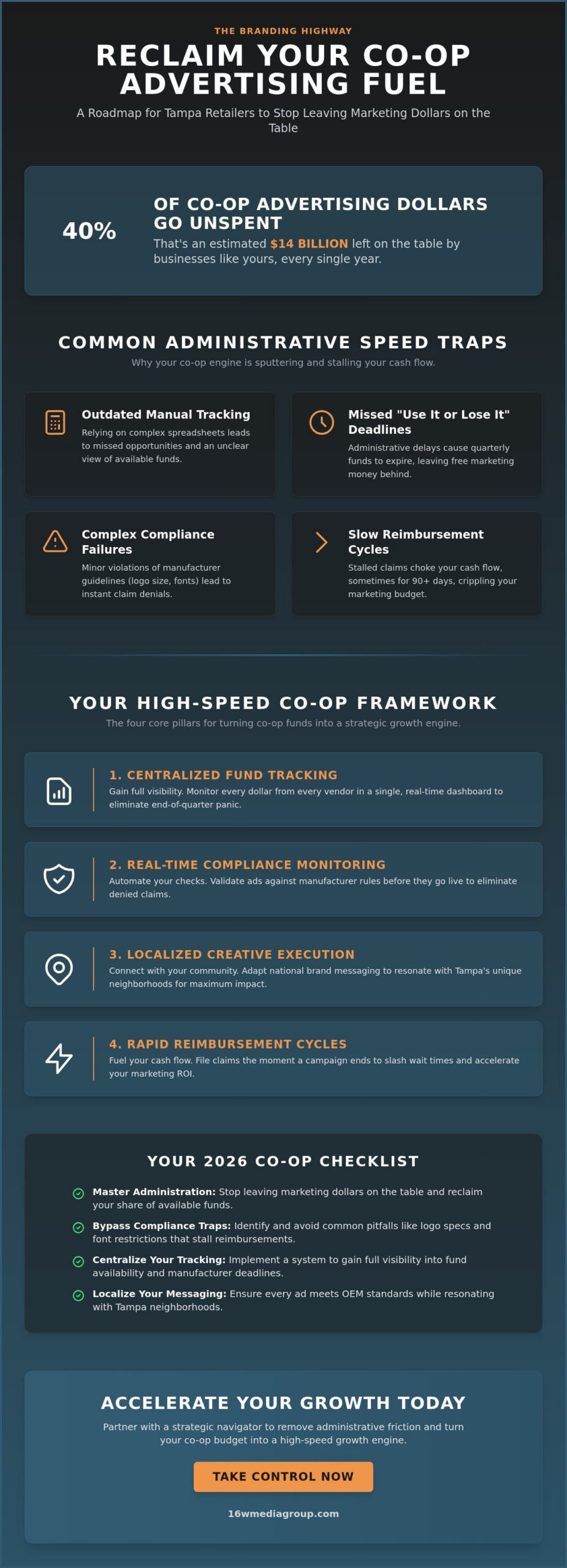
Did you know that 40% of available co-op advertising dollars go completely unspent every single year? For a business in the heart of Tampa, that is not just a missed opportunity; it is high-octane fuel left in the tank while your competitors speed past you on the Branding Highway. Managing a retail co op advertising program administration often feels like navigating a congested intersection during rush hour. You are stuck between complex manufacturer compliance guidelines and slow reimbursement cycles that choke your cash flow. It is a common frustration that turns potential growth into a bureaucratic bottleneck.
It is time to clear the road and reclaim your capital. You deserve a system that works as hard as you do to put your brand in front of local consumers. This guide gives you the high-speed roadmap to reclaim those funds and accelerate your local retail growth without the administrative friction. We are providing a 2026 checklist that streamlines your tracking and ensures your brand localization hits every Tampa neighborhood with precision. We will show you how to automate your compliance checks, slash your reimbursement wait times, and turn your co-op funds into a strategic engine for market dominance.
Key Takeaways
- Stop leaving fuel in the tank by mastering retail co op advertising program administration to reclaim your missing marketing dollars.
- Identify and bypass common compliance speed traps like logo specs and font restrictions that stall your reimbursement cycle.
- Implement a centralized tracking system to gain full visibility into your fund availability and upcoming manufacturer deadlines.
- Localize your national brand messaging for Tampa neighborhoods using our 2026 checklist to ensure every ad meets OEM standards.
- Partner with a strategic navigator to remove administrative friction and turn your co-op budget into a high-speed growth engine.
The Friction of Manual Retail Co-op Advertising Program Administration
Retail co op advertising program administration is the strategic coordination of shared marketing budgets between national manufacturers and local retailers. Think of it as the high-octane fuel for your local marketing engine. When managed correctly, it allows a business to amplify its reach using someone else’s capital. This concept is rooted in the traditional Retailers’ cooperative model, where businesses join forces to increase their competitive edge. However, for many businesses in Tampa, this engine is currently sputtering. Outdated tracking systems and missed submission deadlines act as roadblocks that keep you idling while competitors accelerate past you.
Effective administration requires more than just filing papers. It’s about maintaining a clear view of the road ahead. Many local brands in Ybor City or Westshore leave significant money on the table because they treat co-op funds as an afterthought rather than a primary growth driver. Common friction points include:
- Outdated Tracking: Relying on manual spreadsheets that don’t reflect real-time fund availability.
- Missed Deadlines: Letting “use it or lose it” quarterly funds expire because of administrative delays.
- Compliance Failures: Submitting ads that violate minor manufacturer guidelines, leading to instant claim denials.
Why Traditional Management Fails in the Tampa Market
Florida’s consumer base is not a monolith. The demographics of a shopper in South Tampa differ wildly from those in Northdale or Brandon. Traditional management often relies on “one size fits all” national templates that ignore these local nuances. When you don’t localize your brand messaging, you risk brand dilution. You’re essentially trying to drive a national semi-truck through the narrow alleys of a local neighborhood. Our Branding Highway approach shifts you from congested paperwork to high-speed growth by aligning national requirements with local market realities. It ensures your retail co op advertising program administration isn’t just compliant, but culturally relevant to the Tampa Bay community.
The Real Cost of Poor Administration
Industry data from 2025 indicates that nearly $14 billion in Market Development Funds (MDF) remains unspent annually across the United States. For the average Tampa retailer, this equates to thousands of dollars in lost support every single year. Poor administration doesn’t just lose you money; it chokes your cash flow. When reimbursements are stalled for 90 days because of a minor font size error or a missing invoice, your marketing budget takes a hit. You can learn more about these pitfalls in our guide on Why Your Tampa Business is Leaving Co-op Money on the Table. Speed is the only currency that matters on the Branding Highway, and slow administration is a cost you can’t afford.
Core Pillars of a High-Speed Tampa Co-op Framework
To dominate the Tampa market, your brand needs a framework that prioritizes speed and precision. Think of your retail co op advertising program administration as the transmission of your business. It transfers the power of manufacturer funds into the wheels of local sales. Without a solid structure, you’re just spinning your tires in the sand. Manufacturers continue to invest in valuable co-op advertising programs because they want local movement. To capture that value, you must build your strategy on four high-performance pillars.
- Centralized Fund Tracking: Keep your eyes on the road by monitoring every dollar from every vendor in one place. Real-time visibility prevents the “use it or lose it” panic at the end of the quarter.
- Real-Time Compliance Monitoring: Avoid the speed traps of OEM guidelines. By checking ads against manufacturer rules before they go live, you eliminate the risk of denied claims.
- Localized Creative Execution: National templates are the starting line, not the finish. Your messaging must resonate with the specific culture of Tampa neighborhoods to drive actual foot traffic.
- Rapid Reimbursement Cycles: Speed is everything. A high-speed framework ensures that claims are filed the moment a campaign ends, accelerating your ROI and keeping your cash flow healthy.
Strategic Brand Localization in the Co-op Context
Adapting manufacturer templates for the Tampa Bay audience is where the rubber meets the road. A generic ad might work in the Midwest, but it won’t move the needle in Hyde Park or Seminole Heights. You must blend national brand authority with community-focused publishing to build authentic local trust. This localization ensures that your ads don’t just meet compliance but actually speak to the high-value consumers in our backyard. You can dive deeper into these tactics by listening to our episode on Retail Co-Op Marketing Program Administration: Accelerating Your Tampa Brand. If you’re ready to shift gears, our team can help you optimize your co-op strategy today.
Leveraging Technology for Administrative Speed
Manual paperwork is a relic of the past that only slows you down. In 2026, high-performing Tampa brands utilize digital dashboards to monitor fund utilization across multiple product lines simultaneously. Automation removes the friction of manual claims processing, allowing your team to focus on strategy instead of spreadsheets. MDF automation is a critical 2026 efficiency tool that uses software to validate claims against manufacturer guidelines instantly, slashing processing time by as much as 60%. This technological edge ensures your retail co op advertising program administration is always running at peak performance.
The Ultimate 2026 Tampa Retail Co-op Administration Checklist
Execution is the bridge between a strategic plan and a reimbursed bank account. On the Branding Highway, your checklist is your GPS; it keeps you on track and prevents costly detours. Managing your retail co op advertising program administration requires a disciplined approach to documentation and timing. If you miss a single turn in the manufacturer’s compliance manual, you risk losing the very funds meant to fuel your growth. This 2026 checklist provides the high-speed roadmap needed to navigate the complexities of local brand localization while keeping your cash flow moving.
Phase 1: The Pre-Trip Inspection (Planning)
Before you launch any campaign, you must audit all active co-op agreements for the current 2026 fiscal year. Manufacturers frequently update their “rules of the road,” and using last year’s guidelines is a recipe for a denied claim. A thorough understanding of Co-Op Advertising fundamentals ensures you aren’t leaving money on the table before the engine even starts. Use this phase to set up a dedicated co-op budget tracker. This prevents overspending and helps you identify high-value Tampa media opportunities, such as local community print or digital audio platforms that resonate with our specific neighborhoods.
Phase 2: Driving the Campaign (Execution & Compliance)
During the execution phase, compliance is your primary objective. Every ad creative must pass through a rigorous checklist before it goes live to ensure it meets OEM standards. This includes verifying logo placement, font requirements, and the inclusion of specific legal disclaimers. You must document all media placements in local Tampa publications or digital channels as they happen. Maintain a digital archive of all invoices and tear sheets immediately. For a deeper dive into these operational tactics, check out our podcast on Mastering Co-op Advertising: The Fast-Track Guide for Tampa Brands. Speed and accuracy here ensure you stay ahead of the pack.
Phase 3: The Finish Line (Claims & Reporting)
The finish line isn’t the end of the ad; it’s the moment the reimbursement hits your account. To accelerate this cycle, you must submit claims electronically within the standard 30-day window following the campaign’s end. This requires a complete “Proof of Performance” package. In the context of 2026 digital media, Proof of Performance is the verified data set consisting of timestamped screenshots, third-party impression audits, and localized engagement metrics that validate an ad’s placement and audience reach. Finally, analyze your ROI by comparing your co-op spend against the local sales lift in Tampa. This data is the telemetry you need to refine your retail co op advertising program administration for the next lap.
Navigating Compliance Roadblocks and Local Market Nuances
Compliance guidelines are the speed traps of the marketing world. They’re designed to maintain national brand standards, but for a local retailer, they often feel like unnecessary hurdles. Successful retail co op advertising program administration requires you to thread the needle between strict OEM requirements and your own unique brand voice. If your logo is 5% too small or you use a prohibited phrase like “best deals in Florida” when the manufacturer forbids superlatives, your claim hits a dead end. You’ve essentially paid for a campaign that the manufacturer refuses to fuel.
Managing multiple programs at once adds another layer of complexity. You might be juggling a primary equipment manufacturer’s guidelines alongside three different secondary parts suppliers. Each has its own set of “rules of the road” regarding logo placement, color palettes, and font weights. Without a strategic navigator, these programs can suffer a collision where conflicting rules lead to total claim rejection across the board. You need a system that handles these nuances simultaneously without losing momentum.
Avoiding the ‘Denial’ Trap
In the first half of 2026, industry audits revealed that 35% of co-op claims were denied because of simple formatting errors. Another 22% failed due to missing third-party verification, while 18% were rejected for using unapproved digital platforms. When a denial happens, you don’t just lose the money; you lose the time invested in the campaign. Our team at 16W Media Group acts as your attorney in these disputes. We know the appeal process inside and out, ensuring that minor technicalities don’t derail your reimbursement. We fight to ensure every dollar you’re owed makes its way back to your bottom line.
The Local Advantage: Tampa-Specific Media Nuances
Tampa Bay has a unique media landscape that requires a tailored approach. While national brands often push for broad digital spend, local success in our market comes from community-focused publishing that builds trust in neighborhoods like Carrollwood, FishHawk, or South Tampa. You can leverage these local channels while still meeting rigid co-op requirements. For example, sponsorships on The Branding Highway podcast often qualify as a legitimate co-op expense under digital audio or local awareness categories. This allows you to reach high-value consumers while staying within the manufacturer’s lines.
To see how this works in practice, listen to our episode on Co-op Marketing in Tampa: Accelerate Your Brand. We break down the specific media buys that manufacturers are approving right now in the 813 and 727 area codes. Don’t let compliance friction slow you down. You can outsource your co-op management to us and keep your focus on the road ahead.
Accelerating Your Growth with 16W Media Group’s Strategic Navigator
You have the checklist. You know the compliance speed traps. Now, you need the high-performance vehicle to drive your brand forward. Retail co op advertising program administration shouldn’t feel like a part-time job for your marketing team. It should be a streamlined engine that powers your local growth. Mike and Norman, the driving force behind 16W Media Group, act as your strategic navigators on the Branding Highway. They understand that in a competitive market like Tampa, you don’t have time to idle in the breakdown lane of paperwork. Our approach is designed to remove every ounce of administrative friction, allowing you to reclaim 100% of your available manufacturer funds without the typical headaches.
Our results-oriented strategy focuses on maximum market penetration. We don’t just “manage” your funds; we weaponize them. While national, faceless agencies offer generic templates that ignore the soul of our city, we prioritize strategic brand localization. We know that a campaign that works in a different state won’t necessarily move the needle in the 813. By aligning your brand with the specific cultural heartbeat of Tampa neighborhoods, we ensure your co-op spend drives actual foot traffic and measurable sales lift. We’ve built our reputation on being the guides who know the shortcuts in a congested market, ensuring your business stays in the fast lane.
The 16W Co-op Management Advantage
Choosing 16W Media Group means gaining a partner that handles the heavy lifting from start to finish. We provide a full-service administration suite that covers everything from initial program design to final fund recovery. Our advantage is built on three specific strengths:
- Comprehensive Fund Recovery: We track every dollar and every deadline, ensuring no manufacturer capital is left on the table at the end of the fiscal year.
- Expert Brand Localization: We adapt national OEM guidelines to fit the Tampa identity, ensuring your business remains the local hero while staying 100% compliant.
- Exclusive Media Access: Our deep roots in community-focused print and digital publishing give you direct access to the high-value channels that manufacturers love to fund.
Ready to Fast-Track Your Retail Brand?
Getting started with 16W Media Group is a straightforward process designed for speed. Our roadmap begins with a comprehensive audit of your current co-op agreements to identify immediate opportunities for fund reclamation. From there, we build a tailored strategy that integrates your brand into the local Tampa landscape through community publishing and strategic podcast sponsorships. We handle the compliance, the submissions, and the follow-ups so you can focus on running your business.
Don’t let your marketing budget sit in park for another quarter. It’s time to join the Branding Highway and leave the administrative friction in the rearview mirror. Call 813-72-BRAND to speak with a strategic powerhouse today. Let Mike and Norman show you the path to accelerated growth where all roads lead to your business.
Drive Your Tampa Brand into the Fast Lane
Success in 2026 requires more than just showing up; it requires the right fuel and a clear map. You’ve seen how to bypass manual roadblocks and implement a high-speed framework for your retail co op advertising program administration. By prioritizing real-time compliance and strategic brand localization, you ensure every marketing dollar reaches its full potential in neighborhoods from Ybor to Westshore. Our team has already managed over $5M in co-op funds for Florida retailers, proving our roadmap works for businesses ready to scale. Through our strategic partnership with ‘The Branding Highway’ podcast and direct access to Mike & Norman for high-level strategy, we provide the tactical edge you need to dominate.
Don’t let your available capital expire in a manufacturer’s bank account while your competitors accelerate past you. It’s time to take control of your growth and outpace the competition with a system built for speed. Accelerate your Tampa brand and claim your co-op funds with 16W Media Group today! Your business growth is inevitable when you follow a clear path through the noise. Where all roads lead to your business.
Frequently Asked Questions
What is retail co-op advertising program administration?
Retail co op advertising program administration is the strategic management of shared marketing budgets between a local retailer and a national manufacturer. This process ensures that every advertisement follows specific OEM guidelines to secure a reimbursement of up to 50% or 100% of the total media cost. It acts as the transmission that converts manufacturer capital into local sales momentum for your business.
How do I know if my Tampa business qualifies for co-op funds?
Check your current dealer agreements or purchase contracts for specific marketing allowance clauses. Most manufacturers allocate funds based on a percentage of your total wholesale purchases, often ranging from 1% to 3% of your annual volume. If you sell brand-name products in the 813 or 727 area codes, you likely have untapped capital waiting in your account right now.
What are the most common reasons for co-op claim denials?
Denials usually stem from minor formatting errors like incorrect logo proportions or the omission of required legal disclaimers. In 2025, industry data showed that 35% of claims were rejected because the advertisement didn’t include the manufacturer’s current trademark symbols. Missing the 30-day submission window following a campaign’s end is another frequent speed trap that stalls your reimbursement and chokes your cash flow.
Can I use co-op funds for digital and social media advertising in Tampa?
Yes, most manufacturers in 2026 have expanded their guidelines to include geo-targeted social media, search engine marketing, and digital audio. These digital channels must still meet strict compliance standards regarding brand voice and visual assets. Utilizing localized digital publishing ensures your brand resonates with Tampa consumers while remaining eligible for manufacturer support through your 2026 marketing budget.
How long does the co-op reimbursement process typically take?
A standard reimbursement cycle takes between 45 and 90 days from the date of submission. High-speed systems that utilize electronic filing can often slash this wait time by 30% compared to traditional paper-based methods. Faster processing keeps your cash flow healthy and allows you to reinvest those funds into your next local campaign without the typical administrative friction.
How can a Tampa marketing agency help with co-op administration?
A specialized agency acts as your strategic navigator by handling the heavy lifting of compliance checks and claim submissions. We remove the friction that prevents a large percentage of co-op funds from being spent annually. By managing your retail co op advertising program administration, we ensure your ads are both culturally relevant to Tampa and technically compliant with national standards.
What is the difference between MDF and co-op advertising funds?
Co-op funds are typically earned through past purchases and are tied to specific product lines, while Market Development Funds (MDF) are often granted upfront for future growth initiatives. Co-op is a reimbursement model based on actual ad spend. MDF is more flexible and is usually awarded based on a strategic business plan for market expansion or new product launches.
What documentation is required for a successful co-op claim in 2026?
You need a complete Proof of Performance package consisting of the original media invoice and a verified copy of the ad. For digital campaigns, this requires a third-party impression report and a timestamped screenshot of the live placement. Manufacturers in 2026 also require a clear breakdown of the localized messaging used to target specific Tampa demographics to ensure the brand remains relevant.