

Strategic advertising is a medium- to long-term blueprint that directs how a business allocates its budget, crafts its messages, and selects channels to reach a defined audience with measurable results. The industry term for this practice is “advertising strategy,” and it operates well above the level of individual campaigns or daily bid adjustments. Unlike ad hoc advertising, which reacts to short-term pressures, a true advertising strategy covers a 6–12 month horizon and ties every dollar spent back to a specific business goal. For business owners and marketing professionals, understanding what is strategic advertising is the difference between spending on ads and actually building a brand.
What is strategic advertising and why does it matter?
Strategic advertising is defined as a deliberate, structured plan that aligns advertising activities with overarching business objectives. It is not a single campaign, a social media post, or a Google Ads account. It is the connective tissue between brand intent and creative output, determining why some campaigns succeed and others fail. Business owners who treat advertising as a cost center rather than an investment consistently underperform those who build a real strategy.
The importance of strategic advertising becomes clear when you look at what it produces. A well-built advertising strategy transforms ad spend into predictable returns, shortens sales cycles, and builds a competitive position that is difficult for rivals to copy quickly. That predictability is what separates growing brands from ones that plateau. Without a strategy layer, even well-executed campaigns produce inconsistent results because there is no framework connecting them to business growth.

What are the essential components of a strategic advertising plan?
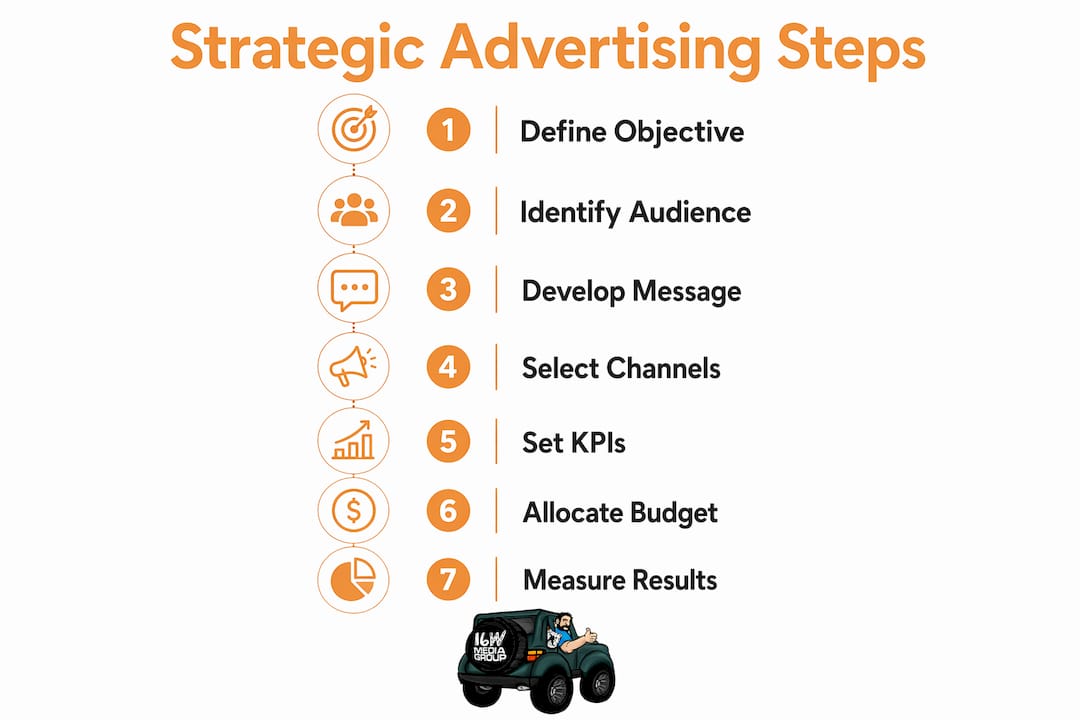
A complete advertising strategy follows seven sequential steps: objective design, target audience design, message development, channel selection, budget allocation, KPI design, and operations and continuous improvement. The sequence is not optional. Skipping or reordering steps creates contradictions downstream. For example, selecting channels before defining your audience almost always results in wasted spend.
Here is what each step requires:
- Objective design: Set specific, measurable business goals. “Increase brand awareness” is not an objective. “Grow unaided brand recall among Tampa homeowners aged 35–55 by 15 points in 12 months” is.
- Target audience design: Define who you are reaching, not just demographically but behaviorally. Where do they consume media? What problems are they solving?
- Message development: Build a core message that speaks directly to that audience’s needs and connects to your brand’s distinct position.
- Channel selection: Choose channels based on where your audience actually spends time, not based on what is trendy.
- Budget allocation: The 70-20-10 framework is the industry standard. Allocate 70% to proven channels, 20% to emerging channels with strong signals, and 10% to experimental formats.
- KPI design: Connect channel-level cost-per-acquisition metrics to business contribution through KPI trees derived from your key growth indicators. Missing this step means campaigns can perform well on paper while delivering nothing to the bottom line.
- Operations and continuous improvement: Set a review cadence, assign ownership, and build a process for acting on data.
Pro Tip: Link every KPI directly to a business goal, not just a media metric. Clicks and impressions are inputs. Revenue, leads, and market share are outputs. Build your KPI tree from the output backward.
How does strategic advertising differ from marketing and tactics?
Strategic advertising sits at a specific level in the planning hierarchy, and confusing it with adjacent concepts is one of the most common mistakes business owners make. Three distinctions matter most.
- Marketing strategy vs. advertising strategy: Marketing strategy is broader. It covers product development, pricing, distribution, and brand positioning. Advertising strategy is one component of marketing strategy, focused specifically on paid and earned media communications.
- Advertising strategy vs. advertising planning: Planning is the quarterly process of deciding which campaigns to run and in what mix. Strategy sets the multi-year direction that planning executes against.
- Advertising strategy vs. operations: Operations are the daily and weekly tasks: adjusting bids, testing ad copy, pulling reports. These are tactical activities. Conflating strategy with operations is why many businesses feel busy with advertising but see no compounding growth.
“Advertising strategy is an investment-level decision. Treating it as a cost center is the same as treating a factory as an expense rather than an asset.” — Dave Winterlich, advertising strategist
The practical implication is this: a business can run excellent individual campaigns and still fail to grow if those campaigns are not connected by a strategy layer. Tactics without strategy produce activity. Strategy produces results.
What are the key benefits of a strategic advertising approach?
The most direct benefit of strategic advertising is predictability. Advertising as a long-term investment compounds over time, much like financial interest. Brands that commit to a consistent strategy build recognition, trust, and preference in ways that one-off campaigns cannot replicate.
The measurable benefits include:
- Shorter sales cycles: Prospects who already recognize and trust your brand convert faster and at lower acquisition costs.
- Competitive moats: Consistent brand presence makes it harder for competitors to displace you in a customer’s consideration set.
- Higher ROI from creative quality: Ads with high creative quality achieve ROIs up to 12 times greater than poor-quality ads. That gap is not closed by increasing media spend alone.
- Scalable lead generation: A documented strategy gives you a repeatable system for generating leads rather than starting from scratch each quarter.
- Brand reputation growth: Consistent, well-placed messaging builds brand equity that has real financial value at exit or during competitive bids.
Effective advertising requires upfront capital and a coherent long-term plan to produce consistent, scalable results. Businesses that treat advertising as a variable expense to cut during slow periods forfeit the compounding gains that sustained investment produces.
What are the most effective examples of strategic advertising in 2026?
Popular strategic advertising types in 2026 span both digital and traditional channels, and each serves a distinct strategic purpose. The right mix depends on your objectives, audience, and funnel stage.
| Strategy type | Primary objective | Best use case |
|---|---|---|
| Search advertising | Capture demand | High-intent buyers actively searching for your category |
| Paid social | Build awareness and retarget | Audiences defined by interest, behavior, or lookalike data |
| Connected TV | Brand awareness at scale | Reaching cord-cutters in specific geographic markets |
| Programmatic display | Reach and retargeting | Efficient delivery across premium inventory at scale |
| Influencer marketing | Trust and social proof | Categories where peer recommendation drives purchase decisions |
| Retail media | Purchase-stage conversion | Brands selling through major retail platforms |
| Native content | Education and consideration | Complex products requiring explanation before purchase |
| Digital out-of-home | Local brand presence | High-traffic areas in target markets like Tampa |
The most effective strategies in 2026 combine two or three of these types rather than relying on a single channel. Media planning and creative quality must be integrated from the start. A connected TV campaign with weak creative will underperform a well-crafted community magazine placement every time.
Pro Tip: Match your strategy type to your funnel stage first, then your budget. Search advertising works for capturing existing demand. Paid social and connected TV build the demand that search later captures. Running only search ads limits your growth ceiling.
You can also explore types of media strategies that local brands use to grow their presence across multiple channels.
Key Takeaways
Strategic advertising is a documented, multi-step investment plan that connects business goals to media spend, creative execution, and measurable outcomes across a 6–12 month horizon.
| Point | Details |
|---|---|
| Definition is specific | Strategic advertising is a medium- to long-term blueprint, not a campaign or a tactic. |
| Seven steps are sequential | Skipping or reordering objective, audience, message, channel, budget, KPI, or operations creates downstream misalignment. |
| Creative quality drives ROI | Ads with strong creative quality can outperform weak creative by up to 12x, regardless of media spend. |
| Strategy differs from tactics | Daily bid management and quarterly campaign planning are not strategy. Strategy sets the 6–12 month direction. |
| Predictability is the payoff | A documented advertising strategy turns ad spend from a variable cost into a compounding business investment. |
Why most businesses are one framework away from real advertising results
Most business owners I work with are not failing at advertising because they lack budget. They are failing because they are running tactics without a strategy layer connecting them. A business might have a solid Google Ads account, a decent social presence, and a few sponsorships, but no documented plan explaining why those channels were chosen, what audience they serve, or how success is measured beyond clicks.
The uncomfortable truth is that risk-averse businesses produce average creative work, and average creative work limits ROI regardless of how well the media is planned. I have seen businesses double their effective return not by increasing spend but by committing to better creative and a clearer strategic framework. The 70-20-10 budget model is a good starting point because it forces you to commit to proven channels while still leaving room to test.
The 2026 media environment rewards businesses that integrate data and creativity from the start. You cannot plan media in isolation and then hand a brief to a creative team. The two disciplines have to work together from objective design onward. That integration is where most businesses have the most room to improve, and it costs nothing to start. Build the media planning checklist first. The strategy follows naturally from it.
— Mike
How 16wmediagroup helps businesses build advertising strategies that work
Building a real advertising strategy takes more than a template. It requires understanding your market, your audience, and which channels will actually move the needle for your specific business goals.
16wmediagroup works with local businesses and regional brands to build documented advertising strategies across traditional media, digital channels, podcasts, and community publishing. The team specializes in markets like Tampa, where local presence and community trust are genuine competitive advantages. Whether you are starting from scratch or trying to connect existing campaigns to a coherent plan, the local advertising campaign planning guide is a practical starting point. For businesses ready to put a full media plan in place, the services page outlines every channel and format available.
FAQ
What is the strategic advertising definition?
Strategic advertising is a medium- to long-term blueprint that directs budget allocation, messaging, and channel selection across multiple campaigns to achieve specific business goals. It operates above individual campaigns and covers a 6–12 month planning horizon.
How is strategic advertising different from a marketing strategy?
Marketing strategy is broader and covers product, pricing, distribution, and brand positioning. Strategic advertising is one component of marketing strategy, focused specifically on how paid and earned media communications are planned and executed.
What are the main benefits of strategic advertising?
The main benefits include predictable lead generation, shorter sales cycles, stronger brand recognition, and compounding ROI over time. Businesses with a documented advertising strategy consistently outperform those running disconnected campaigns.
How do I create a strategic advertising plan?
Follow the seven sequential steps: define your objective, identify your target audience, develop your core message, select channels, allocate budget using the 70-20-10 framework, set KPIs tied to business goals, and build an operations and review process.
What are examples of strategic advertising techniques in 2026?
Search advertising, paid social, connected TV, programmatic display, influencer marketing, retail media, native content, and digital out-of-home are the leading types. Each suits different funnel stages, objectives, and audience profiles.