
Community publishing is defined as a collaborative model where local community members collectively create, curate, and distribute content that represents their shared stories and interests. Unlike traditional publishing, where a single editorial team controls all decisions, community publishing distributes those roles across contributors, residents, and organizers. This peer-driven approach produces content that feels authentic because it comes from the people it represents. 16wmediagroup has built its community-focused publishing work around exactly this principle: local voices telling local stories. Understanding what is community publishing, and how it works in practice, gives content creators and organizers a real advantage in building neighborhood engagement.
What is community publishing and why does it matter?
Community publishing is the process by which a group of people, not a single editor or brand, collectively manages the creation and sharing of content. The collaborative content model reaches audiences that traditional brand content cannot, because contributors share work through their own trusted networks. That peer distribution effect is the core engine behind community publishing’s growth.
The standard industry term for this practice is “community-owned publishing,” which goes one step further than simple user-generated content. Community-owned publishing shifts editorial decision-making and governance from commercial entities to the community itself. That distinction matters because it embeds accountability and sustainability directly into the publishing structure.
Traditional media assigns one editor-in-chief to make every call. Community publishing replaces that single authority with a shared governance model. Contributors propose, review, and approve content together. The result is a publication that reflects the community’s actual priorities rather than a commercial agenda.
For local organizers, this model is especially powerful. A neighborhood newsletter, a community magazine, or a local podcast can all operate under community publishing principles. The format is less important than the structure: distributed contribution, transparent review, and shared ownership of the final product.

How does community publishing work in practice for local groups?
A community publishing workflow has four distinct stages: submission, review, editing, and distribution. Each stage involves different contributors and different tools, but the process is designed to be repeatable with minimal staff.
- Submission. Contributors submit content through a dedicated portal or shared inbox. Automated submission platforms allow publishers to manage incoming content from anywhere, removing the need for a physical editorial office.
- Review. A 3–5 step review process checks content against community guidelines. This typically involves an initial screening, a fact check, a style edit, and a final approval by a community editor or small editorial committee.
- Editing and formatting. Approved content gets formatted for the chosen platform, whether that is a digital magazine, a newsletter, or a podcast episode. The publisher acts as a platform architect at this stage, not a gatekeeper.
- Distribution. Published content goes out through community channels, social media, email lists, and partner networks. Featured contributors share the work with their own audiences, which drives organic reach.
The publisher’s role in this workflow is a fundamental shift from traditional media. The publisher manages the platform and the process, not the content itself. That distinction frees up editorial energy and allows the community to scale content production without proportional increases in staff.
Pro Tip: Set contributor permissions in writing before the first submission arrives. Use plain-language micro-notices at each submission step to explain exactly what rights you are requesting. Micro-notices at submission reduce confusion and build contributor trust far more effectively than a dense legal agreement buried in a footer.
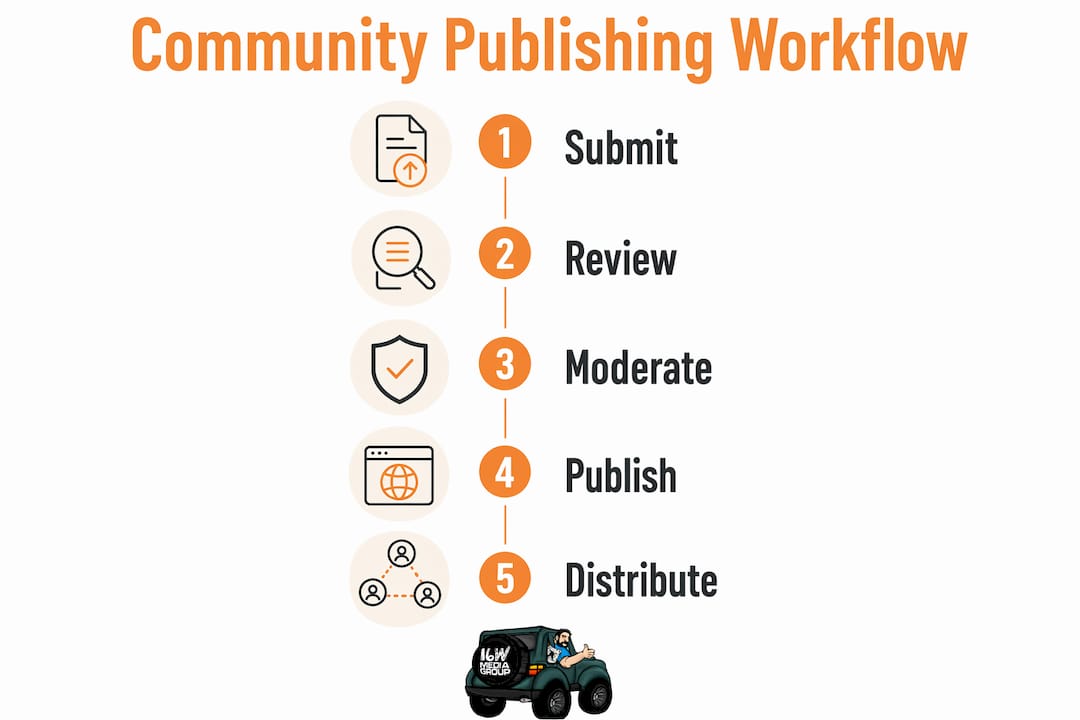
For organizers managing user-generated content across multiple formats, including podcasts, the same workflow principles apply. Structured intake, clear review criteria, and transparent roles keep the process consistent regardless of medium.
What are the benefits of community publishing compared to traditional media?
Community publishing delivers advantages that centralized media production cannot replicate. The benefits fall into four clear categories.
- Authentic reach. Contributor networks expose published work to new, trusted audiences when featured contributors share content with their own followers. That organic distribution outperforms paid promotion for community-specific topics.
- Credibility. Content written by community members reads as more relevant and trustworthy than content produced by an outside brand. Readers recognize the voice of someone who lives the same experience.
- Scalability. A community publishing model scales content production without scaling costs. As more contributors join, output grows. A centralized team would need to hire to achieve the same volume.
- Skill development and advocacy. Community publishing programs build local skills in writing, editing, photography, and media production. They also amplify hyper-local issues that global publishers routinely overlook, from zoning disputes to neighborhood history projects.
The advocacy dimension is often underestimated. Community publishing gives residents a formal channel to advance solutions that matter to them. A neighborhood association that publishes a monthly digital magazine does more than share news. It builds a record of community priorities and creates a platform for local leadership to emerge.
Local nonprofits and community events benefit directly from this model. When an organization publishes content about its own programs and events, it controls the narrative and builds an audience that no third-party outlet can replicate.
The DIY ethos behind community publishing also connects it to activism and scholarship. Many of the most effective community publications operate on minimal budgets but high commitment levels. That commitment, not production value, is what sustains reader loyalty over time.
What challenges and pitfalls should community publishers avoid?
The most common failure in community publishing is the “external loop” problem. Community insights stay inside member-only channels and never reach a broader audience. Packaging community knowledge into accessible formats and pushing it beyond internal channels is what separates ephemeral conversation from professional-grade content with lasting value.
Three other pitfalls consistently undermine community publishing efforts:
- Vague contributor permissions. When contributors do not know how their work will be used, they hesitate to submit or they withdraw content after publication. Plain-language permission requests at the point of submission solve this problem before it starts.
- Over-reliance on legal language. Dense terms-of-service agreements create friction. A one-sentence explanation of how content will be displayed, edited, and promoted does more to build trust than a full legal document.
- Neglecting resource infrastructure. Many organizers focus on teaching contributors technical skills when the real barrier is access to tools. Shared resources, such as equipment pools, shared software licenses, and template libraries, drive creative output more effectively than workshops alone.
Pro Tip: Before launching a contributor training program, audit what physical and digital resources your community actually needs. A shared camera, a Canva Pro account, or a set of audio recording tools often removes more barriers than a three-hour editing workshop.
The external loop failure is worth examining more closely. A neighborhood group might produce excellent content about a local infrastructure issue, share it in a private Facebook group, and consider the job done. That content never reaches city council members, local journalists, or neighboring communities who might amplify it. Building a deliberate distribution plan, including a public-facing website, an email newsletter, and social media channels, turns internal conversation into public record.
Which platforms and tools best support community publishing workflows?
The right platform depends on three factors: community size, content type, and governance model. A small neighborhood group with ten contributors needs different tools than a city-wide network with hundreds of active members.
Platform selection should prioritize four core capabilities: contributor submission portals, moderation tools, flexible editorial workflows, and transparent role management. Without these, the workflow breaks down at the review stage and content backlogs pile up.
| Platform category | Best for | Key feature |
|---|---|---|
| Open submission platforms | Large, diverse contributor pools | High-volume intake with automated screening |
| Curated digital magazines | Branded community publications | Editorial control with contributor credits |
| Newsletter tools | Regular, recurring community updates | Simple distribution and subscriber management |
| Podcast platforms | Audio-first community storytelling | Episode submission and listener engagement |
Open platforms prioritize volume and accessibility. They work well for communities that want to include as many voices as possible and are willing to invest in moderation. Curated digital magazine tools offer more editorial control and produce a more polished final product, but they require a stronger editorial team to manage the review process.
Newsletter tools are the lowest-friction entry point for most community organizers. They require minimal technical knowledge, distribute reliably, and build a subscriber list that the community owns. Podcast platforms add an audio dimension that written content cannot replicate, particularly for storytelling and interview-based formats.
16wmediagroup’s publishing and content marketing services cover both print and digital formats, giving community organizers access to professional production support without building an internal team from scratch.
Key Takeaways
Community publishing succeeds when contributors own the process, content reaches beyond internal channels, and platform tools match the community’s actual size and governance needs.
| Point | Details |
|---|---|
| Core definition | Community publishing distributes editorial roles across members, not a single editor or brand. |
| Workflow structure | A 3–5 step review process keeps content aligned with community guidelines at scale. |
| External distribution | Publishing community insights beyond internal channels is what creates lasting public value. |
| Contributor permissions | Plain-language micro-notices at submission build trust faster than legal agreements. |
| Platform fit | Match tools to community size, content type, and governance model before committing. |
Why community publishing changed how I think about local storytelling
The first time I worked on a community-driven publication, I expected the hardest part to be content quality. It wasn’t. The hardest part was convincing contributors that their stories were worth telling publicly. Most people in a neighborhood assume their experience is too ordinary to publish. That assumption is wrong, and breaking it is the real work of community publishing.
What I’ve found over time is that the communities with the strongest publications are not the ones with the best writers. They are the ones with the clearest processes. When contributors know exactly how to submit, what happens next, and how their work will be credited, they show up consistently. Ambiguity kills participation faster than any technical barrier.
The other thing I’ve learned is that resource sharing changes everything. Giving a contributor access to a decent microphone or a shared design template produces better content than any training session. People already have stories. They just need the tools to tell them well.
Community publishing also builds something that traditional media cannot manufacture: local leadership. When residents see their names on published work, they invest more deeply in the community’s future. That investment compounds over time and creates the kind of sustained engagement that no advertising campaign can replicate.
— Mike
How 16wmediagroup supports community publishers
16wmediagroup works with local content creators and community organizers who want to build publishing programs that actually reach people. The agency’s expertise covers community-focused print and digital publishing, media planning, and localized advertising, giving organizers a full production and distribution infrastructure without building one from scratch.
Whether you are launching a neighborhood magazine, a local podcast, or a multi-channel content program, 16wmediagroup brings the tools and market knowledge to make it work. The agency’s localized marketing strategies are built specifically for communities like yours, where authentic connection matters more than reach alone. Explore the full range of publishing and media services to find the right fit for your initiative.
FAQ
What is the community publishing definition?
Community publishing is a collaborative content model where community members collectively create, curate, and distribute content that represents their shared interests, rather than relying on a centralized editorial team.
How does community publishing work for small neighborhood groups?
Small groups typically use a structured workflow with a submission portal, a 3–5 step review process, and a distribution plan that pushes content beyond internal channels to reach a broader public audience.
What are the main benefits of community publishing?
Community publishing builds authentic reach through contributor networks, increases content credibility, scales production without proportional cost increases, and develops local skills and advocacy capacity.
What is the difference between community publishing and user-generated content?
Community-owned publishing embeds collective governance and editorial decision-making within the community itself, while generic user-generated content platforms retain editorial control with the platform owner.
Which tools work best for a community publishing workflow?
The best tools depend on community size and content type. Newsletter platforms suit small groups starting out, while open submission platforms and curated digital magazine tools work better for larger, more active contributor networks.