

A step-by-step promotional campaign is a structured marketing approach that moves a local business from a clear goal to a measurable result through focused, sequential actions. Most business owners skip the structure and wonder why their promotions fall flat. 44% of businesses struggle to quantify marketing impact, which means nearly half of all promotional spending produces results no one can explain. That gap exists because of missing structure, not missing budget. This guide walks you through every phase of building a campaign that actually works for your community.
What are the prerequisites for a step by step promotional campaign?
Every successful promotional campaign starts before the first ad runs. The work you do upfront determines whether your campaign produces results or just produces activity.
Clear goals and KPIs come first. A goal like “get more customers” is not a goal. A goal like “generate 40 new dine-in reservations in 30 days” is. Your key performance indicators (KPIs) are the numbers that tell you whether you hit that goal. Common KPIs for local businesses include cost per new customer, foot traffic increase, coupon redemption rate, and online booking volume.

Audience data shapes everything else. You need to know who you are trying to reach before you decide what to say or where to say it. Audience segmentation means dividing your potential customers into groups based on shared traits like neighborhood, age, purchase history, or lifestyle. A spa targeting working mothers in a specific zip code will write a very different message than one targeting retirees.
Budgeting should follow math, not habit. Outcome-based budgeting means you calculate how many sales you need, estimate your cost per acquisition, and set your budget from there. Picking a random percentage of revenue and calling it a marketing budget produces random results.
Before launching, gather these four things:
- One specific, measurable campaign goal with defined KPIs
- A clear picture of your primary audience segment
- A budget grounded in projected sales and acquisition costs
- A campaign calendar with pre-launch, launch, and post-launch dates blocked out
Pro Tip: Use a free project management tool like Trello or a shared Google Sheet to assign every campaign task to a specific person with a deadline. Small teams lose campaigns to confusion, not lack of effort.
| Prerequisite | Why it matters |
|---|---|
| Specific goal with KPIs | Gives every decision a clear standard to meet |
| Audience segment defined | Prevents wasted spend on the wrong people |
| Outcome-based budget | Ties spending directly to expected revenue |
| Campaign calendar | Keeps pre-launch, launch, and review phases on track |
What are the step-by-step actions to launch a promotional campaign?
This is the core of your promotional campaign guide. Follow these seven steps in order. Skipping steps does not save time. It creates problems you fix later at a higher cost.
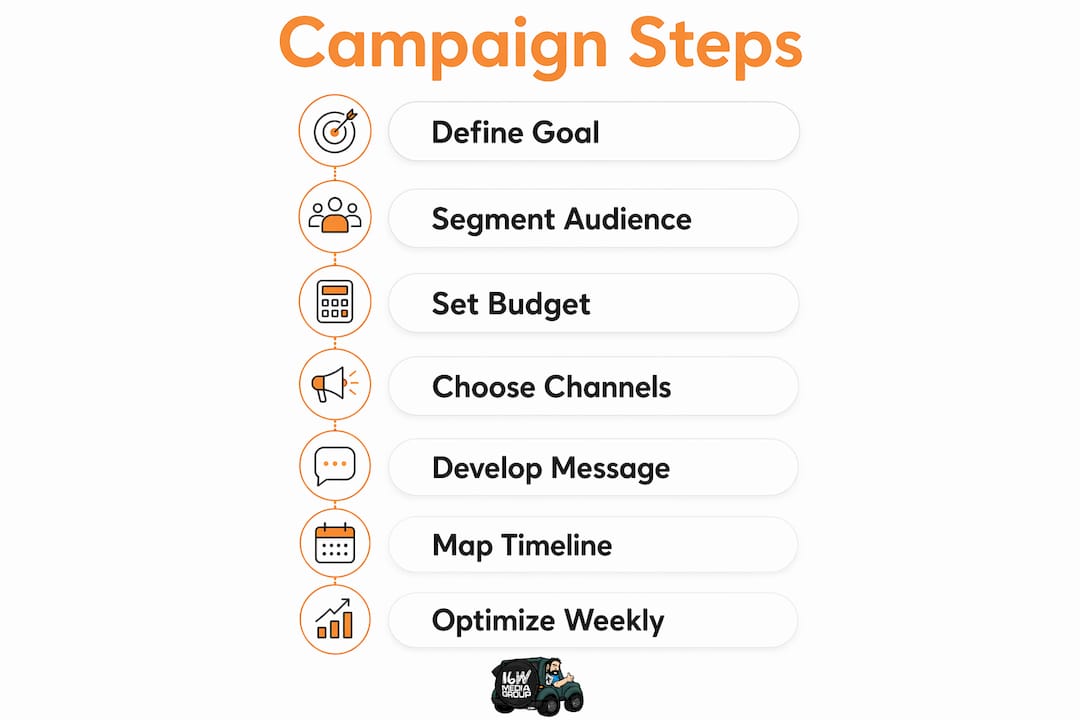
Step 1: Define one goal and its KPIs
Pick one primary outcome for this campaign. Revenue, new customer acquisition, email list growth, or event attendance are all valid. Trying to accomplish all four at once splits your message and your budget. Write the goal in one sentence and list two to three KPIs that will confirm you hit it.
Step 2: Identify and segment your audience
Go beyond “local adults.” Define your audience by geography, behavior, and need. A hardware store running a spring campaign might target homeowners within five miles who have purchased paint before. The tighter your segment, the more relevant your message, and the lower your cost per conversion.
Pro Tip: A practical guide to audience segmentation methods can help you move beyond basic demographics and identify the behavioral signals that predict purchase intent.
Step 3: Set a math-backed budget
Start with your goal. If you need 50 new customers and your average cost to acquire one is $20, your minimum campaign budget is $1,000. Add production costs for creative assets. Budget from outcomes, not from a gut feeling about what “feels right” to spend.
Step 4: Choose 2–3 high-impact channels
Small businesses run better campaigns by focusing on two or three channels rather than spreading thin across many. For local businesses, the highest-impact channels are typically social media (Facebook and Instagram for local targeting), email to existing customers, and one community-facing channel such as a local magazine, podcast, or neighborhood newsletter. Match your channel choices to where your specific audience already spends time.
Step 5: Develop one core message
Your message must answer three questions: What is the offer? Why should your customer care? Why act now? Messaging consistency across every channel drives conversion. A customer who sees your Facebook ad, receives your email, and spots your flyer should encounter the same core offer and the same sense of urgency each time. Inconsistency creates doubt.
Step 6: Map your campaign timeline
Effective campaigns run in three phases: pre-launch (4–8 weeks), launch week, and post-launch (2–4 weeks). Pre-launch builds awareness and anticipation. Launch week delivers your primary offer with full channel activation. Post-launch captures residual conversions and collects performance data for your review.
| Phase | Duration | Primary goal |
|---|---|---|
| Pre-launch | 4–8 weeks | Build awareness and anticipation |
| Launch week | 7 days | Deliver offer and drive conversions |
| Post-launch | 2–4 weeks | Capture residual sales and gather data |
Step 7: Launch, monitor, and optimize weekly
Campaign launch is not the finish line. The first week of data tells you which channel is pulling, which message is resonating, and where budget is being wasted. Review your KPIs every seven days. Shift budget toward what is working. Pause what is not. A campaign you monitor and adjust will consistently outperform one you set and forget.
How to avoid common mistakes during your promotional campaign
Most local campaign failures trace back to a small set of predictable errors. Knowing them in advance keeps your campaign on track.
Mixing goals is the most common mistake. Running different promotion types in one campaign dilutes your message and confuses customers. If your campaign goal is new customer acquisition, every element should serve that goal. Adding a loyalty reward for existing customers in the same campaign splits your message and your budget.
Spreading across too many channels wastes money. A local business with a $1,500 budget split across six channels will be invisible on all six. Concentrate your spend where your audience is most active. Excellence on two channels beats mediocrity on six.
Skipping pre-launch preparation kills momentum. Skipping the pre-launch phase is the number one reason campaigns fail to build the audience attention they need before the offer goes live. Four to eight weeks of pre-launch activity primes your audience so they are ready to act when you launch.
Inconsistent messaging across channels breaks trust. A customer who sees a 20% off offer on Instagram and then receives an email advertising a buy-one-get-one deal will question which is real. Pick one offer, one message, and one call to action. Repeat it everywhere.
Customers respond better to offers perceived as personalized gifts rather than generic discounts. Personalized promotions that connect to a customer’s history or preferences consistently outperform blanket deals on conversion rate.
Use early performance data to pivot fast. If your email open rate is strong but your landing page conversion is low, the problem is the page, not the audience. Fix the specific weak point rather than scrapping the whole campaign.
How to measure the success of your promotional campaign
Measurement is what separates a campaign from an expense. Without it, you cannot improve, and you cannot justify the next budget.
Track KPIs during the campaign, not just after. Weekly check-ins on metrics like click-through rate, redemption rate, and new customer count let you course-correct before the campaign ends. Waiting until the final day to look at data means you missed every opportunity to improve results mid-flight.
Conduct a post-campaign debrief within one week of close. Post-campaign debriefs transform isolated efforts into a cumulative advantage. Answer four questions: Did you hit your KPI? Which channel drove the most conversions? What did the offer cost per new customer? What would you change? Document the answers. They become the foundation of your next campaign.
| Metric | What it tells you |
|---|---|
| Cost per acquisition | Whether your budget produced efficient results |
| Channel conversion rate | Which channel deserves more budget next time |
| Offer redemption rate | Whether your message and offer resonated |
| Return on ad spend | The revenue generated per dollar invested |
Pro Tip: Even a simple spreadsheet tracking weekly KPIs gives you a campaign history. After three campaigns, patterns emerge that tell you exactly where to invest and what to cut.
The local advertising planning process works best when each campaign feeds the next. Businesses that review and document results consistently improve their return on investment over time. Those that skip the debrief repeat the same mistakes at the same cost.
Key Takeaways
A step-by-step promotional campaign succeeds when it starts with one clear goal, targets a defined audience, runs across two or three focused channels, and closes with a documented debrief that improves the next effort.
| Point | Details |
|---|---|
| One goal per campaign | Mixing goals dilutes messaging and splits budget across conflicting priorities. |
| Outcome-based budgeting | Calculate acquisition costs and needed sales before setting any spend figure. |
| Three-phase timeline | Pre-launch, launch, and post-launch phases each serve a distinct purpose. |
| Channel focus wins | Two or three well-funded channels outperform six underfunded ones every time. |
| Debrief after every campaign | Documented learnings compound into measurably better results over time. |
What I have learned running local promotional campaigns
The single biggest shift I made was committing to one goal per campaign. Before that, I was trying to grow my list, drive foot traffic, and push a new product all at once. The message was muddy, the budget was scattered, and the results were impossible to read. The moment I picked one outcome and built everything around it, results became clear and repeatable.
Pre-launch preparation is where most local business owners leave money on the table. The instinct is to get the offer out fast. The reality is that four to six weeks of pre-launch content, teaser posts, and email warmup creates an audience that is primed and ready when the offer drops. A cold audience on launch day converts at a fraction of the rate of a warmed-up one.
I also stopped chasing every new channel. Picking two channels I knew my audience used and funding them properly produced better results than being present everywhere at a low level. The right channel mix for a local business is almost always smaller than the owner thinks it needs to be.
The post-campaign debrief felt like extra work until I realized it was the only reason my second campaign outperformed my first. Document what worked. Document what did not. That file is worth more than any marketing course.
— Mike
How 16wmediagroup helps local businesses run winning campaigns
Running a well-structured promotional campaign takes planning, the right channels, and a clear understanding of your local audience. 16wmediagroup specializes in exactly that, helping small and medium local businesses build campaigns that connect with their communities and produce results you can measure.
16wmediagroup offers local advertising best practices guidance, media planning support, and community-focused publishing options including magazines and podcasts that put your message in front of high-value local consumers. Whether you need help building your first campaign plan or want a full media strategy for the year, 16wmediagroup provides the structure and local market knowledge to make it work. Visit the services page to see how a tailored media plan can support your next campaign.
FAQ
What is a step by step promotional campaign?
A step-by-step promotional campaign is a structured marketing process that moves from a single defined goal through audience targeting, budgeting, channel selection, messaging, timeline planning, and post-launch review. Each step builds on the previous one to produce measurable results.
How many channels should a local business use in a campaign?
Local businesses produce better results by focusing on two or three high-impact channels rather than spreading budget across many. Concentrated spend on the channels your audience actually uses drives stronger engagement and lower cost per acquisition.
How long should a promotional campaign run?
Effective campaigns operate across three phases: a pre-launch period of 4–8 weeks, a launch week, and a post-launch period of 2–4 weeks. The total active campaign window typically runs six to fourteen weeks depending on the goal and budget.
Why do most local promotional campaigns fail?
The most common causes are mixing multiple goals in one campaign, skipping pre-launch preparation, and spreading budget too thin across too many channels. Each error dilutes the message and makes results impossible to measure or repeat.
How do I measure whether my campaign succeeded?
Compare your final results against the KPIs you set before launch, including cost per acquisition, offer redemption rate, and channel conversion rate. Conduct a debrief within one week of campaign close and document findings to improve your next effort.