What do effective word-of-mouth campaigns actually look like?
Word-of-mouth marketing is the practice of turning satisfied customers into active advocates who recommend your business to people they trust. It is not accidental. The best examples of word-of-mouth campaigns are deliberately engineered around moments of genuine delight, community connection, and smart incentive design.
For local businesses, this matters more than almost any other channel. 63% of small businesses that have gained new customers say word of mouth is key to their success. The mechanism behind that number is what researchers call transferred trust: when a neighbor, colleague, or friend recommends your business, their credibility transfers to you instantly, compressing the decision-making process and making prospects far easier to convert.
Effective campaigns share a few common traits:
- They are built around a specific, shareable moment (a result, an experience, an event)
- They make sharing feel natural, not transactional
- They connect the business to a community identity, not just a product category
- They layer digital amplification on top of in-person advocacy
Table of Contents
- 7 word-of-mouth marketing examples built for local businesses
- How to design campaigns that people actually want to share
- Best practices and expert insights for optimizing your campaigns
- Legal and ethical considerations when running word-of-mouth marketing
- Key Takeaways
7 word-of-mouth marketing examples built for local businesses
1. Referral programs with give-to-get asymmetry
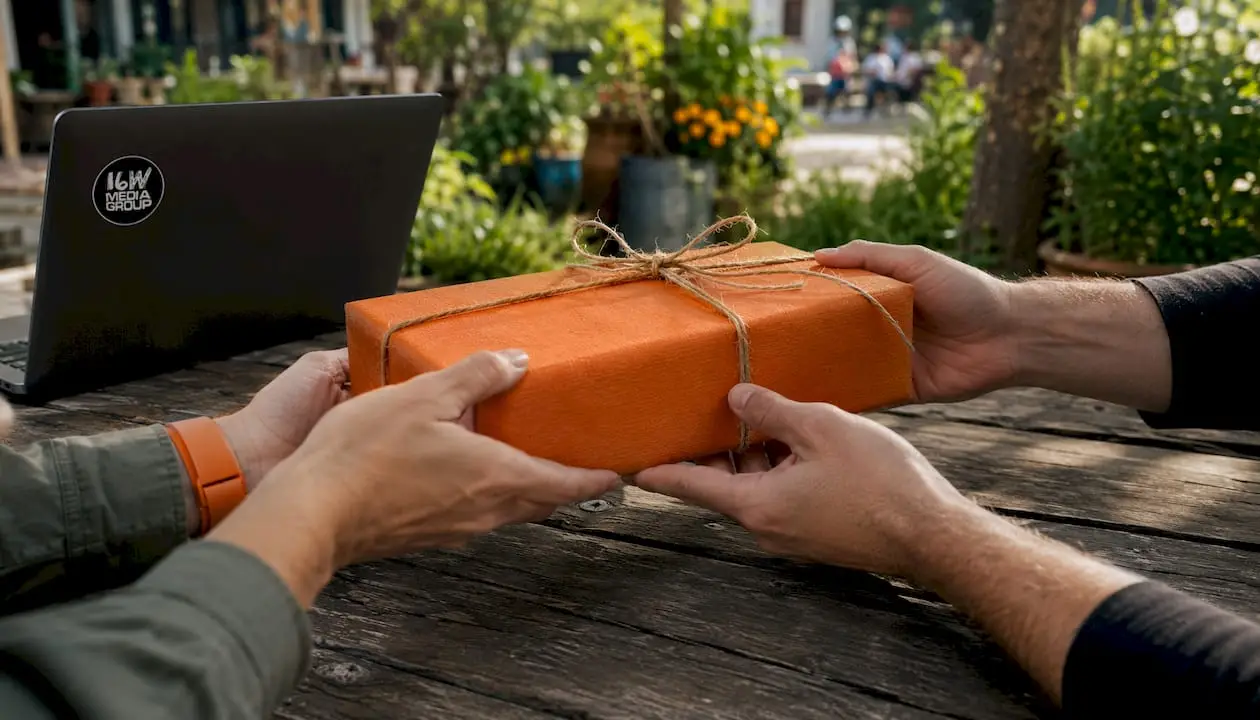
Most referral programs fail because they feel like a coupon exchange. The ones that work are designed around generosity toward the new customer, not the referrer. Offering $25 off to the referred friend and store credit to the referrer outperforms equal discount splits because the referrer feels like they are doing their friend a favor, not collecting a reward. A local spa, salon, or home services company can launch this in a week with nothing more than a shareable link and a personal follow-up text.
2. Micro-ambassador programs
Rather than waiting for organic sharing to happen, identify your top 2% of customers by purchase frequency and enthusiasm. These are the people who already tag you on Instagram or mention you unprompted. Give them early access to new services, a private group chat, or a first look at seasonal promotions. Micro-ambassador programs generate durable organic mentions because recognition matters more to this group than cash. A local fitness studio or boutique retailer can run this with a simple email list and a monthly “insider” update.
3. Community event sponsorships
Dagne Dover pulled back on Google and Meta entirely and replaced that spend with events, sponsorships, and high-touch retail relationships. Their sponsorship of League One Volleyball put them in front of a passionate, underserved audience no other bag brand was chasing. Local businesses can replicate this at a neighborhood scale: sponsor a youth sports league, a 5K, or a school fundraiser. The visibility is hyper-local, the goodwill is genuine, and the conversations it starts are exactly the kind that spread.
4. Founder storytelling through retail and community channels
When Dagne Dover moved into wholesale, founder Melissa Mash personally trained retail sales teams. Those salespeople then retold the founder story firsthand to every customer who walked in. The number of people who heard that story and passed it on was, in her words, exponential. Local business owners have the same asset: a real origin story. Share it through brand storytelling in your community magazine, on a local podcast, or at a chamber of commerce event. People remember stories. They repeat them.
5. Unboxing and packaging experiences designed to be shared
If a customer would not stop to photograph your packaging, your packaging is costing you reach. Brightland, the olive oil brand, designed its bottles explicitly to live on countertops and in flat lays, which drives an estimated 18% of their new customer traffic through organic social. A local bakery, candle shop, or subscription box service can apply the same logic: add a handwritten note, use distinctive wrapping, or include a small unexpected gift. Consistent delivery of unexpected gestures like these fuels organic sharing without a single paid placement.
6. User-generated content moments at the job site or point of service
Right after a job is complete and the customer sees the result, ask if you can take a photo together or film a 30-second reaction video. Post it and tag them. When customers see themselves on your page, most reshare it, putting your business in front of their entire network. User-generated content is 50% more trusted than branded content. A landscaper, HVAC company, or interior designer who does this consistently builds a visual portfolio that doubles as a referral engine.
7. Systematic review generation tied to peak satisfaction
An HVAC company in Raleigh, North Carolina went from struggling to $1 million in annualized revenue in 11 months by building a systematic review generation process. They integrated their CRM with an automated review request sent four hours after job completion, responded to every review within two hours, and mentioned reviews during the final walkthrough. Their Google ranking jumped from #5 to #1 for “HVAC Raleigh.” An updated Google Business listing with recent reviews and accurate responses can increase new customer traffic. Reviews are digital word of mouth, and they work around the clock.
How to design campaigns that people actually want to share
The first step is identifying your native share moments: the specific points in the customer experience where someone feels genuinely delighted and naturally wants to tell someone. For a restaurant, it might be a dish that looks stunning on a plate. For a contractor, it is the moment a client sees the finished result. For a boutique, it is the unboxing. Build your campaign around that moment, not around a generic discount.
Pro Tip: Ask for a referral within 24–48 hours of service completion. That window is when customer satisfaction peaks, and referral requests made in that window get significantly higher response rates than a follow-up email sent a week later.
Once you have identified the moment, amplify it with these steps:
- Design incentives as gifts, not transactions. A gift card to a local coffee shop feels generous. A “refer a friend” coupon feels like a sales tactic.
- Make the ask specific. “Do you know any homeowners in the neighborhood thinking about new floors?” gets a name. “Do you know anyone who needs this?” gets a shrug.
- Leverage community channels. Sponsor a local event, get featured in a community-based advertising strategy, or partner with a complementary local business for a joint post or shared event.
- Capture and amplify UGC. Every tagged photo, Google review, and social mention is an asset. Screenshot it, share it, and boost it with a small paid budget to extend its reach.
Best practices and expert insights for optimizing your campaigns
Transferred trust is the foundation. When a friend recommends your business, their credibility travels with the recommendation, reducing the skepticism a cold prospect would otherwise bring. That is why word-of-mouth marketing has a 37% higher customer retention rate compared to other marketing strategies. Customers who arrive through a referral are pre-sold before they call.
Positive reviews make many consumers trust a local business more, and online reviews convince many people to avoid a business when those reviews are negative or nonexistent.
Measurement matters as much as execution. Track referred customer acquisition cost against your paid channels. Referred customers should carry a higher lifetime value than paid-acquired ones. If they do not, your incentive is attracting deal-seekers rather than genuine advocates. Also watch your Google Business profile views and direct call volume monthly: these are the clearest signals that your digital word-of-mouth is working.
Community relevance is the multiplier most local businesses underestimate. Embedding your business deeply in community activities through sponsorships, local publishing, and unconventional partnerships build the kind of visibility that paid ads cannot replicate. People share businesses they feel proud to be associated with.
Legal and ethical considerations when running word-of-mouth marketing
The Federal Trade Commission requires that any paid, incentivized, or otherwise compensated endorsement be clearly disclosed. If you give a customer a gift card in exchange for a review or a social post, that relationship must be disclosed. “Gifted” or “#ad” labels are not optional. Violating these rules carries real financial penalties and, more importantly, destroys the authenticity that makes word-of-mouth work in the first place.
Never incentivize positive reviews specifically. You can ask customers to leave an honest review; you cannot offer a reward contingent on a five-star rating. Platforms like Google and Yelp prohibit review gating (the practice of filtering customers before asking, so only happy ones get the review request). Keep your process consistent: ask every customer, not just the ones you think will say something nice.
Authenticity is also a practical business concern. Manufactured testimonials or fake reviews are easy to spot and catastrophic when exposed. The most durable word-of-mouth campaigns are built on real experiences, real stories, and real community involvement. That is not just the ethical path. It is the one that actually compounds over time.
Key Takeaways
Word-of-mouth campaigns work best when they are built around genuine customer experiences, timed precisely, and amplified through community channels rather than manufactured through discounts alone.
| Point | Details |
|---|---|
| Transferred trust drives conversion | Recommendations from trusted sources bypass skepticism and make prospects easier to close and more loyal long-term. |
| Timing the referral ask matters | Asking within 24–48 hours of service completion captures peak satisfaction and significantly increases response rates. |
| Incentive design shapes results | Weighting rewards toward the referred friend (give-to-get asymmetry) feels more generous and boosts conversions. |
| Reviews are digital word of mouth | An updated Google Business listing with recent reviews can increase new customer traffic by 30%. |
| Community involvement multiplies reach | Sponsorships, local events, and founder storytelling build visibility that paid ads cannot replicate. |
Ready to turn your customer relationships into a growth engine? 16wmediagroup helps local businesses build the media presence and community connections that make word-of-mouth campaigns thrive. Start with the local advertising best practices guide to map your next move.