
Collaborative marketing works because it multiplies three things at once: reach, credibility, and creative resources, while lowering your cost-per-acquisition. When two brands co-create content and promote it across complementary audiences, you effectively double your effective reach without a proportional jump in budget. The trust each partner’s audience already holds transfers to the other brand, shortening the buyer’s journey. And shared production costs mean more content, more channels, and better results for the same spend.
- Reach multiplier: Co-promotion puts your message in front of your partner’s audience, an audience that would have cost you real media dollars to reach alone.
- Trust multiplier: A partner’s endorsement carries social proof. Their audience doesn’t see an ad; they see a recommendation from a source they already trust.
- Resource multiplier: Shared content production, co-funded media buys, and pooled creative assets lower the cost per lead for both sides.
Two quick examples: A B2B software company co-hosts a webinar with a complementary HR platform, each promoting to their own list. Both brands walk away with qualified leads they didn’t generate alone. At the local level, a Tampa restaurant partners with a nearby fitness studio for a co-branded “Fuel Your Workout” campaign, splitting print and social costs while reaching both communities. The mechanics are the same whether you’re selling SaaS or smoothies.
Table of Contents
- What is collaborative marketing, exactly?
- Why collaborative marketing produces stronger results
- Which collaborative marketing formats fit your objective?
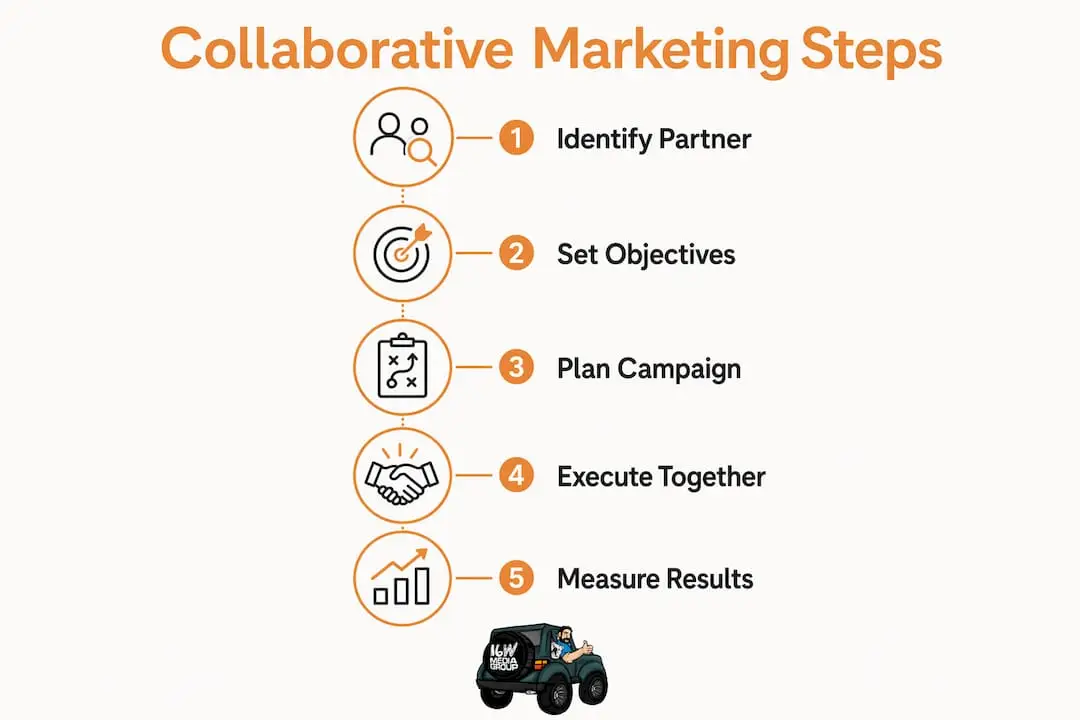
- How to start a brand collaboration: a step-by-step checklist
- How to measure collaborative marketing so results aren’t “vibes-driven”
- Common reasons collaborative marketing fails
- Three examples that show collaborative marketing in action
- Key Takeaways
- When should you partner, and when should you keep it in-house?
- How 16wmediagroup helps you run collaborative local campaigns
- Further reading and sources
What is collaborative marketing, exactly?
Collaborative marketing is the practice of two or more brands co-creating content and co-promoting it toward shared objectives, with each partner contributing audience access, creative assets, or budget. The key word is co-created. Both parties have skin in the game, and both expect a measurable return.
It’s worth separating this from a few terms that get used interchangeably but mean different things:
- Co-marketing is the most common synonym. Two brands jointly produce and promote a campaign or asset. Think co-authored whitepapers, joint webinars, or shared social campaigns.
- Co-selling is a sales-motion concept: two companies work together to close deals, often where one product complements the other. It’s downstream of marketing.
- Partner marketing is broader. It includes co-marketing but also covers channel enablement, reseller programs, and technology integrations. Not all partner marketing is collaborative in the content-creation sense.
- Brand collaboration typically refers to a product-level partnership, like a co-branded product line or limited-edition release. It often involves deeper legal and inventory agreements than a content campaign.
What collaborative marketing is not: a pure logo swap on a landing page, a paid affiliate arrangement where one party simply earns a commission, or a reseller/channel distribution deal. Those are transactional. Collaborative marketing requires both parties to actively promote and co-create, not just lend their name.
Why collaborative marketing produces stronger results
The benefits aren’t abstract. Each one connects to a real metric you can track.
-
Expanded reach. Your partner’s audience is an audience you didn’t pay to build. Co-created content promoted across multiple partner channels reaches more unique audiences than solo publishing, often at a fraction of the equivalent paid media cost. Reach doubles; budget doesn’t.
-
Credibility and trust transfer. When a brand an audience already trusts introduces yours, engagement rates climb. This is the trust multiplier in action. Audiences are more likely to opt in, register, or buy when the recommendation comes from a known source rather than a cold ad.
-
Lower cost-per-acquisition. Splitting content production, media buys, and event costs across two partners cuts CPA for both. A joint webinar that costs $2,000 to produce and promote, split evenly, delivers leads at half the solo cost if the audience sizes are comparable.
-
Faster creative and idea velocity. Two teams bring two creative perspectives. Co-created campaigns often surface angles, formats, or audience insights that neither team would have developed alone. That cross-pollination speeds up the creative cycle and tends to produce fresher work.
-
Category and authority building. Joint research reports, co-branded summits, and shared thought leadership don’t just generate leads; they define categories. When two credible voices validate a concept together, the market takes notice faster than if one brand makes the same claim solo.
For local businesses, these benefits are especially pronounced. A modest advertising budget stretches further when two community brands share the load, and the combined audience signal carries more weight in a local market where word-of-mouth still drives decisions.
Which collaborative marketing formats fit your objective?
Collaborative marketing runs across a wide spectrum of formats. Choosing the right one depends on your goal, your partner’s capacity, and your timeline.
Joint webinars and virtual events
Best for demand generation. Two brands co-host a live session, each promoting to their own list. The activation difficulty is moderate: you need aligned topics, a shared registration page, and agreed lead-routing. Typical timeline from pitch to live event is 4–6 weeks. This format works especially well when both audiences share a professional pain point.

Pro Tip: Build a one-page partner brief that includes pre-written email copy, social captions, and a shared registration link. Partners who don’t have to write their own promotional copy are far more likely to actually promote.
Co-authored content and gated assets
Whitepapers, research reports, and long-form guides co-authored by two brands perform well for awareness and lead generation simultaneously. The gated version captures leads; the ungated version builds authority. Activation difficulty is higher because both teams must align on research, tone, and review cycles. Budget 6–10 weeks.
Co-branded social campaigns and social co-promos
Lower friction, faster to launch. Two brands agree on a shared hashtag, visual theme, or challenge and cross-post across their channels. Great for awareness and audience growth. Timeline can be as short as two weeks. The tradeoff: shorter shelf life and harder to attribute leads directly.
Product bundles and integrations
For product-led growth, bundling complementary products or building a technical integration creates a distribution channel that runs itself. A local spa and a wellness supplement brand bundling a “recovery package” is a simple version. A SaaS integration is a more complex one. Both require contract clarity on pricing, inventory, and revenue splits.
Events and community activations
In local markets, co-sponsored events, pop-ups, and community activations are among the highest-trust formats available. Two brands sharing a booth at a local market, or co-sponsoring a neighborhood event, puts both names in front of a highly engaged, geographically relevant audience. The role of media partnerships in amplifying these activations is significant: local media coverage multiplies the reach well beyond the event itself.

Pro Tip: For creator and influencer partnerships, use a cross-promotion agreement checklist before you brief anyone. Defining asset deliverables, posting windows, and disclosure requirements upfront removes the back-and-forth that kills momentum.
How to start a brand collaboration: a step-by-step checklist
This sequence works whether you’re launching your first co-marketing campaign or building a repeatable partner program.
-
Define your objective and audience first. Before you approach anyone, know what you want: awareness, leads, sales, or category authority. Identify the audience segment you’re trying to reach and what they need from a partner brand.
-
Shortlist three to five potential partners. Look for complementary audiences (not identical), shared values, and comparable brand equity. A partner whose audience overlaps 20–40% with yours is usually the sweet spot: enough shared context, enough new reach.
-
Prepare a mutual value proposition. Your pitch should answer “what’s in it for them” as clearly as it answers “what’s in it for us.” Quantify the audience you bring: list size, social following, event attendance, or monthly readership.
-
Run a diagnostic pilot. Before committing to a multi-quarter program or large co-op budget, prove the collaboration with a low-complexity deliverable, a co-authored blog post or a 20-minute joint video. This exposes legal, approval, and creative friction early, when it’s cheap to fix.
-
Build the partner kit. Once you’ve agreed to move forward, create a one-page brief, pre-written social copy, branded graphics sized for each channel, and a shared landing page URL. Partners who have everything they need activate faster and promote more consistently.
-
Agree on a shared landing page and lead routing. This is non-negotiable for measurement. A unified conversion path, with UTM parameters and agreed CRM tagging, is what separates a campaign you can prove from one you can only feel good about. Refer to the local advertising campaign planning guide for a practical activation checklist.
-
Set promotion windows. A defined 72-hour or one-week window creates urgency for both teams. Open-ended promotions drift. Narrow windows drive action.
-
Schedule a post-campaign debrief and data share. Agree before launch that both sides will share performance data: reach, registrations, leads, and pipeline. This builds trust for the next campaign and gives both teams the proof points they need internally.
Key agreement headlines to nail down
When you’re formalizing a collaboration, successful brand collaborations require contracts that set clear expectations. Cover these at minimum: promotion windows and channel commitments, lead routing and ownership, attribution model and reporting timeline, creative ownership and approval rights, budget split and invoicing, and disclosure requirements for any sponsored or co-created content.
Questions to ask a potential partner on a discovery call
- What’s your current list or audience size, and how engaged is it?
- What’s your typical approval timeline for co-branded creative?
- What KPIs matter most to your team for this type of campaign?
- Do you have a legal or compliance review process for partnerships?
- What’s worked (or not worked) in past collaborations?
How to measure collaborative marketing so results aren’t “vibes-driven”
Vibes-driven measurement is the primary reason co-marketing programs fail to get renewed. If you can’t show sourced pipeline, you can’t justify the next campaign. Here’s how to build measurement that holds up.
KPIs by funnel stage
| KPI | How to measure | What counts as success |
|---|---|---|
| Reach / impressions | UTM-tagged links, social analytics | Meaningful lift vs. solo baseline |
| Engagement rate | Clicks, registrations, time on page | Above your solo content average |
| Lead quality | MQL rate, ICP match score | Equal to or better than paid channels |
| Sourced pipeline | CRM campaign tag, attribution window | Attributable revenue from partner leads |
| Cost-per-acquisition | Total campaign cost ÷ leads or customers | Lower than equivalent solo spend |
Practical tracking checklist
- Create a unified landing page for the campaign, not two separate pages.
- Apply consistent UTM parameters across all partner promotional links (source, medium, campaign, content).
- Tag all leads in your CRM with a campaign identifier so you can filter by partner source.
- Agree on an attribution window before launch (typically 30–90 days for B2B, shorter for consumer).
- Use standard asset naming and campaign tags so every piece of content is traceable back to the partnership.
Reporting timeline
Pilot (days 1–30): Track reach and engagement only. The goal is to confirm both partners promoted and that the landing page converted. Share a one-page summary with both teams.
30-day check-in: Add lead quality data. Are the leads matching your ICP? Are they progressing in the pipeline? Flag any attribution gaps now, not at the end of the quarter.
90-day review: Full ROI picture. Sourced pipeline, influenced revenue, CPA comparison, and a qualitative debrief on what worked operationally. This is the document that gets the next campaign approved.
Stat to know: Research on B2B partner marketing consistently shows that co-created content promoted across multiple partner channels reaches more unique audiences than solo publishing, with distribution efficiency gains that compound when partners are properly enabled.
Common reasons collaborative marketing fails
Most partnership failures are predictable. Here’s what to watch for and how to fix it.
-
Unclear goals. Both teams show up with different definitions of success. Fix: align on two or three shared KPIs before any creative work starts. Write them into the brief.
-
Misaligned audiences. Partners whose audiences don’t overlap enough produce campaigns that feel generic to both. Fix: require audience data (list demographics, engagement rates) during the discovery call, not after the contract is signed.
-
Poor partner enablement. The most common operational failure. One partner promotes; the other doesn’t. Fix: deliver a complete partner kit (pre-written copy, graphics, shared link) and set a specific promotional window. Partners who have to create their own assets rarely do.
-
Legal and IP ambiguity. Who owns the co-created content? Who can use the leads? What happens if one brand’s reputation takes a hit mid-campaign? Fix: address creative ownership, lead rights, and exit clauses in the agreement before launch. For sponsored or co-created content, clear disclosure language also reduces approval friction and keeps both brands compliant.
-
Separate landing pages. Each partner sends traffic to their own page. You end up with two partial data sets and no unified view of performance. Fix: mandate a shared landing page with agreed lead-routing as a non-negotiable campaign requirement.
-
No post-campaign data share. The campaign ends, both teams move on, and neither has the proof points to justify the next one. Fix: schedule the debrief before launch. Make data sharing a contractual deliverable.
Low-friction fixes (you can do these this week): partner kit, shared landing page, UTM conventions, and a scheduled debrief. Higher-friction fixes (require governance or budget decisions): attribution model alignment, CRM integration, and legal agreement templates. Start with the low-friction ones and you’ll already be ahead of most programs.
Three examples that show collaborative marketing in action
B2B co-webinar: software meets HR platform
A project management software company partners with a payroll and HR platform to co-host a webinar on “Building a Productive Remote Team.” Each brand promotes to its own email list and social following. The combined registration pool is roughly twice what either brand would have drawn solo, and the lead quality is high because both audiences self-selected into a shared professional topic. The outcome: both teams walk away with a list of warm, ICP-matched leads they can nurture independently. It worked because the audiences shared a pain point, and neither brand competed with the other for the same sale.
Product bundle: local wellness brands
A Tampa-area yoga studio and a local cold-press juice brand co-create a “Morning Reset” bundle, promoted through both brands’ social channels, email lists, and in-studio signage. The bundle drives foot traffic to the studio and trial purchases for the juice brand. Sales of the bundled offer outperform either brand’s solo promotions during the same period. The trust multiplier here is strong: existing yoga students trust the studio’s recommendation, and the juice brand gains credibility it would have had to buy through paid ads.
Local media co-promotion: community magazine partnership
A regional home services company partners with a community-focused local publication to co-produce a “Home Improvement Spotlight” editorial series. The publication provides editorial reach and credibility; the home services company provides subject-matter expertise and co-funds the print and digital distribution. The result is branded content that reads like editorial, reaches a highly local and relevant audience, and generates inbound inquiries the company attributes directly to the campaign. It worked because the publication’s audience trusted the editorial voice, and the co-production model kept costs manageable for a mid-sized local business.
Key Takeaways
Collaborative marketing works because it compounds reach, trust, and resources simultaneously, making it one of the highest-leverage tactics available to brands with limited budgets.
| Point | Details |
|---|---|
| Reach multiplies, not just adds | Co-promotion across complementary audiences can double effective reach without a proportional budget increase. |
| Measurement must be unified | A shared landing page, UTM conventions, and CRM campaign tags are the minimum infrastructure for proving sourced pipeline. |
| Partner enablement drives activation | Delivering pre-written copy, sized graphics, and a defined promotional window is what separates active programs from stalled ones. |
| Pilot small before scaling | A co-authored blog or 20-minute joint video exposes legal and approval friction early, before large budgets are committed. |
| 16wmediagroup operationalizes this locally | 16wmediagroup builds co-branded campaigns, partner kits, and shared media placements for local businesses in Tampa and surrounding markets. |
When should you partner, and when should you keep it in-house?
Here’s the honest answer: partner when the credibility or audience access you need costs more to buy than to borrow through co-promotion. If you’re launching in a new category, trying to reach an audience that doesn’t know you yet, or working with a media budget that can’t sustain solo paid campaigns at the scale you need, a well-chosen partner is almost always the faster path.
The signals that favor partnering are pretty clear. You need third-party credibility to validate a claim. Your media budget is limited relative to the reach you need. You’re trying to build category authority, not just generate leads. Your partner has an audience that trusts them deeply and overlaps meaningfully with your ideal customer.
The signals that favor keeping it in-house are equally clear. You’re launching something IP-sensitive where brand control is paramount. Your messaging is highly nuanced and requires extensive approval cycles that a partner can’t accommodate. Or you’ve already built the audience you need and the incremental reach from a partner doesn’t justify the coordination cost.
In local markets, the calculus almost always tips toward partnering. A modest budget split between two complementary local brands, amplified through a community-based advertising strategy, consistently outperforms what either brand could achieve alone. The community trust that local brands carry is a genuine asset, and co-promotion lets both brands borrow from each other’s equity at a fraction of what paid media would cost to replicate it.
The mistake most teams make is treating partnerships as a last resort when the budget runs out. The smarter move is to build partner relationships before you need them, so when a campaign window opens, you have ready allies rather than starting from scratch.
How 16wmediagroup helps you run collaborative local campaigns
16wmediagroup is the practical operator for local businesses that want to run collaborative campaigns without the coordination overhead of managing it alone. The team builds co-branded advertising packages across print, digital, podcast, and community publishing channels, handles partner enablement kits so your collaborators have everything they need to promote, and sets up shared landing pages with proper lead-routing so your results are measurable from day one. For Tampa-area businesses and regional brands looking to stretch a local media budget further, the co-op advertising management and community publishing programs are designed specifically for this kind of partnership-driven growth.
Ready to put a collaborative campaign together? Start with the local advertising best practices guide for a practical planning framework, or go straight to the services page to see how 16wmediagroup can build your next co-branded campaign from brief to launch.
Further reading and sources
- 8 Benefits of Collaborative Marketing and How to Execute It — Covers the core reach and cost-sharing mechanics with practical execution guidance.
- The Reality of Co-Marketing in B2B — The best single resource on moving beyond logo swaps to measurable pipeline, including the unified landing page and lead-routing framework.
- B2B Partner Marketing: The Framework That Doubles Reach — Detailed framework on distribution efficiency, partner enablement, and category building through co-created content.
- How Collaborative Marketing Allows Brands to Work Together — Practical format guide with examples across product bundles, social co-promos, and long-term brand collaborations.
- How to Design a Successful Brand Collaboration — Contract and governance advice for brand partnerships, including creative ownership and measurement expectations.
- How to Plan Co-Branded Advertising Locally — 16wmediagroup’s step-by-step guide to planning local co-branded campaigns, from partner selection to media placement.