

Added value advertising works by attaching a real benefit, functional, economic, psychological, or social, to a brand message instead of leaning on features or price alone. The payoff is measurable: value-driven approaches have delivered 79% higher conversions than feature-focused ads in reported cases. Lean on it when you need loyalty and pricing power, not just a quick click.
TL;DR:
- Value-driven campaigns see 79% higher conversions than feature-focused ads, especially when combined with demographic and behavioral targeting.
- Different audience segments respond best to specific value types: economic value for budget-conscious buyers, functional for time-stressed, social for identity-driven, and psychological for older or high-trust segments.
- Embedding shared values early in advertising not only boosts immediate performance but also enhances future ad effectiveness and customer loyalty through trust.
- Successful added value campaigns rely on thorough research, operational planning, and measurement, avoiding promises that cannot be fulfilled or superficial creative layering.
- Local campaigns that incorporate community insights and deliver actual utility within the ad experience outperform generic or price-focused approaches in crowded markets.
Table of Contents
- What Added Value Advertising Actually Means
- Why Added Value Advertising Matters Right Now
- Where Added Value Shows Up Across Channels
- Building Value Into Your Campaign From Scratch
- Proving the Value Actually Moved the Needle
- How We Put This Into Practice at 16W Media Group
- Where Added Value Campaigns Go Wrong
- Added Value Ads Versus Traditional Advertising
- What Long-Term Results Actually Look Like
- Matching the Offer to the Audience Segment
- The Editorial Take: What Marketers Get Wrong About Added Value
- Get Added-Value Advertising Built for Your Local Market
- Sources
What Added Value Advertising Actually Means
Marketers throw around “value” loosely, so it helps to get specific. Added value advertising means the ad itself delivers something beyond the core product claim, a benefit that changes how the customer feels about the transaction, not just what they’re buying.
There are four distinct types worth separating, because they call for different creative and different offers:
- Functional value: a genuine usability or convenience win, like a how-to guide bundled with a product ad, or free installation support.
- Economic value: a real cost benefit, such as a bundled discount, an extended warranty, or a loyalty credit that reduces future spend.
- Psychological value: an emotional payoff, confidence, belonging, relief, delivered through tone, story, or brand alignment.
- Social value: signaling that a purchase connects the buyer to a community or a cause they already care about.
Added value advertising differs from content marketing (which builds authority over time) and cause marketing (which centers a single social issue). It’s closer to a loyalty program, but embedded directly inside the ad rather than delivered after purchase. Choosing which value type to emphasize depends on what your audience actually lacks. A time-starved parent responds to functional value. A budget-conscious shopper responds to economic value. Get this wrong and the ad reads as filler.
Why Added Value Advertising Matters Right Now
Value-driven advertising isn’t a soft nice-to-have squeezed in beside performance metrics. It changes performance metrics.
The numbers: Value-driven campaigns delivered 79% higher conversions than feature-focused ads in reported industry cases, and combining values with demographic and behavioral targeting increases relevance across the entire funnel, not just at the top.
There’s a defensive angle too. WARC and Aletheia’s research on values-driven marketing found that embedding values into creative early protects brand relationships and actually accelerates the performance ads served to that same audience later, an idea sometimes shortened to “return on values,” or ROV. Shared values reduce price sensitivity because the customer isn’t comparing you to a competitor on cost alone anymore. They’re comparing you on fit. That’s a much harder position for a rival to attack with a coupon.
Where Added Value Shows Up Across Channels
The tactics differ by channel, but the goal stays constant: give the customer something useful inside the ad experience itself, not just a message about the product.
- Search and AI-enhanced matching. Microsoft’s AI Max features, including search term matching, text customization, and final URL expansion, drove at least an 8% increase in conversions in early advertiser tests by matching creative to intent rather than exact keywords. Google’s AI Max for Search reports similar gains, with some advertisers seeing 27% more conversions and case examples citing conversion surges alongside sharp drops in cost per acquisition.
- Social and creator-led utility. Instructional content, a five-minute tutorial, a community Q&A, a creator walkthrough, works as added value because it solves a problem before asking for a sale.
- Commerce and post-transaction extras. Loyalty rewards, cross-sell bundles, and helpful add-ons delivered after checkout extend the value exchange past the click. A confirmation email that includes a genuinely useful extension, not a second sales pitch, keeps the relationship warm.
- Local and community media. Sponsored resources inside a community-based advertising strategy work because the “ad” is wrapped in a local story the reader already wanted to read. A regional business sponsoring a neighborhood podcast segment gets attention a banner ad never could.
Search platforms are also getting better at routing long-tail, conversational queries to the right landing page, which means your product and service pages need clear, intent-focused content to capture that traffic once it arrives. For a deeper look at making content discoverable by AI-driven search, see this guide to optimizing content for AI search.
Building Value Into Your Campaign From Scratch
Skip the audience research and you’ll bolt on a value proposition nobody asked for. The workflow below keeps that from happening.
- Research what your audience actually values. Valuegraphics-style segmentation goes beyond age and income to ask what a group prioritizes, security, status, convenience, and gives you the raw material for step two.
- Map that value to a specific offer. A value proposition canvas forces you to write down the exact pain point your added value resolves, instead of assuming it.
- Build a creative brief with a fulfillment plan attached. Every added-value promise needs an operational owner. If the ad promises a free consultation, someone has to do it on day one.
- Loop in stakeholders before launch. Customer service, fulfillment, and legal all need visibility, because a value promise the business can’t keep does more damage than no promise at all.
Pro Tip: Run every draft through a simple filter before it ships: does this ad make the customer’s day easier, or does it just make your funnel look busier? If you can’t answer clearly, the offer isn’t ready.
Local campaigns built through targeted media planning in a specific market tend to follow this exact sequence, research first, offer second, because skipping ahead to creative production is where most added-value campaigns quietly fail.
Proving the Value Actually Moved the Needle
Added value advertising only earns its budget if you can show what changed. That means tracking outcomes beyond simple click-through rate.
| KPI | What it tells you |
|---|---|
| Incremental conversions | Conversions attributable to the value-added creative versus a control group |
| Retention lift | Whether customers exposed to value messaging stick around longer |
| Average order value | Whether bundled or added-value offers increase basket size |
| ROV proxy (repeat rate, referral rate) | Whether shared values are reducing churn and price sensitivity over time |
The cleanest way to isolate a campaign’s real contribution is a holdout test: run the value-added creative against a matched audience seeing standard ads, then compare outcomes over a fixed window. Academic research into value-based advertising deals found that this only works when both advertiser and media partner agree on measurement definitions before launch, otherwise outcome claims get disputed after the fact. The American Marketing Association’s 2025 guide makes a similar point: testing and measurement discipline matter as much as the creative idea itself.
How We Put This Into Practice at 16W Media Group
Mike leads content strategy at a marketing agency, where the added-value approach isn’t theoretical, it’s how local campaigns get built day to day.
- Community publishing that embeds a client’s offer inside a neighborhood story readers already trust.
- Sponsored podcast segments that deliver functional value (real advice, real local voices) alongside the brand mention.
- Targeted regional packages that layer economic value, bundled placement across print, digital, and audio into a single campaign.
Case studies and client partnerships referenced across 16wmediagroup’s local advertising work show how this plays out for businesses trying to stand out in a crowded regional market.
Where Added Value Campaigns Go Wrong
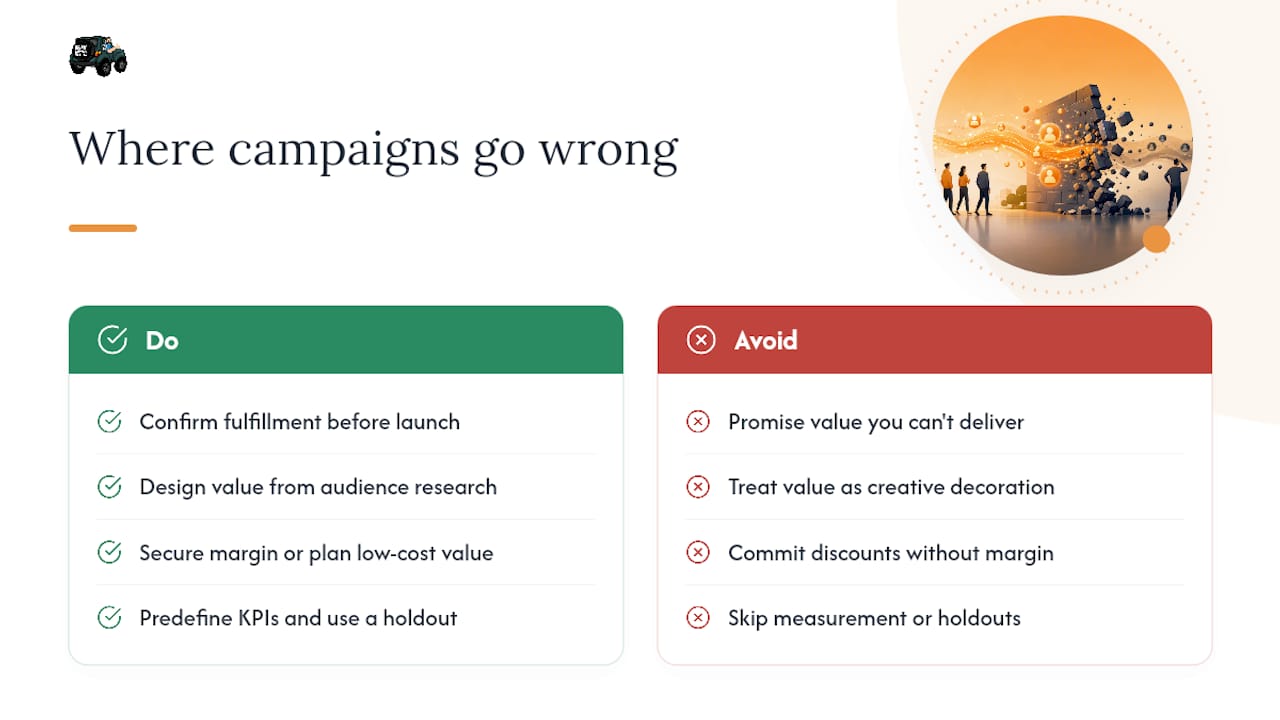
The most common failure isn’t a bad idea, it’s a broken promise. An ad offers a free guide, a discount code, or a consultation, and the fulfillment side isn’t ready. Customers who chase a value promise and hit a dead end end up more skeptical than if you’d never made the offer.
A second pitfall is treating “added value” as a creative decoration instead of a research-backed decision. Teams sometimes bolt an emotional tagline onto an existing feature-led ad and call it value-driven. Industry commentary on what separates ads that add value from ones that don’t points to a simple test: does the ad reduce friction for the shopper, or does it just add noise to an already crowded feed? If the value isn’t rooted in what the audience actually lacks, it reads as filler.
Budget mismatch is another trap. Economic value, discounts, bundles, free upgrades, costs real money, and marketing teams sometimes promise it without securing the margin to support it. Functional and psychological value cost less to deliver but take longer to design well, which means teams under deadline pressure default to the cheap tagline instead of the harder, better idea.
Finally, measurement gets skipped. Without a holdout group or a pre-agreed KPI, there’s no way to prove the value-added creative did anything beyond what a standard ad would have done, and the whole initiative loses budget the next quarter.
Added Value Ads Versus Traditional Advertising
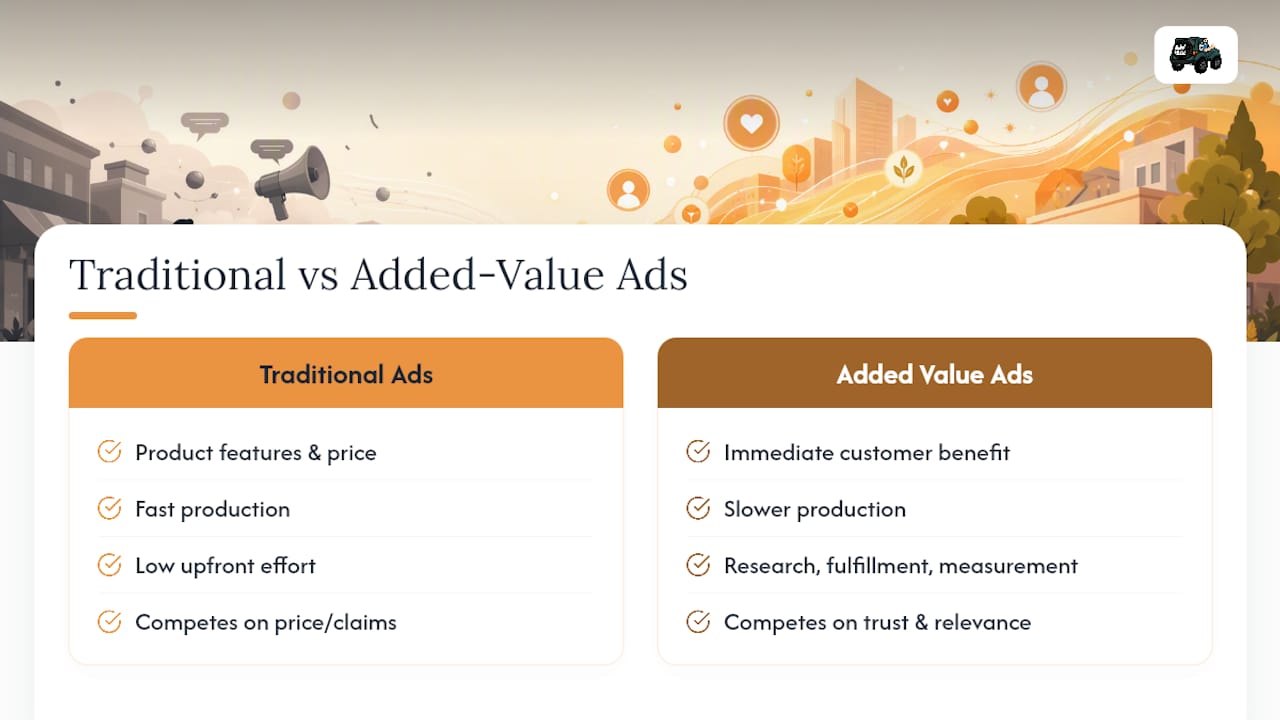
Traditional advertising sells the product: features, price, availability. It works, but it competes on the same axis every competitor is also fighting over, which usually means a race toward the lowest price or the loudest claim.
Added value advertising competes on a different axis entirely. Instead of asking “why is this product better,” it asks “what does this ad do for you right now.” That shift changes the customer relationship from transactional to something closer to ongoing trust, which is exactly why combining values with demographic and behavioral data increases relevance across the funnel rather than just at the point of purchase.
The tradeoff is effort. Traditional advertising can be produced fast: write the offer, state the price, run the media. Added value advertising requires research into what the audience actually needs, a fulfillment plan to deliver on the promise, and a measurement framework to prove it worked. That’s more upfront work, but it buys something traditional advertising rarely does: reduced price sensitivity, because the customer isn’t comparing you to a competitor on cost alone.
The two approaches aren’t mutually exclusive. Many of the strongest campaigns use feature-led messaging to close the sale and value-led messaging to open the relationship, particularly in categories, like local services, where trust is the real barrier to conversion.
What Long-Term Results Actually Look Like
The clearest evidence for added value advertising’s payoff isn’t a single dramatic campaign, it’s the pattern across reported cases. Advertisers running value-driven creative alongside demographic and behavioral targeting have seen conversion lifts that outperform feature-focused control ads by a wide margin, with 79% higher conversions reported in aggregated industry data. On the AI-enabled side, advertisers adopting Microsoft’s AI Max saw at least an 8% increase in conversions in early tests, with some heavy-use cases reporting considerably higher gains.
What’s more interesting than the initial lift is what happens after. The ROV research from WARC and Aletheia found that campaigns embedding values early made the subsequent performance advertising served to that same audience work harder, essentially a compounding effect where the value-driven phase primes the audience and the performance phase converts them at a better rate. That’s the long-term brand impact case: added value advertising doesn’t just win one campaign cycle, it improves the ROI of everything that follows it.
For local and regional businesses specifically, the compounding effect shows up as repeat business and referral, not just a lower cost per click. A customer who felt genuinely helped by an ad, not just sold to, is the customer who mentions your name unprompted six months later.
Matching the Offer to the Audience Segment
A single added-value offer rarely works across every segment you’re targeting, because different groups are solving for different constraints.
Price-sensitive segments respond best to economic value: bundled discounts, loyalty credits, extended terms. Time-constrained professionals respond to functional value, anything that removes a step from their day, a faster checkout, a done-for-you service, a bundled consultation. Younger or identity-driven segments often respond most to social value, offers that connect a purchase to a community or a cause they already associate with. Older or higher-trust segments frequently respond to psychological value, messaging that reduces anxiety or reinforces a decision they’ve already made.
The mistake is running one offer across all four groups and hoping the creative does the work of segmentation. It won’t. Valuegraphics-style research, the kind that maps what a group prioritizes rather than just their age or income, is what makes segment-specific value offers possible in the first place. A local campaign targeting both college students and retirees, for instance, needs two different value hooks running through the same media buy, not one generic offer stretched thin across both.
The Editorial Take: What Marketers Get Wrong About Added Value
Most marketing teams treat added value as a creative layer, something the copywriter sprinkles on top of an already-finished offer. That’s backwards. The research is consistent: value has to be designed into the offer before the ad gets written, or it reads as decoration instead of substance.
The conventional advice, “know your audience,” undersells how specific this needs to be. Knowing that your audience is “budget conscious” isn’t enough to build a real economic-value offer. You need to know whether they’re time-constrained too, because that changes whether the right offer is a discount or a shortcut.
If you’re building a business case for added value advertising internally, don’t lead with the emotional story. Lead with the fulfillment plan and the measurement framework. Executives who’ve been burned by unmeasurable “brand” campaigns will trust a holdout test far more than a mood board. Get the operational side right first. The creative will follow more easily once the promise behind it is one your business can actually keep.
— Mike
Get Added-Value Advertising Built for Your Local Market
Most agencies sell you a media placement and call it a strategy. Some agencies build the added-value layer in from the start, community storytelling, sponsored podcast segments, and regional packages designed around what a specific local audience actually values, not a generic template reused across every client.
That local audience intelligence is the differentiator: instead of guessing which value type will land, campaigns get built around real community insight and delivered through channels, community publishing, regional print, sponsored audio, that your audience already trusts. If your current advertising leans entirely on price or features and conversions have flattened, that’s usually the sign a value-driven layer is missing. Start by reviewing the local advertising best practices guide and reach out through the contact page to scope a campaign built around what your customers actually need, not just what you’re selling.
Sources
- Values-based marketing: Q&A with David Allison | Amazon Ads
- Google AI Max for Search campaigns (product blog)
- The Pursuit of Knowing Instead of Assuming – A study of Value-Based Advertising
- Reimagining search campaigns for the AI era with AI Max | Microsoft Ads blog