

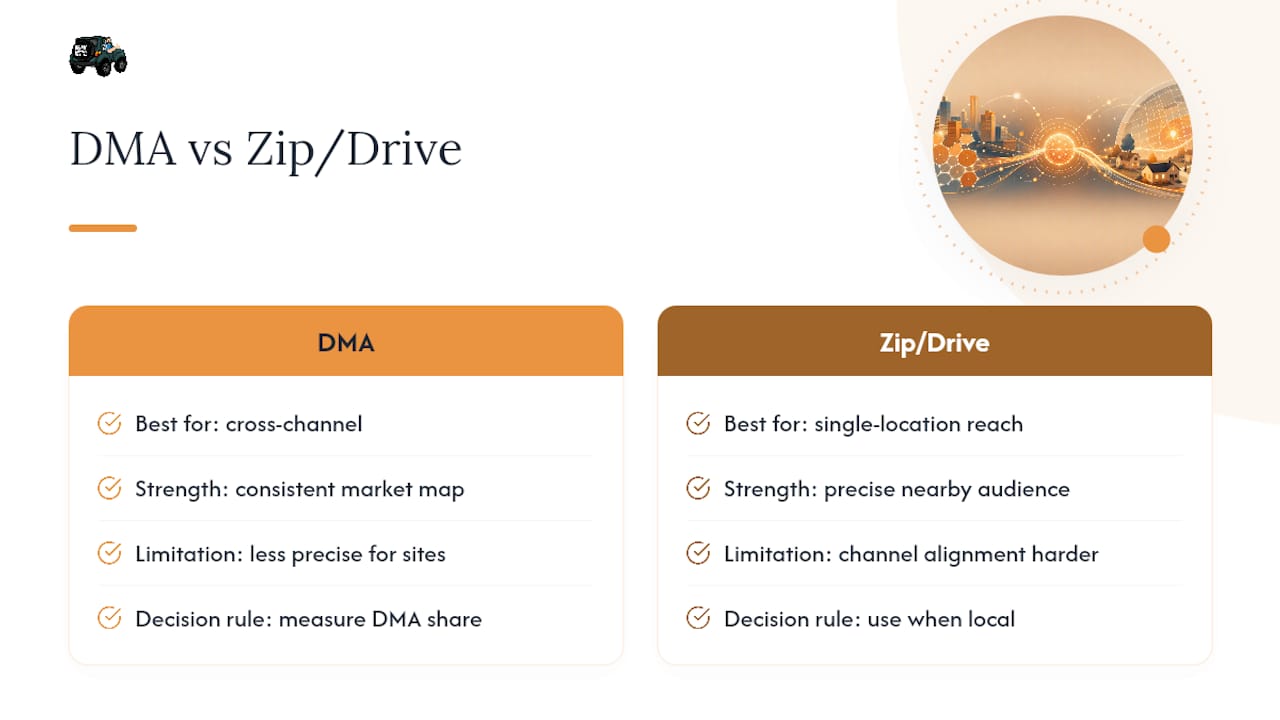
DMA targeting means aiming your ad campaign at one of the many Nielsen-defined media markets that carve up the United States, instead of a city, state, or radius. Nielsen sets these boundaries based on television viewing patterns, and they remain the backbone of regional media buying. Use DMA targeting when you need cross-channel consistency, TV/radio alignment, or budget comparisons across regions. Skip it when your customers live within a tight drive-time radius that cuts across DMA lines.
- Best for: regional promotions, multi-market testing, TV/digital alignment
- Skip it when: your service area is a neighborhood, not a media market
- Remember: DMAs are Nielsen’s territory, not the Census Bureau’s or Google’s
Key Takeaways
DMA targeting aligns cross-channel campaigns to Nielsen’s 210 U.S. media markets, but zip or radius targeting often serves single-location businesses better.
| Point | Details |
|---|---|
| Know your alignment | Check what percentage of your customers fall inside your target DMA before committing budget. |
| Use DMA for cross-channel sync | DMA targeting shines when coordinating TV, radio, print, and digital under one market boundary. |
| Watch boundary counties | IP-based mapping causes overshoot and undershoot near DMA edges and behind VPNs. |
| Layer signals, don’t rely on geography alone | Combine DMA targeting with first-party data and lookalike audiences for stronger results. |
| Get help operationalizing it | 16wmediagroup coordinates print, radio, podcast, and digital buys around DMA logic for local brands. |
Table of Contents
- What A DMA Is And How It’s Defined In The U.S.
- Why DMA Targeting Matters For Advertisers And Media Planning
- How DMA Targeting Works In Digital Platforms And Its Technical Limits
- Platform Availability And How To Select DMA Targets Across Channels
- Best Practices: When To Use DMA Targeting And How To Layer Signals
- 16W Media Group’s Take On Coordinating DMA-Aware Campaigns
- Why The DMA Vs. Zip Code Debate Misses The Real Question
- Let 16W Media Group Build Your DMA-Aware Media Plan
- Sources
What A DMA Is And How It’s Defined In The U.S.
A Designated Market Area groups counties and zip clusters around a shared television viewing habit, not a city limit or a state line. Nielsen built the system decades ago for the broadcast industry and still owns the boundaries today. There are 210 DMAs covering the continental U.S., Hawaii, and parts of Alaska, each one exclusive. No county belongs to two markets.
Here’s what makes DMAs different from the borders you’d draw yourself:
- They follow TV signal reach, not geography. A county might sit two states away from its DMA’s anchor city if that’s where residents historically point their antennas.
- They’re reviewed periodically. Nielsen occasionally adjusts boundaries as viewing habits shift, so a campaign planned around last year’s map might need a refresh.
- They ignore municipal and state lines entirely. The Philadelphia DMA reaches into New Jersey, Delaware, and Maryland.
If you’re mapping a campaign to “the Tampa market,” you’re really mapping to a Nielsen construct, not a city boundary. That distinction changes how you buy and measure.
Why DMA Targeting Matters For Advertisers And Media Planning
DMA targeting exists because someone had to invent a common language for buying media across markets. Nielsen’s framework still functions as that standardized currency for TV and cross-channel planning, even as digital platforms have added their own targeting layers on top.
That standardization pays off in three practical ways:
- Comparability. You can compare cost-per-point or cost-per-impression across the Orlando and Tampa markets using the same yardstick.
- Cross-channel alignment. A TV buy in one DMA and a paid social campaign in the same DMA reference identical geography.
- Budget allocation. Regional brands can rank markets by performance and shift dollars without reworking their targeting logic each time.
DMA-based planning works best for regional promotions, franchise rollouts testing message variations across markets, and any campaign where a media buyer needs to defend spend decisions with apples-to-apples data, as seen with various local businesses in southern California. It works less well for a single storefront trying to reach the three zip codes within a 15-minute drive.
How DMA Targeting Works In Digital Platforms And Its Technical Limits
Digital platforms don’t know your TV habits, so they approximate DMA assignment three ways: IP address mapping, mobile GPS or profile-declared location, and behavioral signals tied to your device or account. Most ad servers cross-reference your IP against a geolocation database, match it to a county, then map that county to its DMA.

That chain introduces real accuracy risk. Google Ad Manager’s own documentation acknowledges that IP-based geolocation can misassign users, particularly near DMA boundary counties, behind corporate VPNs, or on mobile networks that route traffic through a distant server.
Two failure patterns matter most for budget planning:
- Overshoot: your ad reaches people outside your intended DMA because their traffic routed through it.
- Undershoot: your ad fails to reach people genuinely inside your DMA because their IP mapped elsewhere.
Boundary counties suffer the worst of both. A household in a county split between two DMAs might get counted in either one depending on which internet service provider routes their connection.
Pro Tip: *Pull a sample of your actual customer zip codes and check what percentage fall inside your target DMA before you commit real budget.
Platform Availability And How To Select DMA Targets Across Channels
Most major ad platforms now expose DMA as a targeting dimension, though the depth of support varies. TikTok rolled out DMA geo-targeting for U.S. advertisers, letting brands align social spend with the same market boundaries their TV buys use. Google Ad Manager lists Nielsen DMAs as a standard geographic targeting value, and programmatic DSPs generally support DMA-level bidding through the same location taxonomies. Meta’s Ads Manager handles location targeting differently, relying more on radius and location categories than a native DMA picker, so you’ll often need to approximate DMA boundaries with zip clusters there.
Setting this up typically follows the same sequence across platforms:
- Open the geographic or location targeting module in your campaign settings.
- Search for the DMA by its anchor market name (Nielsen labels them by their largest city, like “Tampa/St. Petersburg (Sarasota)”).
- Confirm the platform’s DMA list matches Nielsen’s current 210 markets, since sync timing between Nielsen updates and platform databases can lag.
- Layer in supplemental exclusions (zip codes, radius) if the platform allows stacking targeting types.
Analytics platforms track this too. Adobe Analytics reports a “US DMA” dimension for visitor-level reporting, which is worth checking if you need to reconcile ad platform delivery data against your own site analytics.
Best Practices: When To Use DMA Targeting And How To Layer Signals
Choosing the right targeting unit comes down to how your customers actually move through geography, not how clean the boundary looks on a map.
| Targeting type | Best fit | Watch out for |
|---|---|---|
| DMA | Regional brands, multi-market TV/digital alignment, franchise testing | Boundary counties, IP misassignment |
| State | Compliance-driven campaigns, broad regional awareness | Too coarse for local intent |
| Zip/radius | Single-location retailers, service businesses with drive-time limits | Ignores media market culture and inventory |
Layer DMA targeting with first-party customer data and lookalike audiences rather than relying on geography alone. A DMA tells you where someone lives; your CRM tells you what they actually buy. Combining both usually beats either signal running solo.
For measurement, run geographic A/B tests: pick two comparable DMAs, hold one as a control, and vary spend or creative in the other. Track cost-per-acquisition and conversion rate by market, then reallocate budget toward the DMA with the stronger return after a full purchase cycle, not after three days of data.
Pro Tip: Set a 30-day minimum before judging a DMA-level test. Media markets behave differently on weekly cycles, and a market that looks weak in week one often catches up once local awareness builds.
16W Media Group’s Take On Coordinating DMA-Aware Campaigns
We plan regional campaigns around Nielsen’s market logic every week, and the pattern that works best is coordinating creative timing across every channel inside one DMA at once.
- Sync your print insert drop date with your radio flight and your paid social launch.
- Use the same core message across all three so the market hears one voice, not three disconnected pitches.
- Confirm your digital vendor’s DMA list matches Nielsen’s current boundaries before launch.
When a magazine insert, a radio spot, and a social ad all land in the same week inside the same Nielsen market, brand recall compounds instead of resetting with each channel switch.
Our local advertising playbook walks through this synchronization approach in more depth.
Why The DMA Vs. Zip Code Debate Misses The Real Question
Most advertising guidance treats DMA versus zip/radius targeting as a binary choice, and that framing wastes a marketer’s time. The real question is what percentage of your actual customers live inside the DMA you’re buying. Skip that math and you’re guessing.
Conventional wisdom oversells DMA targeting as the default for any regional brand. It’s not. A single-location HVAC company in suburban Tampa doesn’t need Nielsen’s market boundaries. It needs the 20 zip codes within a 25-minute drive, and a drive-time approach will outperform DMA targeting for that business every time.
Where DMA targeting earns its place is cross-channel coordination, not audience precision. If you’re running TV, radio, print, and digital together, DMA gives every channel the same map. That’s the actual value proposition, and most articles bury it under generic “targeting options” listicles instead of leading with it.
Start by measuring your own DMA alignment before you argue about which targeting method sounds more sophisticated.
Let 16W Media Group Build Your DMA-Aware Media Plan
Figuring out whether your next campaign needs Nielsen’s market boundaries, a zip cluster, or both takes real analysis of your customer data, and that’s exactly where a media plan built by people who do this daily beats a self-serve ad dashboard.
16W Media Group plans and executes campaigns that sync magazine inserts, radio spots, business podcast placements, and digital buys around the same market logic so your message lands consistently across every channel a local audience actually sees. We handle the coordination work: checking DMA alignment against your real customer footprint, timing creative drops across print and broadcast, and managing the digital layer so nothing launches out of sync. A consult starts with a look at where your current customers actually come from, then maps that against the right targeting mix for your budget. Get your local advertising strategy session started and see what a synchronized, DMA-aware campaign looks like for your market.