

Neighborhood marketing is targeted outreach inside a tight geographic boundary, usually a few blocks to a few miles, built to drive nearby discovery, foot traffic, and repeat visits. It’s different from broad “local marketing,” which might mean anything from a citywide radio spot to a statewide ad buy. Neighborhood marketing zooms in tighter than that, often down to a specific zip code or a cluster of streets around your storefront.
This approach works best for brick-and-mortar shops, service-area businesses like plumbers or landscapers, and any retailer whose customers live or work within a short drive. If that describes your business, here’s the payoff: combine consistent community presence with sharp digital targeting, and you should see more repeat customers and a measurable bump in foot traffic within a few months.
- Best suited for: storefronts, restaurants, service-area contractors, and neighborhood retailers
- Core promise: more foot traffic and stronger customer retention when digital ads meet real community presence
- Timeframe to expect results: typically 6 to 8 weeks for early signals, longer for compounding loyalty effects
Key Takeaways
Neighborhood marketing succeeds when tight geographic targeting, offline community presence, and simple attribution tracking all run together instead of in isolation.
| Point | Details |
|---|---|
| Define a tight radius first | Start at 0.5 to 1 mile around a high-traffic anchor before expanding. |
| Pair digital ads with offline presence | Sponsorships and events make geofenced ads more effective, not less necessary. |
| Track every channel separately | Use UTMs, promo codes, and QR codes so you know which tactic drove results. |
| Set realistic targets | Expect 10 to 15 percent early foot traffic lift, scaling toward higher gains over time. |
| Run a 6 to 8 week test | Use that window to launch, measure, and decide whether to scale or adjust. |
Table of Contents
- Explaining Neighborhood Marketing and Where It Fits
- Tactics That Actually Move the Needle at the Block Level
- Which Channels and Tools Should You Start With?
- How Do You Measure a Neighborhood Marketing Campaign?
- Your 6 to 8 Week Starter Playbook
- Common Mistakes and a Pre-Launch Checklist
- How 16wmediagroup Applies Neighborhood Marketing for Local Brands
- Ready to Build Your Neighborhood Presence?
- Why Digital-Only Neighborhood Campaigns Underdeliver
- Frequently Asked Questions
- Sources
Explaining Neighborhood Marketing and Where It Fits
Explaining neighborhood marketing well starts with scale. You’re usually working within a radius of a few blocks up to five miles, sometimes drawn around a specific zip code or a cluster of streets you can name by memory. Hyperlocal marketing operates at this same tight scale, and the two terms overlap heavily. The distinction that matters for your planning is this: “local marketing” often means anything within city or county limits, while neighborhood marketing narrows the lens to the streets your actual walk-in customers live on.
Community marketing is a related but separate idea. It focuses on relationship building, sponsorships, and civic involvement without necessarily tying activity to a defined geographic radius. Neighborhood marketing borrows from that playbook but adds a hard boundary and a commercial goal: get people within that boundary to notice you, visit you, and come back.
Three goals typically anchor a neighborhood campaign:
- Discovery. Get your name in front of people who live or work nearby but have never walked through your door.
- Foot traffic. Convert that awareness into visits, whether that’s a coffee shop stop or a service call.
- Retention and reputation. Turn first-time visitors into regulars who also talk about you at the block party.
The upside is real but variable. Practitioner data compiled by Luminwise shows neighborhood campaigns can lift foot traffic by 20 to 35 percent and local sales by 15 to 40 percent when digital and offline tactics run together and get tracked properly. Those ranges swing widely by industry and execution quality, so treat them as a directional target, not a guarantee. A single geofenced ad campaign rarely produces those numbers alone. It’s the combination of channels, sustained over weeks, that moves the needle.
Tactics That Actually Move the Needle at the Block Level
Once you know your boundary, the next question is which tactics deserve your time and budget. Not every channel that works citywide works at the neighborhood level, and some tactics that seem old-fashioned still outperform digital-only plays when paired correctly.
- Geofencing and radius-targeted social ads. Set your radius around a physical anchor, your storefront, a competitor, or a high-traffic intersection, and layer in dayparting so ads run when nearby residents are most likely to see them (lunch hours for restaurants, evening commute for service businesses). Offer something specific to the zip code, not a generic percentage off.
- Local SEO and Google Business Profile. Fill out every field: service areas, business hours, photos, and Q&A. Respond to reviews within a day or two. This is the single highest-leverage free tactic available, and Search Engine Land’s local marketing guide notes that Google Business Profile signals remain central to how both traditional search and AI-driven discovery surface nearby businesses.
- Direct mail and EDDM (Every Door Direct Mail). Print pieces that reference a specific street or landmark perform better than generic city-wide copy. Add a tracking code or unique coupon so you know exactly which mailer drove a visit.
- Events, sponsorships, and pop-ups. Sponsoring a Little League team or hosting a sidewalk sale builds the kind of recognition that digital ads alone can’t buy, making partnerships with local businesses in southern california especially effective. The SBA’s local marketing strategies list community sponsorships and local partnerships among the most reliable tactics small businesses have.
- Cross-promotions with nearby businesses. Partner with a shop two doors down for a joint discount or referral card. It costs almost nothing and doubles your reach among people who already shop nearby.
- Nextdoor and community platforms. Use these for genuine engagement, answering questions, sharing real updates, rather than posting ads that feel like a Nextdoor version of a billboard. Residents notice the difference fast.
- SMS and email segmentation with BOPIS or curbside offers. Segment your list by zip code and send targeted promotions for buy-online-pickup-in-store deals timed to local events or weather.
Geofencing works best when it’s not carrying the whole campaign by itself. Shopify’s research on hyperlocal marketing points out that pairing geofenced ads with visible offline presence, like sponsoring the same neighborhood’s youth soccer league, increases how effective the digital ads become, because residents already recognize your name when the ad appears.
Pro Tip: Name an actual landmark, park, or intersection in your ad copy or mailer headline. “Two blocks from Riverside Park” outperforms “Serving your area” almost every time, because it signals you actually know the neighborhood instead of running a templated campaign.
For more ideas on activation formats, our roundup of neighborhood marketing ideas that get seen breaks down specific creative formats you can adapt this month.
Which Channels and Tools Should You Start With?
You don’t need an enterprise martech stack to run a neighborhood campaign. You need a handful of tools that support radius targeting, basic tracking, and simple customer segmentation.
- Ad platforms with radius targeting. Google Ads location targeting, Meta’s radius targeting for Facebook and Instagram, and Nextdoor’s local business ads all let you draw a boundary directly on a map and set your budget accordingly.
- Geofencing and location-analytics providers. These add value once you’re running multiple campaigns simultaneously and want to compare foot traffic lift across different radii. For a first campaign, built-in ad platform targeting is usually enough.
- Direct mail vendors. National EDDM automation services handle printing and postal logistics at scale, while a local print shop can turn around smaller runs faster and often at a comparable per-piece cost for neighborhood volumes.
- CRM segmentation and POS integration. Most point-of-sale systems can tag customers by zip code or export purchase data you can cross-reference against a mailing list. This is how you eventually know whether your Elm Street mailer actually sold espresso machines.
- Quick measurement tools. UTM parameters on every digital link, unique promo codes per channel, and QR codes on print pieces linking to a dedicated landing page. These three tools alone cover 90 percent of what a small business needs for attribution.
Start with one ad platform, your Google Business Profile, and a promo code system. Add geofencing analytics and CRM segmentation once you have a baseline campaign running and know what questions you’re actually trying to answer.
How Do You Measure a Neighborhood Marketing Campaign?
Foot traffic, local sales uplift, coupon redemptions, Google Business Profile views and calls, and local web sessions form the core KPI set for any neighborhood campaign. You don’t need enterprise analytics to track any of these.
The most reliable low-cost method: issue a unique promo code or UTM per channel (one for direct mail, one for Nextdoor, one for radius-targeted social), then compare redemptions and web sessions from your target zip codes against a control zip code where you’re not advertising. Luminwise’s measurement approach recommends exactly this kind of comparison to isolate what your campaign actually caused versus normal seasonal traffic.
| Metric | What to Track | Review Cadence |
|---|---|---|
| Foot traffic | Daily visit counts vs. pre-campaign baseline | Weekly |
| Coupon/promo redemptions | Redemption count by channel and zip code | Weekly |
| Google Business Profile activity | Views, direction requests, and calls | Weekly |
| Local web traffic | Sessions from target zip codes vs. control zips | Bi-weekly |
| Sales uplift | Revenue in target zips vs. control zips | Monthly |
Set targets before you launch, not after. A reasonable early goal is a 10 to 15 percent lift in foot traffic within the first month, scaling toward the 20 to 35 percent range Luminwise’s practitioner data cites once channels are running together for a full quarter. If you’re not seeing movement by week four, that’s your signal to adjust creative or targeting before spending more. If redemption-per-impression is climbing and cost-per-visit is dropping, that’s your signal to scale the radius or budget.
Your 6 to 8 Week Starter Playbook
You don’t need a massive budget to test whether neighborhood marketing works for your business. You need a tight plan and the discipline to measure it.
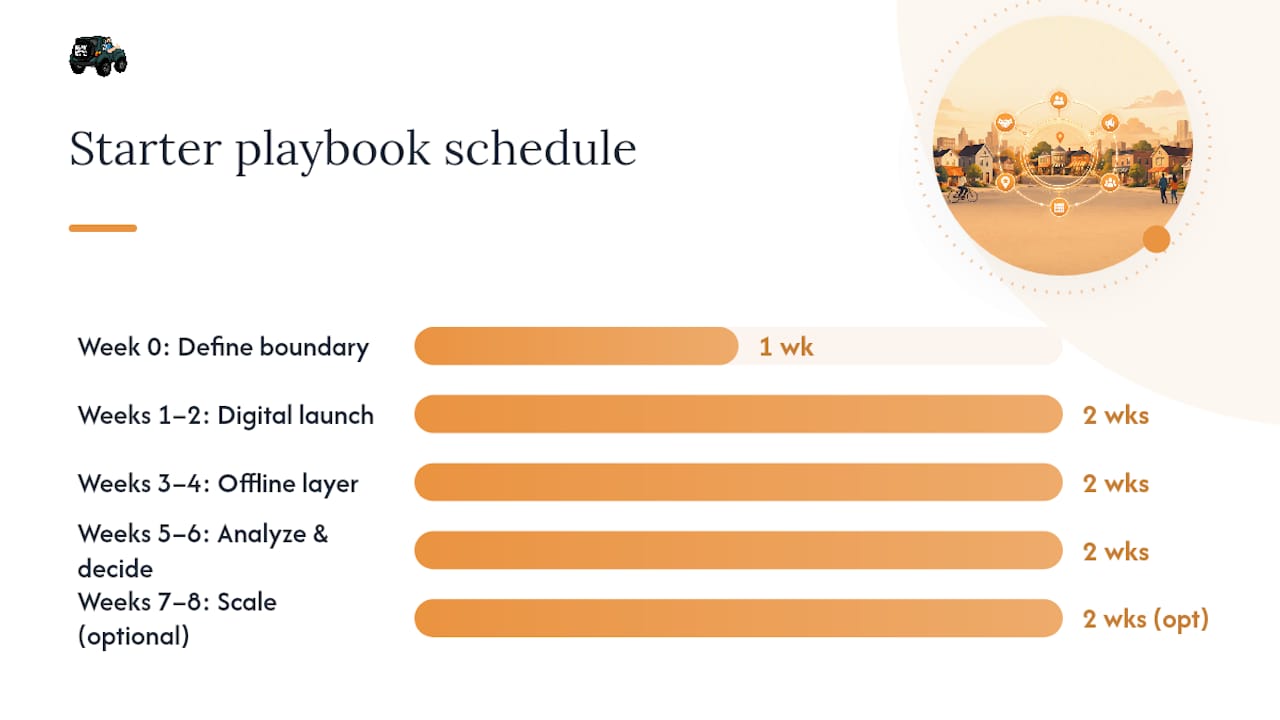
- Week 0: Define your boundary. Pull the zip codes and streets within your target radius. Build two or three quick customer personas based on who actually walks in today.
- Weeks 1 to 2: Launch digital and fix your profile. Start a radius-targeted social campaign at a 0.5 to 1 mile radius around your location, and fully optimize your Google Business Profile, hours, photos, service categories, and posts.
- Weeks 3 to 4: Add an offline layer. Run an EDDM mailer to your target streets or host a small in-store event. Attach a unique promo code to each channel so you can separate results later.
- Weeks 5 to 6: Analyze and decide. Pull your redemption and foot traffic numbers. Compare target zips against a control zip. Decide whether to widen the radius, tighten the creative, or kill the underperforming channel.
- Weeks 7 to 8 (optional): Scale what worked. Increase budget on the highest redemption-per-impression channel and cut the rest.
A reasonable minimum test budget runs $500 to $1,500 across digital ads and a small print run, enough to generate real data without betting the quarter on an unproven channel. Run a simple A/B test in weeks 1 and 2: same offer, two different creative angles (one generic, one landmark-specific), and let the redemption data tell you which wording actually works in your neighborhood.
Pro Tip: Keep your first test radius small, half a mile to one mile around a high-traffic anchor like a school or transit stop. It’s easier to expand a winning radius than to unwind a campaign that spread your budget too thin from day one.
Common Mistakes and a Pre-Launch Checklist
Most neighborhood campaigns that underperform share the same three or four problems, and they’re avoidable once you know to look for them.
- Targeting too broad a radius. A five-mile radius around a coffee shop dilutes your budget across people who will never realistically walk in.
- Running generic creative. Ads and mailers that could apply to any city read as corporate, not neighborly, and get ignored.
- Ignoring offline presence entirely. Digital-only campaigns miss the recognition boost that comes from sponsorships, events, and visible community involvement.
- Weak or missing tracking. Without UTMs, promo codes, or POS-level zip data, you’ll never know which dollar actually worked.
Before you launch, run through a short checklist: boundary defined, promo codes assigned per channel, Google Business Profile fully updated, at least one offline tactic scheduled, and a control zip code identified for comparison.
| Checklist Item | Why It Matters |
|---|---|
| Radius defined and documented | Prevents budget dilution across too wide an area |
| Landmark-specific creative drafted | Signals real local knowledge, per Realty Executives |
| Tracking codes assigned per channel | Enables clean attribution before launch |
| Offline tactic scheduled | Builds recognition digital ads alone can’t create |
How 16wmediagroup Applies Neighborhood Marketing for Local Brands
16wmediagroup builds neighborhood marketing campaigns around the same principle: digital targeting works better when it’s backed by visible community presence. Our services include community magazines, sponsored podcasts, and regional advertising packages built specifically for businesses trying to stand out in competitive local markets.
- Personalized media plans that mix traditional placements with digital radius targeting
- Community-focused publishing that gives your brand a real presence beyond ads
- Co-op advertising management for regional brands entering new neighborhood markets
Businesses that pair a real community footprint, sponsorships, local publishing, event presence, with targeted digital campaigns consistently see stronger recognition than those running geofenced ads in isolation.
When evaluating any media partner, ask what deliverables you’ll actually receive: media placements, content calendars, and measurement check-ins. You can review our full service offerings to see what a complete neighborhood campaign package looks like in practice.
Ready to Build Your Neighborhood Presence?
Explaining neighborhood marketing on paper only gets you so far. Executing it, coordinating digital radius ads, print placements, event sponsorships, and tracking, takes a partner who already has the local media relationships and creative production in place. That’s the gap 16wmediagroup fills for small and medium businesses that don’t have an in-house marketing team but need results fast.
Whether you’re launching your first geofenced campaign or trying to figure out how a community magazine feature fits into your budget, our team can build a plan around your specific neighborhood boundary and your specific goals. Start by exploring how to create a localized marketing plan that works to see the framework we use with local business clients before the first ad ever goes live.
Why Digital-Only Neighborhood Campaigns Underdeliver
Most advice on neighborhood marketing treats it as a targeting problem: narrow your radius, write better ad copy, done. That misses the actual mechanism at work. Residents respond to neighborhood ads because they already half-recognize the brand from somewhere else, a sponsored Little League jersey, a mailer with their street name on it, a booth at the farmers market. Strip that context out and a geofenced ad is just a smaller, more expensive version of a generic ad.
The conventional advice also underrates measurement discipline. Small businesses skip control-zip comparisons because they feel like overkill for a $1,000 test budget. That’s backward. The smaller your budget, the more you need to know which dollar worked, because you won’t get a second shot at that quarter’s spend.
If you take one thing from this: prioritize the offline layer before you scale digital spend. Digital targeting is the easy part. Building genuine neighborhood recognition through sponsorships, events, and local publishing is what makes that targeting convert.
Frequently Asked Questions
What is the main difference between neighborhood marketing and local marketing?
Local marketing can cover an entire city or metro area, while neighborhood marketing narrows the target to a few blocks or a specific zip code, often small enough to reference real streets and landmarks in your creative.
How much should a small business budget for a first neighborhood campaign?
A workable starting test runs $500 to $1,500 across digital ads and a small print run, enough to generate real redemption and foot traffic data without overcommitting before you know what works.
Which businesses benefit most from neighborhood marketing?
Brick-and-mortar retailers, restaurants, and service-area businesses like contractors or salons see the strongest returns, since their customer base is naturally concentrated within a short drive or walk.
How long does it take to see results from neighborhood marketing?
Early signals, redemptions and foot traffic upticks, typically show within 4 weeks. Stronger, compounding gains from combined digital and offline tactics usually appear over a full quarter.
Sources
- Hyperlocal Marketing: How it Works, Strategies & Examples (2026) – Shopify
- Local Marketing Guide: Win More Customers Nearby – Search Engine Land
- 10 local marketing strategies that work – SBA
- Neighborhood Marketing in 2026: Strategies to Boost Local Business Growth – Luminwise