

Geofencing advertising delivers a mobile ad, push notification, or social promotion the moment a device crosses a virtual boundary drawn around a location. It turns physical proximity into a marketing trigger, letting retail, restaurants, event organizers, and service businesses reach people while they’re close enough to walk in. Done well, it drives measurable store visits and same-day conversions, not just impressions.
TL;DR:
- Radius fences are quick and easy to set up but often capture unrelated locations, reducing targeting precision in dense retail areas.
- The success of a geofencing campaign heavily depends on proper geometry choice, measurement, and pilot testing before scaling.
- Credible attribution relies on using control groups and unique promo codes to accurately measure visit lift and campaign effectiveness.
- Geofencing ads perform best when combined with other local channels like search, social, and offline media for broader brand reinforcement.
- Costs vary based on fence size, data layering, and ad format, with managed campaigns generally starting around $850 per month for small to mid-size businesses.
Table of Contents
- How Does Geofencing Advertising Work?
- Which Geofence Shape Should You Use: Radius, Polygon, or Isochrone?
- How Do You Set Up a Geofencing Advertising Campaign?
- What Creative Actually Converts in a Geofence Moment?
- How Do You Measure Geofencing Campaign Performance?
- What Does Geofencing Advertising Cost?
- Is Geofencing Advertising Legal, and What About Privacy Rules?
- When Should You Bring in an Agency for Geofencing?
- What Goes Wrong Most Often in Geofencing Campaigns?
- How Does Geofencing Fit With Other Marketing Channels?
- What Advanced Targeting Techniques Improve Geofencing Results?
- Editorial Take: What the Geofencing Hype Gets Wrong
- Get a Geofencing Plan Built Around Your Local Market
- Sources
How Does Geofencing Advertising Work?
Every geofencing campaign runs on a trigger, a signal, and a delivery channel. Get any one of the three wrong and the campaign either misses the audience entirely or burns budget on people who were never close enough to act.
The trigger is the event that fires the ad. Entry triggers fire when a device enters the fence, useful for “welcome” offers near a storefront. Exit triggers fire on the way out, which works well for post-visit surveys or loyalty sign-up prompts. Dwell triggers require a device to stay inside the fence for a set period, a strong signal of genuine intent (someone browsing a mall for 20 minutes reads differently than someone stuck at a red light outside it).
Underneath the trigger sits the location signal itself. Geofencing marketing typically relies on one of these:
- GPS, the most precise but battery-intensive option, common in-app.
- Wi-Fi positioning, useful indoors where GPS signal degrades.
- Cell tower triangulation, broader but far less exact.
- In-app SDK capture versus ad-network location bidding, which differ in accuracy and consent chain.
Delivery then happens through mobile display ads, in-app push notifications, social platform ads (Meta and others support radius and custom-location audiences), and SMS where the recipient has opted in. On the back end, device IDs get pooled into anonymized audience segments before any ad serves, which is what keeps this practice compliant rather than invasive.
Which Geofence Shape Should You Use: Radius, Polygon, or Isochrone?
Fence geometry is where campaigns quietly succeed or fail, and most marketers default to the simplest option without asking whether it fits the location.
A radius fence draws a simple circle around a point, the fastest to set up and the easiest to scale across dozens of locations. A polygon or building-footprint fence traces the actual shape of a property, which matters enormously in dense retail corridors where a circle would also capture the coffee shop next door and the parking garage across the street. An isochrone fence maps drive-time or walk-time boundaries instead of straight-line distance, accounting for highways, rivers, and one-way streets that a radius ignores entirely.
The tradeoff is overreach versus undercount. A radius around a strip-mall location often bleeds into three or four unrelated businesses, diluting intent and inflating impressions that never convert. A too-tight polygon, on the other hand, can miss shoppers parked in a shared lot 200 feet away. Building-footprint geofences generally outperform simple radius fences for visit attribution in dense retail environments, while isochrones tend to matter most for destinations people drive to deliberately, like furniture stores or auto dealerships.
- Urban core, tight retail rows: polygon or building footprint.
- Suburban strip malls and standalone stores: radius, sized conservatively.
- Regional draws (car dealers, large venues): isochrone based on drive time.
Pro Tip: Run the same location as a radius fence and a building-footprint fence simultaneously for two weeks. Compare visit rates, not just impressions. The gap will tell you which geometry to standardize on for your other locations.
How Do You Set Up a Geofencing Advertising Campaign?
A geofencing launch works best as a sequence, not a single setup screen. Skipping the pilot step is the single most common reason campaigns get judged unfairly before they’ve had a chance to prove themselves.
- Define the objective and KPI. Store visits, app installs, and return on ad spend (ROAS) each demand different creative and different fence sizing. Pick one primary KPI before drawing a single fence.
- Select your points of interest. This might mean your own storefronts, an upcoming event site, competitor locations for a comparative offer, or trade-area census block groups (CBGs) if you’re targeting a broader demographic rather than a specific address.
- Configure the fence, dayparts, and frequency caps. Restrict delivery to your actual hours of relevance (lunch rush for a QSR, evenings for a bar) and cap frequency so the same device doesn’t see the same ad eight times in an afternoon.
- Design a pilot with a control cohort. Hold out a comparable location or a matched audience segment that sees no ads, so you can isolate the lift the campaign actually produced rather than crediting it for visits that would have happened anyway. A short pilot with a defined control window, often two to four weeks depending on typical foot traffic, is usually enough to detect a meaningful signal.
- Launch, then run post-flight analysis. Compare exposed versus control visit rates, redemption counts, and cost per visit before deciding whether to scale.
Pro Tip: Set a minimum impression threshold before launch, not after. If your pilot fence generates fewer than a few thousand weekly impressions, you won’t have enough data to trust the visit-lift numbers no matter how good the creative is.
For businesses building out their first structured plan, a step-by-step local advertising framework can help sequence this alongside other local channels.
What Creative Actually Converts in a Geofence Moment?
Geofenced ads live or die on three qualities: timely, personalized, and actionable. A generic banner ad that could run anywhere wastes the one advantage geofencing gives you, which is knowing exactly where someone is standing right now.
- Retail: “You’re near [Store] — 15% off in-store today only, show this ad at checkout.”
- QSR: “Lunch rush starts now. Skip the line, order ahead.”
- Events: “Doors open in 30 minutes. Tap for parking directions.”
- Services: “Need a quote? Call now, we’re two minutes away.”
The landing experience matters just as much as the message. Directions, click-to-call buttons, and reservation flows convert far better than a generic homepage, because the person seeing the ad is already close enough to act within minutes. Frequency matters too: cap exposure at two or three impressions per device per day inside a single fence, since repetition past that point reads as noise rather than relevance. For more message templates by category, see tactical messaging guidance for local businesses.
How Do You Measure Geofencing Campaign Performance?
Attribution is where most geofencing programs either earn their budget or quietly waste it. The core metrics to track are store visits, offer redemption, click-through rate (CTR), conversions, and ROAS, in roughly that order of importance for a foot-traffic goal.
Three attribution tactics separate credible results from wishful thinking:
- Unique promo codes tied only to the geofenced campaign, so redemption can’t be confused with organic traffic.
- Exposed versus control cohort comparison, the same pilot structure used at launch, now applied to the full campaign window.
- Lift testing, which measures incremental visits against a matched baseline rather than crediting every visit inside the fence to the ad.
Managed geofencing programs commonly report display CPMs in the single-digit to low-double-digit dollar range, with cost climbing for video and connected TV formats where reach is broader and creative production is heavier.
Data quality issues deserve real attention before you trust any dashboard. Point-of-interest (POI) boundary accuracy and panel representativeness (whether the device sample actually reflects your local population) both introduce error. Cross-checking fence performance against foot-traffic analytics platforms helps validate whether a reported visit spike is real or an artifact of a mislabeled polygon. When you do see a lift, size your confidence to your sample: a 40% jump on 200 exposed devices deserves more skepticism than the same jump on 20,000. Scale budget only after the pilot clears both a volume and a significance bar, not just a promising percentage.
What Does Geofencing Advertising Cost?
Geofencing pricing generally runs on a CPM (cost per thousand impressions) or, less often, CPC (cost per click) model, and the geofencing ads cost typically sits above broad programmatic display because you’re paying for precision, not just reach.
- Display CPMs commonly run single-digit to low-double-digit dollars; video and connected TV cost meaningfully more.
- Fence size and audience density drive cost directly: a tight urban polygon with high foot traffic costs more per impression than a sprawling suburban radius with fewer devices passing through.
- Data layering (adding verified audience attributes like loyalty membership) raises CPMs but often improves conversion enough to justify it.
For geofencing marketing pricing on a first pilot, a single-store test is workable on a modest starter budget, while managed programs for small to mid-size advertisers often begin around $850 per month. Multi-location rollouts scale from there, usually priced per active location. Keep costs in check by day-parting aggressively, pruning underperforming fences after the first reporting cycle, and layering in retargeting to recapture exposed devices that didn’t convert on the first pass.
Is Geofencing Advertising Legal, and What About Privacy Rules?
Geofencing is legal and widely used in the United States when it runs on consented location data and follows platform and privacy rules, not on quietly harvested location history.
- Use only location data from users who granted explicit permission, whether through app permissions or an ad network’s own consent chain.
- iOS and Android both restrict background location access and require clear disclosure; work with vendors who can document their consent flow, not just claim compliance.
- California’s CCPA and similar state privacy laws require disclosure of location data collection and give consumers rights to opt out, so your privacy policy needs to name geofencing specifically if you’re running it.
- Before launch, run one checklist item: confirm your ad vendor’s consent documentation and update your public privacy policy to disclose location-based advertising in plain language.
When Should You Bring in an Agency for Geofencing?
Running geofencing well takes more than drawing a circle on a map. It takes fence-geometry judgment, pilot design, and honest measurement, and most in-house marketing teams juggling five channels don’t have the bandwidth to build that discipline from scratch.
A quick gut check: if you have nobody dedicated to reading a lift report, no time to test multiple fence geometries, and no existing plan for cross-channel integration, that’s usually the signal to bring in outside help rather than force it in-house.
16wmediagroup builds geofencing into a broader local media plan rather than running it as an isolated tactic. Pairing a geofenced retail promotion with a mention on a local podcast, a regional print placement, or a co-op ad package tends to reinforce the message across the paths a customer actually takes before walking in. If you’re weighing whether that integration makes sense for your business, our local advertising best practices guide walks through how the pieces fit together.
What Goes Wrong Most Often in Geofencing Campaigns?
Most geofencing failures trace back to one of a handful of predictable mistakes, and nearly all of them show up before the campaign even launches.
Oversized fences top the list. A marketer draws a generous three-mile radius “to be safe,” then wonders why conversion rates look weak. The fence captured people who were never realistically going to visit, diluting every performance number that follows. The opposite problem, fences drawn too tight, starves the campaign of enough impressions to learn anything at all.
Weak attribution is the second recurring issue. Crediting every visit inside a fence to the ad, without a control cohort, routinely overstates results and leads to budget decisions based on numbers that don’t hold up under scrutiny. Stale POI data causes a quieter version of the same problem: a fence built around a location that closed or moved six months ago wastes the entire budget on an empty building.
Creative fatigue sneaks up fast in geofencing specifically, because the audience pool inside a small fence is finite. Running the same ad for a month burns through that pool’s attention within days. And plenty of campaigns skip the pilot phase entirely, jumping straight to a multi-location rollout without ever validating fence geometry or measuring lift, which means scaling mistakes instead of catching them early.
How Does Geofencing Fit With Other Marketing Channels?
Geofencing performs best as one input into a broader plan, not as a standalone channel competing for the same budget line.
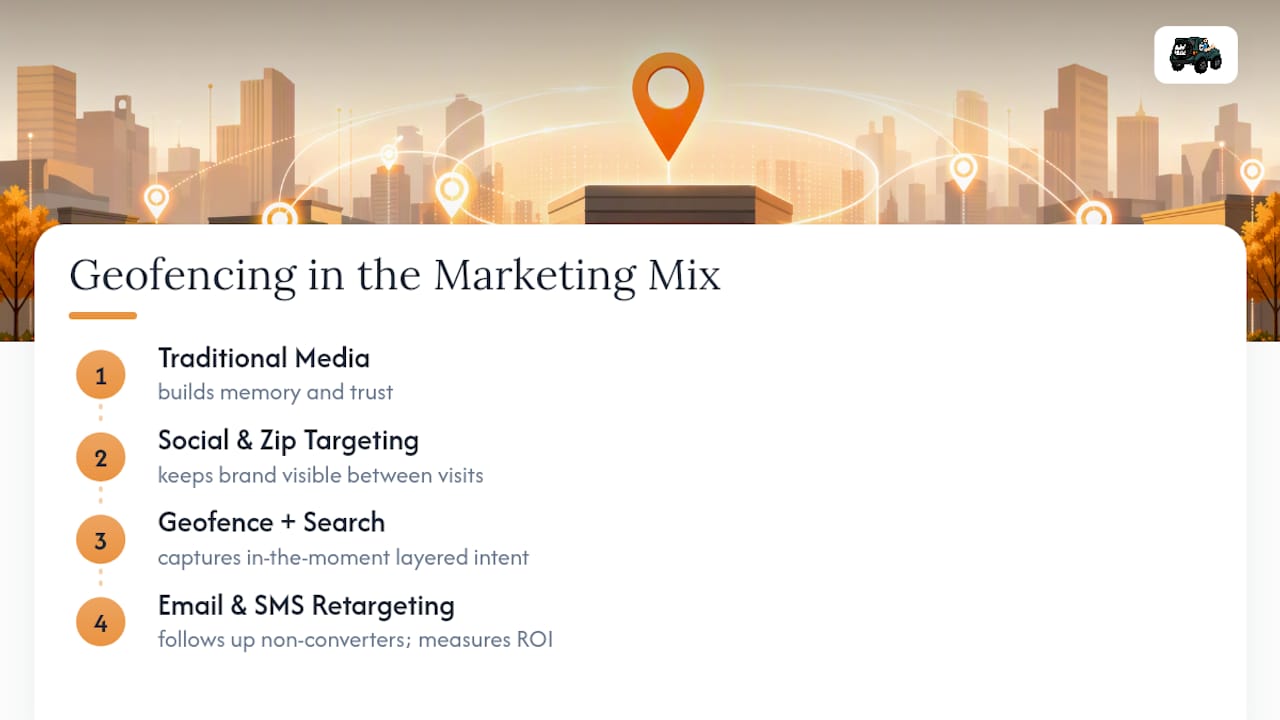
Pairing a geofence with search intent works particularly well: someone who searched “restaurants near me” and then physically enters your fence is showing layered intent that either signal alone wouldn’t capture. Social platforms extend the same logic. Zip code targeting Facebook campaigns can reinforce a geofenced radius by keeping your brand visible to the same households between visits, using a broader boundary than the tight in-the-moment fence.
Traditional local media adds a dimension geofencing can’t replicate on its own: memory and trust built before someone ever gets near your door. A listener who’s heard your name on a community podcast responds differently to a geofenced offer than a total stranger would. Direct mail and print work similarly, planting the brand recognition that makes an in-the-moment mobile ad feel familiar rather than intrusive. Email and SMS retargeting close the loop afterward, following up with people who were exposed to a geofence ad but didn’t convert immediately. Tracking that full path requires the same measurement discipline used for the geofence itself, and ROI tracking practices for offline outcomes apply just as well across these blended campaigns as they do to a single geofenced promotion. For a broader look at how these channels connect, the guide on geotargeted ads in local campaign success covers the mechanics in more depth.
What Advanced Targeting Techniques Improve Geofencing Results?
Once the basics are working, a handful of advanced techniques separate a mature geofencing program from a one-off test.

Layering first-party or verified audience data on top of a fence, such as loyalty membership, student status, or past purchase history, can meaningfully improve conversion rates and justify a higher CPM because you’re reaching people who are both nearby and already predisposed to buy. Exclusion zones work in the opposite direction: carving out areas you don’t want to serve ads in, whether that’s a competitor’s parking lot skewing your data or a residential zone with no realistic path to conversion.
Sequential fencing builds a narrative across multiple locations. A campaign might target a stadium fence during an event, then retarget the same devices with a different message once they enter a fence around nearby restaurants an hour later. Trade-area targeting using census block groups extends beyond a single point, useful for regional brands trying to understand where their actual customer base lives rather than guessing at a radius. Layering DMA (Designated Market Area) targeting on top of ZIP-level fences also lets larger advertisers run broadcast-style reach in a media market while still pinpointing specific ZIP codes for the geofenced layer, giving each budget tier the right level of precision.
Editorial Take: What the Geofencing Hype Gets Wrong
The most common failure in geofencing advertising isn’t a bad fence or weak creative. It’s skipping the pilot because the technology feels too intuitive to bother testing. Marketers see a map, draw a circle, and assume the mechanics are self-evident. They aren’t. Fence geometry has real tradeoffs, and the only honest way to know which shape works for a given location is to run two versions side by side and read the visit-lift numbers, not the impression counts.
Conventional advice oversells scale and undersells measurement discipline. Plenty of guides walk through radius versus polygon fences in detail, then treat attribution as an afterthought, a single paragraph about “tracking store visits.” That’s backwards. A campaign with an average fence and a rigorous control cohort will teach you more, and protect more budget, than a perfectly drawn polygon with no holdout group at all.
If you take one thing from this, prioritize the pilot structure before the geometry. Everything else is refinement.
— Mike
Get a Geofencing Plan Built Around Your Local Market
16wmediagroup runs geofencing as part of a full local media plan instead of an isolated ad buy, which means your radius or polygon fence works alongside podcast placements, print, and regional co-op packages that build the brand recognition making a geofenced ad convert in the first place.

That combination matters because a fence only captures people already close by. Pairing it with community storytelling and regional exposure builds the awareness that gets more people into that fence to begin with, rather than treating geofencing as a channel that has to do all the work alone. Whether you’re running a single-store pilot or planning a multi-location rollout, our team can map fence geometry, pilot structure, and measurement plans against your actual trade area instead of a generic template. Start by reviewing our local advertising best practices guide for a sense of how we structure a first campaign, then reach out through our contact page to talk through your specific locations and budget.
Sources
- What Is Geofencing Marketing? Guide To Getting Started
- Geofencing Marketing: Benefits, Costs & How to Set It Up
- Harnessing the Power of Geofencing Marketing: A Complete Guide