

Choose geofencing when you need immediate action near a physical location. Choose geotargeting when your goal is market-level awareness at scale. Geofencing works like a tripwire: cross a virtual perimeter and it triggers a push notification or ad in real time. Geotargeting works like a filter: it includes anyone inside a broader area, such as a ZIP code or DMA, regardless of what they’re doing at that moment.
- Pick geofencing for store visits, event activations, or geo-conquesting near competitors.
- Pick geotargeting for regional product launches, brand awareness, or top-of-funnel reach.
- Next step: run a small geofence pilot around one location, or set up a geo holdout test before scaling a regional buy.
Key Takeaways
Geofencing drives immediate, location-triggered action while geotargeting builds broad awareness across a defined market, and pairing both with a measurement plan is what separates results from guesswork.
| Point | Details |
|---|---|
| Match tactic to timing | Use geofencing for real-time, proximity-based action and geotargeting for sustained regional reach. |
| Signals determine precision | Geofencing needs GPS, Wi-Fi, or beacons and often app permissions; geotargeting relies on IP and platform geo settings. |
| Layer for full-funnel results | Combine geotargeting for awareness with geofencing for store-level conversion in the same campaign. |
| Measure with holdouts | Run geo-control or device-level tests to confirm incremental lift rather than trusting platform attribution alone. |
| Privacy shapes channel choice | Favor permission-based channels for geofencing and aggregated segments for programmatic geotargeting. |
Table of Contents
- What Is Geofencing and How Does It Work?
- What Is Geotargeting and How Is It Different?
- Geofencing vs Geotargeting: Key Differences That Matter
- Where Each Tactic Wins: Real Campaign Use Cases
- A Five-Step Framework for Choosing the Right Tactic
- How Do You Measure Results and Handle Privacy?
- What We’ve Learned Running Local Campaigns
- Why Most Marketers Overthink This Comparison
- Sources
What Is Geofencing and How Does It Work?
Geofencing draws a virtual perimeter around a physical space and triggers an action the moment a device enters or exits it. That perimeter can be around locations like storefronts, stadium parking lots, or competitor retail sites.
The mechanic depends on layered signals: GPS for outdoor accuracy, Wi-Fi and cell towers for denser environments, and Bluetooth beacons for indoor precision. Geofencing works best when app permissions exist, since the tightest targeting relies on a mobile app requesting location access rather than a browser cookie.
Because it’s event-driven, geofencing shows up in fast, permission-based channels:
- In-app push notifications
- SMS alerts (with opt-in)
- Programmatic mobile display ads
- Beacon-triggered indoor messages
A coffee shop fencing a three-block radius and pushing a “buy one, get one” offer during the 3 p.m. slump is classic geofencing. So is fencing a competitor’s parking lot to intercept shoppers before they walk in, a tactic known as geo-conquesting.
Pro Tip: Match your creative to the moment. A geofence trigger gives you a window measured in minutes, not days, so lead with the offer, not the brand story.
What Is Geotargeting and How Is It Different?
Geotargeting includes users based on a broader geographic boundary rather than a real-time trigger. Instead of watching for someone to cross a line, it simply serves content to everyone inside a defined region: a city, ZIP code, Designated Market Area (DMA), or a radius drawn around a central point.

The signals behind it are less precise but far more scalable. Ad platforms lean on IP address lookups, aggregated GPS data, user-shared profile locations, and built-in geo settings inside DSPs and social platforms. Geotargeting delivers content to users based on broader geographic inclusion, which is exactly what makes it efficient for reach.
Common channels include:
- Display and programmatic advertising
- Paid search with location modifiers
- Connected TV (CTV) campaigns
- Social media geo-targeting layers
- Email list segmentation by region
A regional grocery chain launching a new private-label line across three states, targeting every ZIP code in its distribution footprint, is a textbook geotargeting play. It’s not chasing a single foot-traffic moment. It’s building awareness across an entire market at once.
Geofencing vs Geotargeting: Key Differences That Matter
The clearest way to separate these two tactics is by asking what triggers the action. Geofencing is event-driven and hyperlocal, while geotargeting is inclusion-based and built for larger scale. That single distinction cascades into everything else: timing, budget, tech requirements, and the KPIs you’ll actually report on.
| Factor | Geofencing | Geotargeting |
|---|---|---|
| Trigger type | Entry/exit event | Geographic inclusion |
| Precision | Meters to a few hundred feet | ZIP, city, DMA, radius |
| Timing | Real-time, short window | Ongoing, campaign-length |
| Tech requirement | App SDK, polygon mapping, beacons | Platform geo settings, IP/GPS layers |
| Typical objective | Visits, conversions | Awareness, reach |
Geofencing suits proximity-based engagement and visit attribution, while geotargeting is more efficient for broad regional awareness and mid-funnel campaigns. Setup complexity follows the same split. Geofencing often means drawing polygon shapes around actual building footprints rather than relying on a simple radius, which cuts down on false triggers in crowded commercial strips. Geotargeting setup is usually a dropdown menu inside an ad platform, no polygon drawing required.
- Need immediate foot traffic this week? Geofencing.
- Need to build market share across a metro area over a quarter? Geotargeting.
- Need both? Layer them, which is where most mature campaigns end up.
Where Each Tactic Wins: Real Campaign Use Cases
- Store-level conversion. A retailer fences a small radius around multiple locations and pushes timely discounts to app users who linger nearby. This is geofencing doing what it does best: converting proximity into a visit.
- Event and venue activation. Concert promoters fence the venue and surrounding lots to deliver merchandise offers or upsell VIP parking during the event window.
- Geo-conquesting. Fencing a competitor’s storefront to intercept shoppers works, but it needs conversion tracking, not just impression counts, to prove it actually moved foot traffic.
- Regional awareness. A new market entrant geotargets an entire metro DMA to build name recognition before any single-location promotion makes sense.
- Blended rollout. Many of the strongest local campaigns we’ve seen at 16wmediagroup use geotargeting to build reach across a region, then layer geofencing around specific storefronts to convert that awareness into visits.
Creative timing matters in every scenario: geofenced messages should be short and offer-first, while geotargeted creative has room to tell a brand story.
A Five-Step Framework for Choosing the Right Tactic
- Define your objective and success metric first. Are you chasing store visits, app installs, reach, or measurable lift? The metric you pick determines which tactic even makes sense.
- Check channel readiness. Geofencing depends heavily on app permissions and mobile signals; if your audience mostly sees you on CTV or desktop, geotargeting is the more realistic starting point.
- Choose your scale and fence design. Decide between a tight radius, a custom polygon, or a full DMA/ZIP rollout based on how precise you need to be.
- Build your measurement plan before launch. Set up visit attribution, a geo-holdout group, or a control market so you can isolate real lift from noise.
- Vet your vendor and set a rollout timeline. Ask how they verify device signals, handle consent, and report incrementality, not just impressions.
Pro Tip: Run a two-week geofence pilot around your best-performing location before committing budget to a citywide rollout. It’s the cheapest way to learn whether your creative and offer actually convert foot traffic.
Our own media planning checklist walks through this exact sequence with more detail on budget allocation by channel.
How Do You Measure Results and Handle Privacy?
Attribution looks different for each tactic, and conflating them is where most measurement mistakes happen. Geofencing typically relies on device-based visit tracking or store pixels, timestamped against the fence trigger. Geotargeting usually leans on incrementality testing, since there’s no single “entry event” to point to.
Treating geotargeting as both a targeting strategy and a measurement framework means running zip or DMA-level holdouts to confirm which markets actually drove incremental revenue, not just impressions.
Watch for these common pitfalls:
- Inflated reach numbers from overlapping IP-based signals
- Cross-device gaps that undercount real visits
- Dwell-time false positives near dense commercial zones
On privacy, prioritize permission-based channels like in-app push for geofencing, and use aggregated or hashed segments for programmatic geotargeting to limit personal data exposure. Track visits, conversion rate, cost per visit, and incremental revenue as your core KPIs across both tactics. Our guide to measurable local advertising results breaks down holdout design in more depth.
What We’ve Learned Running Local Campaigns
Mike leads strategy for local and regional media buys at 16wmediagroup, where the team routinely stitches geofencing and geotargeting together for small and mid-size business clients across competitive markets.
One recurring pattern: clients who start with a regional geotargeted awareness layer, then narrow into geofenced offers around their highest-traffic locations, tend to see stronger visit lift than clients who jump straight to hyperlocal tactics with no market context.
The businesses that get this right don’t treat geofencing and geotargeting as competing choices. They treat them as two stages of the same funnel, awareness first, conversion second.
- Explore our full media services if you’re ready to build a layered plan.
- Prefer to hear how it plays out? Check the podcast walkthrough on geotargeted ad strategy.
Ready to test this on your own market? Reach out to start a pilot.
Why Most Marketers Overthink This Comparison
The conventional advice treats geofencing and geotargeting like rival technologies you have to pick between. That framing misses the point. They solve different problems on different timelines, and the businesses getting the best results aren’t choosing sides. They’re sequencing.
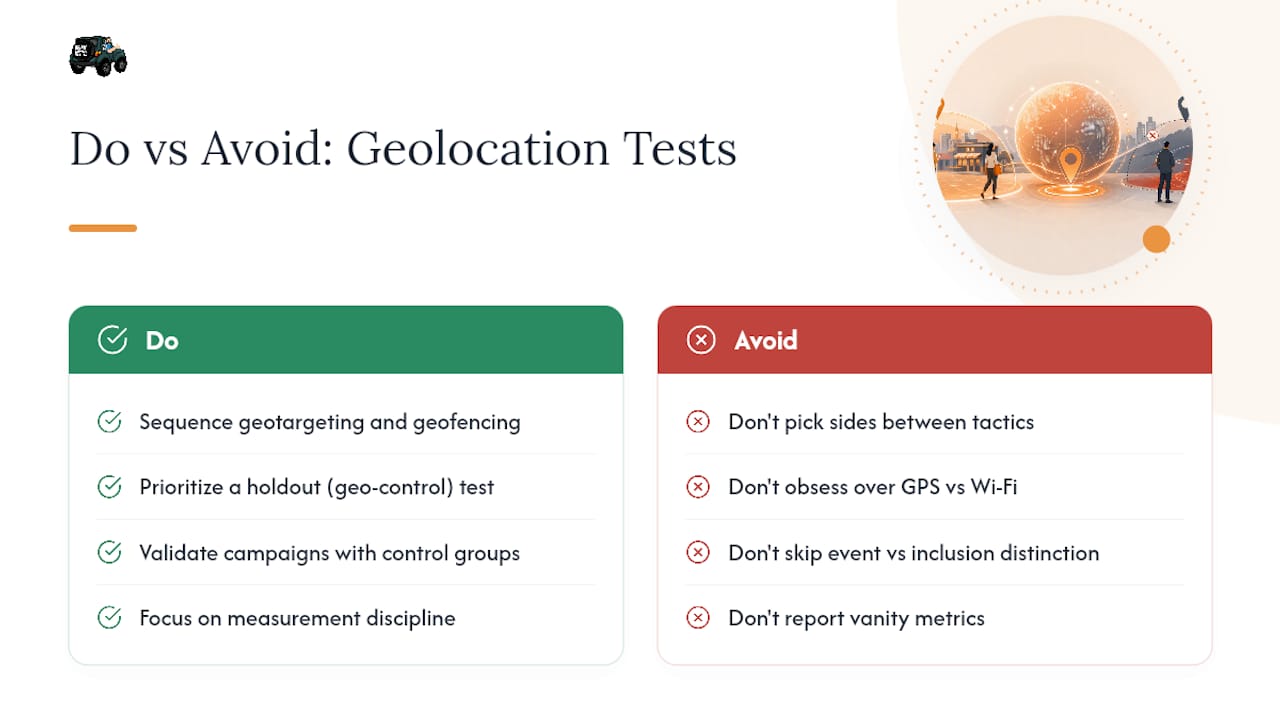
What’s overrated in most guides on this topic is the obsession with signal precision, GPS versus Wi-Fi versus beacons, as if the technology were the hard part. It isn’t. The hard part is measurement discipline. Geofencing and geotargeting get conflated constantly in marketing materials, but their operational difference, event versus inclusion, is what actually determines your KPI and your measurement approach. Skip that distinction and you’ll report vanity metrics dressed up as results.
If you take one thing from this comparison, prioritize the holdout test before you prioritize the fence shape. A geo-control group tells you whether your campaign moved anyone at all. A perfectly drawn polygon around a building you never validated with a control group tells you nothing.
— Mike
Sources
- Location-Based Marketing: What’s the Difference Between Geotargeting and Geofencing? — Airship
- Geotargeting vs Geofencing: What’s the Difference and Which One Should You Use? — CleverTap
- How to Geotarget Audiences for Max Marketing Impact | Tinuiti
- Geofencing marketing — SafeGraph