
Local influencer marketing means partnering with creators whose followers actually live, eat, shop, and book services in your trade area — not chasing national reach, but driving real-world visits and sales in your own backyard. Here’s your three-step plan to start this week:
- Find one creator. Search your city’s top hashtag (e.g., #TampaEats, #AustinStyle) on Instagram, or check who has already tagged your business.
- Prepare a low-friction offer. A complimentary experience, a unique promo code, or an event invite works better than a cash-only pitch for a first outreach.
- Track week one. Set up a creator-specific promo code and a UTM link before the post goes live so you can count verified redemptions from day one.
Every campaign you’ll build from this guide rests on four elements: the right creator, a compelling offer, content that fits the platform, and a tracking hook that proves the return.
Key Takeaways
Local influencer marketing works best when you prioritize audience geography over follower count, pair creators with local media placements, and track every campaign with a verified conversion metric from day one.
| Point | Details |
|---|---|
| Geography beats follower count | Choose creators with 40%+ of their audience in your metro area, regardless of total followers. |
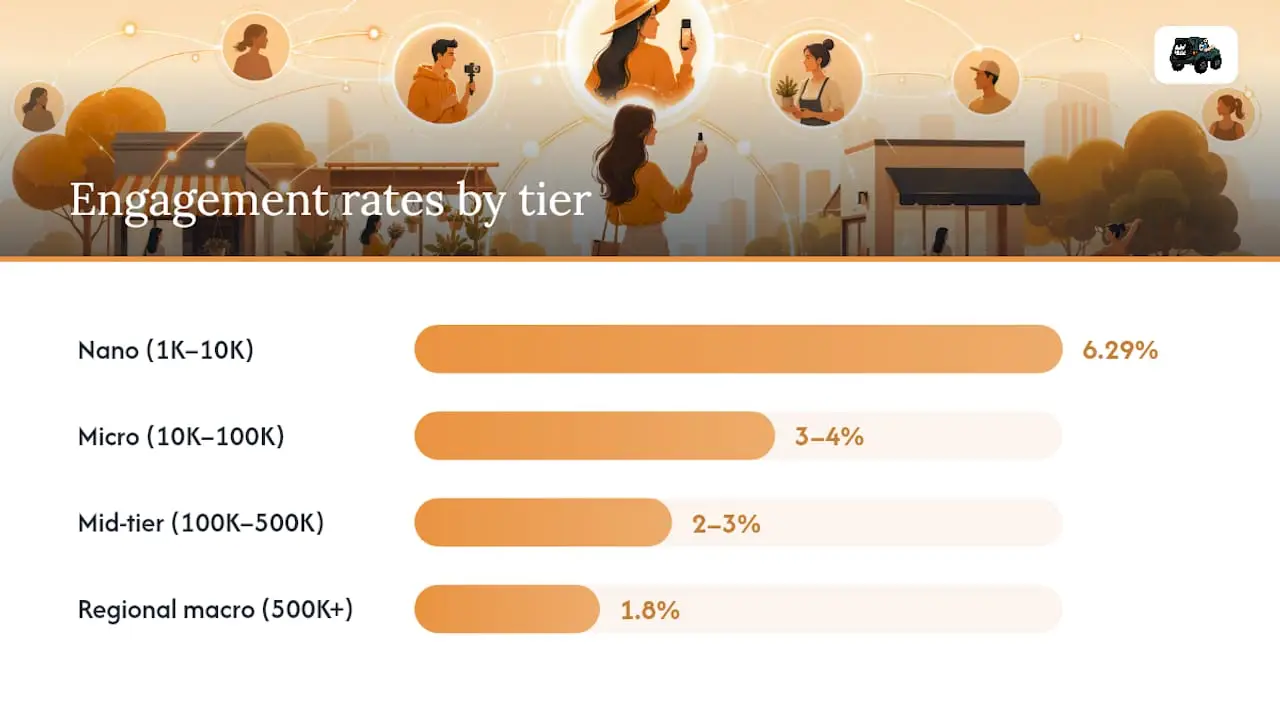
| Nano-influencers lead on engagement | Nano-creators average ~6.29% engagement vs. ~1.8% for mega-creators, making them cost-effective for local campaigns. |
| Track one verified metric | Use a unique promo code or creator-specific QR link to count real conversions, not just impressions. |
| Layer media for faster results | Combining creator posts with a local magazine or podcast placement builds recognition faster than either channel alone. |
| 16wmediagroup for integrated campaigns | 16wmediagroup pairs influencer activations with local media placements and full tracking support for small businesses. |
Table of Contents
- What local influencer marketing is and who local influencers are
- Why local influencer marketing works for small businesses
- Ten practical ways to find local influencers
- How to vet and choose the right local influencer
- Campaign templates, deliverables, and pricing for small budgets
- How to measure results and manage your campaigns
- How a combined local media and influencer campaign works in practice
- Troubleshooting common challenges in local influencer campaigns
- What I’d do first if I were launching a local influencer campaign today
- 16wmediagroup helps you run campaigns that actually convert
- Sources
What local influencer marketing is and who local influencers are
A local influencer is not simply someone with a small following. The defining factor is audience geography: the majority of their followers live, work, or spend money in your market. A creator with 3,000 highly engaged Tampa followers is more valuable to a Tampa restaurant than a lifestyle blogger with 200,000 scattered subscribers.
The creator ecosystem breaks into four practical tiers for local brands:
- Nano-influencers (1K–10K followers): Hyper-local reach, strongest community trust, and the highest engagement rates. Best for neighborhood businesses, pop-ups, and first-time campaigns.
- Micro-influencers (10K–100K followers): Solid local authority, often niche-specific (food, fitness, parenting). Good for product launches and seasonal promotions.
- Mid-tier creators (100K–500K followers): Regional reach. Useful when you want to expand beyond one zip code or run a city-wide event campaign.
- Regional macro creators (500K+ followers): Broad awareness play. Rarely cost-effective for a single-location small business unless the campaign is co-funded.
Industry data cited by Shopify shows nano-influencers average roughly 6.29% engagement versus about 1.8% for mega-creators. That gap matters when your goal is comments like “I’m going this weekend” rather than passive likes from people three states away.
Platform priorities for local campaigns: Instagram leads for discovery and visual storytelling. TikTok drives fast awareness for food, beauty, and entertainment. Facebook reaches older local demographics and community groups. YouTube works for longer-form reviews and service walkthroughs. Start with Instagram, then layer in TikTok once you have a repeatable process.
Why local influencer marketing works for small businesses
Trust is the mechanism. When a familiar face in your community recommends your salon, restaurant, or service, it carries the weight of a personal referral, not an ad. Gallup’s reporting on declining trust in mass media reinforces why local, trusted voices fill a gap that broadcast advertising cannot.
The cost-efficiency case is equally strong. Nano and micro creators often charge a fraction of what a regional radio spot or print placement costs, and they frequently accept a product experience plus a small fee. That combination signals professionalism without requiring a large budget.
Best use cases for local creator campaigns:
- Restaurants and cafés: A single “first look” reel from a local food creator can drive reservation spikes within 48 hours.
- Salons and spas: Before-and-after content from a trusted local voice builds appointment bookings faster than display ads.
- Service businesses (HVAC, landscaping, cleaning): Testimonial-style content from a community creator adds credibility that a Google ad cannot replicate.
- Event promotion: A creator’s story countdown drives RSVPs and foot traffic better than a boosted Facebook event alone.
- Retail and boutiques: Outfit or product hauls from a micro-influencer in town move specific SKUs and drive same-week store visits.
Pro Tip: Pair a creator post with a retargeting ad for local business audiences. Someone who watches a creator’s reel about your café and then sees your ad on Instagram the next day is far more likely to convert than a cold audience. This combination of influencer reach and retargeting for local business is one of the highest-ROI moves a small budget can make.
When should you pick influencer marketing over traditional local media? When you need authentic storytelling, fast turnaround, or a specific niche audience. When you need broad awareness across an entire market, combine both. The best media mix for local brands rarely relies on a single channel.
Ten practical ways to find local influencers
The American Press Institute recommends mapping your local influencer landscape as a structured outreach strategy, not a one-time search. Work through this list systematically:
- Search city-specific hashtags on Instagram. Try #[YourCity]Eats, #[YourCity]Style, #[YourCity]Fitness, or #[YourCity]Moms. Sort by “Recent” to find active creators.
- Check geotags at your location and nearby landmarks. On Instagram and TikTok, search your address or neighborhood name to find creators already posting in your area.
- Review who has tagged your business. Check your Instagram mentions and tagged posts. A customer who already posts about you is a warm lead.
- Browse Google Maps and Yelp reviewers. Prolific reviewers with profile photos often have social media presence. Search their username.
- Attend local events and markets. Farmers markets, pop-ups, and community festivals attract creators looking for content. Introduce yourself in person.
- Use Shopify Collabs. If you run a Shopify store, Collabs lets creators apply to partner with you directly, filtering by niche and audience size.
- Use GRIN. GRIN’s discovery tools let you filter creators by location, engagement rate, and audience demographics — useful for scaling beyond manual search.
- Monitor local Facebook groups. Community groups for your city or neighborhood often surface active local voices. Look for members who post recommendations frequently.
- Ask your best customers. A simple question at checkout or in a post-purchase email (“Do you know any local creators we should work with?”) surfaces warm referrals. Script: “We’re looking to partner with local creators in [city]. Do you follow anyone whose content you love?”
- Partner with local publications. Community magazines and local media outlets often know the creators covering their beat. 16wmediagroup’s local publishing network connects brands with exactly these community voices.
Sample search queries to copy:
- Instagram:
#TampaFoodie,#TampaLifestyle,Tampa + food blogger - TikTok: Search “Tampa restaurant review” or “Tampa small business”
- Google:
"Tampa" + "food blogger" + Instagram
How to vet and choose the right local influencer
Follower count is the last thing to check. Start with audience geography. Ask the creator for a screenshot of their Instagram Insights or TikTok Analytics showing the top cities in their audience. If your city is not in the top three, the partnership will not move your numbers.
Vetting checklist:
- Audience location: 40%+ of followers in your metro area
- Content fit: their aesthetic and topics match your brand naturally
- Engagement quality: comments show purchase intent (“Where is this?”, “I need to try this”), not just emoji
- Posting cadence: at least 3–4 posts per week shows an active, algorithm-friendly account
- Brand safety: scroll back 90 days for anything that conflicts with your values
- Follower authenticity: use a free tool like HypeAuditor’s free report or check the comment-to-follower ratio manually
Questions to ask before signing anything:
- What percentage of your audience is in [city]?
- Can you share a recent campaign’s reach and story views?
- Do you have examples of local brand partnerships?
- Who owns the content after posting — can we repurpose it in ads?
- Are you working with any of our direct competitors right now?
Legal note: The FTC’s Endorsement Guides require that any material connection between a creator and a brand be disclosed clearly and conspicuously. Per FTC’s platform-specific guidance, disclosures must appear in the first lines of a caption or within the video itself — not buried in hashtags or below a “more” fold. Require the creator to use #ad or #sponsored in every post, and include that requirement in your written agreement. If you later repurpose their content as a paid ad, the ad creative must also carry the disclosure, per UGC ad compliance guidance.
A creator with 8,000 followers and 200 comments per post is more valuable to your local campaign than one with 50,000 followers and 80 comments.*
| Tier | Typical Engagement | Audience Geography Check | Best Fit |
|---|---|---|---|
| Nano (1K–10K) | ~6.29% | Ask for Insights screenshot | Single-location, first campaign |
| Micro (10K–100K) | ~3–4% | Require city breakdown | Multi-location, niche product |
| Mid-tier (100K–500K) | ~2–3% | Require audience report | City-wide event or launch |
| Regional macro (500K+) | ~1.8% | Require full analytics report | Co-funded regional awareness |
Campaign templates, deliverables, and pricing for small budgets
Three campaign formats that work reliably for local businesses:
1. The “First Look” Launch
Objective: drive opening-week foot traffic or bookings. Creator tier: nano or micro. Deliverables: one feed post + two Stories with a swipe-up link or promo code. Tracking hook: unique code (e.g., TAMPA15) redeemable in-store or at checkout.
2. The Limited-Time Offer Push
Objective: spike sales during a slow period or seasonal promotion. Creator tier: micro. Deliverables: one Reel or TikTok video + three Stories over a 5-day window. Tracking hook: creator-specific QR code linking to a dedicated landing page with UTM parameters.
3. The Community Ambassador Program
Objective: sustained brand awareness and repeat visits over 3–6 months. Creator tier: nano to micro, rotating roster of 3–5 creators. Deliverables: two posts per month per creator, monthly Story check-in, affiliate link for ongoing tracking. Tracking hook: individual affiliate codes per creator tracked in a shared Google Sheet.
Pricing reference by tier:
Sample sponsor brief (copy and adapt):
- Campaign dates: [Start date] to [End date]
- Offer: [Complimentary experience / product / discount code]
- Key messages: [2–3 brand talking points in plain language]
- Mandatory disclosure: #ad or #sponsored must appear in the first line of every caption and within the first 30 seconds of any video
- Deliverables: [Specific posts, Stories, Reels — list each]
- KPI: [Promo code redemptions / QR scans / booking link clicks]
- Content approval: Brand reviews content 48 hours before posting (optional but recommended for first campaigns)
How to measure results and manage your campaigns
The primary metric for any local campaign is a verified visit or conversion: a promo code redemption, a booking made through a creator-specific link, or a QR scan that lands on a tracked page. InfluencerDB’s foot-traffic guidance confirms that creator-specific promo codes, QR landing pages, and staff-recorded “how did you hear” prompts are the most reliable attribution methods for local campaigns.
Primary KPIs:
- Promo code redemptions (in-store or online)
- Booking or reservation completions via creator link
- QR code scans to a tracked landing page
Secondary KPIs:
- Post reach and impressions (awareness signal)
- Story saves and profile visits (intent signal)
- New followers gained during campaign window
Tracking checklist:
- Create a unique promo code per creator before the campaign launches.
- Build a creator-specific landing page (or UTM-tagged URL) using Google Analytics campaign parameters.
- Set up a Google Analytics event to fire on form submission or purchase completion.
- Brief your front-desk staff or POS team to ask “How did you hear about us?” and log the answer.
- Check your Google Business Profile map views and direction requests during and after the campaign window.
- Pull creator analytics screenshots (reach, saves, link clicks) within 48 hours of each post going live.
UTM example: https://yourbusiness.com/offer?utm_source=instagram&utm_medium=influencer&utm_campaign=creator_name_june
When attribution is messy (a customer saw the post but forgot the code), triangulate: compare your baseline booking volume for the same period last year against the campaign window. A lift above your normal trend, combined with even partial code redemptions, tells a credible story. For deeper ROI analysis, the local marketing ROI roadmap from 16wmediagroup walks through this triangulation in detail.
Tools to manage campaigns:
- Shopify Collabs: Best for e-commerce brands managing affiliate codes and creator applications in one place.
- GRIN: Scales creator discovery, outreach, and reporting for businesses managing 5+ creator relationships.
- Google Sheets + GA: Free, sufficient for a first campaign with 1–3 creators.
How a combined local media and influencer campaign works in practice
The most effective local campaigns we see at 16wmediagroup don’t rely on creators alone. They layer influencer content on top of local media placements to create multiple touchpoints with the same audience.
Here’s how a typical integrated activation looks:
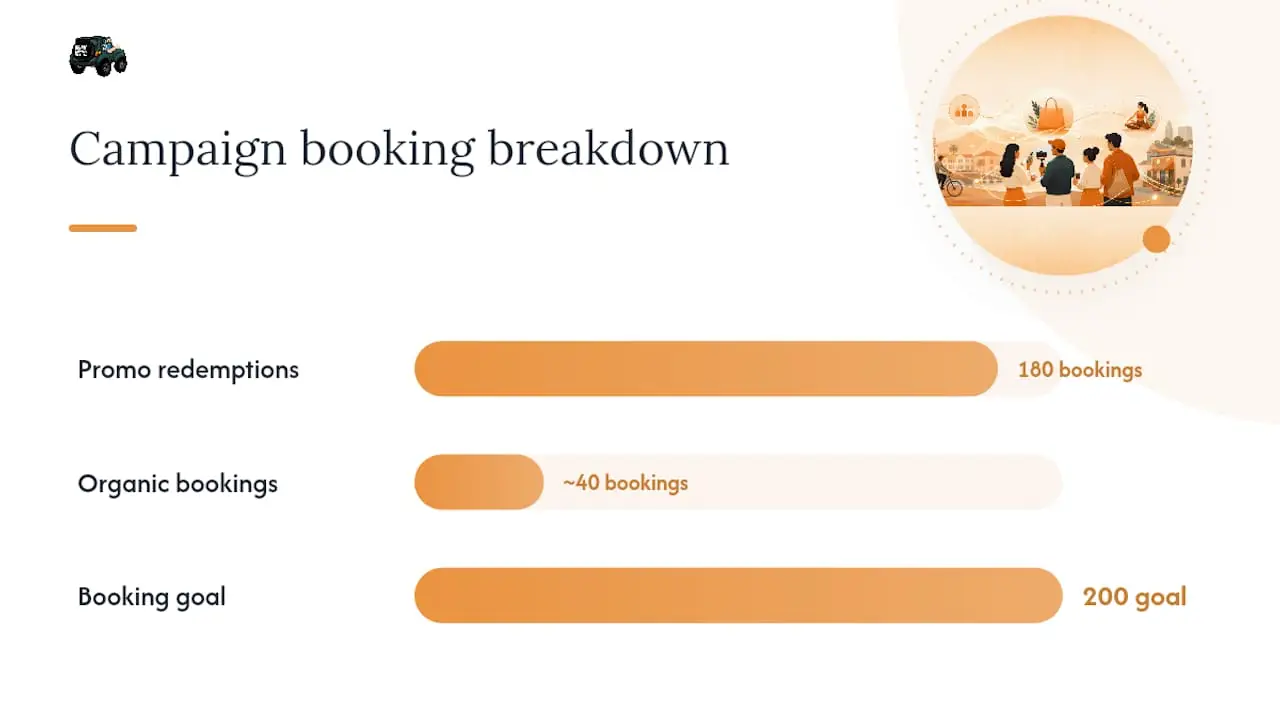
Context: A Tampa-area restaurant group wanted to drive reservations for a new location opening. The goal was 200 verified bookings in the first 30 days.
Campaign design: The team identified five nano and micro creators with combined local reach across Tampa neighborhoods. Each creator received a hosted dinner experience and a $150 flat fee. Simultaneously, the brand ran a feature in a local community magazine and a sponsored segment on a regional podcast.
Execution highlights: Creators posted a mix of Reels and Stories over a 10-day window, each using a unique promo code. The magazine feature ran the week before opening. The podcast segment aired the same week as the creator posts, reinforcing the message across three distinct touchpoints.
The combination of creator content and local media placements meant the audience encountered the brand in their Instagram feed, in print, and through audio — three different contexts that built recognition faster than any single channel could. The promo codes tracked 180 verified redemptions in the first 30 days, with an additional lift in organic reservations that triangulated to roughly 40 more bookings.
Three takeaways to copy:
- Sequence matters. Run the media placement first to build awareness, then activate creators to convert that awareness into bookings.
- Unified tracking. One promo code per creator, one UTM per media channel. Never share codes across placements.
- Add local media when the creator pool is thin. If your city has few relevant nano creators, a community magazine feature fills the trust gap that a single creator cannot.
The role of media partnerships in local brand growth explains this layered approach in more depth.
Troubleshooting common challenges in local influencer campaigns
Even well-planned campaigns hit friction. Here’s how to handle the most common problems without losing momentum.
Influencer no-shows or missed deadlines. Always set a content submission deadline 48 hours before the agreed posting date. Include a late-delivery clause in your brief: if content is not submitted on time, the experience or fee is forfeited. For ambassador programs, build a backup creator into your roster from the start.
Low engagement on posts. Low engagement usually signals one of three things: the creator’s audience is not local, the offer is not compelling enough to prompt action, or the post went live at a low-traffic time. Check the creator’s analytics before the next post and adjust the call-to-action. A specific, low-friction prompt (“Use code TAMPA15 at checkout today”) outperforms a vague “check the link in bio” every time.
Content quality issues. Set clear expectations in the brief: preferred aspect ratio, lighting style, whether the brand logo should appear, and any mandatory talking points. Share two or three reference posts you admire. For first-time partnerships, request a draft or raw footage review before the final post. This is not micromanaging — it’s protecting both parties.
No measurable conversions. If promo codes show zero redemptions after a week, the problem is usually the redemption friction, not the creator. Test the code yourself. Make sure staff know it exists. Simplify the landing page.
Creator-brand mismatch. If the content feels forced or off-brand, it’s almost always a vetting miss. The creator’s existing content style should naturally accommodate your brand before you reach out. If you’re three posts into a campaign and the content still feels wrong, it’s better to pause and find a better fit than to push through six more mediocre posts.
What I’d do first if I were launching a local influencer campaign today
Before you send a single outreach message, run this quick-check list:
- Is your offer genuinely compelling? A free experience or a meaningful discount beats a vague “collaboration opportunity.”
- Is your redemption flow tested? Walk through the promo code or booking link yourself before the creator posts.
- Is your staff briefed? Front-desk and floor staff should know the campaign is live, what the code is, and how to log redemptions.
- Do you have inventory or capacity to handle a spike? A successful creator post that drives 50 new bookings you can’t fulfill is worse than no campaign at all.
- Do you have a tracking sheet ready? Even a simple Google Sheet with columns for creator name, code, redemptions, and post date is enough to start.
The most common pitfall I see is launching a campaign before the business is operationally ready for the response. The creator’s job is to drive attention. Your job is to convert it.
On scaling: once you’ve run two or three campaigns, build a rotating roster of 4–6 local creators you trust. Document what worked (offer type, posting day, content format) and what didn’t. A small, well-managed roster of community influencer partnerships compounds over time. Each campaign teaches you something the next one can use.
16wmediagroup helps you run campaigns that actually convert
Pairing creator content with local media placements is where most small businesses leave money on the table. 16wmediagroup builds integrated local campaigns that combine influencer activations with community magazine features, podcast sponsorships, and regional advertising placements — so your brand shows up in multiple places your audience already trusts.
You don’t have to manage creator outreach, media placements, and tracking in three separate spreadsheets. 16wmediagroup handles the full campaign architecture: identifying the right creator tier for your market, placing your brand in local publications, and building the tracking infrastructure that proves your return. Whether you’re running your first neighborhood influencer campaign or scaling a city-wide ambassador program, the 16wmediagroup services page is the right starting point. You can also grab the media planning checklist to map your first campaign before you call.
Sources
- FTC’s Endorsement Guides: What people are asking
- How influencer marketing can help small businesses — Shopify
- Mapping your local influencer landscape – American Press Institute
- Drive More Foot Traffic: Influencer tactics that convert – InfluencerDB