

A 30-second local radio spot generally runs between $25 in a small market to $500 or more in a major metro, with 60-second spots stretching from around $5 to $750-plus depending on the station and time slot. Production adds another $300 to $2,000 on top of airtime. Everything else, market size, daypart, station ratings, comes down to how those two numbers move against each other.
TL;DR:
- Radio advertising costs vary significantly by market size, with small markets charging $10-$150 for 30-second spots, while large markets can exceed $500.
- Negotiating remnant inventory and volume commitments can reduce costs by up to 70%, especially during off-peak hours and shorter campaigns.
- Use CPM and CPP metrics to compare station efficiency, with CPM ideal for awareness and CPP better for targeted response campaigns.
- Production costs range from free or $300 for basic spots to over $2,000 for premium, agency-level creative; host-read endorsements and licensing add further fees.
- A typical small-market monthly budget of $500-$1,500 supports enough spots for initial testing, while larger markets require $8,000 or more for sustained, multi-station campaigns.
Table of Contents
- How Much Does Radio Advertising Cost by Spot Length?
- What Drives Radio Ad Pricing?
- What Does Radio Ad Production Actually Cost?
- What Should a Monthly Radio Budget Look Like?
- How Do You Compare Radio Buys Using CPM and CPP?
- How Can You Lower Your Radio Advertising Cost?
- How Do You Track Radio Advertising ROI?
- What Contract Terms and Minimums Should You Expect?
- Should You Buy Regional or National Radio Advertising?
- How Does Ad Frequency and Campaign Length Affect Total Spend?
- Which Pricing Model Is Best: Flat Rate, CPM, or CPP?
- What Extra Fees Should You Budget For?
- How Does Digital Radio Advertising Cost Differ from Traditional Radio?
- 16W Media Group Perspective: When Radio Belongs in a Local Mix
- Plan Your Radio Buy with a Local Media Partner
- Sources
How Much Does Radio Advertising Cost by Spot Length?
The fastest way to budget a radio buy is to anchor it to spot length and market size, since those two variables move the price more than almost anything else.
- Small markets (rural towns, cities under 100,000 people): 15-second spots often run $10 to $50, 30-second spots land around $25 to $150, and 60-second spots run $30 to $200.
- Midsize markets (regional cities, mid-tier DMAs like Tampa or Sacramento): 15-second spots typically cost $50 to $200, 30-second spots run $100 to $400, and 60-second spots climb to $150 to $600.
- Large markets (top-10 DMAs like Los Angeles, Chicago, or New York): 15-second spots can hit $150 to $400, 30-second spots often reach $300 to $500-plus, and 60-second spots can push past $750 during prime dayparts.
These figures reflect local spot buys on individual stations, which differ from national or network buys that run identical spots across dozens of affiliated stations simultaneously, and from syndicated buys tied to a specific national program (think a nationally distributed talk or sports show) where you pay a premium for guaranteed reach regardless of local market pricing. Local spot buys give small and midsize businesses the most control over budget and targeting, which is why most first-time radio advertisers start there.
What Drives Radio Ad Pricing?
Two stations in the same city can quote wildly different rates for what looks like the same spot. The gap almost always traces back to a handful of variables buyers need to interrogate before signing anything.
- Market size and audience reach. Nielsen ranks U.S. radio markets by Designated Market Area (DMA), and stations in larger DMAs charge more because they reach more listeners per spot.
- Average Quarter Hour (AQH) and ratings. AQH measures how many people listen to a station during a typical 15-minute period. A station with a smaller total audience but a highly engaged, loyal AQH in your target demographic can actually be the better buy than a bigger station with diffuse reach.
- Daypart. Morning drive (roughly 6 to 10 AM) and afternoon drive (3 to 7 PM) command the highest premiums because commuters are a captive audience. Overnight and weekend slots cost far less.
- Special programming. Live sports broadcasts, breaking news coverage, and syndicated talk programs carry their own premium pricing separate from the standard rate card.
- Seasonal demand. Fourth-quarter retail season and election cycles pressure inventory hard, often pushing rates up 20% to 50% over baseline.
- Inventory availability. Rate cards are a starting point for negotiation, not a fixed price. Stations quote availability based on what’s open that week, and unsold (“remnant”) inventory can be had for a steep discount.
Ask any station for their current rate card, then ask what’s actually available in your target dayparts. The two numbers are rarely the same.
What Does Radio Ad Production Actually Cost?
Airtime is only half the invoice. Production, the actual creation of the spot, gets billed separately from most stations unless you negotiate a package deal.
- Basic production (a station staffer reads a script over stock music) often runs $0 to $300 and sometimes comes bundled free with a minimum ad buy.
- Standard production (professional voice talent, custom sound design, light editing) typically costs $300 to $1,000.
- Premium production (original music, multiple voice actors, agency-level scripting and sound branding) can run $1,000 to $2,000 or more, matching the broader production cost range industry guides report.
Host-read endorsements, where a familiar on-air personality delivers your message in their own voice, cost extra because you’re paying for that host’s credibility with their audience. Expect a separate talent fee on top of airtime, often negotiated per-flight rather than per-spot. Music licensing adds another line item if you want a recognizable song bed rather than production-library tracks. Budget for at least one creative refresh mid-flight too. Running the identical spot for eight straight weeks causes listener fatigue, and most media buyers recommend a new cut or edit around the halfway point of any campaign longer than a month.
What Should a Monthly Radio Budget Look Like?
Budget scenarios help more than abstract per-spot numbers because campaigns succeed or fail on frequency, not on a single airing.
- Small-market test budget: $500 to $1,500 per month typically buys 20 to 40 spots on a single station, enough to gauge initial response before committing further.
- Midsize-market sustaining budget: $2,000 to $6,000 per month supports 40 to 80 spots, often spread across two dayparts or two complementary stations for broader reach.
- Large-market baseline budget: $8,000 to $20,000-plus per month is common when running multiple stations or a heavier drive-time rotation, since single-station large-market rates alone can absorb that fast.
Flight length changes the math substantially. A four-week flight negotiated as a package almost always beats the same spot count bought week-by-week, since stations reward volume commitment with lower per-spot rates. A 16wmediagroup media plan typically models flight length against frequency targets before locking a station buy, because the right cadence matters more than the sticker price on any single spot.
How Do You Compare Radio Buys Using CPM and CPP?
Two stations quoting different prices for the “same” spot are only comparable once you normalize for audience size, and that’s what CPM and CPP exist to do.
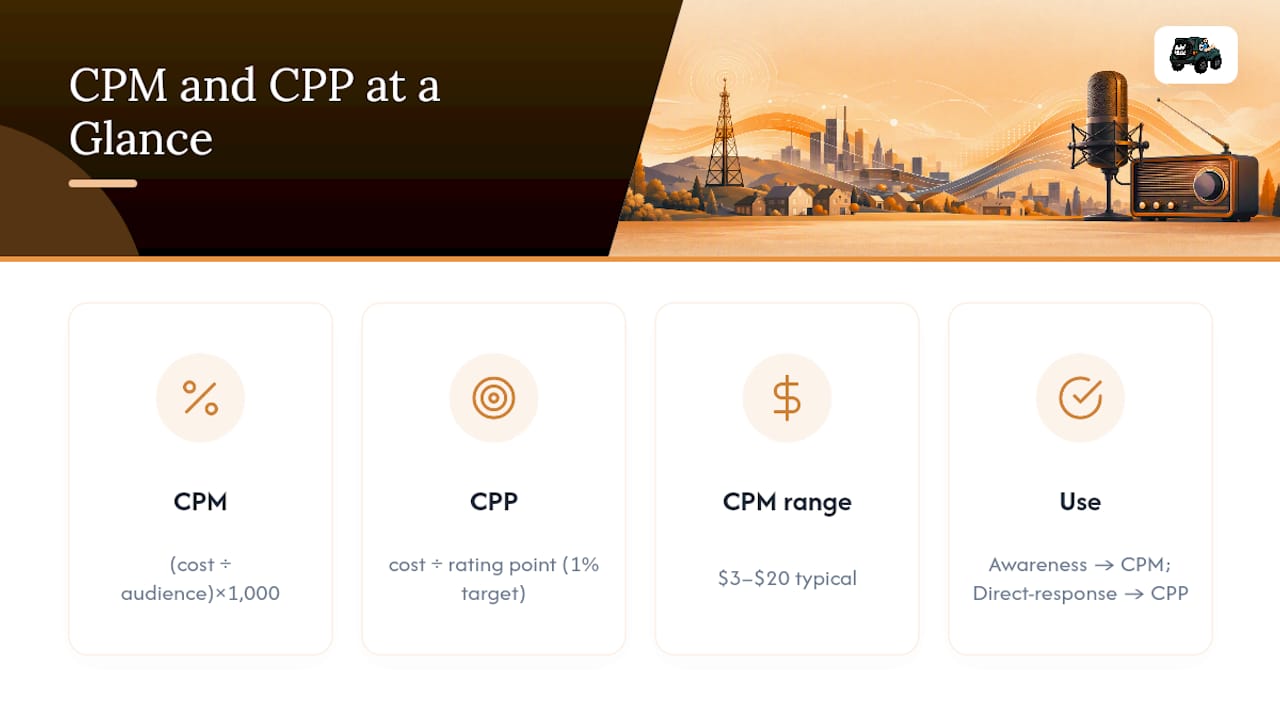
CPM (cost per thousand impressions) = (spot cost ÷ audience reached) × 1,000. Radio CPMs typically run $3 to $20, depending on market and daypart.
CPP (cost per rating point) = spot cost ÷ rating points delivered, where a rating point represents 1% of the target audience. Stations report both figures alongside AQH data so buyers can compare apples to apples.
Station A wins on both metrics despite the higher sticker price. For awareness campaigns, prioritize CPM since you’re paying for reach. For direct-response campaigns built around a call-to-action, CPP against your specific target demographic matters more than raw reach.
How Can You Lower Your Radio Advertising Cost?
Negotiation happens on almost every radio buy, and a handful of specific asks consistently produce better rates than accepting the first quote.
- Use remnant inventory for flexible campaigns. Unsold airtime can be discounted 40% to 70% below rate card, ideal for promotions or tests where exact air times don’t matter.
- Commit to volume for better per-spot pricing. Longer flights and higher spot counts are the most reliable path to a discount.
- Mix in off-peak dayparts. Blending premium drive-time spots with cheaper midday or evening slots stretches frequency without blowing the budget.
- Ask for added value. Bonus spots, free production, or cross-promotion on the station’s website and social channels often cost the station little but save you real money.
Pro Tip: Before signing any flight, ask the sales rep directly: “What’s your remnant inventory look like for the next two weeks?” Stations would rather sell that time cheap than let it go unsold, and you’ll often get a same-quality slot for a fraction of the rate card price.
How Do You Track Radio Advertising ROI?
Radio has a real measurement problem: nobody clicks a radio ad. The workaround is building trackable response mechanisms directly into the creative.
- Vanity URLs and dedicated landing pages let you isolate radio-driven traffic from every other channel.
- Unique promo codes tie a purchase directly back to a specific station or flight.
- Call tracking numbers capture phone response, still one of the most common radio conversions for local service businesses.
- Marketing mix modeling (MMM) becomes worthwhile once you’re running multi-market or multi-station campaigns large enough that simple attribution tools can’t isolate radio’s contribution.
Pairing radio with a digital push tends to lift site traffic and response beyond what either channel drives alone. Set a measurement cadence, weekly for test flights, monthly for sustained campaigns, and adjust dayparts or stations based on what the tracking data actually shows rather than gut instinct.
What Contract Terms and Minimums Should You Expect?
Most stations won’t quote a one-off spot at their best rate. Minimum buy requirements are standard practice, and understanding them before you negotiate keeps you from overpaying for flexibility you don’t need.
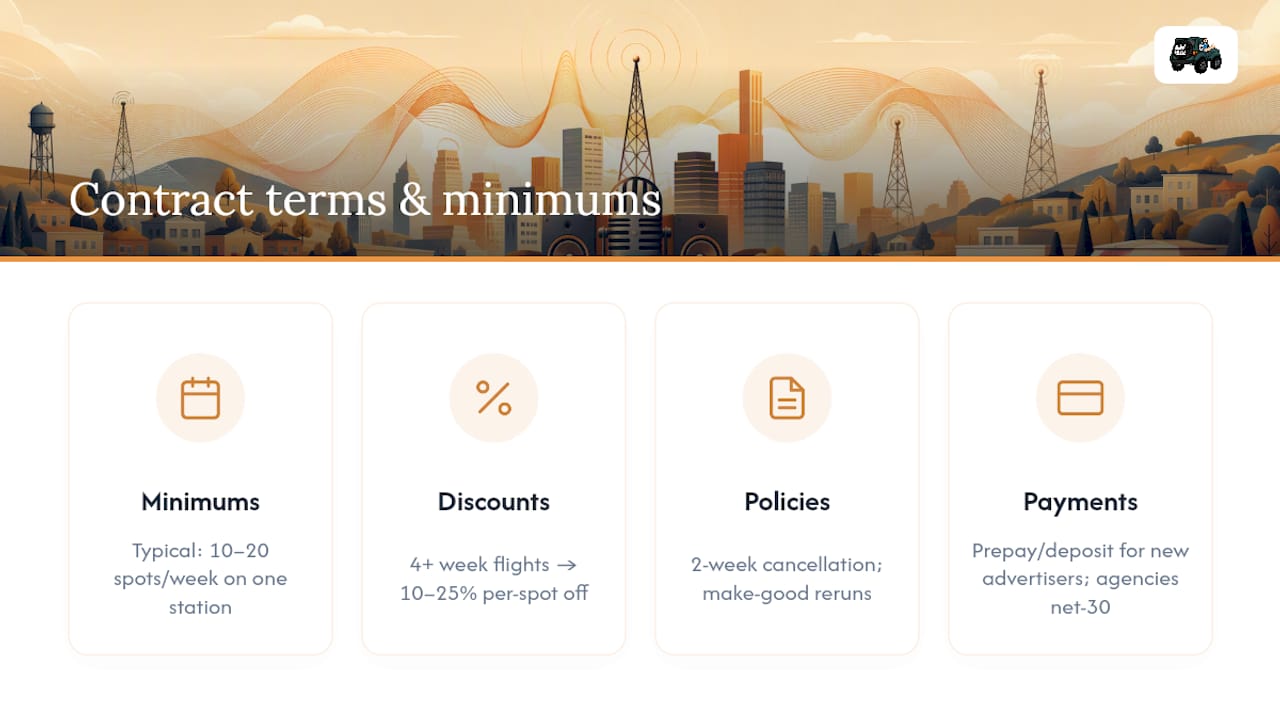
A typical minimum ranges from a one-week flight of 10 to 20 spots on a single station, though some stations set higher floors for their most competitive dayparts. Shorter commitments almost always carry a rate-card premium since the station has less certainty about filling that inventory otherwise. Longer flights, four weeks or more, unlock tiered discounts that can knock 10% to 25% off the per-spot price once you clear certain volume thresholds.
Contracts typically specify a cancellation window, often two weeks’ notice, and many include a “make-good” clause that requires the station to rerun any spot that aired outside the agreed daypart or was preempted by breaking news or severe weather coverage. Read that clause carefully. It’s your only recourse if a big sports broadcast bumps your drive-time spot to a lower-value slot.
Some stations also require pre-payment or a deposit for new advertisers without an established payment history, while agencies with ongoing relationships often get net-30 terms. If you’re testing radio for the first time, ask specifically about a short-term trial flight. Many stations will build a smaller test package rather than lose the business entirely to a competitor.
Should You Buy Regional or National Radio Advertising?
Local spot buys and national or network buys solve different problems, and conflating them is one of the most common budgeting mistakes new advertisers make.
Regional buys, running spots on a handful of stations across a specific geographic footprint, give you granular control over which markets you enter and let you tailor the message to local context. This is where most small and midsize businesses should start, since it lets a $2,000 to $6,000 monthly budget actually move the needle in a defined trade area instead of getting diluted across dozens of markets.
National and network buys spread a single spot across affiliated stations nationwide, priced as a bundle rather than negotiated market by market. These buys make sense for brands selling a product available everywhere, but they’re often inefficient for a business that only serves three counties. You end up paying for impressions in markets where nobody can actually become your customer.
The middle ground, regional expansion, involves adding markets progressively as budget allows, testing each new DMA with a smaller flight before committing to a full-scale buy. That approach lets you validate response in market two before you’ve locked in spend across markets three through six.
How Does Ad Frequency and Campaign Length Affect Total Spend?
Frequency, how many times the average listener hears your spot, matters more to campaign performance than almost any other single variable, and it directly multiplies total spend.
Media planners generally recommend a listener hear a spot three to seven times before the message registers enough to prompt action. Hitting that frequency requires either a high spot count on one station or a moderate spot count spread across a station’s most popular dayparts. A campaign running 10 spots a week for two weeks costs less in total than one running 20 spots a week for four weeks, but the shorter flight rarely builds enough frequency to move behavior.
Campaign length compounds this. A single-week flight might generate initial awareness, but conversion-focused campaigns typically need four to eight weeks of sustained presence before response rates climb meaningfully. That’s also where the per-spot discount curve kicks in: stations reward the longer commitment with lower unit pricing, so total spend doesn’t scale linearly with flight length.
Which Pricing Model Is Best: Flat Rate, CPM, or CPP?
Stations quote radio advertising in three main formats, and each suits a different campaign goal.
Flat rate charges a fixed price per spot regardless of audience delivered. It’s simple to budget and easy to compare across a station’s own rate card, but it makes cross-station comparison difficult since you can’t normalize for actual reach.
CPM (cost per thousand impressions) ties price to audience size, making it the standard for awareness campaigns where the goal is maximum reach at the lowest cost per listener. The tradeoff: CPM alone doesn’t tell you anything about how targeted that audience actually is to your business.
CPP (cost per rating point) ties price to the percentage of your specific target demographic reached, which makes it the sharper tool for direct-response campaigns aimed at a defined audience segment. It requires more sophisticated audience data to calculate, which is why smaller stations sometimes default to flat-rate quotes instead.
Most experienced buyers use flat rate for quick local negotiation, then convert every quote to CPM and CPP before comparing stations, since that’s the only way to know whether a “cheap” spot on one station actually beats a “pricier” spot on another once real audience delivery is factored in.
What Extra Fees Should You Budget For?
The quoted airtime rate is rarely the full invoice. A handful of recurring fees catch first-time radio advertisers off guard.
Agency commissions, typically 15% of gross media spend when you work through a media buying agency, get built into the total campaign cost rather than charged as a separate line item in most cases. Working directly with a station avoids this fee but also means you’re negotiating without an agency’s volume leverage across multiple accounts.
Production revisions beyond the first draft often carry an additional charge, especially if you’re requesting a full script rewrite rather than a minor edit. Clarify how many revision rounds are included before production begins.
Scripting fees sometimes get bundled into the base production cost and sometimes billed separately, particularly if you want a professional copywriter rather than a station staffer drafting the read. Ask upfront which model applies.
Talent and usage fees for host-read endorsements or celebrity voice talent can recur if you want to extend a spot beyond its original contracted usage window. A voice actor’s rate typically covers a specific flight length and market, and re-running the same spot months later after the license expires can trigger a renewal fee.
Get every fee itemized in writing before signing.
How Does Digital Radio Advertising Cost Differ from Traditional Radio?
Streaming audio and digital radio platforms price differently than terrestrial AM/FM, and understanding the split matters as more listening moves to app-based platforms.
Traditional broadcast radio sells inventory in fixed spot lengths on a rate-card basis, with pricing driven by DMA size, daypart, and station ratings. Digital audio and programmatic streaming platforms instead sell impressions, typically at lower entry-point CPMs than broadcast, but with far more granular targeting available, age, location, listening habits, even specific podcast genres.
The tradeoff is scale versus precision. Broadcast radio still reaches the largest share of ad-supported audio listeners, and listening patterns have stayed remarkably steady in recent years despite the rise of streaming. Digital audio buys, by contrast, let you target a specific listener segment with surgical precision, but at meaningfully smaller reach per dollar unless you’re paying premium programmatic rates.
For most local businesses, the smart move isn’t choosing one exclusively. Broadcast handles broad local awareness at a lower cost per impression, while a smaller digital audio allocation targets a narrower, high-intent segment, like podcast listeners in a specific category who overlap heavily with your customer base.
16W Media Group Perspective: When Radio Belongs in a Local Mix
Radio earns its budget when a business needs broad local awareness fast, think a grand opening, a seasonal promotion, or an event with a hard deadline. It underperforms when the goal is narrow targeting a small digital audience can reach cheaper.
At 16wmediagroup, we typically bundle radio with community magazine placements and local podcast features rather than running it alone. That combination builds frequency across formats without forcing a business to over-invest in any single channel. and shape how we calibrate that mix for each client’s market and budget.
— Mike
Plan Your Radio Buy with a Local Media Partner
Getting a fair radio rate takes more than a single phone call to a sales rep. It takes someone who already knows which stations in your market negotiate, which dayparts are overpriced, and how to bundle airtime with other local channels so your budget works harder than a station’s rate card alone would let it.
16wmediagroup builds local media plans that pair radio buys with community magazine placements and podcast features, so a Tampa-area business isn’t betting an entire budget on one channel’s guesswork. We handle the station negotiations, production coordination, and response tracking so you get a campaign built around your actual audience, not a generic rate card. Visit our services page to see how we structure local and regional media plans, or start with our campaign planning guide to map your budget before you talk to a single station.