

Spotify Ads Manager requires a $250 minimum campaign budget to launch, and most advertisers should plan around a $15 to $25 CPM, with industry benchmarks landing near $18. Where you fall in that range depends on targeting precision, ad format, geography, and how competitive your auction is that week. If you want the planning math, skip to the budgeting section below; if you’re deciding between formats, start there instead.
TL;DR:
- Spotify ad costs typically range from $15 to $25 CPM, with industry benchmarks around $18, but prices vary based on targeting and competition.
- Bidding is auction-based, meaning CPMs can fluctuate depending on listener relevance, target audience size, and ad format.
- A minimum campaign budget is $250, with small businesses starting from $250 to $1,000 for local tests, and larger brands investing $20,000+ monthly.
- Creative production costs should be factored separately, with a simple 30-second audio ad costing a few hundred dollars, while video ads are more expensive.
- Testing multiple creatives and audiences for two to three weeks ensures reliable data before scaling and helps optimize cost efficiency.
Table of Contents
- How Spotify’s Auction and Budget Controls Determine Cost
- Ad Formats and What Drives Their Cost
- Setting a Budget and Choosing a Bid Strategy
- Benchmarks and Worked Examples
- Turning CPMs Into Business Metrics
- Testing Spotify the Right Way as a Local Advertiser
- What a Full Spotify Campaign Actually Costs
- How 16wmediagroup Helps Plan and Manage Your Spotify Campaign
- Test Small, Measure Everything, Then Scale
- Sources
How Spotify’s Auction and Budget Controls Determine Cost
Spotify prices ads through an auction, not a fixed rate card. You’re not paying a set fee for a slot. You’re bidding against other advertisers for the same listener’s attention, and the winner is decided by a mix of bid amount and how relevant your ad is likely to be to that listener. This is why two advertisers targeting the same audience segment can end up paying noticeably different CPMs.
You control spend two ways: a daily budget or a lifetime budget. A daily budget caps what you spend each day and smooths delivery over the campaign’s run. A lifetime budget lets Spotify’s system decide how to pace spend across the full window, which tends to work better for campaigns with a hard end date, like a product launch or a local event promotion.
Bid strategy matters just as much as budget size. You’ve got three main levers:
- Maximum bid, where you set a ceiling and let the auction do the rest.
- Target cost per result, which asks Spotify’s algorithm to hold your average cost near a number you set.
- Automated bidding, where you hand pacing and bid adjustments entirely to the platform based on your stated goal.
Frequency caps also shape cost. Capping how often the same listener hears your ad prevents fatigue and wasted impressions, but it can also slow delivery if your audience is narrow. Wider audiences pace faster and usually cost less per impression; tightly filtered segments cost more because you’re competing for a smaller pool of eligible listeners.
Ad Formats and What Drives Their Cost
Spotify sells four main formats, and they don’t cost the same. Audio ads (the classic 15 to 30 second streaming spot) sit at the lower end of the CPM range because they’re the highest-volume inventory on the platform. Video ads, shown when a listener has the app open on their phone or is browsing on desktop, typically command a premium because they capture more attention and inventory is more limited. Display ads, including banners and companion overlays that run alongside audio, tend to be the cheapest per impression but also the easiest to ignore. Podcast placements are their own category. Programmatic podcast buys price on CPM like audio ads, but host-read integrations often carry a flat fee on top of a CPM rate, since you’re paying for the host’s voice and credibility, not just the impression.
A few things push CPMs higher across any format:
- Premium placement (first-in-pod audio slots, above-the-fold video).
- Narrow demographic or interest targeting.
- Competitive categories like finance or insurance bidding in the same auction window.
- Exclusivity requests, such as category exclusion within a listening session.
Production costs add up separately from media spend. A polished audio spot needs a script, a voiceover artist, and studio time; video needs editing on top of that. A voiceover pricing guide is worth checking before you set your total campaign number, because a $30 voice track and a $500 professional read produce very different results on a format where the listener has nothing to look at.
Pro Tip: Budget your creative production as a separate line item from media spend before you touch Ads Manager. Advertisers who fold both into one number almost always underfund the media side once the voiceover invoice comes in.
Setting a Budget and Choosing a Bid Strategy
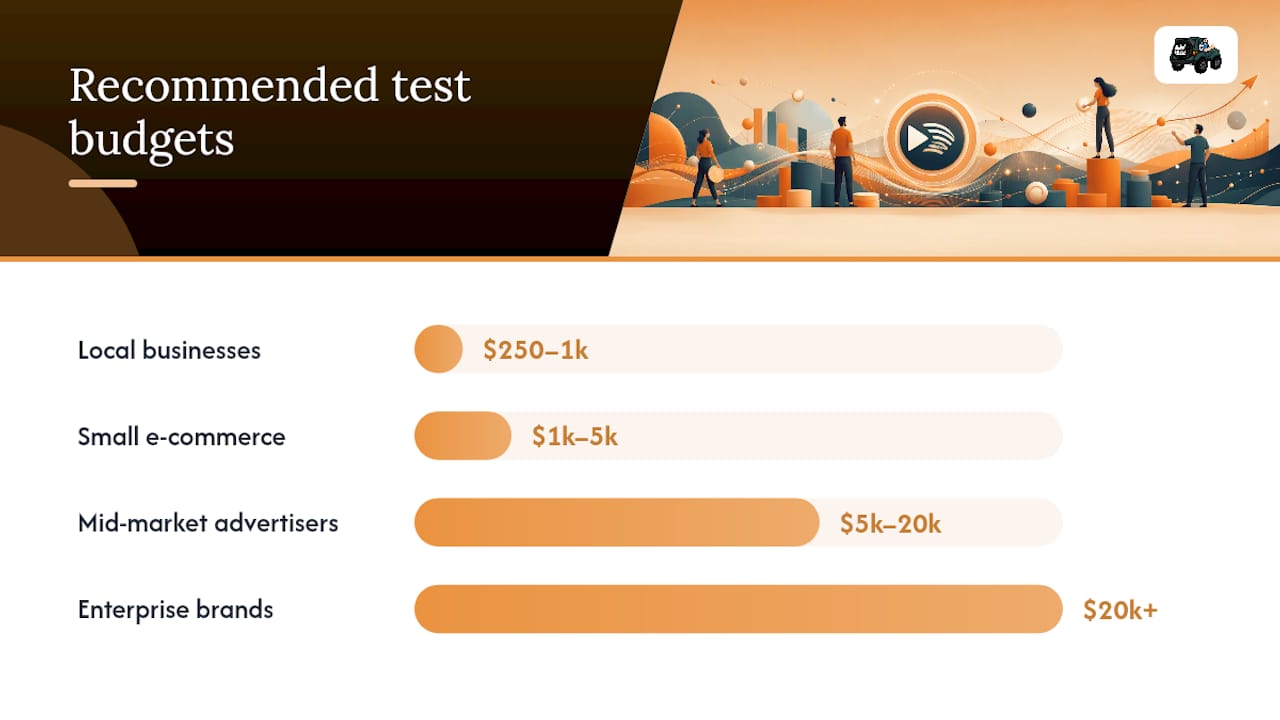
Your starting budget should match the size of your business and how much risk you can absorb while you learn what works. Rough ranges that hold up across most campaigns:
- Local businesses: $250 to $1,000 to run an initial test in a single metro area.
- Small e-commerce brands: $1,000 to $5,000 to test multiple audience segments and at least two creative versions.
- Mid-market advertisers: $5,000 to $20,000 for sustained monthly campaigns with layered targeting.
- Enterprise brands: $20,000 and up, often spread across audio, video, and podcast placements simultaneously.
The math behind any of these tiers is simple. Divide your budget by your expected CPM, then multiply by 1,000 to get estimated impressions: budget ÷ (CPM ÷ 1,000) = impressions. A $1,000 budget at an $18 CPM buys roughly 55,500 impressions. From there, apply an assumed click-through or action rate to estimate results, but treat that number as a planning input, not a guarantee.
On bidding, automated bidding is the better default for advertisers without a large history of Spotify data. It reacts to auction conditions faster than a person watching a dashboard can. Manual bid caps make more sense once you have a few campaigns’ worth of data and want to protect margin on a specific CPA target. For pacing, lean on daily budgets for always-on campaigns and lifetime budgets for anything tied to a fixed date, like a grand opening or a seasonal push.
Benchmarks and Worked Examples
Streaming audio CPMs generally sit between $15 and $25, and that range holds up whether you’re a local coffee shop or a national retailer, at least at the format level. What changes is how many impressions your budget buys and what you can reasonably expect from them.
Three quick scenarios show how this plays out:
- Local test: A $500 budget at an $18 CPM buys about 27,700 impressions, enough to gauge whether a Tampa listener segment responds to your creative before committing more.
- E-commerce launch: A $3,000 budget split across audio and display at a blended $17 CPM produces roughly 176,000 impressions, enough volume to compare two creative versions side by side.
- Mid-market monthly plan: A $12,000 monthly budget at $18 CPM generates about 666,000 impressions, which is where you start seeing frequency patterns worth optimizing against.
Impressions are not conversions. A campaign can hit every impression target and still underperform if the creative doesn’t land or the landing page doesn’t convert, so treat these numbers as a planning floor, not a success metric.
Turning CPMs Into Business Metrics
Awareness campaigns and performance campaigns need different scorecards. If you’re building brand recognition, reach and frequency tell you whether enough of the right people heard your ad enough times to remember it. If you’re chasing sales or sign-ups, CPA and ROAS are what matter, and CPM is just the raw material that feeds those numbers.
The conversion math works in steps: take your impressions, apply an assumed click-through rate, then apply an assumed conversion rate on those clicks. A campaign generating 100,000 impressions at a 0.5% CTR produces 500 clicks; at a 3% conversion rate, that’s 15 conversions. Divide your total spend by 15 to get your effective CPA.
- Set your KPI before launch, not after you see the first report.
- Use a consistent attribution window (7 day or 28 day, matched across campaigns) so month-to-month comparisons stay honest.
- Pair Spotify’s own reporting with your website analytics, since evaluating reach and frequency before layering in conversion tracking gives a cleaner read than judging an awareness buy purely on last-click sales.
A useful anchor number: at an $18 average CPM, a $5,000 monthly budget buys roughly 277,000 impressions, enough to run a meaningful two-creative test in most local or regional markets.
Testing Spotify the Right Way as a Local Advertiser
Run a phased test instead of committing your full budget on day one. Try two or three creative versions first, start with a broad audience before layering in demographic or interest filters, and get conversion tracking live before you scale spend. Only increase budget once you’ve confirmed which creative and audience combination is actually working.
Hiring an agency makes sense once you hit a wall: limited internal time for creative production, no in-house expertise in local audience targeting, or a need to blend Spotify with other channels like community publications and podcast placements for a fuller local media mix.
Pro Tip: Don’t judge a Spotify test on week one. Auction dynamics and delivery pacing need at least two to three weeks to settle before the data means anything.
What a Full Spotify Campaign Actually Costs
Media spend is only part of the number you should be planning around. A realistic total campaign cost stacks three layers: the ad spend itself (starting at the $250 platform minimum), creative production, and, if you’re not managing the buy yourself, account management fees.
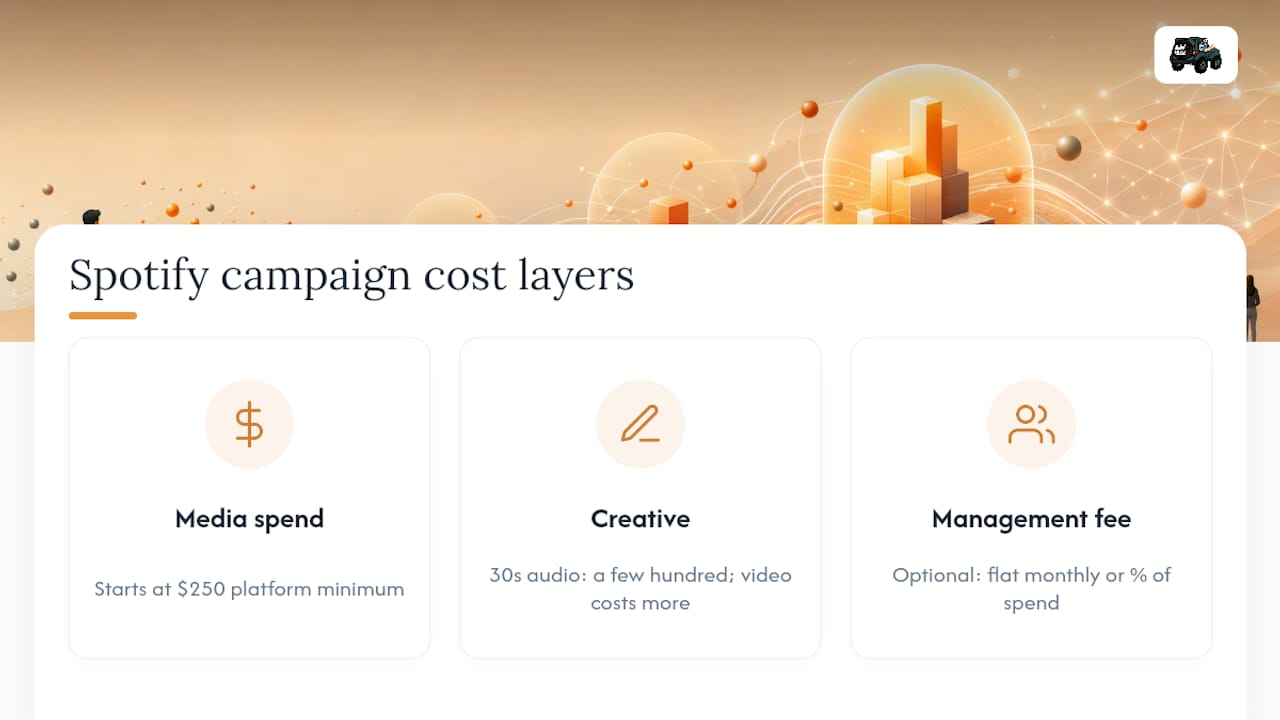
Creative production varies widely by format. A single 30 second audio spot with a professional voiceover and light sound design can run a few hundred dollars. Video ads cost more once you factor in editing and any licensed footage. Podcast host-read integrations add a flat placement fee on top of media spend, since you’re compensating the host directly for the endorsement, not just buying an impression slot.
If you’re running the campaign yourself through Ads Manager, your total cost is roughly media spend plus creative production, with no management markup. If you bring in outside help, expect a management fee structured as either a flat monthly rate or a percentage of ad spend, typically covering campaign setup, ongoing bid and budget adjustments, creative direction, and reporting.
A realistic first campaign for a local business often involves a modest media spend, a reasonable amount for creative production, and possibly a management fee if using an agency. Larger advertisers generally experience lower relative management fees due to scale.
How 16wmediagroup Helps Plan and Manage Your Spotify Campaign
Running a Spotify test on your own is doable, but most local business owners don’t have the bandwidth to build creative, monitor an auction daily, and reconcile Spotify’s reporting against actual foot traffic or sales. That’s the gap 16wmediagroup closes for advertisers who want a Tampa-area audio strategy without hiring a full internal media team.
We build media plans that put Spotify alongside the channels your audience actually uses, whether that’s a companion podcast placement, a community magazine feature, or a coordinated regional push. That blended approach tends to reduce wasted spend compared to running Spotify in isolation, because your creative and targeting stay consistent across every channel instead of getting reinvented for each platform. We also handle the reporting side, tying Spotify’s impression and CTR data back to what actually happened in your business.
If you’re ready to map out a realistic media mix and budget, start with our local advertising best practices guide or reach out directly to build a plan built around your market and your budget.
Test Small, Measure Everything, Then Scale
The advertisers who get the most out of Spotify aren’t the ones with the biggest budgets. They’re the ones who test two creatives before committing to one, set up conversion tracking before they need it, and resist the urge to judge a campaign before the auction has had time to settle. Spotify’s CPM range rewards patience and punishes advertisers who chase scale before they’ve confirmed what actually converts. Get the small test right first. The scaling math takes care of itself once you know your real numbers instead of the ones you assumed going in.
— Mike
Sources
- Spotify Ads Manager overview (US) — Ads Help
- Spotify Ads Pricing And Costs — Spotify Advertising
- Webtools