

Building local relationships lowers customer acquisition costs, drives referrals, deepens loyalty, and makes your business more resilient when things go sideways. That is the whole case in one sentence, and the evidence behind it comes from public health research, academic studies on local networks, and years of agency work watching small businesses grow through community ties instead of ad spend alone.
- The CDC links social connectedness to stronger community resilience and lower isolation, both of which shape how customers perceive and trust local brands.
- A London School of Economics discussion paper found that adding a single well-connected local “dealmaker” causally increased firm employment and sales.
- 16wmediagroup has spent years pairing local businesses with media placements and podcast features built entirely around community relationships, not cold outreach.
Pro Tip: Treat local relationship building like a marketing channel with its own budget and timeline, not a side project you get to eventually.
Key Takeaways
Local relationships lower customer acquisition costs, increase referrals, and build the kind of resilience that helps businesses survive downturns and disruptions.
| Point | Details |
|---|---|
| Trust lowers costs | Repeated local interactions reduce transaction friction, making referrals cheaper than paid acquisition. |
| Connectors matter most | A single well-connected local “dealmaker” can causally boost firm employment and sales. |
| Measure early and often | Track referral rate, repeat purchase rate, and local NPS starting at day 30. |
| Inclusion prevents backfire | Outreach that skips underserved neighborhoods reinforces bias instead of building trust. |
| Partner for speed | 16wmediagroup helps businesses turn local media, podcasts, and publishing into measurable community ROI. |
Table of Contents
- Why Build Local Relationships: The Business Case
- How Local Connections Turn Into Revenue
- 8 Practical Tactics to Build Local Relationships
- How a Local Media Partner Fits Into the Picture
- Measuring the Impact of Local Relationship Building
- Risks and Ethical Pitfalls in Community Outreach
- Your 30/60/90-Day Plan to Build Local Relationships
- A Practitioner’s View on What Actually Works
- How We Help You Build Local Relationships That Last
- Frequently Asked Questions
- Sources
Why Build Local Relationships: The Business Case
Local relationships are not a soft, feel-good add-on. They show up as hard numbers: referral rates, repeat purchase rates, and customer acquisition cost. Businesses embedded in their communities spend less to win customers because word of mouth does part of the selling for them, and they keep customers longer because loyalty grows out of familiarity, not just satisfaction.
- Referrals and word of mouth. Customers who feel connected to a business tell their neighbors, and neighbor recommendations convert faster than paid ads.
- Repeat purchases and loyalty. Familiarity breeds return visits. A regular who knows your staff by name is far less likely to switch to a competitor over a $2 price difference.
- Lower customer acquisition cost. Referral-driven customers cost a fraction of what a comparable paid lead costs, since the trust-building work already happened socially.
- Brand equity and crisis resilience. Businesses with strong community ties recover faster after disruptions, whether that’s a bad review cycle or a supply shortage, because goodwill acts as a buffer.
- Civic goodwill. Sponsorships and visible community involvement build a reputation that outlasts any single campaign.
Public health research backs the scale of this effect beyond marketing metrics. Harvard T.H. Chan School of Public Health reports that strong social connections correlate with longer, healthier lives, while loneliness and isolation are linked to markedly higher risks of illness and premature death. When your business becomes part of a community’s connective tissue, you are tapping into something people already value deeply, which is why the loyalty it generates tends to run deeper than a typical rewards program.
Map each benefit to a KPI you already track: referral rate, repeat purchase rate, local Net Promoter Score, and cost per acquisition. If those numbers move after six months of relationship-building work, you have your ROI story for stakeholders.
How Local Connections Turn Into Revenue
Local relationships create economic value through a specific mechanism: they lower the cost of trust. Every business transaction carries some friction from uncertainty. Will this vendor deliver on time? Is this new customer worth the discount? Local relationships shrink that friction because trust has already been established through repeated, low-stakes interactions.
Economists studying regional business networks call certain individuals “dealmakers”: highly connected local operators who broker introductions, deals, and information. The LSE Centre for Economic Performance found that firms which added one of these connectors to their network saw measurably higher employment and sales growth compared to similar firms that didn’t. Connection quality, not just quantity, moves the needle.
A mixed-methods study on community integration found that relationship rapport predicted community integration with a correlation of 0.268, and that longer, more meaningful interactions produced stronger rapport than brief, transactional ones.
That finding matters for how you structure local outreach: a five-minute handshake at a ribbon-cutting does less than a genuine, sustained conversation.
- Trust reduces negotiation and vetting costs between businesses and customers alike.
- Local information flow improves targeting, because connectors know who actually needs what you sell.
- Dense local networks accelerate referrals and partnership formation.
One caveat worth stating plainly: much of this evidence shows strong correlation, and the dealmaker study is one of the few to demonstrate a causal link. Treat local networking as a high-probability investment, not a guaranteed formula.
8 Practical Tactics to Build Local Relationships
None of these require an enterprise budget. They require consistency.
- Host local events or pop-ups. Success looks like: repeat attendees and new email signups. Effort: medium.
- Co-market with complementary local businesses. Success looks like: shared customer traffic and joint social mentions. Effort: low.
- Sponsor civic activities. Success looks like: logo visibility plus at least one earned media mention. Effort: low to medium.
- Tell your story through local media and podcasts. Success looks like: inbound inquiries citing the feature. Effort: medium. 16wmediagroup’s work on business storytelling through local media shows how a single well-placed feature outperforms weeks of banner ads.
- Build volunteer partnerships. Success looks like: staff morale improvements and community goodwill mentions online.
- Publish hyperlocal content. Success looks like: local search visibility gains within 60 to 90 days.
- Run neighborhood-specific referral programs. Success looks like: a measurable lift in referral rate by zip code.
- Join or start a neighborhood business network. A bike shop that supports a local cycling club sees repeat customers and word-of-mouth referrals that a generic ad campaign rarely produces.
Pro Tip: Audit your outreach list before you launch anything. If every event, sponsorship, and partnership targets the same demographic, you’re building a smaller community, not a stronger one.
A local bakery that partnered with a nearby coffee roaster for a joint tasting event saw foot traffic from an audience that had never walked through its doors before. That is the low-effort, high-return end of this playbook.

How a Local Media Partner Fits Into the Picture
Local relationship building moves faster with a partner who already has the connections and the platform. 16wmediagroup works with small and regional businesses on the pieces that are hardest to build alone: local media placements, sponsored podcast features, and community publishing that tells your story to the people already reading and listening locally.
- Traditional media placements: magazines, radio, direct mail, and regional print.
- Podcast production and guest placement that puts your business in front of engaged local listeners.
- Community publishing that highlights your involvement in neighborhood life, not just your product.
A typical engagement starts with a media plan tailored to one neighborhood or region, layers in a podcast feature or two, and builds toward a co-branded campaign with a complementary local partner. Deliverables and results vary by market and budget, so ask about a plan built around your specific customer base.
Pro Tip: Ask any media partner for examples of past regional placements before signing on. A feature in the right community magazine can outperform months of digital ads for local trust-building.
Measuring the Impact of Local Relationship Building
Track a small, consistent set of KPIs so you can show progress without drowning in spreadsheets.
Use a mix of direct tracking (referral codes, POS notes), short customer surveys, and matched cohort comparisons between neighborhoods with and without active outreach. Expect early signals by day 30, clearer trends by day 60, and enough data to report real ROI by day 90.
- Direct tracking catches referral and repeat purchase data automatically.
- Surveys catch sentiment shifts that raw transaction data misses.
- Matched cohorts isolate the effect of your local efforts from broader market trends.
Risks and Ethical Pitfalls in Community Outreach
Local relationship building can backfire if it excludes the people who need it most. Programs that only reach affluent, already-connected neighborhoods reinforce existing inequities instead of building genuine community trust.
- Excluding marginalized groups: mitigate by actively recruiting partners and voices from underserved neighborhoods, not just the loudest local networks.
- Bias on neighborhood platforms: apps and forums can amplify stereotyping. Vet any platform partnership for moderation practices.
- Privacy pitfalls: collecting customer location or behavior data for hyperlocal targeting requires transparency about how it’s used.
- Tokenism in partnerships: a one-off sponsorship photo op without follow-through erodes trust faster than doing nothing. The National League of Cities recommends inclusive, community-led design as one of the proven ways to build lasting social connection.
Pro Tip: Before launching any outreach program, ask who it doesn’t reach. That gap is often where the real opportunity sits.
Your 30/60/90-Day Plan to Build Local Relationships
- Days 1 to 30: Listen and map. Identify local connectors, audit your current local media presence, and run one small event or co-marketing test.
- Days 31 to 60: Activate. Launch two tactics from the playbook above, set up referral tracking, and start collecting early KPI signals.
- Days 61 to 90: Scale and formalize. Standardize your best-performing partnerships, fold the lessons into your broader campaigns, and present early ROI data to stakeholders.
- Week 1 checklist: list five local connectors, audit media mentions, pick one event or co-marketing test.
- Week 5 checklist: confirm referral tracking is live, schedule your second tactic.
- Week 10 checklist: draft your ROI summary using the KPI table above.
A simple timeline chart, plotting referral rate and repeat purchase rate against the 30/60/90 markers, makes this progress easy to present to any stakeholder meeting.
A Practitioner’s View on What Actually Works
The lesson that took longest to learn: relationship building fails when it’s treated as a campaign with an end date. The businesses that see real results treat it as infrastructure, something that runs quietly in the background of every quarter, not a push before a big sale. Expect early wins in referrals within 60 to 90 days, but expect the compounding value, the kind that shows up in loyalty and resilience, to take a full year or more to mature. [Author credentials and proprietary campaign data to be added.]
How We Help You Build Local Relationships That Last
You don’t have to build this playbook from scratch. 16wmediagroup exists specifically to help small and regional businesses turn local visibility into local loyalty, without the guesswork of running your first podcast feature or media placement solo.
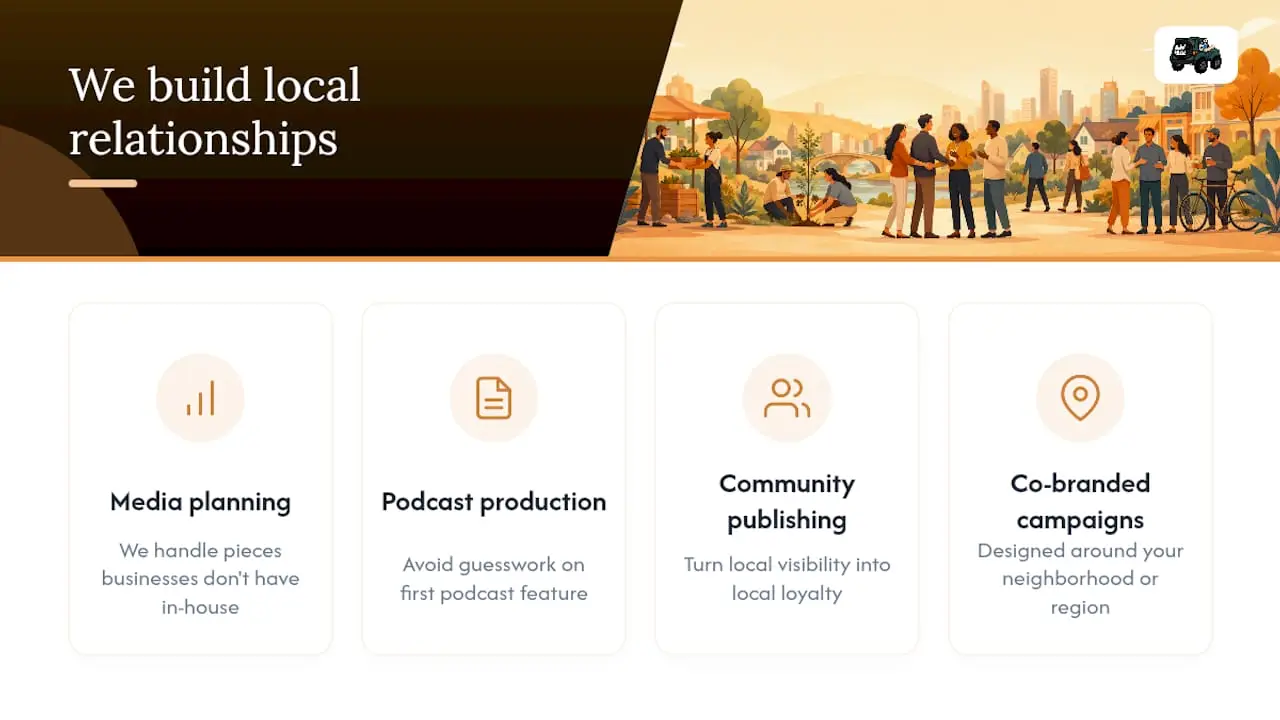
We handle the pieces most businesses don’t have in-house: media planning, podcast production, community publishing, and co-branded campaigns designed around your specific neighborhood or region. Whether you’re launching your first local ad campaign or looking to formalize partnerships you’ve already started, our local advertising campaign planning guide walks through the same 30/60/90 structure outlined above, built out with media-specific timelines and budgets.
Ready to see what a tailored plan looks like for your market? Request a 30/60/90 planning session and let’s map out where your local relationships can go next.
Frequently Asked Questions
Why build local relationships instead of just running paid ads?
Paid ads reach strangers; local relationships reach people who already trust the person who referred them. That trust shortens the sales cycle and lowers acquisition costs over time.
How long does it take to see results from local relationship building?
Early signals like referral upticks often appear within 60 to 90 days. Deeper loyalty and resilience benefits tend to compound over a year or more.
What’s the fastest tactic to start with?
Co-marketing with a complementary local business is typically the lowest-effort, fastest-to-launch tactic on the playbook.
How do I avoid excluding parts of my community?
Actively recruit partners and event participants from neighborhoods you haven’t reached yet, and audit your outreach list regularly for demographic gaps.
Can a media partner really help with this, or is it something I have to do myself?
A media partner like 16wmediagroup can accelerate the process by handling placements, podcast production, and storytelling, but the relationship-building itself still depends on genuine, consistent local involvement from your team.
Sources
- Improving Wellbeing Through Local Communities: A Mixed Methods Study on the Role of Relationship Building | Journal of Happiness Studies | Springer Nature Link
- Local social capital, dealmakers and firm performance (CEP discussion paper)
- The importance of connections: Ways to live a longer, healthier life | Harvard T.H. Chan School of Public Health
- Social connectedness | CDC
- 5 proven ways to build social connections in your community | National League of Cities