

Focus on community stories because locally rooted narratives build trust, increase discoverability, and convert more neighborhood customers than generic ads ever will. The mechanism is straightforward: people buy from businesses they recognize as part of their world, and a well-told local story makes that recognition happen faster than any billboard.
Three things make community storytelling work for local brands:
- Emotional memory: Stories activate recall in ways that feature lists simply cannot. Research cited by StoryLab points to narrative formats producing substantially higher retention than raw facts alone.
- Social proof at scale: A neighbor’s experience, told authentically, carries more weight than a polished ad. Community validation turns customers into credibility signals.
- Local search momentum: Story-driven content on Google Business Profile posts, local landing pages, and review platforms feeds the discovery signals that bring foot traffic through your door.
The sections below cover the full playbook: formats, production steps, measurement, budget, and how to find the right media partner.
Key Takeaways
Community stories build local brand trust, drive foot traffic, and compound into long-term loyalty in ways that paid ads alone cannot replicate.
| Point | Details |
|---|---|
| Research-backed impact | A systematic review of 75 studies confirms storytelling improves engagement, brand identity, and equity for SMEs. |
| Authenticity gains | MSMEs using validated local narratives reported perceived authenticity gains of roughly 35–40%. |
| Layer your formats | Pair short social teasers with long-form articles or podcasts to balance discovery and trust-building. |
| Measure at 30–90 days | Track review velocity and foot-traffic lift at 30–60 days; LTV changes take 90 days to read reliably. |
| 16wmediagroup | The agency offers community publishing, sponsored articles, podcast placement, and media planning for SMEs ready to scale. |
Table of Contents
- Why community stories work: the research behind local brand storytelling
- What formats do community stories actually take?
- How do you create a community story from scratch?
- How do you measure whether community stories are working?
- How do you get community stories seen by more people?
- What pitfalls and ethical rules should you know?
- What does community storytelling cost, and what ROI should you expect?
- What do real results from community stories look like?
- How 16wmediagroup helps you build a community story program
- Why community stories are the smartest local marketing investment
- Sources
Why community stories work: the research behind local brand storytelling
The evidence base here is stronger than most marketers realize. A 2025 systematic review of 75 peer-reviewed studies found that brand storytelling consistently improves consumer engagement, builds emotional brand identity, and contributes to long-term brand equity for SMEs. The review spans 15 years of research and identifies digital storytelling, emotional engagement, and co-creation as the mechanisms that show up repeatedly across industries and markets.
Field data backs the theory. A multi-case study of MSMEs in Malang reported perceived significant brand authenticity gains after businesses integrated validated local narratives and community collaboration into their content. The same study flags a real trade-off: short-form social platforms compress context, so depth requires a layered approach.
Authenticity gains of 35–40% were reported by MSMEs that validated local narratives with community partners, per the Malang case studies.
The four mechanisms that drive these results:
- Narrative transportation: A well-structured story pulls readers into a scene, reducing skepticism and increasing openness to the brand’s message.
- Social proof: Community voices signal that real people, not just the brand, endorse the experience.
- Memory and recall: Narrative formats outperform feature lists on retention, which is why brand storytelling best practices consistently prioritize story arc over spec sheets.
- Co-creation: When community members contribute to a story, they become invested in its success and share it organically, compounding reach without additional spend.
Community-driven marketing builds more durable growth than short-term ad spend precisely because trust compounds. A paid ad stops working the moment the budget runs out. A story lives on in search results, social feeds, and word-of-mouth long after publication.
What formats do community stories actually take?
The format you choose should match the business outcome you need, not just what’s easiest to produce.
- Sponsored long-form article: Best for deep trust-building. A 600–900 word profile of a local customer or community figure gives search engines indexable content and gives readers a reason to stay.
- Podcast episode or feature: Ideal for personality-driven brands. A 15–20 minute conversation with a neighborhood voice builds intimacy and positions your brand as a community connector. See how business storytelling through local media works in practice.
- Short social video (TikTok, Reels): Discovery-first. Use it to tease a longer story, not replace it. The depth-versus-virality trade-off is real: short posts reach more people, but they rarely build the trust that converts.
- Community magazine feature: High perceived credibility. Print and digital magazine placements signal permanence and editorial endorsement.
- User-generated content (UGC): Low cost, high authenticity. Prompts, hashtags, and small incentives get customers sharing their own experiences, which you can then repurpose across channels.
- Google Business Profile posts: Underused by most SMEs. A story-driven GBP post tied to a local event or customer moment feeds local search signals directly.
For visual storytelling, short video and strong still photography preserve authenticity while fitting platform constraints. The goal is always to layer: a social teaser drives traffic to a long-form piece, which captures email subscribers, who then receive the next story directly.
How do you create a community story from scratch?
A repeatable production process keeps quality consistent and protects you from the most common pitfalls.
- Define the goal and audience (Days 1–7): Choose one objective per story — awareness, foot traffic, or loyalty. Identify the community voice (customer, local figure, partner) whose experience best illustrates that goal.
- Secure permissions and consent (Days 7–14): Get written consent before recording or quoting anyone. Confirm how the person’s name, image, and story will be used and where it will appear.
- Conduct the interview (Days 14–21): Use open-ended prompts to get candid, specific answers. See the question template below.
- Edit and approve (Days 21–35): Share a draft with the subject for factual review. Do not over-edit their voice out of the copy.
- Publish and layer (Days 35–45): Publish the long-form piece first, then release social teasers, email excerpts, and GBP posts over the following two weeks.
- Amplify and measure (Days 45–90): Run a micro-boost on the best-performing social teaser. Track KPIs against your baseline. Collect reviews that reference the story.
Interview question template:
- What problem were you trying to solve before you found us?
- What was the moment you knew it was working?
- How has this changed your day-to-day?
- What would you tell a neighbor who’s on the fence?
- Is there anything about this neighborhood or community that made the experience feel different?
Pro Tip: Ask the subject to describe a specific moment, not a general feeling. “Tell me about the day you first noticed the difference” produces a quote ten times more vivid than “How did it go overall?”
For a full local storytelling strategies walkthrough, the 16wmediagroup podcast covers community involvement tactics step by step.
How do you measure whether community stories are working?
Set your KPIs before you publish, not after. The primary metrics that matter for local brands:
- Engagement rate on story posts (likes, comments, saves, shares)
- Website visit lift to the story landing page and to your contact or booking page
- Review velocity: how many new reviews mention the story subject or theme
- Conversion rate on story-linked offers or promo codes
- Customer lifetime value (LTV) changes among customers acquired through story content
Secondary metrics worth tracking: time on page (target 2+ minutes for long-form), referral traffic from social and email, and inbound link growth.
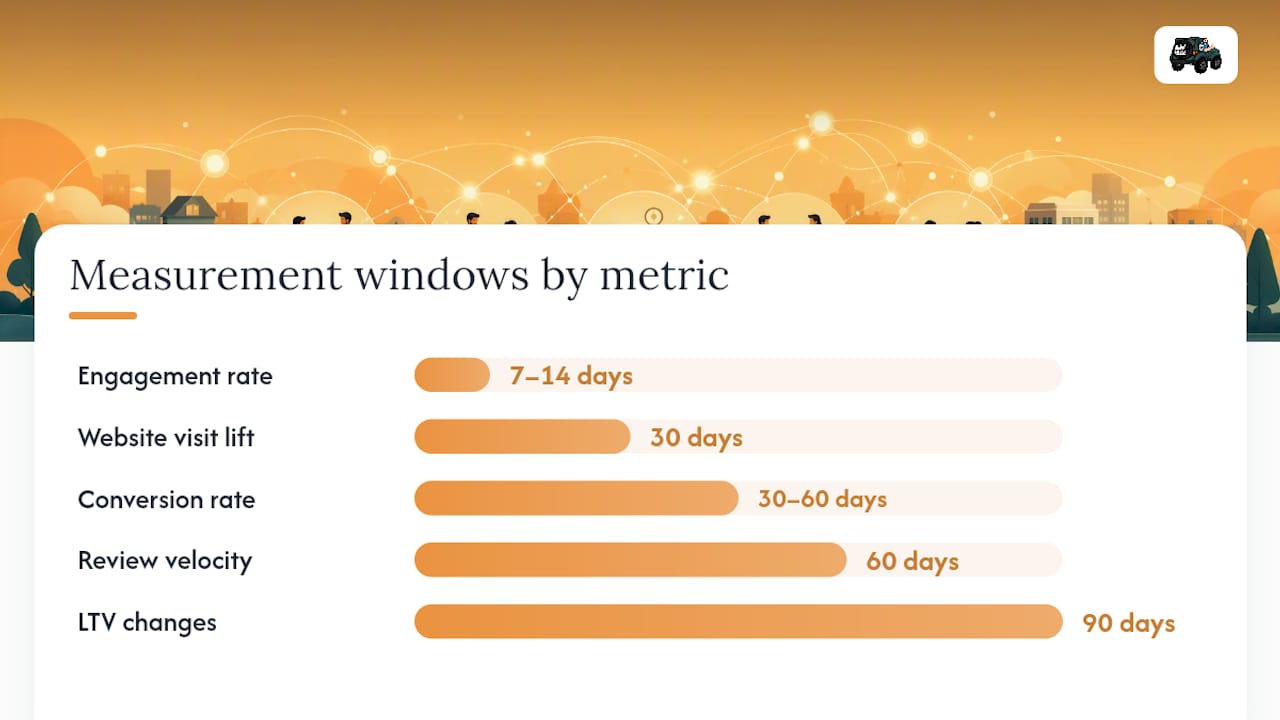
| Metric | Suggested tool | Measurement window |
|---|---|---|
| Engagement rate | Native platform analytics | 7–14 days post-publish |
| Website visit lift | Google Analytics 4 | 30 days |
| Review velocity | Google Business Profile dashboard | 60 days |
| Conversion rate | UTM-tagged links + GA4 | 30–60 days |
| LTV changes | Your CRM or POS system | 90 days |
For attribution, tag every story link with UTM parameters. Use unique promo codes for print and podcast placements. Ask new customers directly how they heard about you — store-level feedback remains one of the most reliable signals for community content.
How do you get community stories seen by more people?
Publishing is only half the job. Distribution is where most SMEs leave reach on the table.
Owned channels: Email your list with a story excerpt and a link. Post to Google Business Profile within 48 hours of publication. Add the story to a dedicated local landing page for long-term SEO value.
Earned channels: Share the story with local creators who cover your neighborhood. A creator partnership designed as a local trust system — sequenced from awareness to proof to conversion — can increase store visits and review velocity meaningfully. Prioritize creators with neighborhood credibility over raw follower counts.
Paid micro-boosts: A $200 geo-targeted boost on a strong story post extends reach to a hyper-local audience for 7–10 days. A $600 creator amplification package (one local creator, two posts, one story reshare) adds social proof. A $1,000 event-tied push works well when the story connects to a local happening. These are not awareness campaigns — they are trust accelerators layered on top of content that already works organically.
Repurpose every story across at least three formats before retiring it. A long-form article becomes a podcast talking point, an email feature, two social posts, and a GBP update. That single story asset earns its production cost many times over.
What pitfalls and ethical rules should you know?
Community storytelling done poorly damages trust faster than no storytelling at all.
Common mistakes:
- Over-editing community voices until they sound like marketing copy, which readers detect immediately
- Tokenizing community members by featuring them once for optics without genuine relationship-building
- Publishing without written consent, which creates legal exposure and breaks community trust
- Hiding sponsorship, which violates FTC guidelines and erodes credibility when discovered
The FTC requires clear, conspicuous disclosure whenever there is a material connection between a brand and the content creator or subject. “Sponsored,” “Paid partnership,” or “Advertisement” must appear where readers will see it before engaging with the content. This applies to social posts, articles, and podcast episodes alike.
For guidance on localizing your brand authentically, the 16wmediagroup podcast covers how to preserve community voice without losing brand consistency.
Ethics checklist for every story:
- Written consent from every named subject
- Clear sponsorship disclosure on every placement
- Subject review of factual claims before publication
- No fabricated quotes or composite characters
- Community partner validation where cultural narratives are involved
What does community storytelling cost, and what ROI should you expect?
Cost drivers: interview production, copywriting, photography or video, creator fees, and paid amplification. You can reduce costs by repurposing assets across formats, partnering with micro-creators who accept product or experience compensation, and using customer interviews instead of professional talent.
Realistic ROI timelines: expect early engagement signals (shares, comments, time on page) within the first two weeks. Review velocity and foot-traffic lift typically show up in the 30–60 day window. LTV and loyalty signals take 90 days or more to measure reliably. Community-driven marketing builds compounding returns — each story adds to a body of credibility that makes the next story easier to place and more trusted by readers.
What do real results from community stories look like?
Local restaurant, Tampa area: A neighborhood eatery commissioned a sponsored long-form profile of a longtime regular customer, published in a community magazine and amplified via two local creator posts. Within 60 days, the restaurant saw a measurable lift in Google reviews that referenced the featured customer’s story, and weekend reservation volume increased. Lesson: pairing print placement with creator amplification compounds reach faster than either channel alone.

Home services business: A plumbing company used customer interview videos (30–60 seconds each) posted to Google Business Profile and Instagram Reels, linked to a longer sponsored article. Review velocity doubled over 90 days, and the company’s GBP ranking for local service terms improved. Lesson: UGC video paired with a long-form anchor piece creates both discovery and trust signals simultaneously.
Retail boutique: A specialty retailer partnered with a neighborhood micro-creator to document a “day in the store” story across three posts, sequenced from awareness to a limited-time offer. Store visits from new customers increased during the campaign window, with several citing the creator’s content as their first touchpoint. Lesson: sequencing creator content from awareness to conversion, as outlined in the creator partnership playbook, produces better results than a single promotional post.
How 16wmediagroup helps you build a community story program
16wmediagroup turns community storytelling from a good idea into a running program. The agency handles community publishing, sponsored article placement, podcast features, and full media planning — so you get a coordinated story strategy, not a one-off piece.
Getting started takes three steps. First, audit your current content and identify one customer story worth telling. Second, run a pilot: one sponsored article or podcast feature, tracked with UTM parameters and a simple KPI baseline. Third, scale what works — add creator amplification, a second story, and a distribution calendar. 16wmediagroup’s branding and media services cover every stage, from story sourcing to paid amplification. Ready to build your first community story? Connect with the team to start your pilot.
Why community stories are the smartest local marketing investment
Most local businesses underestimate how much a single well-told story can do. A sponsored article that profiles a real customer, placed in a community magazine and amplified by a local creator, does three things at once: it builds search-indexed content, generates social proof, and signals to the neighborhood that your brand belongs here. Generic ads do none of that.
The brands I see winning in local markets are not the ones with the biggest ad budgets. They are the ones that have figured out how to make their neighbors the heroes of their marketing. That shift, from “look at us” to “look at them,” is what community storytelling actually is. The research backs it, the field results confirm it, and the production process is manageable for any SME willing to commit to a 90-day pilot.
Sources
- A Systematic Review of Brand Storytelling Strategies for Strengthening New Business Identity in Local Entrepreneurship Contexts
- The Power of Storytelling for Local Service Business Marketing
- Creator Partnerships That Build Local Trust
- Community-Driven Marketing: Why Local Trust Beats Paid Ads in 2026