
Dealer marketing funds, the industry term covering both Market Development Funds (MDF) and co-op advertising programs, are manufacturer-provided dollars earmarked specifically to support your local campaigns. Your first move right now: log into your manufacturer portal, check your current fund balance, confirm any claim deadlines within the next 30 days, and flag any accruals that look short to your rep.
- Check your portal balance and note the claim expiration date
- Confirm your current-quarter accrual matches your sales volume
- Escalate missing accruals to your manufacturer rep in writing
- Identify any pre-approved campaign kits available for immediate use
Pro Tip: Bundle your claims monthly rather than submitting one at a time. A single well-documented monthly submission with all invoices, screenshots, and UTM reports moves through approval faster than four scattered ones.
Key Takeaways
Dealers who treat MDF and co-op as operational levers, not accounting line items, consistently outperform those who manage them reactively. The programs reward documentation discipline, pre-approved creative use, and monthly claim batching.
| Point | Details |
|---|---|
| MDF vs. co-op distinction | MDF is upfront/discretionary; co-op accrues per unit sold and reimburses after proof of spend. |
| Pre-approve before spending | Confirm every tactic in writing before launch to avoid post-spend claim denials. |
| Track everything before launch | UTMs, unique phone numbers, and promo codes are required proof, not optional extras. |
| Batch claims monthly | Single monthly submissions with complete documentation move through approval faster. |
| 16wmediagroup manages the cycle | 16wmediagroup handles media planning, OEM compliance, tracking setup, and claim bundling for dealers. |
Table of Contents
- What are dealer marketing funds, and how do MDF and co-op differ?
- How does the MDF/co-op funding workflow actually operate?
- What can dealers actually spend MDF and co-op funds on?
- What program rules, tiers, and caps should you plan around?
- How do you measure impact and build proof of performance?
- What practices actually maximize approvals and speed reimbursement?
- How do manufacturer portals and governance work?
- Local media plays that perform for dealer MDF
- Legal and contractual considerations in MDF/co-op agreements
- How to coordinate MDF/co-op funding with your full marketing budget
- What dealers often get wrong about MDF programs
- 16wmediagroup helps dealers put co-op and MDF to work
- Sources
What are dealer marketing funds, and how do MDF and co-op differ?
The terms get used interchangeably, but they work differently in practice, and knowing which pipeline you’re drawing from changes how you plan and document your spend. According to Salesforce, MDF is provided to channel partners as discretionary or upfront support, while co-op funds are typically earned or accrued based on sales volume and paid out as reimbursements after the fact.
MDF tends to fund short-term projects: a new model launch event, a training initiative, a brand-awareness push tied to a national campaign window. Co-op is the ongoing engine, accruing per unit sold and reimbursing a share of eligible local advertising spend. 360insights describes MDF as the right tool for short-term brand or training projects, while co-op funds are better suited to continuous local advertising tied to sales performance.
| Dimension | MDF | Co-op |
|---|---|---|
| Timing | Upfront or discretionary | Accrual-based, earned per unit sold |
| Eligibility | Manufacturer-approved projects | Ongoing local advertising tied to sales |
| Proof requirements | Project outcomes, invoices | Media invoices, tearsheets, performance data |
| Typical uses | Events, launches, training | Search ads, social, radio, direct mail |
Two quick use-case examples:
- Weekend sales event: Use MDF if the manufacturer is running a national push and has allocated discretionary funds for local activations. The upfront nature means you can plan the event before you’ve sold a single unit.
- Monthly Google Search campaign: Co-op is the right fit here. Your accrual builds with every vehicle sold, and you submit proof of the media buy after the campaign runs to claim reimbursement.
How does the MDF/co-op funding workflow actually operate?
The Pedowitz Group explains that manufacturers co-fund dealer marketing by standardizing program rules, pre-approved campaigns, funding workflows, and proof-of-performance requirements. That standardization is your roadmap.
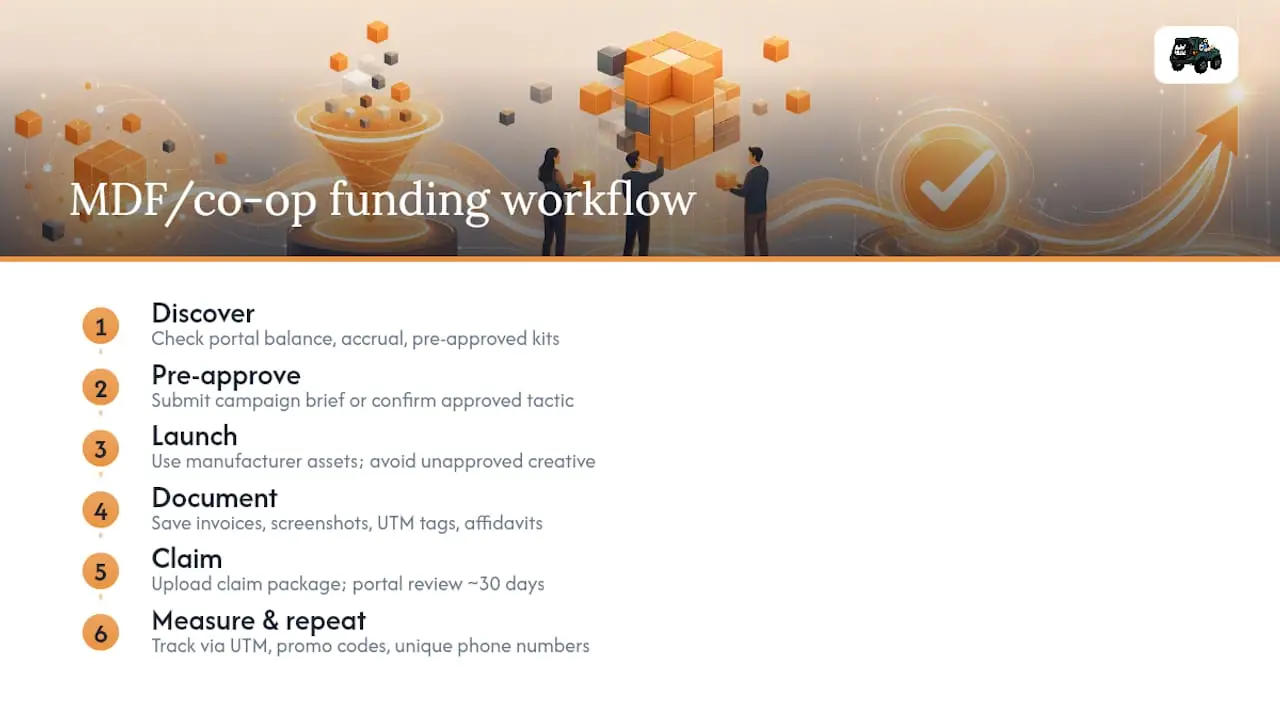
The workflow runs in five stages:
1. Discover. Log into your manufacturer portal and review your available balance, accrual rate, and any pre-approved campaign kits. Some OEMs push email alerts when funds hit a threshold; turn those on.
2. Apply or pre-approve. For MDF, submit a campaign brief before you spend. For co-op, confirm the tactic is on the approved list. Pre-approval protects you from a denial after the spend is already made.
3. Launch. Execute the campaign using brand-safe assets from the manufacturer’s asset library. Any deviation from approved creative risks a claim denial.
4. Collect proof. During the campaign, save every invoice, screenshot, media affidavit, and performance report. Tag all digital placements with UTM parameters and use unique phone numbers or promo codes so results are attributable.
5. Submit and reconcile. Upload your claim package to the portal with all required documentation. Most OEM programs target a 30-day review window, though reimbursement timelines vary. Advance-funded MDF programs pay before execution; reimbursement-based co-op programs pay after claim approval, often 30–60 days post-submission.
Think of the flow as a loop: discover → pre-approve → launch → document → claim → measure → repeat.
What can dealers actually spend MDF and co-op funds on?
Coopable confirms that co-op programs reimburse a portion of approved local marketing spend, subject to compliance with program rules and documentation. The eligible tactic list is broader than most dealers realize.
Commonly approved uses:
- Local paid search (Google Ads, Microsoft Ads) with geo-targeting
- Geotargeted social media ads (Facebook, Instagram, YouTube)
- Connected TV and OTT placements targeting your DMA
- Local radio and streaming audio
- Direct mail and targeted print
- Community magazine placements
- In-dealership experience upgrades (digital signage, event materials)
- Co-branded webinars and virtual test-drive events
- Outdoor and billboard placements in approved markets
Reimbursement rates vary by OEM and tactic. Industry roundups note that programs can cover roughly 50–75% of eligible spend depending on the manufacturer and activity type.
Assets needed: OEM-approved radio scripts, co-branded social graphics from the asset library, a unique promo code for tracking. Timeline: pre-approve four weeks out, launch two weeks before the event, submit claim within five business days of close.
Assets needed: co-branded slide deck, OEM-approved logo usage, registration landing page with UTM tracking. Timeline: pre-approve six weeks out, run promotion for three weeks, submit claim with registration data and attendance report.
Pro Tip: Pull creative assets directly from the manufacturer’s portal library. Using pre-approved templates cuts approval time and eliminates the most common denial reason: brand guideline violations. For visual storytelling that meets brand standards, strong visual execution also improves ad performance before the claim is ever filed.
What program rules, tiers, and caps should you plan around?
OEM programs are not one-size-fits-all. Brandmovers reports that average OEM incentive spend represented a notable share of the average transaction price by mid-2025, and the layered structure of co-op, training rewards, and EV adoption incentives materially shapes dealer behavior. Understanding your tier determines how much you can claim and at what match rate.
Common eligibility checklist:
- Current sales tier certification (volume thresholds vary by OEM)
- Completed required training modules for the model year
- Active dealer agreement in good standing
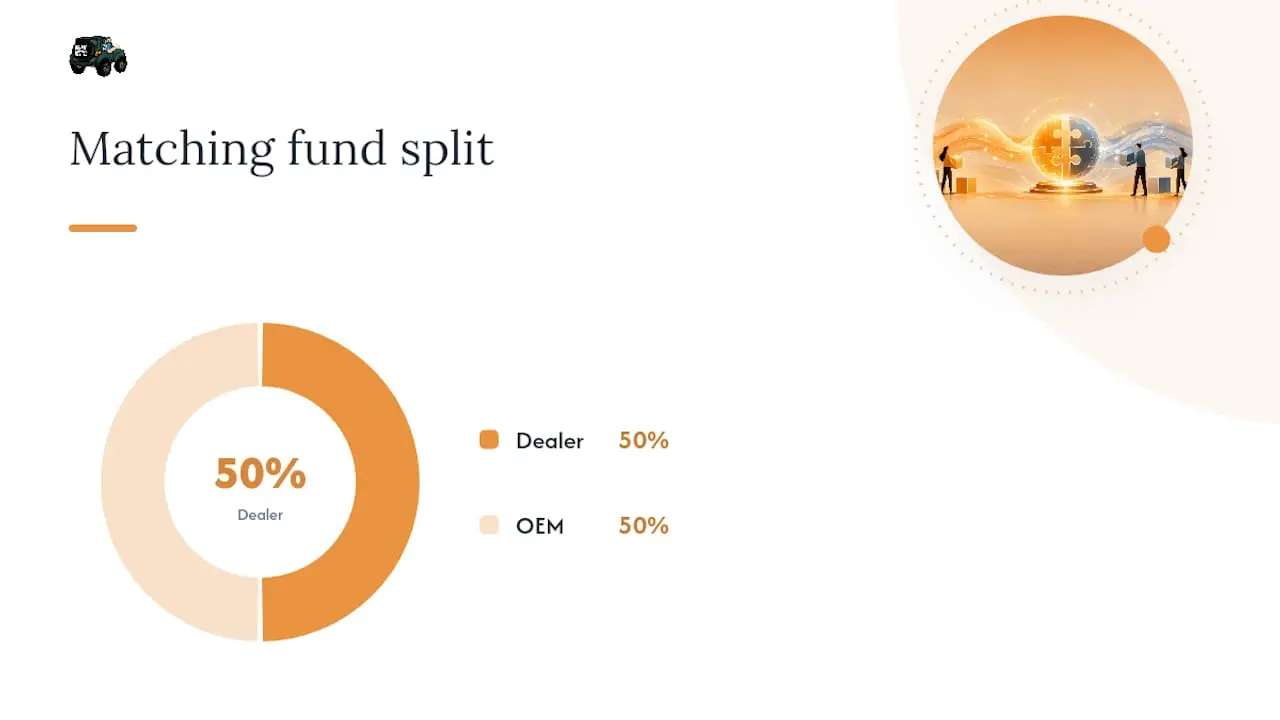
- Matching fund contribution (typically 50% dealer, 50% OEM, though rates vary)
- Spend within the approved tactic list for the program period
Accruals typically work on a per-unit basis: for every vehicle sold, a fixed dollar amount or percentage of invoice price accrues to your co-op balance. Tiered programs release higher match rates as volume climbs. MDF, by contrast, is often a lump-sum allocation tied to a specific campaign window or manufacturer initiative.
Practical budgeting example: A dealer selling 80 units per month at a $200 per-unit accrual rate builds $16,000 in monthly co-op. Plan your annual media calendar against that accrual curve, front-loading spend in high-traffic months (spring and fall sales seasons) and banking funds in slower periods for a major event push.
Pro Tip: When co-op funds are limited, prioritize tactics with the highest attribution clarity first: paid search and geotargeted social produce the cleanest proof of performance. Align your local spend calendar with the manufacturer’s national campaign windows to benefit from shared creative assets and potentially higher match rates. A solid media planning checklist keeps every spend decision tied to a measurable outcome.
How do you measure impact and build proof of performance?
Forrester’s research makes the challenge plain: demonstrating clear ROI for market development funds is difficult without disciplined measurement and governance. The dealers who get reimbursed consistently are the ones who build the tracking infrastructure before the campaign launches, not after.
KPIs manufacturers care about:
- Vehicle Detail Page (VDP) views
- Leads generated (form fills, phone calls, chat)
- Test drives scheduled and completed
- Attributed sales lift during campaign window
- Cost per lead and cost per VDP view
The performance potential is real. Autotrader reports a 104% average increase in VDP views for dealers using OEM co-op solutions, illustrating how co-op-enabled placements can measurably lift local performance.
Stat to know: Autotrader’s co-op data shows a 104% average VDP view increase for participating dealers, a benchmark worth building your own reporting against.
Tracking checklist before launch:
- Apply UTM parameters to every digital URL (source, medium, campaign, content)
- Assign unique call-tracking numbers to each campaign
- Create campaign-specific promo codes for in-store attribution
- Set up a dedicated landing page with conversion tracking
- Enable first-party lead capture with timestamp and source fields
Claim documentation fields every submission needs:
- Campaign name and dates
- Total spend and dealer match percentage
- Media invoices with line-item detail
- Screenshots of live placements
- Landing page performance report (sessions, conversions)
- Phone call log or recording summary
- Expected vs. actual outcomes narrative
Measurement discipline, UTMs, unique numbers, and matched sales data, is what separates programs that show ROI from those that become accounting headaches. Build the habit of saving proof assets in a shared folder organized by campaign and claim period.
What practices actually maximize approvals and speed reimbursement?
Getting the funds is one thing. Getting reimbursed cleanly and quickly is the operational skill that compounds over time.
Repeatable checklist for every campaign:
- Use manufacturer-provided pre-approved creative kits for every execution
- Batch all claims for a given month into a single submission
- Negotiate match rates annually during dealer agreement renewals
- Schedule a quarterly audit to catch missing accruals before they expire
- Keep a running claim log with status, submission date, and expected payment date
- Assign one internal owner for all MDF/co-op administration
Sample language for portal requests (paste and adapt):
- “Requesting pre-approval for [campaign type] targeting [geography] from [start date] to [end date], estimated spend $[X], using OEM-approved assets from [asset library name].”
- “Submitting claim for [campaign name], period [dates], total eligible spend $[X], dealer match $[X], attached: invoices, screenshots, UTM report, call log.”
Common denial reasons and how to avoid them:
- Brand guideline violations: Always use assets from the manufacturer portal, never third-party creative
- Missing or incomplete invoices: Require itemized invoices from every vendor before the campaign ends
- Expired claim window: Set calendar reminders 15 days before every claim deadline
- Ineligible tactic: Confirm tactic approval in writing before spending, not after
- Insufficient proof of performance: Attach UTM reports, call logs, and screenshots as a standard package, every time
How do manufacturer portals and governance work?
Most OEM programs run through a dedicated web portal that handles balance visibility, asset access, claim submission, and payment tracking. Understanding the portal’s features, and its limits, saves hours of back-and-forth with your rep.
Common portal features:
- Real-time fund balance and accrual history
- Pre-approved asset library with downloadable creative
- Claim submission with document upload
- Approval status tracker and payment timeline
- API or SFTP reporting feeds for dealers with in-house analytics
When a claim gets stuck, the escalation path matters. Start with the portal’s internal messaging tool to create a documented record. If no response within five business days, escalate to your manufacturer rep by email with the claim number and submission date in the subject line. For unresolved disputes beyond 30 days, most OEM agreements include a formal dispute resolution process, typically outlined in the program terms.
Manufacturers that standardize pre-approved campaign kits and automate claims see higher dealer participation and lower fraud risk, which means your compliance with the portal workflow directly benefits your approval rate.
Governance basics every dealer should have:
- A documented SOP for claim submission, including who owns each step
- A shared drive or folder structure organized by program year and campaign
- Monthly reconciliation of portal balance against your internal accounting
- An annual review of program terms to catch rule changes before they cause denials
Local media plays that perform for dealer MDF
The best media mix for local brands combines channels that reach your DMA with precision and produce the kind of documented proof manufacturers expect. At 16wmediagroup, we see consistent results from a specific set of local-media plays when they’re paired with proper tracking.
Tactics with strong MDF/co-op performance:
- Local radio with geotargeted CTV: drives VDP view lifts and builds brand recall across commute and prime-time windows
- Direct mail to conquest zip codes: produces measurable service booking lifts with unique promo codes as proof
- Community magazine placements: builds brand authority and generates documented impressions for co-op claims
- Geotargeted social with OEM creative: highest attribution clarity, easiest claim documentation
A local media agency’s role in this process goes beyond placing ads. At 16wmediagroup, we handle creative compliance review against OEM brand guidelines, claim bundling and documentation, UTM and call-tracking setup, and monthly reporting packages formatted for manufacturer submission. Local media paired with precise tracking, unique landing pages and promo codes, reliably produces the proof manufacturers expect for local ad reimbursement.
For dealers looking to expand their community marketing reach, local publishing and podcast placements are increasingly accepted under MDF programs as brand-awareness tactics with documented distribution metrics.
Legal and contractual considerations in MDF/co-op agreements
MDF and co-op agreements are binding contracts, and the fine print carries real financial exposure. Before you spend a dollar, read the program terms for the current model year.
Key clauses to review include the definition of eligible expenses, the claim submission window (funds often expire if unclaimed within 90–180 days), the audit rights the manufacturer retains, and the clawback provisions that apply if a claim is later found non-compliant. Some agreements require dealers to maintain records for two to three years post-claim.
Misrepresenting spend, submitting duplicate claims, or using non-approved vendors can trigger clawbacks and, in serious cases, jeopardize the dealer agreement itself. The Federal Trade Commission’s co-op advertising guidelines require that promotional allowances be offered on proportionally equal terms to competing dealers, which affects how manufacturers structure their programs and how dealers can use the funds.
One practical safeguard: never submit a claim for a tactic you haven’t confirmed is on the approved list in writing. A pre-approval email from your manufacturer rep is documentation worth keeping.
How to coordinate MDF/co-op funding with your full marketing budget
MDF and co-op dollars work best when they’re integrated into your total marketing plan, not treated as a separate, reactive spend. The goal is to use manufacturer funds to amplify what you’d spend anyway, not to replace your own investment.
Start by mapping your annual media calendar against your expected co-op accrual curve. Manufacturer-funded campaigns should cover the channels and tactics the OEM prioritizes: new model launches, national campaign windows, and brand-awareness placements. Your own budget fills the gaps: conquest campaigns, service department promotions, and local community sponsorships that may not qualify for co-op.
Lead nurturing strategies that follow up on MDF-funded lead-gen campaigns are a strong use of dealer-owned budget, since manufacturers rarely fund post-lead follow-up. Pairing a co-op-funded awareness push with a dealer-funded email or retargeting sequence captures more of the value from the initial spend.
A practical rule: if a tactic qualifies for co-op or MDF, fund it through the program first. Reserve your own dollars for tactics that don’t qualify, and for the match contribution the program requires. That discipline stretches your total marketing budget further than treating the two pools as interchangeable. For a deeper look at how localized marketing strategies can align with manufacturer objectives, the channel choices and KPI frameworks translate directly to co-op-eligible campaign planning.
What dealers often get wrong about MDF programs
Most dealers leave money on the table not because the programs are hard to use, but because the administration gets treated as an afterthought. The fund balance sits in the portal, the claim deadline passes, and the accrual expires. It happens at dealerships of every size.
The deeper issue is framing. MDF and co-op are often managed by the same person juggling inventory, vendor relationships, and floor traffic. When a claim requires a UTM report, three invoices, and a screenshot of a live placement, it feels like paperwork. But that documentation is the product. It’s what converts manufacturer dollars into reimbursed spend and, eventually, into a track record that earns you better match rates and earlier access to discretionary MDF.
The dealers who consistently maximize their programs treat claim documentation as a campaign deliverable, not an afterthought. They build the tracking before the campaign launches, assign a single internal owner, and batch submissions monthly. That rhythm, once established, runs almost automatically.
16wmediagroup helps dealers put co-op and MDF to work
Running co-op and MDF campaigns correctly takes more than a media buy. It takes pre-approved creative, clean tracking, and claim documentation that survives manufacturer review. 16wmediagroup handles the full cycle for dealer clients: localized media planning across traditional and digital channels, OEM brand-compliance review, UTM and call-tracking setup, claim bundling, and monthly reporting packages ready for portal submission.
Our local advertising campaign planning guide walks through the channel choices and documentation steps that align with manufacturer requirements. For dealers ready to stop leaving co-op dollars on the table, the next step is a conversation about your current fund balance and where your local campaigns have room to grow. Reach out to 16wmediagroup to schedule a media planning session and put your manufacturer funds to work.
Sources
The following sources informed the definitions, statistics, and program guidance throughout this guide.
- In search of ROI for market development funds | Forrester
- What Are Marketing Development Funds (MDFs)? | Salesforce
- How do manufacturers co-fund dealer marketing? | The Pedowitz Group
- Understanding the Basics of Auto Dealer Co-op Programs | Coopable