
Running a small business in Tampa means competing for attention in one of Florida’s fastest-growing markets. Generic media plans, the kind that treat every customer the same and scatter ads across every channel, routinely waste budget and produce forgettable results. If you want to know how to develop a personalized media plan that actually moves the needle, the answer starts with understanding that 71% of consumers expect personalized interactions and 76% get frustrated when they don’t get them. This guide walks you through every stage, from setting goals to measuring ROI, so you can build a strategy your Tampa customers will actually respond to.
Table of Contents
- Understanding the essentials: what you need before building your media plan
- Step-by-step process to develop your personalized media plan
- Leveraging technology and AI to boost personalization and campaign effectiveness
- Measuring success and refining your personalized media plan for maximum ROI
- Why most small business media plans fail without continuous iteration and local focus
- How 16W Media Group helps Tampa businesses develop and execute personalized media plans
- Frequently asked questions
Key Takeaways
| Point | Details |
|---|---|
| Understand your audience | Gather detailed data on your customers to tailor messages effectively. |
| Set clear goals and KPIs | Define measurable objectives to guide your media planning and measure success. |
| Use dynamic segmentation | Update audience groups in real time to maintain relevance and engagement. |
| Leverage AI-powered tools | Apply AI to create personalized content and automate campaign management efficiently. |
| Measure and optimize continuously | Regularly track performance and refine your media plan to maximize ROI. |
Understanding the essentials: what you need before building your media plan
Before you touch a single channel or write one ad, you need three things locked in: clear goals, deep audience knowledge, and reliable data. Skipping this foundation is exactly why most local media plans underperform. You end up spending money on the right channels for the wrong people, or the right people at the wrong time.
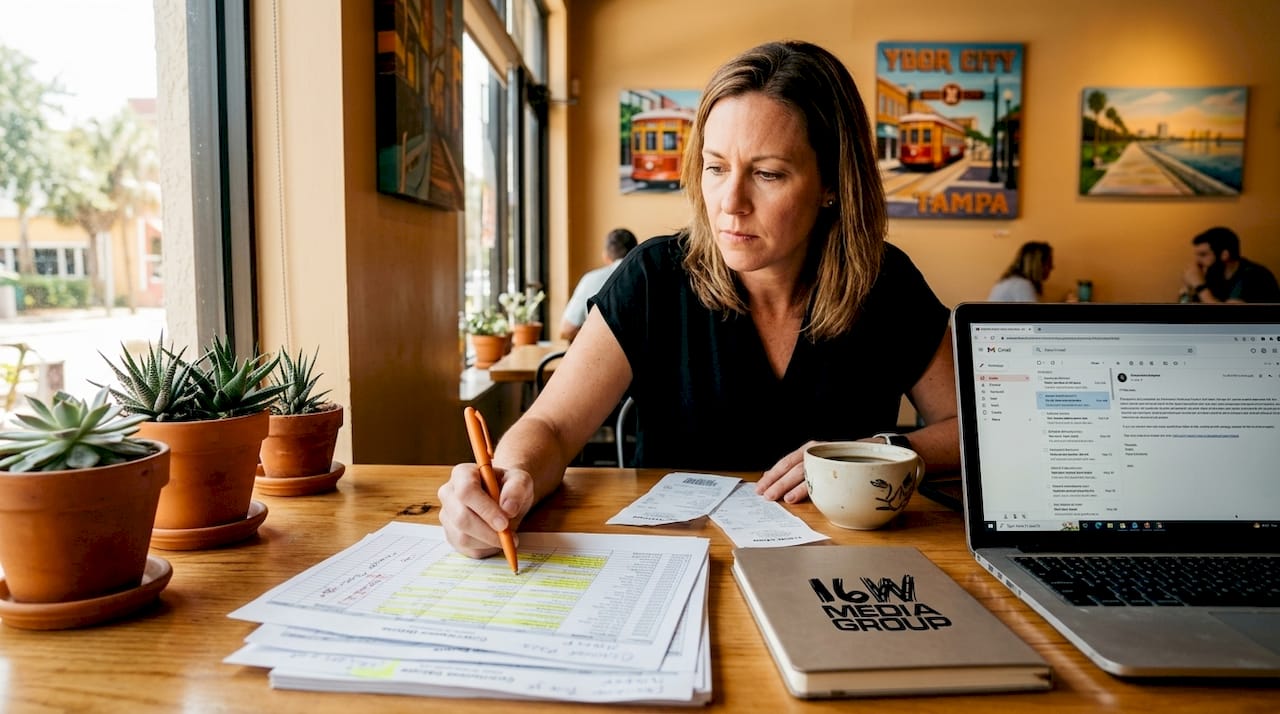
Start with goals that are specific and measurable. A goal like “get more customers” tells you nothing. A goal like “increase foot traffic by 20% over 90 days” gives you something to plan around. Setting SMART goals and KPIs before channel selection is the single most important step in building a media plan that produces measurable results. Your goal shapes everything downstream: budget, timing, channel mix, and how you define success.
Know your audience at a granular level. Tampa is not a monolith. A boutique in South Tampa draws a very different customer than a family-owned HVAC company serving Brandon or a restaurant near Ybor City. Before you spend a dollar, document:
- Demographics: age, income, household size, profession
- Psychographics: values, lifestyle interests, buying motivations
- Media habits: which platforms they use, when, and how often
- Local context: neighborhood, community events, seasonal behaviors
Audit your data quality before you build. Personalization is only as good as the data feeding it. If your customer list is three years old and scattered across a spreadsheet, a CRM, and a stack of business cards, no amount of creative planning will save you. Integrate your platforms early.
Here’s a quick snapshot of realistic budgets as you plan:
| Business stage | Monthly budget range | Primary focus |
|---|---|---|
| Early/testing phase | $500 to $800 | One to two channels, build audience data |
| Growth phase | $800 to $1,500 | Multi-channel, content + paid |
| Scaling phase | $1,500 to $2,000+ | Full mix, automation, retargeting |
Pro Tip: Don’t split your budget evenly across channels just to feel thorough. Start with the one or two places your audience is most active and master those before expanding.
With these basics clarified, the next step is to map out the step-by-step process for building your personalized media plan.
Step-by-step process to develop your personalized media plan
What is personalized media planning, exactly? It’s the practice of matching your marketing messages, timing, and channels to the specific behaviors and preferences of defined audience segments, rather than broadcasting one message to everyone. Here’s how to execute it from the ground up.
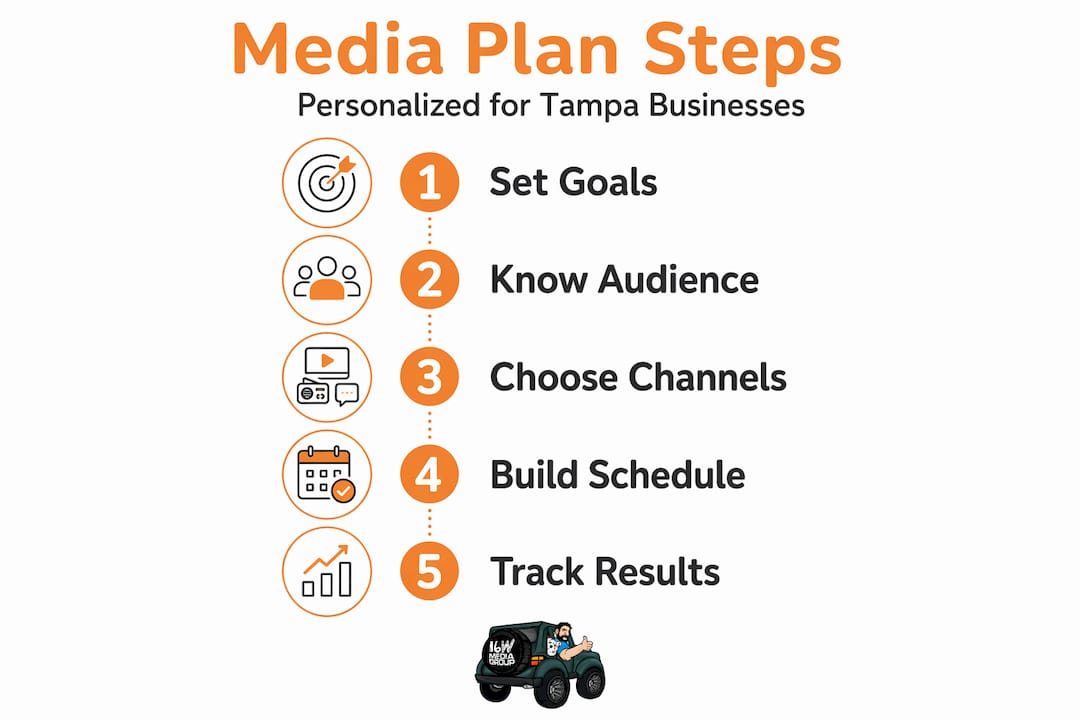
Media planning involves seven key steps including goal-setting, audience research, channel selection, budgeting, scheduling, tracking, and return on ad spend (ROAS) analysis. Here’s how those steps look in practice for a Tampa small business:
-
Define your audience segments. Don’t work from static lists. Group customers by behavior, purchase stage, and local context. A Tampa customer who attended a community event and a customer who found you through Google Search need different messages.
-
Choose channels based on data, not habit. Tampa residents index high on mobile usage, social media, local podcast listening, and community publications. Balance digital channels (social ads, email, search) with traditional touchpoints (community magazines, local radio, event sponsorships) based on where your specific segments actually spend their time.
-
Build content that adapts to lifecycle stage. A first-time visitor to your website needs awareness-focused content. A returning customer who hasn’t bought in 60 days needs a re-engagement message. A loyal customer needs something that makes them feel valued. One message doesn’t serve all three.
-
Schedule with local timing in mind. Tampa’s seasonal calendar matters. Tourist season, major events like Gasparilla, back-to-school periods, and summer humidity that keeps people indoors all affect consumer behavior. Plan your campaign calendar around these rhythms, not just national averages.
-
Allocate budget by expected ROI, not equal distribution. If email marketing consistently drives three times the return of display ads for your business, shift spend accordingly. Revisit allocation monthly.
Here’s a comparison to clarify what separates tailored media plan development from generic approaches:
| Approach | Audience targeting | Content | Optimization |
|---|---|---|---|
| Generic media plan | Broad demographics | Single message | Reviewed quarterly |
| Personalized media plan | Behavioral segments | Adapted by lifecycle | Reviewed weekly |
| Tailored media plan (advanced) | Real-time dynamic segments | AI-assisted variations | Continuous A/B testing |
Pro Tip: Review your media planning steps in Tampa through the lens of your customer journey, not just your product catalog. Customers buy solutions to problems, not features.
Now that you know the key steps, let’s discuss how to use technology and tools to scale your personalization effectively.
Leveraging technology and AI to boost personalization and campaign effectiveness
Technology doesn’t replace good strategy. It accelerates it. For Tampa small business owners who don’t have a marketing department, the right tools can make a personalized approach achievable without a full-time team.
AI-driven promotions and generative AI for tailored content at scale are now the factors that separate successful personalization from average efforts in competitive markets. You don’t need a Fortune 500 budget to access this. Here’s how to put it to work:
-
Use AI content tools to generate message variations. Instead of writing one email for your whole list, write three versions tuned to different segments. AI tools can help you produce these variations quickly, test subject lines, and identify which versions resonate.
-
Implement real-time data sync. Consistent real-time data ingestion and identity resolution are what enable audience segments to stay fresh and content delivery to stay relevant. If your ad platform doesn’t know that a customer made a purchase yesterday, you’ll waste money showing them an ad for something they already bought.
-
Deploy behavioral triggers. When a customer visits your pricing page but doesn’t convert, trigger a follow-up ad or email within 24 hours. When someone makes a second purchase, trigger a loyalty message. These automations require setup time upfront but run with minimal ongoing effort.
-
A/B test every week, not every quarter. Without dynamic segments updating in real-time, personalization drifts. Weekly A/B testing can boost engagement by 20 to 40% before you scale budgets. Test one variable at a time: subject line, image, call to action, or offer.
-
Avoid siloed data systems. If your email platform, ad account, and CRM don’t talk to each other, your personalization is already broken. A unified customer data platform, even a simple one, dramatically improves your targeted media campaigns outcomes.
Pro Tip: Before buying any new marketing tool, ask one question: does this connect to the platforms I already use? A tool that lives in isolation creates more problems than it solves.
With the technology foundation established, it’s critical to monitor and measure your media plan’s success for ongoing improvement.
Measuring success and refining your personalized media plan for maximum ROI
Building the plan is only half the job. What separates businesses that scale from those that stall is what they do after the campaign launches. Measurement isn’t a report card. It’s a decision-making tool.
Start with KPIs tied directly to your goals. If your goal is foot traffic, track store visits and local landing page conversions. If it’s online sales, track revenue per campaign and cost per acquisition. Vanity metrics like impressions and follower counts feel good but rarely pay rent.
| KPI | What it measures | Review frequency |
|---|---|---|
| Cost per acquisition (CPA) | Efficiency of spend | Weekly |
| Return on ad spend (ROAS) | Revenue generated per dollar | Weekly |
| Engagement rate | Content relevance to audience | Weekly |
| Customer retention rate | Long-term loyalty | Monthly |
| Revenue growth | Overall business impact | Monthly |
Use dashboards you’ll actually check. A reporting setup you ignore is the same as no reporting at all. Keep it simple. One dashboard with your five most important numbers, reviewed every Monday morning, beats a complex analytics setup that gets opened once a quarter.
Companies that excel at personalization generate 40% more revenue from marketing than average performers. That gap comes directly from measurement and iteration, not from spending more. Personalization strategies can boost subscription and recurring revenue by 15 to 25% while improving both engagement and churn rates.
Solicit direct customer feedback. Surveys, in-store conversations, and social media comments tell you things your data never will. Ask customers what content they found useful, what felt irrelevant, and what would make them more likely to return.
“The businesses that win in Tampa aren’t the ones with the biggest budgets. They’re the ones that listen, adjust, and show up with the right message at the right time.”
Commit to at least three to six months of tracking. Tracking performance over three to six months gives you enough data to identify real trends rather than reacting to weekly noise. One slow week in January is not a reason to scrap your entire strategy. Review your local marketing ROI over time to understand what’s actually working before making major pivots.
Why most small business media plans fail without continuous iteration and local focus
Here’s the uncomfortable truth most marketing guides skip: a personalized media plan is not something you build once and deploy. Treating it that way is the number one reason plans underperform.
Without dynamic segments updating in real-time, personalization drifts. Your audience changes. Tampa’s market shifts. New neighborhoods develop, new businesses open, and the customers who responded to your messaging six months ago may have completely different needs today.
The businesses we see fail at this most often are the ones that did the hard work upfront, built a solid plan, launched well, and then let it run on autopilot. They mistake “launched” for “done.” Media planning is an ongoing process, not a project with a finish line.
What the successful Tampa businesses do differently is this: they stay connected to their local context. A message that lands in February during Gasparilla season is not the same one you run in August. A customer segment that was highly engaged in spring may go quiet in summer and re-engage in the fall. These patterns are uniquely local, and they don’t show up in national marketing templates.
Technology is necessary, but it’s insufficient on its own. An automated system running on stale data produces confidently wrong results. Human oversight, someone who knows Tampa, knows your customers, and knows when something feels off, is what turns good technology into great outcomes. The best approach pairs localized marketing strategies with real-time data and genuine community understanding. Neither works as well without the other.
How 16W Media Group helps Tampa businesses develop and execute personalized media plans
Building a personalized media plan from scratch, while running a business, is genuinely hard. Most small business owners in Tampa know what they want to achieve. They just don’t have the time or team to execute it at the level the market demands.
That’s exactly where 16W Media Group steps in. We build custom media plans specifically designed around Tampa market dynamics, your audience’s real behaviors, and your actual business goals, not a generic template. Our approach combines digital, traditional, and community channels, including local publications, podcasts, and targeted ad campaigns, to create the kind of broad, consistent presence that builds real brand recognition.
You get access to advanced analytics and AI-driven personalization tools without needing to become a tech expert. And because we’re embedded in the Tampa market, our localized marketing expertise means your campaigns reflect what’s actually happening in your community. We provide ongoing optimization based on live performance data, so your plan improves over time rather than fading out. If you’re ready to stop guessing and start growing, explore our targeted campaign guidance and find out what a purpose-built media plan can do for your business.
Frequently asked questions
What is a personalized media plan?
A personalized media plan customizes your marketing messages and channel choices to match your target audience’s specific preferences, behaviors, and lifecycle stage, resulting in higher engagement and stronger ROI than one-size-fits-all approaches.
How much should a small business budget for a personalized media plan?
Small businesses typically allocate between $500 and $2,000 per month, depending on their goals, the channels selected, and how aggressively they want to grow.
How does AI improve personalization in media plans?
AI enables rapid, scalable creation of tailored content variations and dynamic audience segmentation, improving message relevance and campaign performance without requiring a large team.
How often should media plans be reviewed and adjusted?
Monitor campaigns continuously and conduct a formal review at least monthly. Adapting over three to six months based on KPI trends gives you enough data to make meaningful, confident adjustments.
What are common mistakes to avoid in personalized media planning?
The biggest pitfalls are relying on static audience segments, ignoring Tampa’s local market nuances, and skipping regular testing. Without real-time segment updates, your personalization drifts and campaigns lose effectiveness faster than you’d expect.