
Digital media services for advertisers are the managed planning, buying, creative, and measurement solutions brands use to reach audiences across search, social, programmatic display, CTV, audio, and commerce channels. Think of them as the full operational engine behind a campaign: from the first audience brief to the final attribution report.
Before you read further, map your primary goal to one of three service paths:
- Direct-response / performance: You need conversions, leads, or sales. Prioritize search (Google Ads), social (Meta Ads), and Amazon Ads with CPA and ROAS as your north-star KPIs.
- Brand / awareness: You need reach and recall. Prioritize CTV, programmatic display via The Trade Desk or DV360, and YouTube pre-roll.
- Local market activation: You need foot traffic, community recognition, or regional share. Prioritize localized digital targeting layered with community publishing and podcast placements.
Three trust signals to check before you commit to any provider: documented case study results with named metrics, verified platform certifications (Google Partner, Meta Business Partner), and a clear written privacy and first-party data policy.
Table of Contents
- What do digital media services actually cover?
- Which services and channels fit your campaign goals?
- How does a campaign actually get built and run?
- What do digital media services cost, and how long until you see results?
- Agency, in-house, or platform-managed: which model fits you?
- How do you measure whether a campaign is working?
- What should you know about privacy and first-party data?
- How do you evaluate and choose the right provider?
- How 16wmediagroup approaches digital media for regional brands
- Key Takeaways
- The mistake most local advertisers make with digital media
- What 16wmediagroup can do for your next campaign
- Useful sources for further reading
What do digital media services actually cover?
Digital advertising spans paid, owned, earned, and shared media. A full-service provider ties all four together into what the industry calls a full-funnel media strategy. In practice, that means six capability areas working in parallel.

Media planning translates your budget and objectives into a channel mix, flight schedule, and audience strategy. Media buying executes that plan, whether through programmatic auctions, private marketplace deals, or direct reserved buys on premium publishers. Creative and ad ops handles asset production, trafficking, and quality assurance so ads actually serve correctly. Measurement and analytics tracks performance against KPIs and feeds optimization decisions. Audience strategy and data builds the targeting architecture using first-party signals, third-party data, and identity solutions. Adtech integrations connects your CRM, DMP, and analytics stack to the buying platforms.
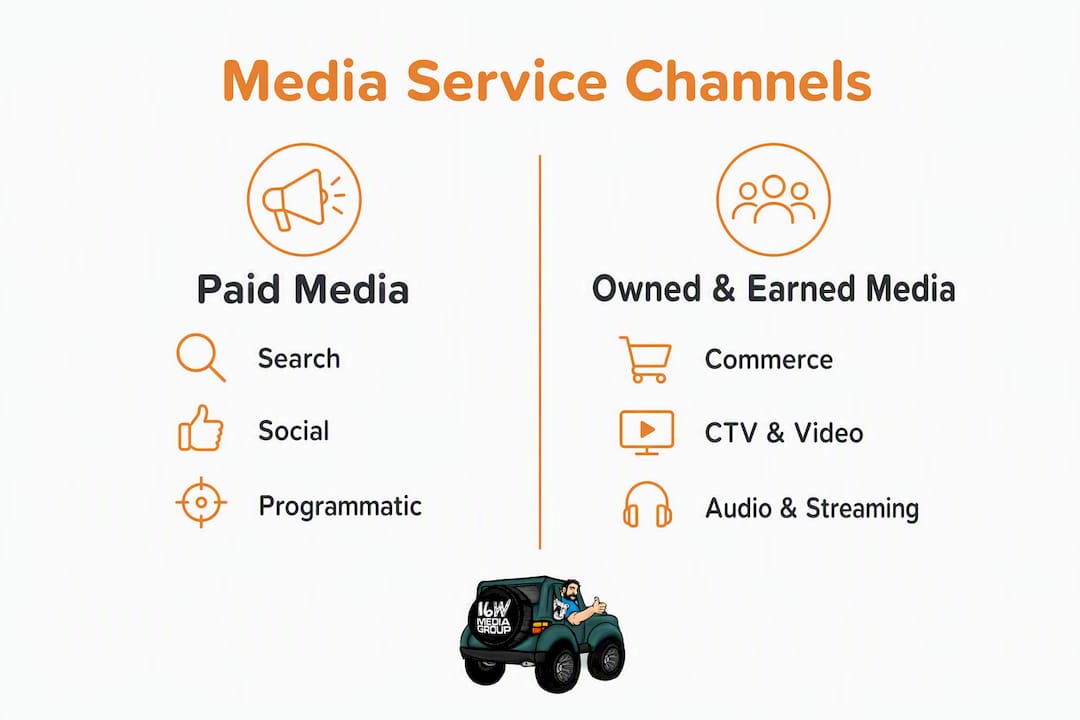
Channels covered at a glance: search, social, programmatic display, video and CTV, audio and streaming, commerce media, and owned media activation. A managed service should deliver a written media plan, defined audience segments, a trafficking sheet, and a recurring campaign performance report. If a provider cannot show you those four deliverables upfront, keep looking.
Which services and channels fit your campaign goals?
The table below maps core capabilities to channels, cost profiles, and best-fit use cases. Use it to identify the service mix that matches your objective.
| Capability / Channel | Platforms | Targeting Precision | Cost Profile | Best Use Case |
|---|---|---|---|---|
| Search (paid) | Google Ads | High (intent-based) | CPC, moderate to high | Direct-response, lead gen |
| Social | Meta Ads (Facebook & Instagram) | High (behavioral + demo) | CPM / CPC, flexible | Acquisition, retargeting, brand |
| Programmatic display | The Trade Desk, DV360 | Medium–high (audience + context) | CPM, low to moderate | Awareness, retargeting at scale |
| Video / CTV | YouTube, DV360, CTV networks | Medium–high | CPM, moderate to high | Brand lift, upper-funnel reach |
| Audio / streaming | Programmatic audio, podcast buys | Medium | CPM, moderate | Awareness, local market reach |
| Commerce media | Amazon Ads | Very high (purchase intent) | CPC / CPM, variable | Product discovery, conversion |
| Community publishing | Local magazines, owned digital | Hyper-local | Flat fee / CPM | Local trust, foot traffic |
For a direct-response campaign, search plus social is the workhorse combination. Google Ads captures in-market intent; Meta Ads layers on behavioral targeting to reach people before they search. For upper-funnel brand work, CTV via DV360 or The Trade Desk delivers premium video inventory at scale, while YouTube adds a cost-efficient mid-funnel layer. Local market activation benefits from pairing targeted digital buys with community publishing, a channel national platforms simply cannot replicate.
Pro Tip: When you’re building a social media advertising plan, start with one objective per campaign. Mixing awareness and conversion goals in a single ad set confuses the algorithm and inflates your cost per result.
Audience segmentation is the connective tissue across all of these channels. Understanding how segmentation works before you brief a provider will sharpen every targeting decision you make.
How does a campaign actually get built and run?
The operational flow has six stages, and knowing them helps you hold any provider accountable.
- Onboarding and briefing — You share business objectives, budget, audience data, and brand guidelines. The agency audits your existing pixels, tags, and CRM data.
- Optimization. The team monitors delivery, adjusts bids, rotates creative, and reallocates budget toward top-performing placements. Programmatic advertising platforms use algorithmic bidding to do much of this in real time.
Essential terms to know:
Google Marketing Platform integrates campaign management and analytics so teams can optimize across walled gardens without jumping between disconnected dashboards. AI-assisted tools are also accelerating this stage, with algorithmic budget allocation reducing manual A/B testing cycles for performance teams.
What do digital media services cost, and how long until you see results?
Pricing structures vary by provider type and campaign complexity. Several models are common in the market.
Retainer: A fixed monthly fee covering strategy, management, and reporting. Works well when you need consistent, ongoing campaign management and want predictable costs. Common for regional and national brands running always-on programs.
Percent of spend: The agency charges a percentage of your total media budget. Aligns agency incentives with your spend level, though it can create pressure to increase budgets regardless of performance.
Flat project fee: A one-time charge for a defined scope, such as a campaign launch or a media plan. Best for brands testing a new channel or running a short-burst campaign.
On timelines: expect a few weeks for onboarding, creative build, and trafficking before a campaign goes live. Meaningful performance signals generally appear after several weeks of active delivery, assuming sufficient impressions and conversion volume. Local campaigns with tighter geo-targeting can sometimes surface directional data faster, but resist optimizing on limited data.
Minimum monthly ad spend recommendations vary by channel and market conditions, tending to be higher for search and video-focused campaigns and lower for social campaigns with retargeting.
Agency, in-house, or platform-managed: which model fits you?
The right operating model depends on five factors: budget scale, in-house expertise, speed-to-market requirements, local market knowledge, and how much data control matters to you.

Agency model fits when you need cross-channel expertise fast, lack in-house media buyers, or want access to premium inventory relationships and platform certifications. The tradeoff is cost and the time it takes to onboard a new partner. For local and regional brands, an agency with genuine community knowledge, like one that also publishes local content and runs community podcasts, adds a layer of audience insight that a national shop cannot replicate. See how local media buying compares to pure digital when you’re weighing this decision.
In-house model fits when you have a skilled media team, significant budget to justify the overhead, and a strong preference for data ownership. The challenge is keeping up with platform changes across Google Ads, Meta Ads, Amazon Ads, The Trade Desk, and DV360 simultaneously. Most in-house teams end up specializing in one or two channels and outsourcing the rest.
Platform-managed services (Google’s Performance Max, Meta’s Advantage+ campaigns) fit when budget is limited and you want algorithmic optimization with minimal management overhead. The tradeoff is reduced transparency and limited control over targeting and creative decisions.
- Small local brand: Agency with local market expertise, starting with search and social, adding community publishing for trust.
- Regional expansion: Hybrid model, in-house brand strategy with agency execution across programmatic and CTV.
- National direct-response: In-house or large agency with dedicated DSP access, strong attribution infrastructure, and a test-and-learn budget.
How do you measure whether a campaign is working?
Match your KPIs to your objective before the campaign launches. Misaligned metrics are the single most common reason campaigns get cut too early or run too long without course correction.
| Objective | Primary KPIs | Secondary KPIs | Attribution Approach |
|---|---|---|---|
| Acquisition / direct-response | CPA, ROAS | CTR, conversion rate | Last-click or data-driven |
| Engagement | CTR, video completion rate | Time on site, pages per session | Multi-touch |
| Brand awareness | Reach, frequency, brand lift | Viewability, share of voice | Reach-based / survey |
| Retention / loyalty | Repeat purchase rate, LTV | Email open rate, re-engagement rate | CRM-based |
Reporting best practices: demand weekly delivery reports during active flights and monthly strategic reviews. Your dashboard should show spend, impressions, reach, frequency, and conversion metrics by channel and creative. Any provider that cannot give you channel-level breakdowns is hiding something.
Pro Tip: Attribution is where campaigns get misread most often. Last-click attribution systematically undercredits upper-funnel channels like CTV and display. Ask your provider to run a data-driven or time-decay model alongside last-click so you can see the full picture before cutting a channel that’s actually contributing.
Trust signals in reporting include named case study metrics (not just “we improved ROAS”), sample dashboard screenshots shared before you sign, and SLAs that specify report delivery timing and escalation paths. Google Marketing Platform’s unified analytics layer is one example of how cross-channel measurement can reduce fragmentation for teams making fast optimization calls.
What should you know about privacy and first-party data?
Third-party cookies are effectively gone from most major browsers, and the advertising industry has been building around that reality for several years. The practical implication for advertisers: your own first-party data is now your most valuable targeting asset.
Leading omnichannel platforms position contextual targeting and first-party identity as core performance drivers, not fallback options. In practice, that means three things for your campaigns.
First, clean rooms let you match your CRM data against publisher or platform data without exposing raw records. Amazon Marketing Cloud and Google’s Ads Data Hub are the most widely used examples in the U.S. market. Second, hashed and pseudonymous IDs (like email-based universal IDs) allow people-based targeting across publishers without relying on cookies. Third, contextual targeting places ads based on the content environment rather than individual tracking, and it has proven more effective than many buyers expected.
Pro Tip: Before briefing any provider, audit what first-party data you actually have: email lists, website pixel data, purchase history, and CRM segments. The richer your first-party foundation, the more precisely any DSP or social platform can find your best customers.
A short privacy checklist for vendor evaluation:
- Written data governance policy covering collection, storage, and deletion
- Documented consent management process (CMP integration)
- Disclosure of any third-party data partners and their compliance status
- Google Partner or Meta Business Partner certification as a baseline signal of platform accountability
How do you evaluate and choose the right provider?
Start with a written vendor checklist before your first call. It keeps the conversation focused and makes comparison easier.
Capabilities checklist:
- Full-service or channel-specific? Confirm they cover the channels your plan requires.
- Tech stack: which DSPs do they access (The Trade Desk, DV360, Amazon DSP)? Do they have direct API integrations with Google Ads and Meta Ads?
- First-party data handling: how do they onboard and activate your CRM data?
- Creative and ad ops: in-house or outsourced? Who owns quality control?
- Measurement: what attribution models do they support? Can they integrate with your analytics platform?
- Local market experience: do they have case studies from your geography or vertical?
Use the media planning checklist to structure your RFP before you send it.
Ten questions to ask on an intro call:
- What does your reporting dashboard look like? Can I see a sample?
- Which DSPs do you buy through, and do you have preferred pricing?
- How do you handle first-party data onboarding and privacy compliance?
- What’s your typical onboarding timeline from contract to campaign launch?
- Can you share two case studies from brands with a similar budget and objective?
- Who is the day-to-day contact, and what’s the escalation path?
- What’s your SLA for reporting delivery and issue resolution?
- How do you handle creative testing and iteration?
- What’s your fee structure, and are there any pass-through costs?
- How do you measure incrementality, not just last-click attribution?
Red flags that should stop the conversation: no sample reporting available, vague answers about measurement methodology, pricing that cannot be broken into media cost versus management fee, and no documented privacy or data governance policy.
How 16wmediagroup approaches digital media for regional brands
16wmediagroup operates from a local-first position that most national digital shops cannot replicate. The agency combines targeted digital buys with community publishing and branded podcast placements, creating a multi-channel presence that reaches local audiences both online and in the physical spaces they trust.
A typical regional campaign at 16wmediagroup starts with a localized media plan that maps the client’s objective (brand awareness, foot traffic, or direct-response) to a specific channel mix. Digital targeting runs across search and social, with programmatic display layered in for reach. This digital activity is reinforced by placements in community magazines and podcast features that carry the brand’s story to the same audience in a higher-trust context.
The deliverables are concrete: a written media plan, audience segments, campaign trafficking, weekly performance reports, and a monthly strategic review. 16wmediagroup’s full service offering spans traditional media, digital campaigns, podcast production, and community publishing, giving regional brands a single partner for the entire media mix. That integration matters because it eliminates the coordination gap between digital performance and brand storytelling that often costs local advertisers real money.
Key Takeaways
Choosing the right digital media services comes down to matching your objective to the right channel mix, demanding transparent measurement, and verifying that your provider has genuine local market knowledge before you sign.
| Point | Details |
|---|---|
| Map goals to service paths | Direct-response needs search and social; brand awareness needs CTV and programmatic; local activation needs community publishing plus digital. |
| Demand transparent reporting | Require channel-level breakdowns, named case study metrics, and a sample dashboard before signing any contract. |
| First-party data is your edge | Audit your CRM and pixel data before briefing a provider — it determines how precisely any DSP can target your best customers. |
| Match KPIs to objectives | CPA and ROAS for acquisition, reach and brand lift for awareness, repeat rate and LTV for retention. |
| 16wmediagroup for local-first campaigns | 16wmediagroup integrates digital targeting, community publishing, and podcast placements for regional brands in Tampa and surrounding markets. |
The mistake most local advertisers make with digital media
The conventional wisdom says digital advertising is a volume game: more impressions, more clicks, more conversions. That framing leads advertisers to optimize for the cheapest CPM they can find, which usually means low-quality inventory, irrelevant placements, and a ROAS that looks fine on paper but doesn’t move the business.
What actually drives results in local and regional campaigns is relevance density, not raw volume. A regional brand that appears in a community magazine, runs a branded podcast episode, and serves targeted display ads to the same audience in the same week creates a compounding recognition effect that no single-channel digital buy can match. The audience sees the brand in contexts they trust, not just in ad slots they ignore.
The second mistake is treating creative as an afterthought. Advertisers routinely underinvest in ad creative relative to media spend, then wonder why CTRs are low. The platform algorithm can only optimize what you give it. Weak creative caps performance regardless of how well the targeting is set up. Investing in one strong creative concept, tested across two or three variations, almost always outperforms a library of mediocre assets.
The third mistake is ignoring local audience signals. National platforms give you demographic and behavioral targeting, but they don’t know that your best customers read a specific community publication, listen to a local podcast, or attend a neighborhood event. That local signal is what separates a campaign that generates impressions from one that builds a customer base.
Pro Tip: Run a two-week test with your best-performing digital creative alongside a community publishing placement targeting the same geography. Compare brand recall and conversion rate. In most local markets, the combined exposure outperforms either channel alone.
What 16wmediagroup can do for your next campaign
If you’ve read this far, you have a clear picture of what good digital media services look like. The next step is translating that picture into a plan that fits your market, your budget, and your growth goals.
16wmediagroup builds localized media plans that connect digital targeting with community publishing and podcast placements, giving regional brands in Tampa and surrounding markets a presence that national agencies simply don’t offer. A discovery call produces a specific outcome: a recommended service mix, baseline KPIs for your objective, and a realistic timeline from kickoff to first results.
You won’t get a generic proposal. You’ll get a plan built around your local audience, your competitive position, and the channels where your customers actually spend time. Start with the local advertising campaign planning guide to see the framework, or use the media planning checklist to prepare your brief before the call. Ready to build your media plan? Contact 16wmediagroup and let’s get to work.
Useful sources for further reading
These primary references back the claims in this article and are worth bookmarking for your own research.
- Adobe Advertising: Digital Advertising Platform — Platform documentation covering programmatic buying, DSP functionality, and full-funnel media strategy definitions.
- Google Marketing Platform — Official resource for understanding unified campaign management, cross-channel analytics, and DV360 integration.
- 16wmediagroup Services — Overview of 16wmediagroup’s local-first service mix spanning digital, traditional media, podcasts, and community publishing.