

The fastest way to boost customer loyalty is to combine data-driven personalization, friction-free service, and a reward system that reinforces the behaviors you actually want. Loyalty is not a campaign you run once. It is the cumulative result of every interaction your customer has with your brand, and engagement is a stronger predictor of retention and revenue than any single transaction.
Here are the highest-impact actions you can run this week, ordered by effort:
- Send a proactive check-in to new customers (Days 1–7). A short, personal email from a real team member asking how onboarding is going costs nothing and signals that you care. Owner: CX or marketing.
- Audit your returns or cancellation flow (Days 1–5). Remove one unnecessary step. Friction at exit is one of the fastest loyalty killers. Owner: operations.
- Launch a short personalization email to your top 20% of buyers (Week 1–2). Use purchase history to recommend one relevant product or offer. Owner: marketing.
- Add a referral offer to your post-purchase confirmation (Week 2–3). A double-sided incentive (reward both the referrer and the new customer) can be live in days with most email platforms. Owner: marketing.
- Set up a 24-hour follow-up for any support ticket rated below 4 stars (Week 1–4). This single habit recovers more loyalty than most programs. Owner: CX.
Start with the top two. They require no budget, move fast, and surface the friction points your program will need to address anyway.
Table of Contents
- How do you collect and use customer data to drive loyalty?
- What loyalty program type fits your business?
- How does customer service become a loyalty engine?
- How do you turn satisfied customers into referral advocates?
- Why do brand values and personalization make loyalty stick?
- How do you collect feedback and actually close the loop?
- What metrics actually measure loyalty, and what do they cost?
- Your 90-day loyalty implementation plan
- What does the research say about loyalty and engagement?
- Key Takeaways
How do you collect and use customer data to drive loyalty?
Loyalty starts with knowing who your best customers are and what keeps them coming back. The signals that matter most are purchase frequency, recency, and monetary value (the classic RFM model), plus support contact volume, product usage depth, referral activity, and email engagement (opens, clicks, and site visits). Together, these paint a picture of relationship health far more useful than any single metric.

Your minimum viable customer profile should unify five fields in your CRM: customer ID, last purchase date, total lifetime spend, support ticket count, and email engagement score. From those five fields alone, you can build four segments that map directly to tactics.
Four practical segments:
- High-value repeaters (high frequency, high spend): reward and deepen the relationship; these are your advocates in waiting.
- At-risk customers (declining recency, no recent purchase): trigger a re-engagement sequence with a time-sensitive offer.
- Newly activated customers (first or second purchase): focus on onboarding quality and early habit formation.
- Convenience-seekers (price-driven, low engagement): test value-add offers before discounting further.
Data hygiene is a shared responsibility. Marketing owns the segmentation logic, CX owns contact-record accuracy, and analytics owns the reporting cadence. Assign one owner per segment for quarterly reviews or the data will drift.
Pro Tip: Survey fatigue is real. Send no more than one relationship survey per quarter per customer, and time transactional surveys (CSAT, CES) within 24 hours of the interaction. Fewer, better-timed questions get higher response rates and more honest answers.
What loyalty program type fits your business?
Not every program type works for every business. The right choice depends on your margins, average order value, and how often customers naturally buy from you.
Points and earn-and-redeem programs
Points programs work best for high-frequency, moderate-ticket businesses. Starbucks Rewards is the gold standard: customers earn Stars on every purchase and redeem them for free drinks. The genius is behavioral, not financial. The program trains daily purchase habits and makes the app the default ordering channel. The key mechanic is a short earn-to-redeem cycle so customers feel progress quickly.
Tiered status programs
Tiers create aspiration. Sephora’s Beauty Insider program runs three tiers (Insider, VIB, Rouge) with escalating perks, and the tier structure drives customers to consolidate beauty spending at Sephora rather than split it across retailers. Tiers work when your customers have a clear sense of identity tied to the category and when the top tier perks are genuinely exclusive, not just deeper discounts.
Subscription and membership programs
Amazon Prime is the clearest proof that a paid membership can redefine loyalty. Prime members spend significantly more per year than non-members, and the program bundles enough value (shipping, streaming, pharmacy) that switching costs become real. Subscription programs suit businesses where convenience and bundled value justify a recurring fee.
Paid VIP and mission-driven programs
The North Face’s XPLR Pass rewards outdoor experiences and adventure check-ins, not just purchases. TOMS built loyalty around its one-for-one giving model, turning each purchase into a values statement. Both approaches attract customers whose identity aligns with the brand’s mission. The loyalty is emotional, which makes it far more durable than a points balance.
Behavioral and engagement-based programs
These reward actions beyond purchase: writing reviews, sharing on social media, completing a profile, or attending an event. They work well for brands with longer purchase cycles where you need to maintain engagement between transactions.
Program design checklist:
- Define the one behavior you most want to reinforce (repeat purchase, referral, review).
- Set a redemption threshold customers can reach within 60–90 days.
- Balance discounts with experiential perks (early access, exclusive content, events).
- Draft clear terms, fraud controls (limit stacking, set redemption caps), and a launch test with a small cohort before full rollout.
- Measure participation rate and redemption rate monthly; a program with under 20% active participation needs a redesign.
Loyalty programs can lift retention by 15–45% depending on design quality. Programs that reward behaviors rather than only offering discounts consistently outperform pure discount models. The brand loyalty building process matters as much as the program mechanics.
How does customer service become a loyalty engine?
Great service is not a cost center. It is one of the highest-ROI loyalty investments you can make. The metric that predicts loyalty best at the service level is First Contact Resolution (FCR): did the customer’s problem get solved the first time they reached out? Every repeat contact for the same issue erodes trust.

| Metric | What it measures | When it slips, do this |
|---|---|---|
| First Contact Resolution (FCR) | % of issues resolved on first contact | Audit top repeat-contact reasons; fix root causes |
| Customer Effort Score (CES) | How easy was it to get help? | Simplify self-service paths; reduce transfer handoffs |
| CSAT | Satisfaction with a specific interaction | Coach agents on the specific interaction type failing |
| Average Handle Time (AHT) | Efficiency of resolution | Check if agents lack tools or authority to resolve faster |
Handoffs are where loyalty breaks. When a customer moves from chat to phone to email and has to re-explain their issue each time, the relationship takes a hit. Unified conversation history, visible to every agent, is the single most impactful operational fix most businesses can make. Pair it with clear escalation triggers (issue unresolved after two contacts, customer mentions cancellation) and agent empowerment to issue credits or exceptions without manager approval.
Self-service and AI-powered chat can handle a large share of routine queries, but route to a human the moment sentiment turns negative or the issue involves money, account security, or a complaint. AI augments human agents for scale; it does not replace the human touch for emotional recovery.
Pro Tip: The “inner loop” is your highest-ROI service habit. When a customer rates an interaction below 4 out of 5, follow up personally within 24–48 hours. Only 48% of organizations consistently follow up with dissatisfied customers, which means a prompt, personal response immediately sets you apart.
How do you turn satisfied customers into referral advocates?
Referrals are the most cost-efficient acquisition channel you have, and they come with a loyalty bonus: referred customers tend to have higher lifetime value than customers acquired through paid channels.
The most effective referral structure is double-sided: reward the person who refers and the friend who converts. Single-sided programs (reward only the referrer) see lower participation because the referrer feels awkward asking a friend to do something that only benefits themselves.
A simple referral flow:
- Trigger the invite at peak satisfaction (post-purchase confirmation, after a 5-star support rating, after a milestone).
- Give the customer a unique link or code they can share in one tap.
- When the friend converts, issue both rewards automatically within 24 hours.
- Send the original referrer a notification confirming their reward, which reinforces the behavior.
Metrics to track:
- Referral participation rate: what percentage of eligible customers share a link.
- Referral conversion rate: what percentage of referred friends make a purchase.
- Incremental CLV of referred customers: do they retain longer and spend more than average?
Fraud prevention basics: set a minimum purchase threshold before a referral reward triggers, limit the number of referrals per account per month, and flag accounts with unusually high referral rates for manual review. These controls take an hour to configure and prevent most abuse.
Why do brand values and personalization make loyalty stick?
Customers stay loyal to brands they trust and feel understood by. Trust is built through three consistent signals: authenticity (you do what you say), logic (your offers make sense for where the customer is in their journey), and empathy (you acknowledge their situation before pitching). When all three are present, loyalty becomes emotional, and emotional loyalty survives price competition.
Personalization beyond merge tags means using unified data across support history, purchase behavior, and product usage to tailor the next interaction. A customer who contacted support twice about the same issue should not receive a generic upsell email the next day. A customer who just hit their 12-month anniversary deserves a different message than someone on their first purchase.
A practical journey map has four personalization moments:
- Onboarding (Days 1–14): confirm the purchase, set expectations, and offer one relevant tip or resource.
- Post-purchase (Days 15–60): check in on satisfaction, surface complementary products based on what they bought.
- Renewal or re-order window: send a reminder with a loyalty reward or exclusive offer before they go looking elsewhere.
- Re-engagement (90+ days inactive): a single, honest “we miss you” message with a specific reason to return.
Milestone-based engagement (birthdays, purchase anniversaries, usage milestones) increases perceived value and reduces churn even when competitors undercut on price. These moments feel personal because they are timed to the customer’s own timeline, not your promotional calendar.
Privacy matters. Personalization becomes uncomfortable when it references data the customer did not knowingly share or when it feels surveillance-like. Keep personalization tied to actions the customer took with your brand, and always give them a clear way to update their preferences.
Pro Tip: Set up a single automated milestone trigger for customer anniversaries. A short “You’ve been with us for one year” message with a small reward costs almost nothing to build and generates outsized goodwill. Pair it with a visual content strategy to make the moment feel premium, not generic.
How do you collect feedback and actually close the loop?
Most businesses collect feedback. Far fewer act on it fast enough to matter. The gap between capturing a low score and following up is where loyalty is won or lost.
The signals worth capturing are:
- Transactional CSAT: right after a purchase or support interaction.
- Relational NPS: quarterly, to measure overall relationship health.
- Customer Effort Score (CES): after any multi-step process (returns, onboarding, billing).
- Open-text feedback: always include one open field; the unstructured comments surface issues no scale question catches.
- Behavioral signals: usage decline, login frequency drop, or cart abandonment are feedback without words.
The closed-loop process that works:
- Capture the signal (survey, behavioral trigger, support rating).
- Analyze it with NLP tagging or a simple category system (product, service, price, delivery).
- Route it to the right owner within two hours (CX for service issues, product for feature complaints, marketing for messaging confusion).
- Follow up with the customer within 24–48 hours.
- Record the outcome in your CRM so the pattern is visible over time.
Prioritize cases for immediate follow-up using a simple escalation matrix: any NPS detractor (score 0–6), any CSAT below 3, or any customer who mentions cancellation or a competitor by name. These are your highest-ROI recovery opportunities.
Here is a real pattern that plays out repeatedly: a customer gives a 2-star rating after a delayed shipment. A CX rep calls within 24 hours, apologizes, and offers expedited shipping on the next order. The customer updates their review to 4 stars and places a repeat order within two weeks. The follow-up costs five minutes. The alternative is a lost customer and a negative review that stays public.
What metrics actually measure loyalty, and what do they cost?
Loyalty metrics fall into two categories: leading indicators (engagement, NPS, CES) that predict future behavior, and lagging indicators (retention rate, churn, CLV) that confirm what already happened. You need both.
| Metric | Formula | Cadence | What a 1–5% improvement means |
|---|---|---|---|
| Retention Rate | (Customers at end of period / Customers at start) | Monthly/Quarterly | Direct revenue protection; fewer replacement acquisition costs |
| Churn Rate | (Customers lost / Customers at start) | Monthly | Each 1% reduction compounds into significant CLV gains over 12 months |
| Repeat Purchase Rate | Repeat buyers / Total buyers | Monthly | Higher rate signals program effectiveness and product-market fit |
| Customer Lifetime Value (CLV) | Avg. order value × Purchase frequency × Customer lifespan | Quarterly | A 5% CLV improvement often outpaces a 5% acquisition increase in net revenue |
| NPS | % Promoters minus % Detractors | Quarterly | Predicts organic growth; high NPS correlates with lower CAC |
| CSAT | Avg. satisfaction score / Max score | Per interaction | Tracks service quality; low CSAT predicts churn within 90 days |
Timeline expectations: Activation fixes (better onboarding, faster service response) move metrics in two to four weeks. Loyalty program participation builds over two to three months. Community programs and NPS improvements take six months or more to show statistically meaningful shifts.
Cost guidance: A low-cost playbook (email personalization, referral program, closed-loop follow-up) runs on tools most businesses already own and costs primarily staff time. A medium investment adds a dedicated loyalty platform, CRM automation, and analytics dashboards. Enterprise-level programs layer in AI-driven personalization, predictive churn modeling, and omnichannel integration.
Predictive analytics can flag at-risk customers 30–90 days before they churn, giving you a recovery window most brands never use. Embedding those signals into your CRM workflow is the difference between reactive and proactive retention.
Your 90-day loyalty implementation plan
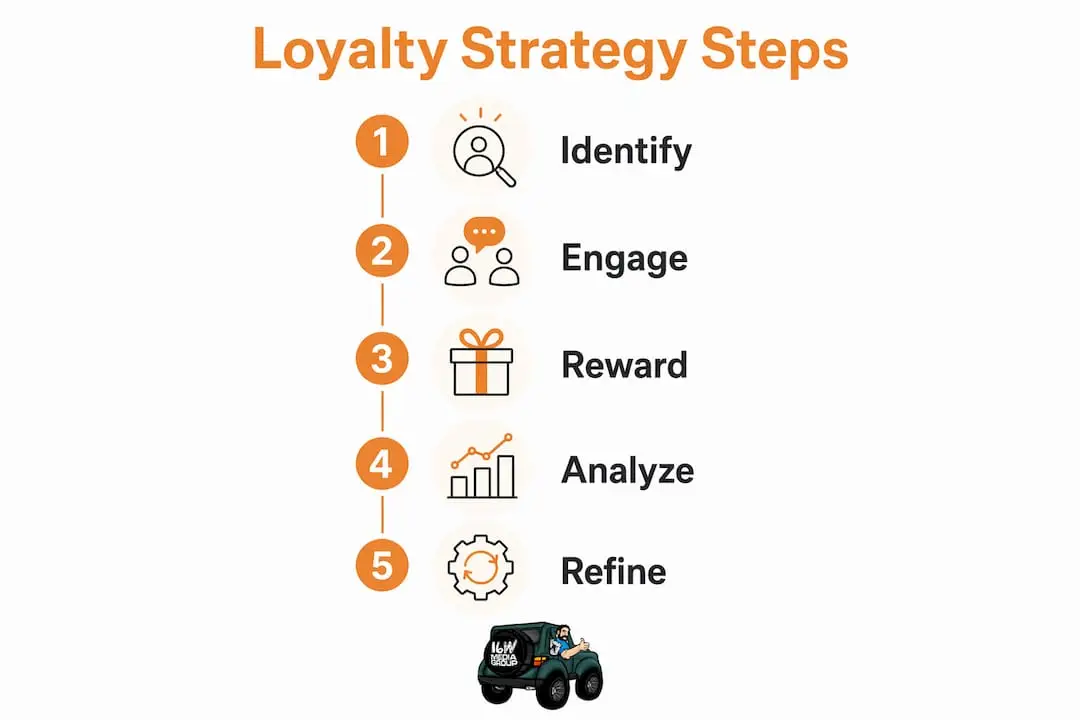
A 90-day plan works because it is long enough to see real signal and short enough to stay focused. Here is the playbook, role by role.
-
Weeks 1–2: Audit and baseline. Marketing pulls RFM segments. CX audits the top five repeat-contact reasons. Analytics sets baseline metrics (retention rate, repeat purchase rate, NPS). Acceptance criteria: segments defined, baselines documented, one friction point identified for immediate fix.
-
Weeks 3–4: Quick wins live. CX launches the 24-hour follow-up protocol for low-rated interactions. Marketing sends a personalization email to the top 20% segment. Operations removes the highest-friction step in the returns or cancellation flow. Acceptance criteria: follow-up protocol running, personalization email sent, friction step removed.
-
Weeks 5–8: Pilot loyalty mechanic. Marketing and product/ops design and launch a single loyalty mechanic (referral program or points pilot) to a cohort of 200–500 customers. Track participation rate and redemption rate weekly. Acceptance criteria: pilot live, participation rate tracked, first redemptions recorded.
-
Weeks 9–10: Feedback loop closed. Analytics reviews pilot data. CX reviews follow-up outcomes. Marketing reviews personalization email performance. Identify the one change most likely to improve the pilot. Acceptance criteria: data reviewed, one iteration identified, owner assigned.
-
Weeks 11–12: Iterate and plan scale. Implement the iteration. Present results to leadership with a recommendation to scale or pivot. Set the north-star metric for the next quarter. Acceptance criteria: iteration live, leadership briefed, next-quarter metric set.
Your north-star metric across all teams should be repeat purchase rate. It is simple to calculate, directly tied to loyalty program effectiveness, and visible to every function. Review it weekly during the pilot and monthly thereafter.
The customer acquisition strategies conversation often overshadows retention, but the math consistently favors loyalty investment. Fix the biggest lifecycle friction first, then expand. That is the core principle high-performing CX teams apply.
What does the research say about loyalty and engagement?
The evidence base for loyalty investment is strong, and a few findings stand out as particularly useful for practitioners.
Pricing sensitivity is real, but loyalty is not helpless against it. A 2024 IBM retail study found that 77% of U.S. consumers across income groups say they make trade-offs in brand loyalty when prices get too high. That is not an argument against loyalty programs. It is an argument for pairing loyalty mechanics with genuine, ongoing value delivery. A points balance a customer cannot redeem easily will not hold them when a competitor drops prices.
Personalization lifts revenue and customers expect it. Industry research consistently shows that personalization can lift revenue meaningfully, and 77% of customers expect relevant, personalized interactions. Generic outreach does not just underperform; it actively frustrates customers who have already shared their preferences with you. Unifying data across support, product usage, and purchase history is the prerequisite.
The follow-up gap is a competitive advantage. Only 48% of organizations consistently follow up with dissatisfied customers, per Medallia/Ipsos research. That means the other 52% of businesses are leaving recovery opportunities on the table every week. The brands that close the loop within 24–48 hours are not doing something heroic. They are just doing something most competitors skip.
What to stop doing: Stop treating engagement metrics (opens, clicks, app sessions) as vanity numbers. They are leading indicators of churn and expansion. Stop running broad re-engagement campaigns to your entire lapsed segment. Isolating actively disengaged customers and treating them with targeted recovery plays yields far better ROI than a mass email blast.
What to start doing: Embed at least one behavioral trigger (usage decline, no purchase in 60 days, support ticket without follow-up) into your CRM workflow this week. That single change moves you from reactive to proactive retention.
Key Takeaways
Loyalty grows fastest when you combine proactive service, data-driven personalization, and a reward system that reinforces the specific behaviors you want to see more of.
| Point | Details |
|---|---|
| Start with quick wins | Proactive check-ins, a friction-free returns fix, and a 24-hour follow-up protocol cost almost nothing and move metrics in weeks. |
| Segment before you program | Build RFM segments first; map each segment to a tactic before designing any loyalty mechanic. |
| Match program type to business model | Points suit high-frequency buyers; tiers suit identity-driven categories; subscriptions suit convenience-first customers. |
| Measure repeat purchase rate | Use repeat purchase rate as your north-star metric; it is simple, universal, and directly tied to loyalty program performance. |
| 16wmediagroup accelerates the process | 16wmediagroup helps local businesses build localized media and community campaigns that reinforce loyalty at every customer touchpoint. |
The loyalty discipline most businesses skip
Loyalty strategy conversations tend to focus on the program: the points, the tiers, the app. What gets far less attention is the operational discipline that makes any program work, specifically the habit of closing the loop on every dissatisfied customer within 48 hours, reviewing your segments quarterly, and treating engagement signals as early warnings rather than vanity metrics.
The brands that build durable loyalty, whether it is Starbucks training daily habits through its app or The North Face rewarding adventure experiences rather than just purchases, are not doing it with a clever mechanic alone. They are doing it with consistent, repeatable operational habits that most competitors find too unglamorous to prioritize.
The research on brand loyalty is clear: loyalty is cumulative. Every interaction either adds to or subtracts from the relationship account. The businesses that win long-term are the ones that treat loyalty as a daily operational discipline, not a quarterly campaign. Measure it, act on the signals, and close every loop you open.
How 16wmediagroup helps you build local loyalty that lasts
Local businesses have a loyalty advantage that national brands spend millions trying to replicate: genuine community connection. 16wmediagroup helps you turn that advantage into a repeatable system through localized media plans, community-focused publishing, podcast content, and regional ad campaigns that keep your brand visible and relevant between purchases.
Where most loyalty programs stop at a points card, 16wmediagroup builds the media layer around it: the community magazine feature that makes customers proud to be associated with your brand, the podcast episode that tells your story in a way a discount never could, the local advertising campaign that reaches high-value consumers in your market at exactly the right moment. The result is loyalty that goes deeper than a transaction.
If you are ready to build a loyalty pilot with real community reach, start with a media planning checklist built for local businesses, or reach out directly to the 16wmediagroup team to map out a campaign that fits your market, your customers, and your growth goals.
Useful sources and further reading
- IBM: What is customer engagement? The 2024 IBM retail study on consumer pricing sensitivity and loyalty trade-offs. Essential reading for understanding the value-loyalty relationship.
- Kayako: What is customer engagement? Covers engagement as a leading indicator of loyalty and retention, with frameworks for measuring relationship depth.
- Kayako: 12 Customer Engagement Strategies Practical strategy summaries including personalization lift, segmentation approaches, and program design principles.
- Sogolytics: How to build customer loyalty Covers closed-loop follow-up data, predictive analytics benchmarks, and program fatigue research.
- Twilio: What is customer engagement? Expert perspective on milestone-based engagement and AI-augmented personalization at scale.
- Harvard Business Review: The one number you need to grow The original NPS research by Fred Reichheld; foundational for understanding how referral behavior predicts growth.
- Harvard Business Review: How customer service can turn angry customers into loyal ones Evidence-based case for service recovery as a loyalty driver.
- 16wmediagroup: Services Overview of how 16wmediagroup supports local businesses with media, publishing, and community campaign planning.