
Business visibility optimization is the practice of making your brand consistently findable, credible, and citable across search engines, AI tools, and the platforms where your customers make decisions. For local entrepreneurs and marketing managers competing in markets like Tampa, this is no longer optional. The rules changed when AI tools like ChatGPT and Google’s AI Overviews became primary discovery channels. Winning visibility in 2026 requires a connected strategy built on profile completeness, structured content, and platform focus. The businesses that get this right show up everywhere their customers look. The ones that don’t become invisible.
How to optimize business visibility with Google Business Profile
Your Google Business Profile (GBP) is the single most important free asset for local search visibility, and most businesses leave it half-finished. A complete, verified GBP with updated service areas, holiday hours, photos, and service categories acts as a primary trust signal for AI-powered map results and local search features. Incomplete profiles send the opposite signal: they tell Google and AI tools that your business may not be reliable enough to recommend.
Here is how to complete your GBP for maximum impact:
- Verify your business and confirm your primary service area down to the zip code level.
- Select the most specific primary and secondary categories available for your industry.
- Upload at least 10 photos covering your team, location, products, and services.
- Add a short video (30 to 90 seconds) showing what your business does.
- Set holiday hours every quarter so your profile never shows outdated information.
- Respond to every review, positive or negative, within 48 hours.
The review response habit matters more than most owners realize. Google’s algorithm treats active review engagement as a freshness signal. A restaurant in Tampa that responds to 90% of its reviews within a day will consistently outrank a competitor with more reviews but zero responses.
Pro Tip: Regularly updating your GBP with new posts, seasonal offers, and updated photos maintains content freshness, which is a confirmed ranking factor for both standard search and AI-generated local results.

What multi-channel approaches maximize business exposure?
The most effective strategies for business exposure focus on four to six high-value platforms rather than spreading effort across every available channel. Top growth brands prioritize a short list of platforms where their customers actually research and decide, such as Google, LinkedIn, ChatGPT, TikTok, or niche industry forums, and they build depth on each one rather than thin presence everywhere.
The platforms worth prioritizing depend on your audience:
- Local service businesses: Google Business Profile, Nextdoor, Facebook Groups, and community publications
- B2B companies: LinkedIn, Google Search, industry directories like Crunchbase, and email newsletters
- Retail and hospitality: Google, Instagram, TikTok, and local media features
- Professional services: Google, LinkedIn, podcast appearances, and guest contributions to trade publications
What separates the businesses gaining ground from those standing still is integration. SEO, digital PR, and community engagement work as a connected system where each channel amplifies the others. A podcast appearance earns a backlink. That backlink improves organic rankings. Higher rankings drive branded searches. Branded searches reinforce trust signals for AI tools. None of these channels works as well in isolation.
| Platform | Best for | Primary visibility benefit |
|---|---|---|
| Google Business Profile | Local and service businesses | Map pack and AI local results |
| B2B and professional services | Branded search and entity recognition | |
| Community publications | Local entrepreneurs | Trust, reach, and offline credibility |
| Niche forums and directories | Specialty industries | Targeted audience and citation signals |
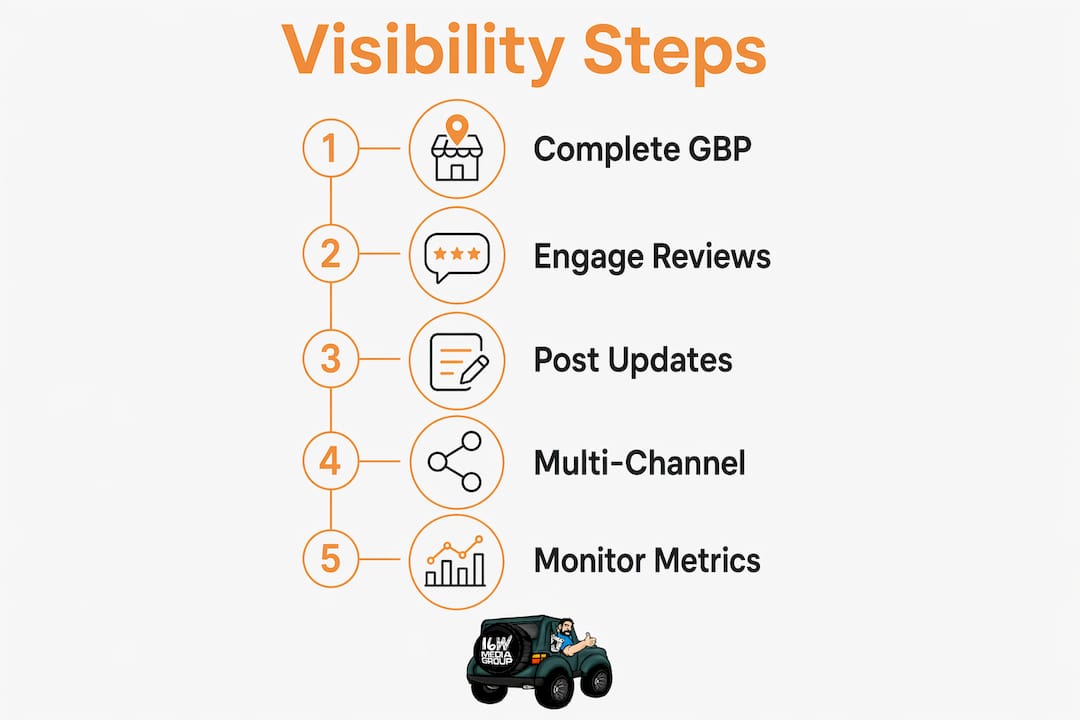
Pro Tip: Use tools like SEMrush for organic search tracking and native platform analytics for social performance. Measure each channel monthly and cut the ones that produce no measurable referral traffic or engagement after 90 days. This is how you build a multi-channel local marketing system that actually scales.
How to structure content for AI and search engine visibility
Answer Engine Optimization (AEO) is the practice of structuring content so AI tools like ChatGPT, Perplexity, and Google’s AI Overviews can extract and cite it directly. Most businesses fail to appear in AI answers because they write in long, narrative blocks without explicit question-and-answer formatting or schema markup. AEO requires FAQ and Q&A formats with direct answers of 100 to 200 words per question, paired with FAQ schema or HowTo markup in the page’s structured data.
The practical steps to make your content AI-ready:
- Rewrite your service pages so every major question a customer might ask appears as an H2 or H3 heading phrased as a direct query.
- Answer each question in the first sentence of the paragraph below it. Do not build to the answer. Lead with it.
- Add FAQ schema markup to every page that contains question-and-answer content.
- Include at least one verifiable data point, case study result, or named expert source per page.
- Keep individual answers between 100 and 200 words. Longer answers dilute the signal.
The content types AI tools prioritize most are original data, expert-backed claims, and named examples. Generic informational posts that rehash what every other site says get ignored. Publishing original data and case studies is far more likely to earn AI citations than rewritten industry summaries. A Tampa marketing agency that publishes its own campaign performance benchmarks will be cited far more often than one that publishes generic “marketing tips” articles.
Pro Tip: Audit your top five pages every quarter. Check whether the H2 headings are phrased as actual user questions, whether FAQ schema is installed, and whether the content still reflects current data. Content relevance decays without updates, and AI tools deprioritize stale sources.
Why consistent brand entity management is crucial
Brand entity management is the practice of maintaining exact, consistent business information across every platform where your name appears. NAP consistency, meaning your Name, Address, and Phone Number match precisely across your website, GBP, LinkedIn, Yelp, Crunchbase, and every directory listing, is the primary signal AI agents use to verify that your business is legitimate. A single discrepancy, such as “St.” on one listing and “Street” on another, creates ambiguity that weakens your entity recognition score.
Here is the entity management process that works:
- Run a citation audit using a tool like BrightLocal or Moz Local to find every listing that contains your business name.
- Correct any NAP discrepancy, no matter how minor it appears.
- Claim and fully complete your LinkedIn company page, Crunchbase profile, and any relevant Wikipedia or industry wiki entries.
- Pursue mentions in credible third-party sources: local news outlets, industry reports, guest posts on recognized publications, and podcast appearances.
- Set a quarterly calendar reminder to re-audit listings and check for new discrepancies.
Visibility today is about entity recognition and connecting your brand name with specific products, services, and credible third-party mentions. Volume of mentions matters less than the authority of the sources. One mention in the Tampa Bay Business Journal carries more entity weight than 50 mentions on low-authority directories.
Pro Tip: When you earn a media mention that does not include a link, contact the publication and request one. Unlinked brand mentions still carry some entity value, but a linked citation from a credible local outlet is a measurably stronger trust signal for both Google and AI tools.
What role does branded search play in long-term visibility?
Branded search is when someone types your company name directly into a search engine, and owning those results is as important as ranking for competitive generic keywords. When your branded search results page shows your website, your GBP, your LinkedIn, a positive press mention, and a podcast episode, you project authority. When it shows nothing, or worse, a competitor’s comparison page, you lose trust before the conversation starts.
The strategies that build branded search strength include:
- Publishing thought leadership content under your name or your team’s names on recognized platforms like Forbes, industry trade publications, or LinkedIn Articles
- Earning guest spots on podcasts and local radio programs where your brand name is spoken and linked
- Using your About page and Home page to clearly state your expertise, leadership credentials, partnerships, and certifications
- Maintaining consistent messaging across every channel so your brand name always appears in the same context
Branded search is a critical trust signal that influences AI-driven rankings, not just traditional search. When AI tools encounter your brand name repeatedly in credible contexts, they build a stronger association between your name and your area of expertise. That association is what gets you cited when a potential customer asks an AI tool for a recommendation in your category.
Key takeaways
Optimizing business visibility requires combining a complete Google Business Profile, structured AI-ready content, consistent NAP data, and focused platform strategy into one connected system.
| Point | Details |
|---|---|
| Complete your GBP first | Verified profiles with photos, categories, and updated hours are the foundation of local visibility. |
| Focus on 4 to 6 platforms | Depth on fewer channels outperforms thin presence across many. |
| Structure content for AEO | Use question headings, 100 to 200 word answers, and FAQ schema to earn AI citations. |
| Maintain exact NAP consistency | Any discrepancy across listings weakens entity recognition for search and AI tools. |
| Build branded search strength | Owning your branded results page reinforces trust signals that influence both rankings and AI recommendations. |
What I’ve learned about visibility that most guides won’t tell you
Most visibility advice treats each tactic as a separate project. Fix your GBP. Post on LinkedIn. Write blog content. Run ads. The problem is that siloed execution produces siloed results. What I’ve seen work, consistently, is treating every channel as a node in one connected network. When a community magazine feature about your business links to your website, that link supports your domain authority. That authority makes your FAQ content more likely to be cited by AI tools. Those citations drive branded searches. Those searches reinforce your E-E-A-T signals. The whole system feeds itself.
The other thing most guides skip is the patience required. Business owners often abandon a platform after 60 days because they don’t see immediate traffic. But entity recognition and branded search strength build over six to twelve months of consistent, quality output. The businesses I’ve watched succeed in competitive local markets are the ones that commit to the system and measure the right things: citation appearances, branded search volume, and review velocity, not just website sessions.
If I had to give one piece of advice, it would be this: start with your GBP and your About page, get those completely right, then build outward. Those two assets are the ones AI tools check first when deciding whether your business is worth recommending.
— Mike
How 16wmediagroup helps you build real visibility
If you’ve read this far and you’re thinking about where to start, the answer is a plan built around your specific market, audience, and goals.
16wmediagroup works with local businesses and marketing managers to build the kind of multi-channel visibility that compounds over time. From community magazine placements and podcast features to regional advertising packages and local advertising campaign planning, the team at 16wmediagroup builds media strategies that connect your brand with high-value consumers in your area. If you’re competing in a market like Tampa and you want your business to show up where decisions are made, explore the full range of media and publishing services at 16wmediagroup.
FAQ
What is the fastest way to increase local search visibility?
Completing and verifying your Google Business Profile with accurate categories, photos, and updated hours produces the fastest measurable lift in local search and map results. Active review management accelerates the effect.
How does AEO differ from traditional SEO?
Answer Engine Optimization structures content specifically for AI tools like ChatGPT and Google’s AI Overviews using question-and-answer formats and schema markup, while traditional SEO focuses on keyword ranking in standard search results. Both matter in 2026.
How many platforms should a local business focus on?
The most effective approach is to focus on four to six platforms where your customers actively research and make decisions, building depth and consistency on each rather than spreading effort thin.
Why does NAP consistency matter for AI visibility?
AI agents use exact NAP data across directories and listings to verify business legitimacy. Any inconsistency in your Name, Address, or Phone Number creates ambiguity that reduces the likelihood of your business being cited or recommended.
What content type is most likely to be cited by AI tools?
Original data, case studies, and expert-backed content earn AI citations far more reliably than generic informational posts. Pair that content with FAQ schema markup and direct 100 to 200 word answers for the best results.