

Standing out in a crowded market comes down to five levers: niche positioning, a crisp unique selling proposition, a distinctive brand story, a customer experience worth talking about, and fast, cheap marketing tests. Forbes frames this as an “abundant” mindset that treats competitors as colleagues, not threats. Square backs it up with tactics: know your competition, know your customers, personalize, innovate. We see the same pattern play out for local businesses every day.
Here’s your verdict, scanned in ten seconds:
- Pick one underserved segment and own it before chasing everyone.
- Write a UVP you can prove, not just claim.
- Turn your actual customer language into your marketing copy.
- Redesign one moment in the customer journey to create surprise.
- Run a two-week paid test on a single channel before committing budget.
Next step: block some time this week to interview several recent customers about why they picked you over the alternative they almost chose instead.
Key Takeaways
Standing out in a competitive market requires a narrow niche, a testable UVP, a distinctive customer experience, and fast, cheap marketing experiments run in that order.
| Point | Details |
|---|---|
| Start narrow | Pick one underserved segment and prove results there before expanding to a broader market. |
| Validate before you spend | Test your UVP with interviews and a small ad budget before committing real marketing dollars. |
| Fix CX first | A single surprise-and-delight moment in the customer journey often costs less than a paid campaign and lifts retention. |
| Pick one channel | Choose the channel that best shows your differentiator, run a two to four week test, and measure one KPI. |
| Local partnerships compound | Community media and co-marketing partnerships build credibility that larger competitors can’t easily copy at the local level. |
Table of Contents
- Ten Immediate Actions to Start Standing Out This Month
- How Do You Find a Positioning Wedge and Write a UVP?
- How Do You Build a Brand Voice That Doesn’t Blend In?
- Can Customer Experience Actually Be a Competitive Advantage?
- Which Product or Service Features Should You Prioritize?
- Which Marketing Channels Should You Test First?
- How Should Pricing Signal Your Market Position?
- How Do Partnerships Extend Your Reach Without a Big Budget?
- What Should You Measure to Know What’s Actually Working?
- What Does a 90-Day Roadmap Actually Cost?
- What Do Real Differentiation Wins Look Like?
- Ready to Put This Into Action?
- An Editorial Take on What Actually Moves the Needle
- Sources
Ten Immediate Actions to Start Standing Out This Month
Run this checklist in order over the next 30 days. Each item lists priority and time required.
- Interview three recent customers on why they chose you (high, 90 minutes each).
- Write one draft UVP using the formula below (high, 1 hour).
- Audit your top three competitors’ websites and offers (medium, 2 hours).
- Publish one short customer case story on your site or socials (high, half a day).
- Test your UVP as ad copy in a $50 to $100 micro-campaign (medium, 1 day setup).
- Map your customer journey and flag one weak moment (medium, 1 hour).
- Pilot one “surprise” touch, like a handwritten note or fast follow-up call (low, 1 week).
- Pitch one local partner or community publication for a co-feature (medium, 1 week).
- Set a baseline for retention and referral rate (high, 90 minutes).
- Review results and pick one channel to double down on (high, 1 week).
Sequence matters: interviews and UVP drafting come first because everything downstream depends on them.
How Do You Find a Positioning Wedge and Write a UVP?
You find your wedge by targeting a narrower slice of the market than feels comfortable, proving results there, then expanding outward. Businesses that try to appeal to everyone typically end up sounding like everyone else. A “wedge” strategy means picking a specific underserved segment, dominating it, and using that proof as your expansion story.
Start with a persona template you fill in with real answers, not guesses:
- Job to be done: What task or outcome is this person actually hiring you for?
- Current workaround: What are they doing today instead of buying from anyone, including doing it manually or ignoring the problem?
- Emotional drivers: What’s the fear or ambition behind the purchase?
- Decision triggers: What event or moment makes them start looking for a solution?
Validate it cheaply before you spend real money. Build a one-page landing site describing the offer, run five more customer interviews specifically testing the phrasing, and run a small ad test with $100 and two creative variations. Watch for early signals: click-through above your industry norm, interview subjects repeating your language back to you unprompted, or direct requests to buy before you’ve pitched.
Win/loss interviews often reveal that your real competitor isn’t the company you assumed. It’s frequently a manual workaround or simply doing nothing.
Pro Tip: Ask “what would you have done if we didn’t exist?” in every customer interview. The answer tells you who you’re actually competing against.
How Do You Build a Brand Voice That Doesn’t Blend In?
Most differentiation problems aren’t a strategy gap. They’re a communication gap. Businesses often have genuine strengths they simply describe in generic language that sounds identical to every competitor’s website copy.
Build a brand-voice checklist covering four things: tone (are you formal, warm, blunt?), vocabulary (words you use and words you ban), visual cues (colors, imagery, consistent formatting), and a bank of real customer quotes you can legally reuse.
Then build a simple message architecture: one core message, three supporting points that back it up, one proof point per supporting point, and a handful of short stories you can drop into different channels without rewriting from scratch.
A full visual rebrand rarely changes how customers already feel about you. It’s usually more effective to express your existing strengths more clearly, in the language your actual customers use, than to redesign a logo and hope perception shifts. Save the rebrand for when your positioning has genuinely changed, not when your marketing has gone stale.
- Pull exact phrases from customer reviews and testimonials into your homepage headlines.
- Replace jargon with the plain words your best customers use to describe you.
- Keep one “voice document” that every piece of content gets checked against.
Pro Tip: If a customer says “you actually called me back,” put that exact phrase in your marketing. Invented copy never beats a real customer’s words.
Businesses working through this shift often start with a look at why updating brand messaging matters more than a visual overhaul.
Can Customer Experience Actually Be a Competitive Advantage?
Yes, and it’s usually the cheapest lever available. A defensible customer experience creates repeat business and referrals that competitors can’t easily copy, because it’s built on operational habits, not a headline claim.
Map your customer journey and identify one moment where a small surprise would land hard: a faster-than-expected callback, a handwritten thank-you note, or a proactive check-in before the customer has to ask. Then pilot it. Try a guarantee (“we’ll redo it free if you’re not satisfied within 30 days”), white-glove onboarding for your first ten new customers, or a simple personalization rule based on past purchases.

Tie your experiments to metrics that map to revenue: Net Promoter Score, retention rate, and time-to-first-value (how fast a new customer sees a real result).
Statistic callout: A modest lift in retention compounds. Businesses that raise repeat-purchase rates even slightly typically see outsized effects on lifetime revenue, because retained customers cost far less to keep than new ones cost to acquire.
A low-cost example: one local service business piloted a 48-hour follow-up call for every new client. It cost roughly an hour of staff time per week and raised referral rate within the first quarter, measured simply by asking new customers how they heard about the business.
Which Product or Service Features Should You Prioritize?
Not every improvement moves the needle, so prioritize with a simple matrix: plot each potential feature or service change on value to the customer against ease and cost to build. Focus first on anything that lands high on customer value and low on build cost. Those are your fastest wins.
For service businesses, build a minimum viable version before committing to a full rollout. That might mean piloting a new service with five existing customers before productizing it, or offering a stripped-down version of a new package manually before automating it.
Your decision rule should depend on how mature your market is. In an immature market where customers are still using manual workarounds, incremental features that remove friction often win. In a mature, saturated market, cosmetic tweaks rarely matter; you need structural changes like distribution advantages or a genuinely different business model to pull ahead.
- Score each idea 1 to 5 on customer value and 1 to 5 on build cost.
- Prioritize anything scoring 4 or higher on value and 2 or lower on cost.
- Test the smallest version possible with real customers before scaling.
Which Marketing Channels Should You Test First?
Pick one or two channels that best showcase your differentiator, not the channel everyone else is already using. Score each option on three things: how many of your actual target customers it reaches, how well it matches your message, and how cheaply you can test it.
Match content ideas to where the buyer is in their decision:
- Awareness stage: a short video or local podcast feature that tells a customer story.
- Consideration stage: a long-form case study showing a specific before-and-after result.
- Decision stage: a comparison-style piece or a limited-time offer tied to your UVP.
Then build a paid test template before spending real budget: set a fixed budget (start with $200 to $500), write two creative variations, define one audience segment tightly, and pick a single primary KPI, such as cost per lead. Give the test two to four weeks and write down what you learned before scaling spend.
Community-based channels like local podcasts and regional publications often outperform generic digital ads for local businesses, because larger competitors can’t replicate that hyper-local credibility at scale.
- Choose channels where your differentiator is easy to show, not just describe.
- Test small, measure fast, and kill anything that isn’t working within a month.
How Should Pricing Signal Your Market Position?
Pricing is a positioning statement whether you intend it or not. A three-tier structure with a deliberately-priced high anchor makes your mid-tier package look like the obvious smart choice. That’s the anchoring effect at work, and it costs nothing to test.
Try a decoy offer (a package priced just below your target tier but missing key features), or run a trial-versus-subscription test to see which converts better for your specific offer.
- Reduce friction with risk reversal: a money-back guarantee or a free trial period.
- Increase perceived value with bundles or outcomes-based pricing tied to results, not hours.
- Use time-limited demos to create urgency without discounting your core price.
Compete on price only when you’re genuinely the low-cost operator. Otherwise, compete on value, and let your pricing structure reinforce the story you’re already telling.
How Do Partnerships Extend Your Reach Without a Big Budget?
Local partnerships create third-party credibility that’s hard to fake and expensive for bigger competitors to replicate at a hyper-local level; understanding what is station branding: a guide for radio pros can help businesses leverage local broadcast partnerships effectively. Choose partners whose audience already trusts them and whose values align with your positioning, not just anyone with a mailing list.
Build a simple pitch: what you offer, what you’re asking for, and what’s in it for them, specifically.
- Local podcasts and community magazines put your story in front of an audience that already trusts the publisher.
- Co-marketing with a complementary (non-competing) local business splits cost and doubles reach.
- Track every partner-driven lead separately, using a dedicated promo code or landing page, so attribution doesn’t get muddy.
Set a 30-day attribution window and measure cost per lead by partner, not just total leads generated.
What Should You Measure to Know What’s Actually Working?
Track five numbers: acquisition cost, activation rate (how many new customers reach real value), retention rate, referral rate, and revenue per customer. Differentiation experiments succeed or fail on activation and retention specifically, since those two reveal whether your positioning matches what you actually deliver.
Structure every test with a hypothesis, one primary metric, and a decision threshold set in advance: continue, stop, or scale.
Statistic callout: Small businesses running experiments with limited sample sizes should treat quantitative results as directional, not definitive, and pair every quantitative test with a handful of qualitative interviews to understand the “why” behind the numbers.
- Write the hypothesis and success threshold before launching, not after.
- When sample sizes are small, trust patterns across five interviews over noisy percentage swings.
What Does a 90-Day Roadmap Actually Cost?
A realistic timeline runs three phases. Weeks 1 to 3: discovery and positioning, customer interviews, UVP drafting. Weeks 4 to 8: CX pilots and one channel test. Weeks 9 to 12: measurement review and scale decisions.
- Discovery and positioning (weeks 1 to 3): budget $0 to $500 for a small business, $1,000 to $3,000 for growth-stage firms doing formal research.
- CX pilots and creative work (weeks 4 to 6): $200 to $1,500 depending on whether you build in-house or hire freelance help.
- Channel testing (weeks 6 to 10): $300 to $2,000 in paid spend plus creative production.
- Measurement setup and review (weeks 10 to 12): mostly time investment, plus any analytics tooling you adopt.
When budget is tight, fund discovery and one CX pilot first. Those cost the least and generate the clearest signal about what to scale next. Reviewing a media planning checklist before your channel test phase helps avoid wasted spend.
What Do Real Differentiation Wins Look Like?
A regional home services company narrowed its focus from “everyone in the metro area” to “homeowners in three specific zip codes with older housing stock.” Within one quarter, referral rate climbed because their marketing finally spoke to a specific problem instead of a generic promise.
A boutique retailer added a 48-hour personalized follow-up text after every purchase. The cost was near zero, just staff time, and repeat purchase rate rose measurably within two months.
Local publishers and podcasts give small and regional brands a distribution advantage that bigger national competitors typically can’t buy their way into at the neighborhood level.
16wmediagroup has seen this pattern directly through local market work in Tampa, where businesses that paired a clear niche story with community media placement saw faster brand recall than those relying on generic digital ads alone.
- Narrow focus plus one CX change often beats a broad campaign with no story.
- Local distribution channels create credibility that’s difficult for outside competitors to replicate.
Ready to Put This Into Action?
You don’t need a bigger budget to stand out. You need a sharper story, a customer experience that backs it up, and a media plan that puts both in front of the right local audience. That’s the exact intersection where 16wmediagroup works with small and regional businesses every day, building personalized media plans that combine traditional placements, digital campaigns, podcasts, and community publishing to make your differentiation visible where it counts.
If you’re ready to turn a positioning idea into a real campaign, the local advertising campaign planning guide walks through exactly how to structure the first 90 days, budget included. Businesses further along can review the services 16wmediagroup offers to see how a tailored media plan gets built from scratch.
An Editorial Take on What Actually Moves the Needle
Most advice on differentiation treats it as a branding exercise: pick a color, write a tagline, launch a campaign. The research behind this piece points somewhere less glamorous. Differentiation is mostly an operations problem disguised as a marketing one.
The businesses that actually pull ahead don’t invent a clever new claim. They interview customers, find the specific workaround people were using before, and build a narrow offer around that gap. Then they fix one thing in the customer experience that competitors haven’t bothered to fix, because it’s unglamorous and slow. Only after that do they spend on marketing, and even then in small, measured tests rather than big campaign bets.
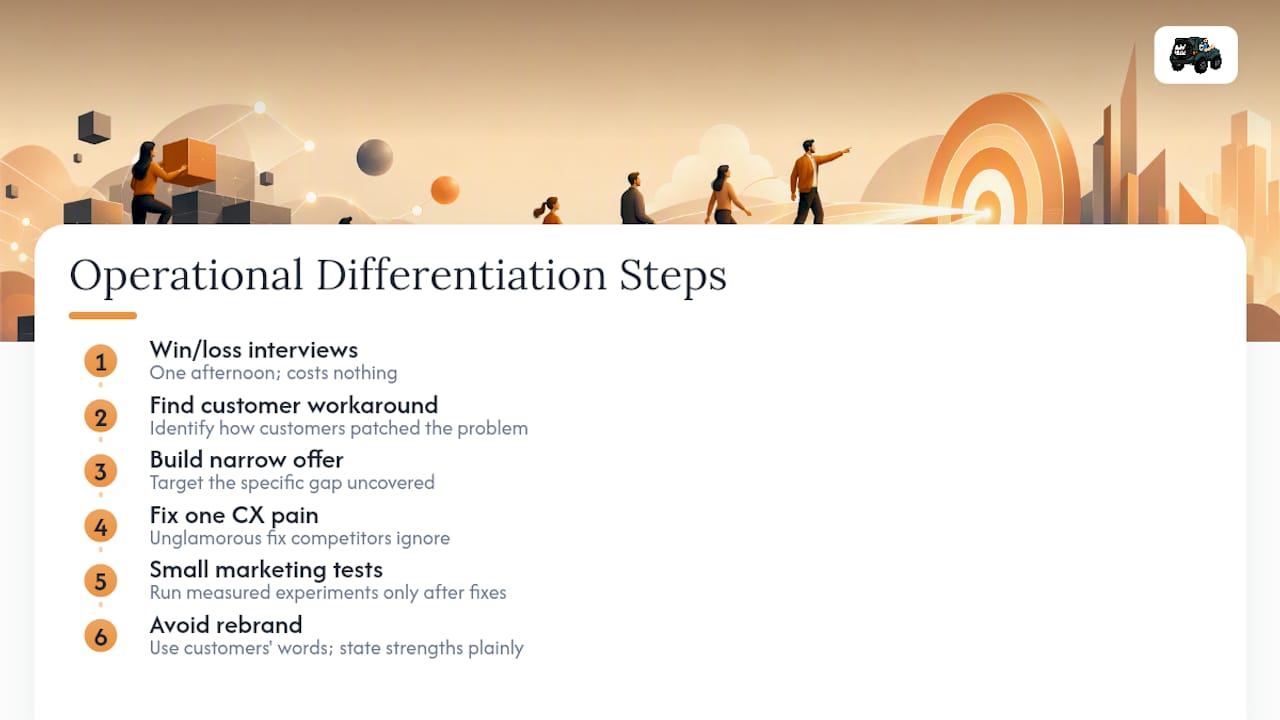
The overrated move is the rebrand. Businesses reach for a new logo or tagline when what they actually need is to say their existing strengths more plainly, in the words their own customers already use. If you take one thing from this guide, make it the win/loss interview. It costs nothing, takes an afternoon, and tells you more about your real competitive position than any strategy deck will.