

Tampa’s local advertising market is moving fast. Local ad spend hit $151.6 billion in 2025, and the overwhelming share of that money is now flowing into digital channels. Yet most small business owners in Tampa still believe media buying is reserved for big-budget brands with marketing departments and agency retainers. That’s a costly myth. Whether you run a plumbing company in Westchase or a boutique salon in South Tampa, a well-structured media buying strategy can place your business in front of the exact customers you need, at the exact moment they’re ready to buy.
Table of Contents
- What is media buying and why does it matter for Tampa businesses?
- Digital vs. traditional media: Choosing the right channels
- Avoiding wasted spend: Targeting strategies and common pitfalls
- Measuring campaign success: Beyond clicks to meaningful outcomes
- Our take: What Tampa businesses always get wrong about media buying
- Connect with Tampa’s media buying experts
- Frequently asked questions
Key Takeaways
| Point | Details |
|---|---|
| Digital leads local spend | Most Tampa businesses now benefit more from digital ad channels than traditional ones. |
| Smart targeting saves money | Precise geo-targeting and tailored messaging greatly reduce wasted advertising dollars. |
| Track real outcomes | Measuring offline actions and phone calls is essential for capturing actual business success. |
| Iterative strategies win | Continuously refining campaigns yields better ROI than one-time setups. |
What is media buying and why does it matter for Tampa businesses?
Media buying is the process of purchasing advertising space or time across specific channels to reach a defined audience. For a small business, that might mean buying a 30-second spot on a Tampa-area radio station, securing a banner placement on a local news website, or running a targeted Facebook ad to homeowners in Hillsborough County. It’s not just about buying ads. It’s about buying the right ads in the right places at the right price.
Here’s what separates smart media buying from random ad spending:
- Audience targeting: You define who sees your ad by location, age, income, interests, and behavior.
- Channel selection: You choose where your message appears based on where your customers actually spend their time.
- Budget efficiency: You negotiate or optimize for the best cost-per-impression or cost-per-click so every dollar works harder.
- Performance tracking: You measure results and adjust in real time rather than waiting for a quarterly report.
Digital advertising now dominates local spend, according to Borrell Associates data, but that doesn’t mean traditional media is dead. In Tampa’s diverse market, the most effective campaigns often combine both worlds.
“The biggest mistake local businesses make is treating media buying like a one-time purchase rather than an ongoing strategy that needs to be managed, measured, and refined.”
Tampa is a competitive market. You’re not just competing with the business down the street. You’re competing with national brands that run locally targeted digital campaigns in your zip code. Understanding localized marketing strategies gives you a genuine edge because you know your community better than any national brand ever will.
Traditional media examples like community magazine placements, local radio, and sponsorship of Tampa Bay events still build brand trust and recognition in ways that purely digital strategies sometimes miss. And as media agency growth data shows, Tampa SMBs that work with experienced partners consistently outperform those running campaigns on their own.

Digital vs. traditional media: Choosing the right channels
Now that you understand media buying, it’s time to decide where your dollars work hardest. Not every channel suits every business. A family-owned HVAC company and a new restaurant in Ybor City have very different audiences and very different needs.
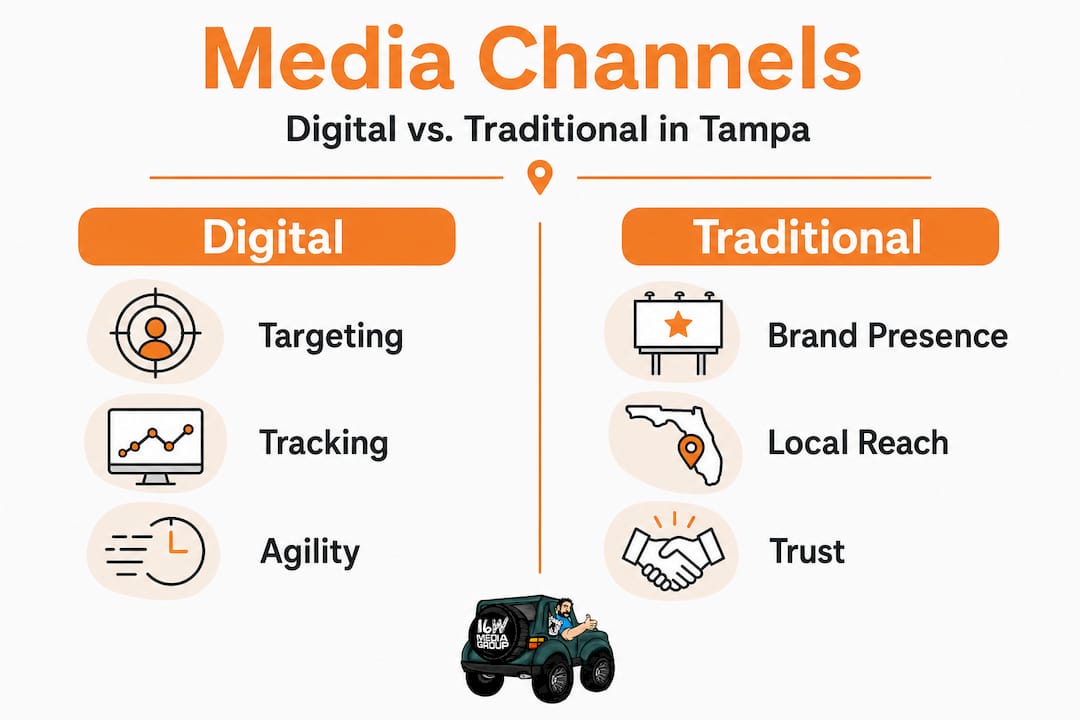
Here’s a side-by-side comparison to help you think through your options:
| Factor | Digital media | Traditional media |
|---|---|---|
| Targeting precision | Highly specific (zip, age, behavior) | Broader (region, demographic estimate) |
| Cost to start | Low to moderate | Moderate to high |
| Speed to launch | Hours to days | Days to weeks |
| Measurability | Real-time analytics | Estimated reach and frequency |
| Trust and authority | Moderate (ad fatigue is real) | High (especially print and radio) |
| Longevity | Short (disappears when budget stops) | Longer (print stays in homes) |
| Best for | Lead gen, promotions, retargeting | Brand awareness, community presence |
The shift in local advertising is significant. Display, social, and video are overtaking search as the fastest-growing categories in local ad spend growth. This means if you’re still pouring your entire budget into Google Search ads alone, you’re missing the platforms where local audiences are actually spending their time.
For Tampa service businesses specifically, a few channels consistently perform well:
- Social media advertising (especially Facebook and Instagram) for businesses targeting homeowners, parents, or lifestyle-oriented consumers in Tampa neighborhoods.
- YouTube pre-roll ads for service businesses that benefit from visual demonstrations, such as contractors, dentists, and fitness studios.
- Community magazine placements for reaching affluent Tampa Bay neighborhoods where print still drives purchase decisions.
- Podcast sponsorships for building authority and reaching engaged local audiences who actively seek information.
The question isn’t digital or traditional. The question is which combination of channels reaches your Tampa customer most efficiently. Explore the full breakdown on traditional vs digital advertising to sharpen your channel strategy, and look closely at local advertising channels for service-specific guidance.
Pro Tip: Start with one digital channel and one traditional channel. Run both for 60 days, track every lead source carefully, then shift more budget to whichever channel delivers the lower cost per customer acquired. Don’t let the initial appeal of “doing everything” scatter your focus.
Avoiding wasted spend: Targeting strategies and common pitfalls
Channel selection matters, but poorly targeted campaigns waste even the best budget. This is where many Tampa small businesses bleed money without realizing it. They set up a Google or social campaign, let the platform’s default settings run, and wonder why they’re getting clicks that never convert.
Here’s a practical breakdown of the most common wasted-spend traps and how to avoid them:
-
Relying on default geographic settings. Platforms like Google Ads often default to targeting a much broader area than your service zone. Default targeting can pull in researchers from outside your service area, inflating click costs without generating real customers. If you serve South Tampa and St. Petersburg, set your targeting to those specific zip codes or a tight radius around your business location.
-
Ignoring search intent in your ad copy. Someone searching “emergency plumber Tampa” is ready to call right now. Someone searching “how to fix a leaky pipe” is researching. Write separate ad copy and landing pages for each intent level, because treating both the same way burns budget on visitors who aren’t ready to buy.
-
Setting and forgetting campaigns. The Tampa market shifts. Events, seasonality, neighborhood development, and competitor activity all affect how your ads perform. Campaigns need weekly or biweekly reviews, especially in the first 90 days.
-
Running ads without a strong landing page. Sending paid traffic to your homepage is like inviting someone to dinner and making them find the kitchen themselves. Build dedicated landing pages for each campaign that match the ad’s promise and make it easy to take one specific action.
-
Overbidding on broad keywords. Broad match keywords often pull in irrelevant traffic. Use phrase match and exact match keywords in Google campaigns, and build a solid negative keyword list to filter out searches that won’t convert.
| Targeting mistake | What it costs you | How to fix it |
|---|---|---|
| Too-wide geographic radius | Wasted impressions and clicks | Narrow to your actual service area |
| Generic ad copy | Low click-through rates | Use local-specific, intent-driven language |
| No negative keywords | Irrelevant clicks | Build and update negative keyword lists weekly |
| Default audience settings | Broad, unqualified traffic | Layer in demographic and interest filters |
| No landing page match | High bounce rates | Create campaign-specific landing pages |
Hyperlocal digital advertising takes this a step further by creating campaigns tailored to specific Tampa neighborhoods, events, and community contexts. A roofing company, for example, might run hyper-specific ads in Carrollwood right after a major storm event because that’s precisely when and where demand spikes.
The fastest path to building brand awareness fast isn’t always the biggest budget. It’s the most precisely targeted budget, deployed in the channels where your specific community is already paying attention.
Measuring campaign success: Beyond clicks to meaningful outcomes
After avoiding wasted spend, it’s crucial to measure what really matters in local advertising. Clicks are easy to count. Customers are harder to track. Most local businesses stop at surface-level metrics like impressions and click-through rates, which can look great on a dashboard while the phone stays quiet.
Real campaign success for a Tampa small business looks like this:
- Phone calls generated from ads, tracked by a unique tracking number assigned per campaign.
- Form submissions that turn into actual appointments or estimates, not just email addresses.
- Foot traffic increases connected to a specific promotion or ad run (trackable through Google Business Profile insights or in-store offer codes).
- Revenue tied to campaign periods to see whether ad activity actually lifts sales, not just website visits.
- Customer lifetime value from leads generated by each channel, because a $50 lead that becomes a $5,000 annual customer is worth far more than a $10 lead who never converts.
In many local campaigns, tracking must go beyond clicks. Call tracking and CRM conversion actions often matter most for understanding true campaign performance.
Pro Tip: Set up Google’s call tracking feature and import those calls as conversions into your campaign dashboard. Then train your front desk or sales team to ask every caller “How did you hear about us?” and log that answer in your CRM. Combining digital tracking with human intelligence gives you the most accurate picture of what’s working.
Here’s a simple framework for what to track weekly:
- Cost per click by channel
- Click-to-call rate on mobile ads
- Call conversion rate (calls that become bookings)
- Cost per booked appointment
- Revenue attributed to each campaign
The deeper your measurement, the smarter your spending decisions. Explore media planning strategies for a Tampa-specific framework, and use the ad campaign strategy guide to set up your tracking infrastructure before you spend a single dollar.
Our take: What Tampa businesses always get wrong about media buying
Having looked at measurement, here’s what years of Tampa market experience have actually taught us.
The single biggest mistake local businesses make isn’t a bad ad. It’s a short time horizon. Owners run a campaign for two or three weeks, see limited results, declare it doesn’t work, and cut the budget. Meanwhile, their competitor down the street has been running a similar campaign for six months, iterating every two weeks, and is now dominating local search and social impressions in the neighborhood.
Media buying is not a switch you flip. It’s a compounding process. The businesses that win in Tampa’s local market are the ones that treat their media strategy like a living system rather than a series of one-off experiments.
The second mistake is ignoring offline conversions entirely. We see businesses celebrate low cost-per-click numbers while having no idea whether those clicks are generating phone calls, bookings, or revenue. If you’re measuring the wrong thing, you’ll optimize toward the wrong outcome. Cheap clicks that don’t convert are not a bargain.
The third mistake is going generic when hyper-local wins. A Tampa homeowner in New Tampa responds to very different messaging than a homeowner in Davis Islands. They have different income levels, different community concerns, different seasonal patterns, and different media consumption habits. Localized marketing strategies that speak to specific neighborhoods outperform generic Tampa-wide campaigns almost every time, even when the hyper-local budget is smaller.
What we’ve found works consistently is building a media plan that layers channels, sets realistic 90-day goals, and reviews performance at least biweekly. The businesses that commit to this process, using strong media planning strategies, are the ones calling us six months later to scale up because their ROI finally makes sense.
Stop chasing the cheapest ad. Start building the smartest one.
Connect with Tampa’s media buying experts
You now know what works in Tampa. Here’s how to take your visibility further with professional support.
At 16W Media Group, we work directly with Tampa small and medium businesses to build media buying strategies that are tailored to your neighborhood, your audience, and your revenue goals. We don’t sell generic ad packages. We build localized campaigns that connect your brand to the Tampa communities where your best customers already live and work. Explore our media buying services to see how we structure campaigns for businesses like yours, or review our media planning strategies to deepen your understanding before we talk. Ready to start? Contact our team and let’s build a plan that actually moves your numbers.
Frequently asked questions
How much should a Tampa local business spend on media buying?
Most local businesses allocate between 5% and 10% of gross revenue toward advertising, but your exact spend depends on your growth goals and how competitive your specific Tampa market category is.
What channels work best for Tampa service businesses?
Display, social, and video ads now outperform search and traditional media for most service businesses in Tampa, particularly for reaching homeowners and lifestyle-oriented consumers across the greater Tampa Bay area.
What is geo-targeting in local advertising?
Geo-targeting means narrowing your ad audience to specific zip codes or neighborhoods so your budget reaches real potential customers. Tightening geo settings prevents platforms from serving your ads to researchers or browsers outside your actual service area.
Should my business track phone calls or only clicks?
For most local campaigns, tracking phone calls and offline actions matters just as much as tracking clicks. Call tracking and CRM conversions often reveal the true revenue impact of your campaigns when clicks alone tell an incomplete story.
Is media buying only for large companies?
Absolutely not. Digital advertising dominates local spend at every business size level, and Tampa small businesses that use structured media buying consistently outperform those relying on ad-hoc boosted posts and unpromoted content.