

Most Tampa business owners think media planning is something only large corporations with million-dollar marketing departments do. That assumption costs them thousands in wasted ad spend every year. The truth is, a thoughtful media plan gives any local business, whether a family-owned restaurant in Ybor City or a boutique fitness studio in South Tampa, the power to reach the right people at the right time without burning through their budget. This guide breaks down exactly what media planning is, how the process works step by step, and how you can put it to work for your business starting right now.
Table of Contents
- What is media planning?
- The media planning process explained
- Budgeting for media planning in Tampa
- Choosing the right media channels
- Media planning trends: Agile, automation, and local impact
- What experience teaches: Media planning truths for Tampa SMBs
- Partnering with Tampa media experts for your business success
- Frequently asked questions
Key Takeaways
| Point | Details |
|---|---|
| Media planning clarified | Media planning helps Tampa businesses target their advertising for greater results. |
| Budgeting for ROI | Recommended media spend is 5-10% of revenue, favoring digital channels first. |
| Step-by-step process | Successful plans follow clear steps: objectives, research, channel choice, budgeting, and measurement. |
| Channel selection | Choosing the right mix of digital and traditional media matches your audience and local goals. |
| Embrace agility | Adopting real-time, data-driven strategies outperforms rigid, annual media plans for Tampa SMBs. |
What is media planning?
Media planning is not just buying ads. It is a structured approach to deciding where, when, and how you communicate with your customers. According to a leading marketing education resource, media planning is the strategic process of determining the optimal ways to deliver advertising messages to a target audience, including audience analysis, channel selection, budgeting, scheduling, and measurement. That definition packs a lot in, so let’s unpack it.
Think of media planning as the blueprint before construction. Without it, you might spend money on a radio spot that nobody in your target demographic listens to, or run social media ads that reach people three counties away who will never walk into your store.
The core components of a strong media plan include goals and KPIs (key performance indicators), budget allocation, audience targeting, messaging strategy, scheduling, and media mix. Each piece connects to the others. A weak goal produces a fuzzy audience target, which leads to poor channel selection and, ultimately, wasted money.
Key elements every Tampa SMB media plan should address:
- Goals and KPIs: What does success look like? More foot traffic, online orders, or phone calls?
- Budget: How much can you realistically spend, and how should it be divided?
- Audience: Who exactly are you trying to reach, and where do they spend their time?
- Channels: Will you use social media, community publications, podcasts, email, or outdoor advertising?
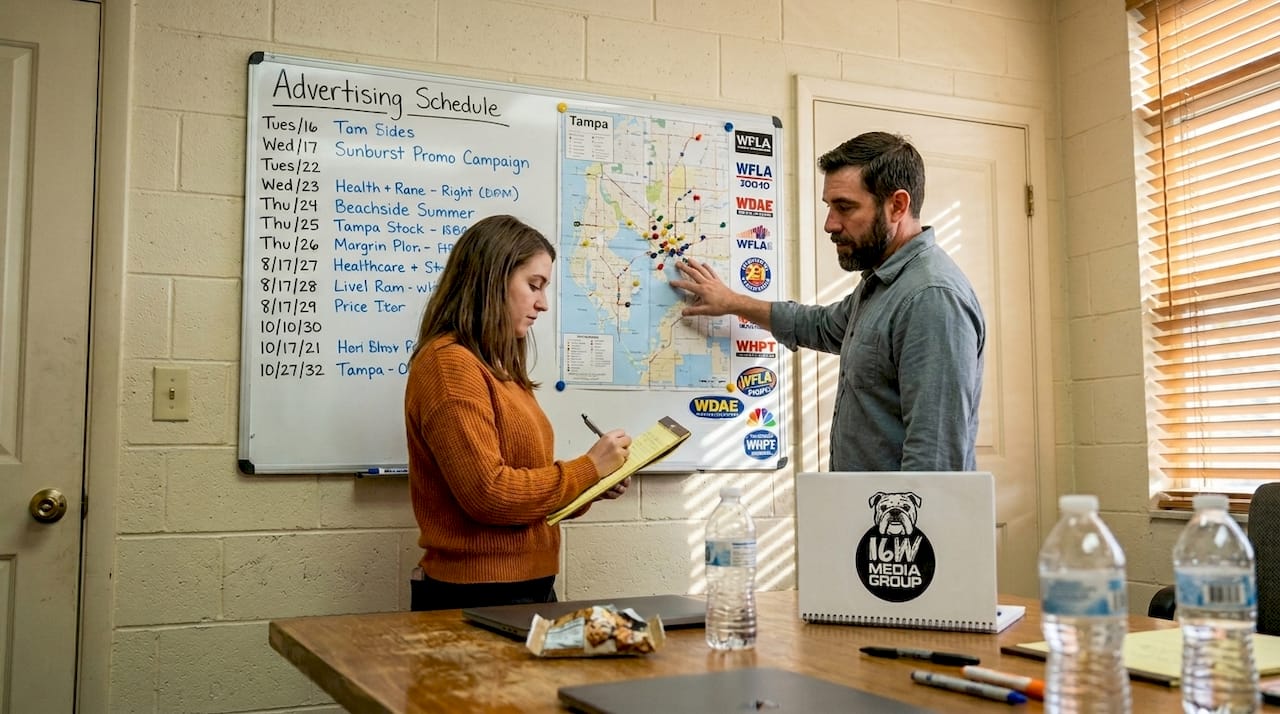
- Schedule: When will your campaigns run, and for how long?
- Measurement: How will you track results and make adjustments?
Media planning is not about spending more. It is about spending smarter. Every dollar you invest should be working toward a defined goal, not just generating impressions in the hope that something sticks.
Understanding these fundamentals connects directly to broader marketing campaign essentials that help Tampa businesses build lasting customer relationships.
The media planning process explained
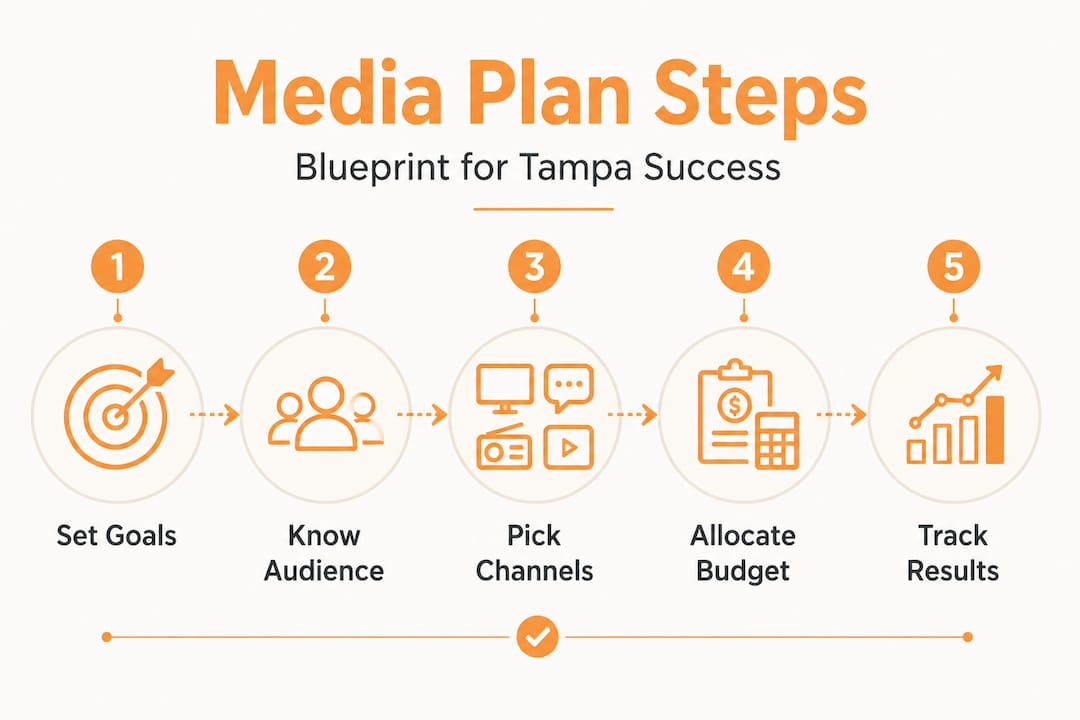
Knowing what a media plan is and actually building one are two different things. The media planning process typically involves steps like setting objectives, audience research, competitive analysis, channel selection, budget allocation, scheduling, creative development, and measurement. Here is what each step looks like for a real Tampa business.
- Set clear objectives. A Tampa plumbing company might set a goal to increase service calls by 20% during the summer months.
- Research your audience. Who calls a plumber? Homeowners, property managers, and landlords. Where do they look for help? Google, Nextdoor, and local Facebook groups.
- Conduct competitive analysis. Look at what other plumbers in Tampa are doing. Are they running Google ads? Sponsoring community newsletters? Identify gaps you can fill.
- Select your channels. Based on audience research, paid search ads and a listing in a community magazine may outperform a radio spot.
- Allocate your budget. Split spending based on which channels offer the best reach for your specific audience.
- Build your schedule. Time campaigns around high-demand periods, like summer storms that cause pipe issues.
- Develop your creative. Write ad copy and design visuals that speak directly to stressed Tampa homeowners who need fast, reliable help.
- Measure and optimize. Track calls, clicks, and conversions. Cut what is not working and double down on what is.
| Step | Description | Tampa example |
|---|---|---|
| Set objectives | Define measurable goals | Increase monthly calls by 20% |
| Audience research | Identify who you are reaching | Homeowners in South Tampa, aged 35 to 60 |
| Competitive analysis | Study rivals’ strategies | Review local plumbers’ Google and social presence |
| Channel selection | Choose where to advertise | Google Ads plus community magazine |
| Budget allocation | Divide spend strategically | 60% digital, 40% print and local |
| Scheduling | Time your campaigns | Summer and storm season surges |
| Creative development | Produce compelling ads | Fast-response messaging with local trust signals |
| Measurement | Track and improve performance | Monitor calls, conversions, cost per lead |
Pro Tip: Prioritize clarity at every stage. A vague objective like “get more customers” will derail every decision that follows. Tie each goal to a specific number and a deadline.
Pairing this process with localized marketing strategies designed for small businesses gives Tampa owners a real edge over competitors who are still guessing.
Budgeting for media planning in Tampa
One of the biggest obstacles for Tampa SMBs is figuring out how much to spend. Experts recommend that small to medium businesses allocate 5 to 10% of revenue to marketing, with digital channels like paid search, social, and email prioritized for high ROI. So if your business brings in $500,000 annually, your media budget should land somewhere between $25,000 and $50,000 per year.
That might sound like a lot, but spread across 12 months and multiple channels, it becomes very manageable. The key is the split between digital and traditional media.
| Media type | Benefits | Common channels | Typical cost range |
|---|---|---|---|
| Digital | Highly targeted, measurable, flexible | Google Ads, Facebook, Instagram, email | $500 to $5,000 per month |
| Traditional | Builds trust, broad local reach | Community magazines, radio, outdoor | $300 to $3,000 per month |
| Hybrid | Combines both for maximum coverage | Digital plus print plus events | Varies by mix |
For most Tampa SMBs, a 60/40 split, with 60% going to digital and 40% to traditional, is a practical starting point. Digital gives you speed and targeting precision. Traditional media, like a community magazine or local radio spot, builds the kind of credibility and neighborhood trust that digital alone rarely achieves.
Budget optimization tips for Tampa businesses:
- Start with a 90-day test budget before committing to a full annual spend.
- Track cost per lead, not just impressions or clicks.
- Reinvest money from underperforming channels into what is working.
- Use retargeting ads online to stay visible to people who have already visited your website.
- Negotiate rates with local publications, especially for multi-month commitments.
Key insight: Digital channels consistently deliver the highest measurable ROI for SMBs, but traditional media builds the kind of brand recognition that shortens the sales cycle. Use both.
If building brand awareness is a priority, a well-timed mix of digital visibility and community-facing traditional media is your most efficient path forward.
Choosing the right media channels
Channel selection is where many Tampa business owners get overwhelmed. There are simply too many options, and every vendor claims their platform is the best. The reality is that the right channel depends entirely on your audience, your goals, and your local context.
The media mix, scheduling, and audience targeting choices you make will determine how efficiently your budget performs. Here is a practical breakdown of the most relevant channels for Tampa businesses.
Pros and cons of common media channels for Tampa SMBs:
- Paid search (Google Ads): Reaches people actively looking for your service. High intent, but competitive and can get expensive in popular categories like law, real estate, and home services.
- Social media ads (Facebook, Instagram): Excellent for building brand awareness and retargeting. Best for visual businesses like restaurants, salons, and fitness studios.
- Email marketing: Lowest cost per engagement. Ideal for businesses with existing customer lists who want to drive repeat purchases.
- Radio: Reaches commuters across the Tampa Bay area. Works well for businesses with broad audience appeal, but harder to measure directly.
- Community print publications: Builds hyperlocal credibility. Perfect for neighborhood-focused businesses wanting to connect with specific zip codes.
- Outdoor advertising (billboards, transit): High visibility for brand building along busy Tampa corridors. Less targeted but great for awareness.
Pro Tip: Never scale a channel before you test it. Run a small pilot campaign for 30 days, measure results, and only increase your investment when the data supports it. This approach alone saves thousands in misdirected ad spend.
When choosing an advertising agency to help manage your channels, look for one that has direct experience with Tampa’s local media landscape. National agencies often miss the nuances that make local campaigns perform. For a deeper look at your options, exploring traditional media insights can help you decide how to balance your channel mix.
Media planning trends: Agile, automation, and local impact
The media planning field is shifting fast. Traditional planning is being challenged by algorithmic automation, with 60 to 80% of ad spend now driven by algorithms and data silos, shifting the field toward agile, real-time optimization rather than rigid annual plans. That shift creates both challenges and genuine opportunities for Tampa SMBs.
“The annual media plan is no longer a reliable map. It is more like a rough sketch. The real work happens in the real-time adjustments you make when the data comes in.”
What does this mean for a local Tampa business? It means your media planning approach should be built for speed and flexibility, not locked into a 12-month calendar you set in January and forget until December.
Actionable trend adaptations for Tampa SMBs:
- Embrace agile campaign cycles. Plan in 30 or 90-day sprints instead of committing your entire annual budget upfront.
- Use automated ad platforms strategically. Google’s Smart Campaigns and Meta’s Advantage+ tools use algorithms to optimize your spend in real time. Let them work, but monitor closely.
- Leverage local data. Tampa has distinct seasonal patterns. Tourism peaks in winter and early spring, while summer brings local families back into the market. Build your planning calendar around actual Tampa behavior.
- Integrate your channels. Automation works best when your digital and traditional channels tell a consistent story. Mixed messaging across platforms dilutes your impact.
- Review performance monthly. Real-time optimization requires real-time attention. Set a monthly review date and make decisions based on current data, not assumptions.
Understanding how digital media buying services are evolving in 2026 gives Tampa business owners a clearer picture of where the industry is heading and how to stay ahead.
What experience teaches: Media planning truths for Tampa SMBs
Here is something most media planning guides will not tell you: the plan you build in a conference room rarely survives contact with reality. That is not a failure. That is just how local markets work.
Tampa has a genuinely unique media environment. The market is a mix of long-term Tampa Bay residents who are fiercely loyal to trusted local brands, and a large and growing population of new residents from other states who are still figuring out where to shop, eat, and find services. Those two audiences respond to very different messages and very different channels.
The businesses we have seen succeed are not the ones with the most sophisticated media plans. They are the ones who stay curious, measure honestly, and adjust without ego. They test a community magazine placement for one quarter, see strong engagement from a specific neighborhood, and then double down on that hyperlocal channel instead of chasing a broader audience they cannot afford to reach effectively.
Rigid plans also tend to ignore the calendar realities of Tampa. A restaurant that spends heavily on social ads in August, when much of the area is dealing with back-to-school transitions and hurricane season anxiety, is going to see different results than one that times campaigns around Gasparilla, the holiday dining season, or spring festival weekends. These timing details are not in any national media buying template. They come from paying attention to what actually moves Tampa customers.
Measurement is where most small businesses shortchange themselves. It is not enough to know that you spent $2,000 on ads last month. You need to know exactly how many leads, calls, or store visits that $2,000 generated, and which channel produced them. Without that data, you are just guessing. The businesses that grow their ad effectiveness year over year are the ones that treat every campaign as a learning exercise.
Do not overlook the hyperlocal nuances that localized strategy insights continue to surface. A campaign that works brilliantly in Westchase may need a completely different message to resonate in Seminole Heights. Tampa is not one audience. It is dozens of distinct neighborhoods, each with its own character and media habits.
Partnering with Tampa media experts for your business success
Building and executing an effective media plan takes time, local knowledge, and consistent attention. Most business owners are already managing operations, staff, and customer relationships. Adding full media strategy on top of that is a recipe for burnout and mediocre results.
Working with a Tampa-based media partner means you get a team that already understands the local landscape, has relationships with regional publishers and platforms, and can build a plan around your specific goals rather than a generic template. At 16W Media Group, our media planning services are designed specifically for businesses that want to grow their presence in competitive Tampa markets without wasting budget on guesswork. From hyperlocal digital advertising that targets your exact neighborhood to full digital media buying guidance for 2026 and beyond, we help Tampa SMBs build media plans that actually deliver.
Frequently asked questions
What is media planning and why does it matter for small businesses?
Media planning is the strategic process of delivering your ads to the right audience through the right channels at the right time. It matters because without it, small businesses waste money reaching people who will never become customers.
How much should a Tampa SMB spend on marketing and media?
Most experts recommend 5 to 10% of revenue for marketing, with digital channels typically delivering the strongest return on investment for local businesses.
What are the typical steps in the media planning process?
The standard process covers setting goals, researching your audience, analyzing competitors, selecting channels, allocating your budget, scheduling campaigns, developing creative assets, and measuring results.
Which media channels work best for local Tampa businesses?
Digital options like paid search, social media, and email usually deliver the strongest measurable ROI, but pairing them with targeted digital and traditional community placements amplifies local brand recognition significantly.
How is media planning being changed by automation and digital trends?
Algorithmic automation now drives the majority of ad spend decisions, which means effective media planning has shifted toward agile, real-time strategies rather than fixed annual campaigns.
Recommended
- Local Marketing Strategy for Tampa Businesses: The 2026 Growth Roadmap – 16W Media Group
- Top Advertising Companies in Tampa: How to Fast-Track Your Brand Growth in 2026 – 16W Media Group
- Accelerating Your Brand: A Tampa Business Guide to Digital Media Buying Services in 2026 – 16W Media Group
- Accelerating Growth: The Definitive Guide to Media Buying Services in Tampa (2026) – 16W Media Group