


What are geotargeted ads and why do they matter?
Geotargeted ads are location-focused advertisements delivered to consumers based on their physical whereabouts and related geographic data. Instead of broadcasting a message to everyone, you show it only to people in the places that actually matter to your business. That shift alone changes the economics of a campaign.
The role of geotargeted ads goes well beyond simple map pins. Platforms like Google Ads use location targeting to let advertisers reach users by country, city, zip code, or a custom radius, and they can distinguish between someone physically present in a location and someone who has shown interest in it. That distinction shapes how your budget works.
Location data powering these campaigns comes from three main sources:
- GPS signals from mobile devices, offering the highest accuracy for real-time targeting
- IP address detection, which identifies a user’s approximate city or region
- Wi-Fi and Bluetooth signals, used for hyperlocal proximity targeting inside malls, venues, or neighborhoods
The payoff is real. According to recent research, 89% of marketers reported increased sales after integrating location data for targeting. Geotargeting improves ad relevance, cuts wasted impressions, and connects your brand to the right community at exactly the right moment.
How do geotargeted ads actually work?
The mechanics are straightforward once you see the full data flow. When a user opens an app or browser, their device emits location signals. The ad platform captures those signals, matches them against the geographic criteria you set, and decides in milliseconds whether to serve your ad.
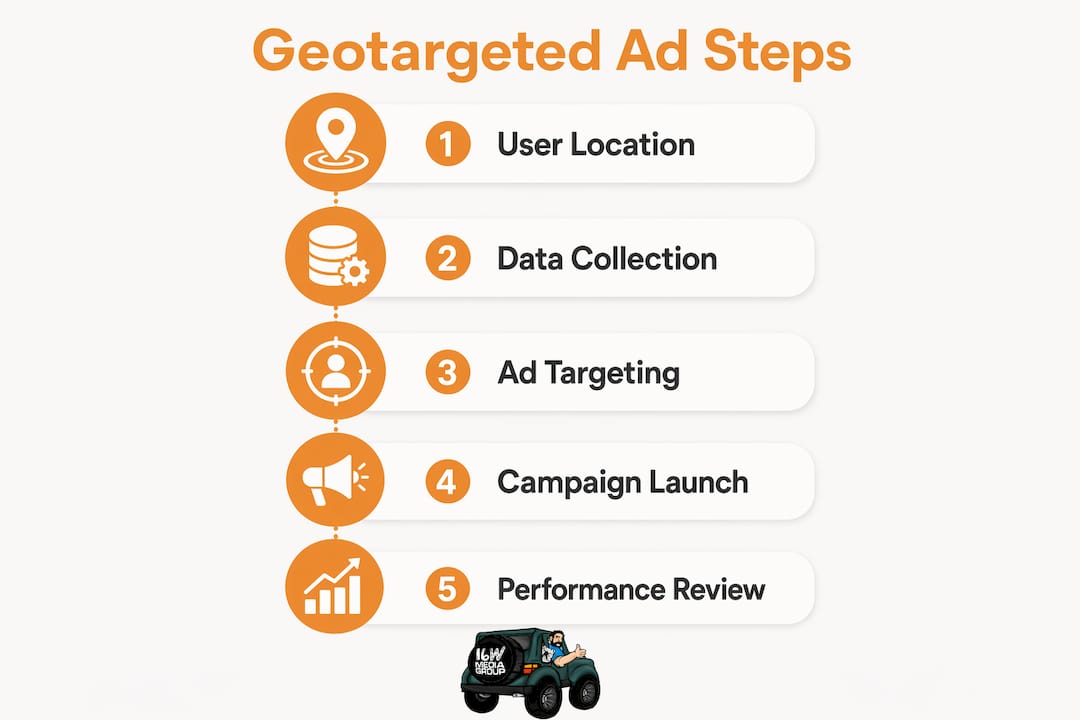
Here is a simplified view of that process:
| Stage | What happens |
|---|---|
| Location detection | GPS, IP, or Wi-Fi data identifies the user’s position |
| Criteria matching | Platform compares position to your defined geographic targets |
| Audience filtering | Demographic and behavioral filters narrow the eligible audience |
| Ad delivery | Qualifying users see your ad in real time |
| Performance logging | Impressions, clicks, and conversions are recorded by region |
Targeting granularity options give you real control:
- Country level for national or international campaigns
- City or region level for metro-area promotions
- Radius targeting (minimum 1 km in Google Ads) for businesses serving a defined local area
- Points of interest (POI) for targeting users near specific venues like stadiums or shopping centers
- Geofencing to trigger ads the moment a device enters or exits a virtual perimeter
Geofencing takes this a step further by activating campaigns around competitor stores, transit hubs, or event venues. A coffee shop, for example, can push a morning coupon to anyone walking within two blocks during rush hour. The ad fires because context and location align, not because someone typed a keyword.
Pro Tip: Set up separate ad groups for radius targeting and city-level targeting. The messaging that converts someone two blocks away differs from what resonates with someone across town.

What are the real benefits of geotargeted advertising?
The benefits of geotargeted ads show up in three places: relevance, budget, and results. When your ad matches where someone is right now, engagement climbs. When you stop serving ads to people who can never visit your store, your budget goes further.
Localized campaigns stretch ad budgets by reducing irrelevant impressions, and that efficiency compounds over time. A restaurant in Austin spending on “women’s jewelry store in Austin” style specificity pays less per click than a broad national term and converts better because the audience is already nearby and already interested.
Key benefits worth building your strategy around:
- Higher click-through rates because the ad speaks directly to the user’s current environment
- Improved conversion rates from audiences already near a purchase decision
- Increased foot traffic to physical locations through timely, location-specific promotions
- Stronger community presence as your brand becomes a familiar name in the neighborhood
- Better budget efficiency by reducing wasted impressions on audiences outside your service area
- Richer personalization when location data combines with purchase history and demographics
Local businesses gain something beyond the numbers, too. Delivering content that reflects a customer’s immediate environment positions your brand as attuned and reliable, which builds the kind of loyalty that national campaigns rarely achieve.
Which industries get the most from geotargeted campaigns?
Geotargeting works across almost every sector, but some industries have turned it into a genuine competitive edge. Understanding where it performs best helps you apply the right model to your own campaigns.
- Retail uses radius targeting to drive foot traffic with time-sensitive offers. A sustainable clothing store, for instance, can target people near its location who also search for eco-friendly brands, combining geography with intent.
- Restaurants and food service rely on proximity-based promotions to capture the “where should we eat?” moment. Burger King’s “Whopper Detour” campaign, which offered a discounted Whopper to users ordering near a McDonald’s, is a well-documented example of geo conquesting in action.
- Hospitality and travel targets tourists arriving in specific cities with hotel deals, attraction promotions, and local experience packages, reaching people at peak decision moments.
- Real estate uses city and neighborhood-level targeting to reach buyers and renters actively searching in specific zip codes.
- Healthcare promotes vaccination drives, urgent care options, and local clinic services to residents within a defined service radius.
- Event promotion targets people near a venue in the days and hours before showtime, turning proximity into ticket sales.
- Retail chains layer geotargeting with local SEO to appear in both paid and organic results when nearby shoppers search for products.
Geotargeting also complements in-store promotions well. When a campaign drives someone to a physical location, the in-store experience closes the loop that the ad opened. For localized marketing strategies built around community connection, that combination is hard to beat.
How do you set up geotargeted ads in Google Ads and Meta Ads Manager?
Setup is where strategy meets execution. Both Google Ads and Meta Ads Manager offer location targeting, but the configuration choices you make at the start determine whether the campaign reaches the right people or bleeds budget on the wrong ones.
In Google Ads:
- Create or open a campaign and navigate to the Settings tab.
- Under “Locations,” choose your targeting type: country, region, city, or radius.
- Select advanced location options to choose between “Presence or Interest” (the default, which reaches users physically present or who have shown interest) and “Presence only” (for campaigns where physical location is non-negotiable).
- Add location exclusions to block areas you do not serve.
- Layer in demographic filters (age, household income) and audience segments at the ad group level.
In Meta Ads Manager:
- At the ad set level, open the “Audience” section and select “Locations.”
- Choose from options to reach people who live in, recently visited, or are currently in your target area.
- Set a radius around a specific address or drop a pin on the map.
- Stack interest and behavioral targeting on top of the location layer.
- Use dayparting to schedule ads during peak local hours, such as lunchtime near an office district.
Best practices that consistently improve performance:
- Start with a 1–5 mile radius and expand only after reviewing click and conversion data by location.
- Create location-specific ad copy rather than generic messaging. “Just around the corner from Ybor City” outperforms “Visit our store.”
- Exclude locations where your conversion data shows consistently poor results.
- Review the media planning checklist before launch to confirm every targeting layer aligns with your campaign goals.
How does layering behavioral data make geotargeting more powerful?
Location alone is a starting point, not a complete strategy. The real lift comes when you combine where someone is with what they care about. Geotargeting combined with behavioral and demographic filters creates context-aware messaging that resonates far more deeply than a location-only approach.

Think about the difference between showing a gym ad to everyone within a mile of your location versus showing it only to people in that radius who have also searched for fitness equipment or visited running tracks in the past 30 days. The audience shrinks, but the relevance spikes.
This layered approach also supports local brand loyalty. When your messaging acknowledges both where someone is and what they value, it feels personal rather than broadcast. That feeling drives repeat visits and word-of-mouth, two outcomes that paid ads alone rarely produce.
Privacy and data accuracy are the two constraints to plan around carefully. Geotargeting requires careful planning to navigate privacy expectations and maintain data accuracy, especially as location permissions on mobile devices become more selective. Campaigns built on aggregated, anonymized signals rather than individual tracking tend to perform more consistently and face fewer compliance issues.
Video content adds another dimension to this layered approach. Pairing location-triggered ads with locally relevant video creative, as explored in local video marketing, can significantly lift engagement when the visual story matches the viewer’s immediate environment.
Pro Tip: Build separate audience segments for “currently in location” and “recently visited location.” The messaging for each should differ. Someone in your target area right now responds to urgency; someone who visited last week responds to follow-up value.
How do you measure whether your geotargeted campaigns are working?
Measurement is where most local advertisers leave money on the table. Clicks and impressions tell you reach; conversions and store visits tell you impact. Both matter, but the second set is what justifies the budget.
Start with the metrics that map directly to your campaign goals. For foot traffic campaigns, track store visit conversions, a feature available in Google Ads for eligible accounts. For online conversions, segment your results by geographic region to see which locations drive the most revenue per impression. For brand awareness, monitor reach and frequency within your target radius.
Key performance indicators to track by location:
- Click-through rate (CTR) by region to identify which geographic segments respond best
- Conversion rate by location to find where intent is highest
- Cost per acquisition (CPA) by radius to compare efficiency across targeting zones
- Store visit lift for brick-and-mortar businesses using Google Ads store visit tracking
- Return on ad spend (ROAS) by city or zip code to guide budget reallocation
Attribution is the harder problem. A user who sees your geofenced ad on Monday and walks in on Thursday may not show up as a direct conversion in your dashboard. Building a measurement framework that accounts for view-through attribution and offline visit data gives you a more accurate picture. Platforms like Google Ads and Meta both offer tools for this, though the accuracy depends on the size of your audience and the volume of conversions you generate.
Reviewing performance weekly by location, not just overall, lets you reallocate budget toward the zones that convert and pull back from those that do not. That discipline, applied consistently, is what separates campaigns that grow from those that plateau.
What challenges should you expect with geotargeted advertising?
Geotargeted advertising is not without friction. Knowing the common failure points before you launch saves budget and frustration.
Location data accuracy is the most persistent challenge. IP-based targeting can misplace users by dozens of miles, particularly on desktop devices. GPS is more accurate but depends on users granting location permissions, which fewer people do as privacy awareness grows. Building campaigns that work across multiple location signals, rather than relying on one, improves reliability.
Privacy compliance is a growing constraint. Regulations like the California Consumer Privacy Act (CCPA) and the broader framework of state-level privacy laws in the United States require that businesses handle location data responsibly. Campaigns using third-party location data need to confirm that data was collected with proper consent. Responsible geotargeting focuses on aggregated behavioral patterns rather than tracking individuals.
Audience size limitations can reduce delivery in tight radius campaigns. A 1-mile radius around a suburban store may not generate enough daily impressions to exit the learning phase on Meta or Google. Widening the radius or layering in interest targeting can solve this, but it requires testing.
Ad fatigue hits harder in small geographic areas. When the same audience sees your ad repeatedly because your radius is tight, frequency caps become critical. Set them early and monitor them weekly.
Over-segmentation is a real risk when layering too many filters. Combining a narrow radius with strict demographic and behavioral criteria can shrink your audience to the point where the platform cannot optimize effectively. Geotargeting is not one-size-fits-all, and finding the right balance between precision and scale takes iteration. Start broader, measure, then tighten.
Key Takeaways
Geotargeted ads deliver their strongest results when location data is layered with behavioral and demographic signals, not used in isolation.
| Point | Details |
|---|---|
| Location data drives relevance | GPS, IP, and Wi-Fi signals let platforms match ads to users’ physical whereabouts in real time. |
| — | 89% of marketers who integrated location data into their strategy reported increased sales outcomes. |
| Budget efficiency improves | Limiting delivery to defined geographic areas reduces wasted impressions and lowers cost per acquisition. |
| Layered targeting outperforms | Combining location with behavioral and demographic filters produces higher engagement than location alone. |
| Measurement requires location segmentation | Tracking CTR, conversion rate, and ROAS by region reveals which zones justify increased spend. |
Ready to put location to work for your brand?

16wmediagroup helps local businesses and marketing teams build campaigns that connect with the right audiences in the right places. From localized media planning to full-scale regional ad campaigns, the team brings the targeting precision and community knowledge that generic national agencies simply do not have.
Start with the local advertising best practices guide to build a campaign framework grounded in what actually works in 2026. Or, if you are ready to map out a full plan, the local advertising campaign planning guide walks you through every decision from audience definition to post-campaign analysis.
Your next customer is already nearby. Let’s make sure they see you first.