

Most small businesses that struggle with advertising don’t have a creativity problem. They have a planning problem. Money gets spread across Facebook ads, a few radio spots, and a local mailer with no clear connection between any of it, and then the results are disappointing. Step by step media planning fixes that by giving you a repeatable structure: one that connects your business goals to specific channels, schedules, and budgets before you spend a single dollar.
Table of Contents
- Key takeaways
- What you need before starting your media plan
- The stepwise media planning process
- Common pitfalls to avoid in local media planning
- Measuring success and iterating your plan
- My honest take on local media planning
- How 16wmediagroup can help you build your local media plan
- FAQ
Key takeaways
| Point | Details |
|---|---|
| Start with clear objectives | Define specific business and media goals before selecting any channel or setting any budget. |
| Choose channels by audience fit | Match media choices to where your local audience actually spends time, not where ads are cheapest. |
| Use pulsing schedules | For small budgets, pulsing beats continuous scheduling by concentrating spend at high-impact moments. |
| Track five core KPIs | Qualified Lead Rate, Lead-to-Close Conversion Rate, AOV, Local Intent Score, and CAC tell you what is working. |
| Treat plans as living documents | Review performance weekly and monthly, then adjust spend and timing based on real data. |
What you need before starting your media plan
Before you write a single line of your media plan, you need three things locked down: a clear business objective, a specific audience profile, and a realistic budget number.
Your business objective is not “get more customers.” It’s “generate 40 new service calls per month in the Westchase zip code by August.” The more specific, the better. Media objectives address who you want to reach, when, where, and how often. Without a defined business goal, none of those questions have good answers.

Your audience profile goes beyond age and income. For local businesses, neighborhood behavior matters. Where do your customers go on weekday mornings? What local publications do they read? What podcasts do they listen to during their commute? The answers shape every channel decision you make later.
Once you have your audience, you need to understand two foundational media concepts before moving forward.
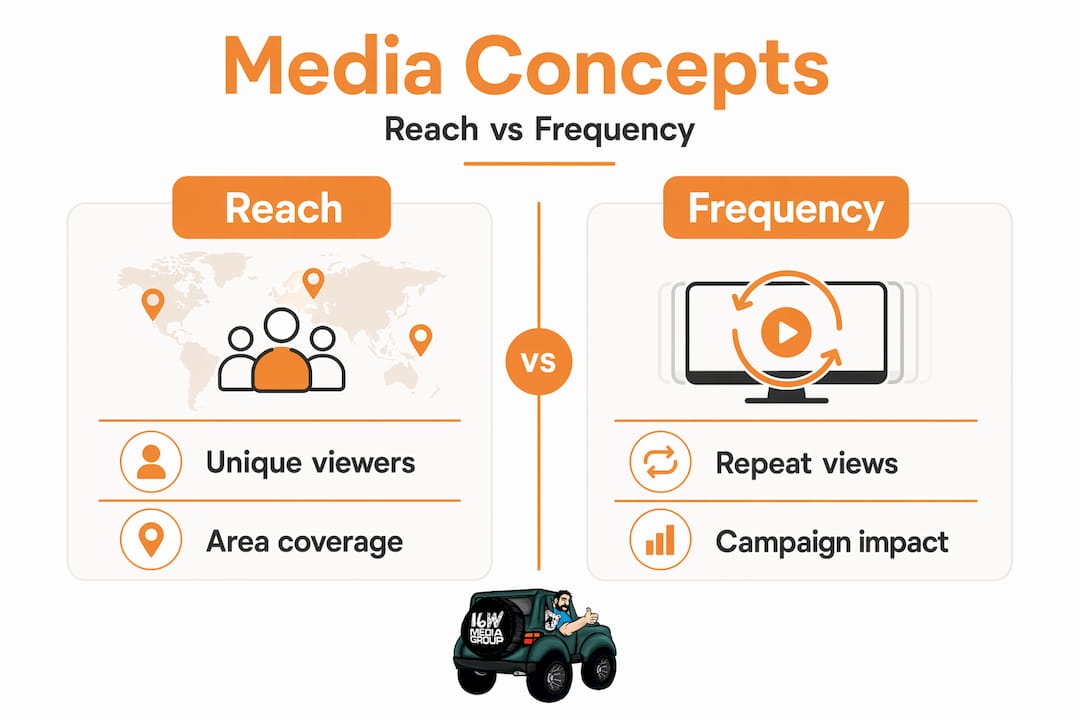
Reach is how many unique people in your area see your ad at least once. Frequency is how many times the same person sees it. Reach and frequency trade off directly against each other on a fixed budget. High reach works best for new product launches. High frequency works better when you’re trying to persuade customers who are already aware of you.
Here’s a quick reference for common media channels and how well they fit local business goals:
| Channel | Best for | Reach potential | Budget fit |
|---|---|---|---|
| Community magazine | Brand authority, affluent neighborhoods | Moderate, hyper-local | Medium |
| Social media ads | Targeted demographics, retargeting | High | Low to medium |
| Podcast sponsorship | Engaged niche audiences | Moderate | Medium |
| Direct mail | Geographic targeting | Moderate | Medium |
| Local radio | Broad awareness, commuters | High | Medium to high |
| Out-of-home (OOH) | Location-based visibility | High | Medium to high |
Pro Tip: Don’t try to use every channel at once. Pick two or three that fit your audience best, and do them well. Thin coverage across six channels rarely beats concentrated presence on two.
The stepwise media planning process
This is where the actual work happens. Follow these steps in order, and you will produce a media plan that is specific enough to execute and flexible enough to adjust.
-
Research your market and competition. Before choosing channels, find out where your competitors are advertising. If every local competitor runs Facebook ads but none of them uses a community magazine, that gap is an opportunity. Also research your audience’s media consumption habits. Local surveys, customer interviews, and your own sales data are all valid sources.
-
Set media goals tied to business outcomes. A media goal sounds like: “Achieve 60% reach among homeowners aged 35 to 55 within a 10-mile radius over a 90-day campaign, with a minimum average frequency of three exposures.” That level of specificity makes channel selection and budget decisions much easier.
-
Select channels and media vehicles. A media vehicle is the specific outlet within a channel. “Social media” is a channel. “Facebook in-feed ads targeting zip codes 33626 and 33647” is a vehicle. Choose vehicles based on where your audience actually is, not just where the cost-per-click looks good.
-
Design your media schedule. Three scheduling strategies exist, and each serves a different purpose. Continuous scheduling spreads your budget evenly across the campaign period. It works for services with steady, year-round demand. Flighting runs ads in concentrated bursts with no activity in between. It works well for seasonal businesses. Pulsing maintains a low baseline presence all year with budget spikes during peak periods. For most small local businesses, pulsing delivers the best return because it keeps you visible without burning through budget during slow months.
-
Allocate your budget across channels and timing. Split your total budget between your chosen vehicles, then map the spend to your schedule. If you are pulsing, heavier spend goes into your peak windows. A general starting point for local businesses: put 60 to 70 percent of your budget into your top one or two channels and test the rest with the remainder.
-
Build a media calendar. Your calendar is a visual summary of your plan. A media plan should show ad sizes, placements, dates, and timing tied clearly to your objectives. Here is a simple format:
| Month | Channel | Vehicle | Weekly spend | Objective |
|---|---|---|---|---|
| July | Social | Facebook in-feed | $400 | Reach |
| July | Community magazine | Full-page print ad | $600 | Brand authority |
| August | Social | Facebook retargeting | $300 | Conversion |
| August | Podcast | Mid-roll sponsorship | $500 | Awareness |
- Write the media plan document. This is the one-page to three-page summary you share with stakeholders or agency partners. It should cover your objective, audience, channel rationale, schedule overview, and budget breakdown. Keep it clear enough that someone who didn’t build it can execute it.
Pro Tip: Review your localized marketing strategies before finalizing channel selections. Local behavioral data often reveals audience preferences that national demographic reports miss completely.
Common pitfalls to avoid in local media planning
Most local media planning mistakes fall into three categories: budget misallocation, wrong scheduling, and no measurement.
On budget, the biggest trap is spreading spend too thin. Concentrating your budget through geographic and demographic focus beats broad, low-visibility coverage every time. Being memorable in one neighborhood beats being invisible in five.
On scheduling, many small businesses default to continuous campaigns because they feel safer. Running a $50-per-week Facebook ad every week of the year sounds consistent, but it rarely generates recall or response. Concentrating budgets via pulsing creates more memorable impressions at the moments that actually drive decisions.
On measurement, the problem is usually starting a campaign with no baseline. You cannot tell whether your ads are working if you have no idea what your normal lead volume looked like before the campaign started.
Here are the most common traps, and how to sidestep each one:
- Targeting too broadly. A local plumber does not need citywide reach. Tighten your geographic and demographic parameters aggressively.
- Ignoring local intent data. Search behavior, neighborhood-level foot traffic data, and local social listening all tell you what your audience is thinking about right now.
- Skipping the media calendar. Without a calendar, campaigns drift. Ads run on the wrong dates, budgets overspend in one channel and underspend in another.
- Not tracking by channel. Use unique phone numbers, offer codes, or dedicated landing pages so you know which channel drove each conversion.
- Changing too much too fast. When a campaign is underperforming, change one variable at a time. Otherwise you will never know what actually fixed it.
Pro Tip: When you are balancing reach versus frequency on a tight budget, lean toward frequency. Seeing your ad three times beats three different people each seeing it once, especially for local service businesses where trust drives the buying decision.
Measuring success and iterating your plan
Measurement is not what you do at the end of a campaign. It is what you set up before the campaign launches.
Five KPIs connect media spend to revenue for local businesses: Qualified Lead Rate, Lead-to-Close Conversion Rate, Average Transaction Value, Local Intent Score, and Customer Acquisition Cost per qualified lead. Most small business owners only track total leads, which tells you nothing about efficiency or profitability.
| KPI | What it measures | Why it matters |
|---|---|---|
| Qualified Lead Rate | % of leads that match your ideal customer | Shows whether your targeting is accurate |
| Lead-to-Close Conversion Rate | % of leads that become paying customers | Reveals sales process and offer strength |
| Average Transaction Value | Revenue per closed customer | Helps calculate true ROI on media spend |
| Local Intent Score | Engagement from local audience segments | Confirms geographic targeting is working |
| CAC per qualified lead | Cost to acquire one ideal customer | Your most important efficiency metric |
Before your campaign goes live, record your baseline numbers for each KPI. Use a simple spreadsheet updated weekly. Phone call tracking, unique offer codes, and landing pages each help you attribute results to the right channel without expensive software.
Weekly and monthly reviews of your qualified lead rate and conversion rate give you the data to make smart adjustments. If your Qualified Lead Rate drops below 30 percent, your targeting needs tightening. If your Lead-to-Close Rate stalls, the problem is often the offer or follow-up, not the media.
- Set a firm review cadence: weekly for in-flight campaigns, monthly for overall plan assessment.
- Make small adjustments, not wholesale changes, when a metric underperforms.
- Document every change with a date so you can connect adjustments to outcomes later.
Pro Tip: Build your measurement setup, including tracking phone numbers and offer codes, into the plan document itself. If measurement is an afterthought, it usually gets skipped.
My honest take on local media planning
I’ve worked with enough local businesses to know that most of them treat media planning like a once-a-year chore. They pull together a budget in November, pick the same channels they used last year, and call it done. That approach almost never grows a business.
What I’ve seen actually work is treating the plan as a quarterly operating document. The businesses that get real results check their qualified lead rates every week, move budget away from underperforming channels without sentimentality, and think hard about scheduling before they commit to anything.
The other thing I’ve learned is that concentration beats coverage for small budgets. It feels counterintuitive to put 70 percent of your spend into one or two channels, but media dominance in a targeted niche or geography consistently outperforms being mildly present everywhere. A full-page ad in the right community publication, combined with a well-targeted podcast sponsorship, can outperform a five-channel digital campaign at a fraction of the complexity.
Finally, stop optimizing for lead volume and start optimizing for qualified lead rate. More calls from the wrong people is not a win. Fewer calls from people who actually buy is exactly what you want your media plan to produce.
— Mike
How 16wmediagroup can help you build your local media plan
Getting media planning right from scratch takes time that most small business owners don’t have. 16wmediagroup specializes in building tailored local media plans that connect the right channels to your specific audience and market.
From campaign planning and media buying to podcast sponsorships and community magazine placements, the team at 16wmediagroup handles the full media planning process for local businesses in Tampa and beyond. If you want a plan built around your market, your budget, and your growth goals, the full service offerings are a strong starting point. You can also reach out directly through the contact page for a personalized consultation to discuss where your current media spend is working and where it isn’t.
FAQ
What is step by step media planning?
Step by step media planning is a structured process for connecting your business goals to specific advertising channels, budgets, and schedules. It starts with audience research and ends with a measurable media calendar that guides every spending decision.
How many steps does a basic media plan have?
A solid local media plan follows seven core steps: research, goal-setting, channel selection, scheduling, budget allocation, calendar creation, and documentation. Each step informs the next, so skipping one usually creates problems downstream.
What is the best scheduling strategy for small business budgets?
Pulsing is generally the most effective scheduling strategy for small budgets. It maintains baseline presence year-round while concentrating heavier spend during the periods when your audience is most likely to act.
Which KPIs should local businesses track in media campaigns?
The five most useful KPIs are Qualified Lead Rate, Lead-to-Close Conversion Rate, Average Transaction Value, Local Intent Score, and Customer Acquisition Cost per qualified lead. Together they show whether your media spend is producing profitable customers, not just traffic.
How often should you update a local media plan?
Review in-flight campaigns weekly and assess the overall plan monthly. Most local businesses benefit from rebuilding or substantially revising their plan every quarter based on actual performance data.