

Your logo is not your brand. Neither is your color palette, your tagline, or your storefront sign. For Tampa business owners competing in one of Florida’s most dynamic local markets, the real differentiator is the story you tell and how consistently you tell it. Research confirms that stories trigger oxytocin release in the brain, building trust and emotional connection far more effectively than product features alone. This guide walks you through the frameworks, practical steps, and real-world evidence you need to use storytelling as a genuine branding engine for your Tampa business.
Table of Contents
- Why stories matter in branding
- Types of storytelling: Strategic vs. tactical for Tampa businesses
- The anatomy of a compelling brand story
- Storytelling in action: Use cases and tools for Tampa brands
- How brand storytelling boosts customer loyalty and sales
- The pitfalls: When storytelling misses the mark
- Take your Tampa brand further with expert storytelling
- Frequently asked questions
Key Takeaways
| Point | Details |
|---|---|
| Storytelling builds trust | Emotional narratives foster stronger brand loyalty and customer engagement than facts alone. |
| Strategy plus tactics | Combining strategic brand narratives with tactical campaign stories maximizes marketing impact. |
| Local stories matter | Tailoring stories to Tampa’s community needs and values sets you apart as an authentic brand. |
| Measure and refine | Tracking engagement and loyalty helps you improve your brand storytelling for better results. |
| Be authentic | Ensure your stories are true to your brand to avoid backlash or lost trust. |
Why stories matter in branding
Most small business owners think branding means having a polished logo and a catchy slogan. That thinking leaves enormous value on the table. Branding is really about how people feel when they interact with your business, and feelings are shaped by stories, not graphics.
The science is clear. Narratives trigger oxytocin, the brain’s trust and empathy chemical, making stories more memorable than lists of facts or product specs. When a Tampa restaurant owner shares how her grandmother’s recipes survived a hurricane evacuation and inspired the menu, that story sticks. A price promotion does not.
“Effective stories include tension, stakes, relatability, and clear takeaways. They are remembered longer and trusted more deeply than facts alone.”
For local businesses, this is a massive advantage. You have real stories rooted in your community. A large national chain cannot authentically claim Tampa as its home. You can. Highlighting your neighborhood roots, your customers’ real struggles, or a cause you champion locally gives your brand a texture that no corporate competitor can replicate. Investing in building local brand awareness through storytelling is one of the highest-return moves a small business can make.
Key reasons storytelling works for Tampa brands:
- It creates emotional memory, making customers more likely to return
- It builds trust faster than advertising claims or promotional offers
- It differentiates you from competitors who look and sound identical
- It gives your team a shared identity and purpose to rally around
- It attracts customers who share your values, not just your price point
Types of storytelling: Strategic vs. tactical for Tampa businesses
Understanding why stories work leads to another question: what types of stories actually strengthen your brand identity day to day?
There are two distinct layers. Strategic and tactical storytelling both mediate between brand identity and business performance, and research shows they strongly correlate with better positioning and results for small and medium businesses. Knowing the difference helps you deploy each type at the right moment.
| Type | Focus | Time horizon | Example |
|---|---|---|---|
| Strategic | Core values, origin, mission | Long-term, always-on | A bakery’s founding story woven into all marketing |
| Tactical | Specific campaign or event | Short-term, campaign-based | Holiday promotion featuring a loyal customer spotlight |
Strategic storytelling is the foundation. It answers: who are you, why do you exist, and what do you stand for? This story appears on your website’s About page, in your staff training, in how you answer the phone. It is consistent across every touchpoint.
Tactical storytelling plugs into that foundation for specific moments. A Tampa fitness studio might run a January campaign featuring a real member’s transformation story. That story is tactical, but it only works because it connects to the studio’s deeper strategic narrative about community and resilience.
Here is a simple process for combining both:
- Write your strategic story first. Define your origin, your values, and the problem you solve for Tampa customers.
- Identify three to five recurring tactical opportunities each year, such as holidays, local events, or product launches.
- For each tactical moment, find a real customer or team story that reinforces your strategic narrative.
- Publish that story across your channels during the campaign window.
- Archive stories so they build a library of proof over time.
Pro Tip: Think of your strategic story as the trunk of a tree and your tactical stories as branches. Every branch should grow from the same trunk or the tree looks broken.
Explore how narrative strategy vs. campaign storytelling plays out for Tampa brands in practice.
The anatomy of a compelling brand story
Now that we know the types of brand storytelling, let us explore what actually makes a story compelling and how to build one your community cares about.
Research identifies four non-negotiable elements. Stories with tension, stakes, relatability, and clear takeaways are most effective at building trust and are remembered far longer than pure facts. Remove any one of these and the story loses its grip.
| Story element | What it means | Tampa example |
|---|---|---|
| Tension | A real problem or conflict | A family-owned hardware store nearly closing after a big-box competitor opened nearby |
| Stakes | Why the outcome matters | Losing the store meant losing three generations of family legacy |
| Relatability | A human connection point | Every Tampa homeowner has shopped at a local hardware store |
| Takeaway | What changed or was learned | The store survived by specializing in hurricane prep expertise no chain could match |
Notice how that example uses a Tampa-specific challenge. Hurricane season is real here. That detail is not decoration; it makes the story land with local customers in a way a generic narrative never could.
Here is how to build your own brand story using this framework:
- Identify the tension. What real problem did your business face or solve? Be honest. Sanitized stories feel fake.
- Raise the stakes. Explain why this problem mattered to real people, your family, your customers, your community.
- Build relatability. Ground the story in a shared Tampa experience, a neighborhood, a local event, a seasonal challenge.
- Deliver the takeaway. What did you learn, change, or create because of this experience?
Pro Tip: Interview your three most loyal customers and ask them why they keep coming back. Their answers will often reveal your brand story better than anything you could write yourself.
Applying localized marketing strategies means your story should feel like it could only come from Tampa, not from anywhere else.
Storytelling in action: Use cases and tools for Tampa brands
With the anatomy clear, let us put storytelling in motion and see how to apply stories with real business outcomes in Tampa.
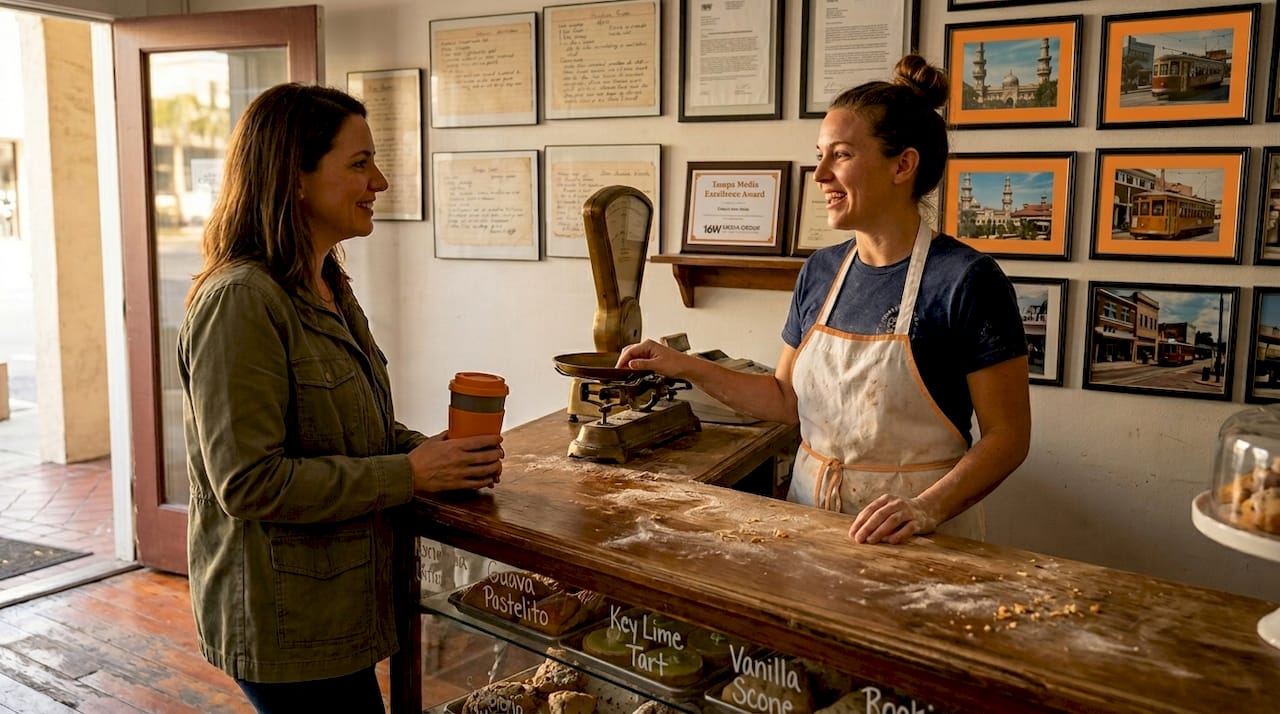
The platforms you use matter, but consistency matters more. For local businesses, storytelling builds differentiation, attracts aligned clients through authentic narratives, and case studies show increased foot traffic, sales, and loyalty when stories are shared consistently across channels.
Practical steps to activate your brand story:
- Gather real stories. Talk to customers, staff, and community members. Record short video interviews or collect written testimonials.
- Structure for engagement. Use the tension, stakes, relatability, and takeaway framework for every piece of content.
- Publish on your website. Your About page and blog are prime real estate for your strategic story.
- Use social media for tactical moments. Instagram and Facebook work well for customer spotlights and behind-the-scenes content.
- Include stories in email newsletters. A monthly story-driven email builds loyalty and keeps your brand top of mind.
- Measure consistently. Track engagement rates, repeat visits, referral traffic, and customer retention month over month.
Consider a Tampa bakery that started sharing its family history in local ads and on social media. Within one year, customer retention tripled. The product had not changed. The price had not changed. The story had changed, and customers felt a reason to come back beyond the pastry itself. Community-focused retail strategies like this one show that storytelling is not a soft tactic. It produces hard numbers.
You can also use traditional advertising examples to see how local businesses have woven stories into print, radio, and direct mail campaigns with measurable results.
How brand storytelling boosts customer loyalty and sales
You have seen how to craft and share your stories. Now let us tie those efforts to the business results Tampa owners actually care about.
Storytelling builds differentiation with limited resources and attracts aligned clients, with documented case studies showing increased foot traffic, sales, and repeat business for small businesses that commit to it. This is not a soft marketing benefit. It is a revenue driver.
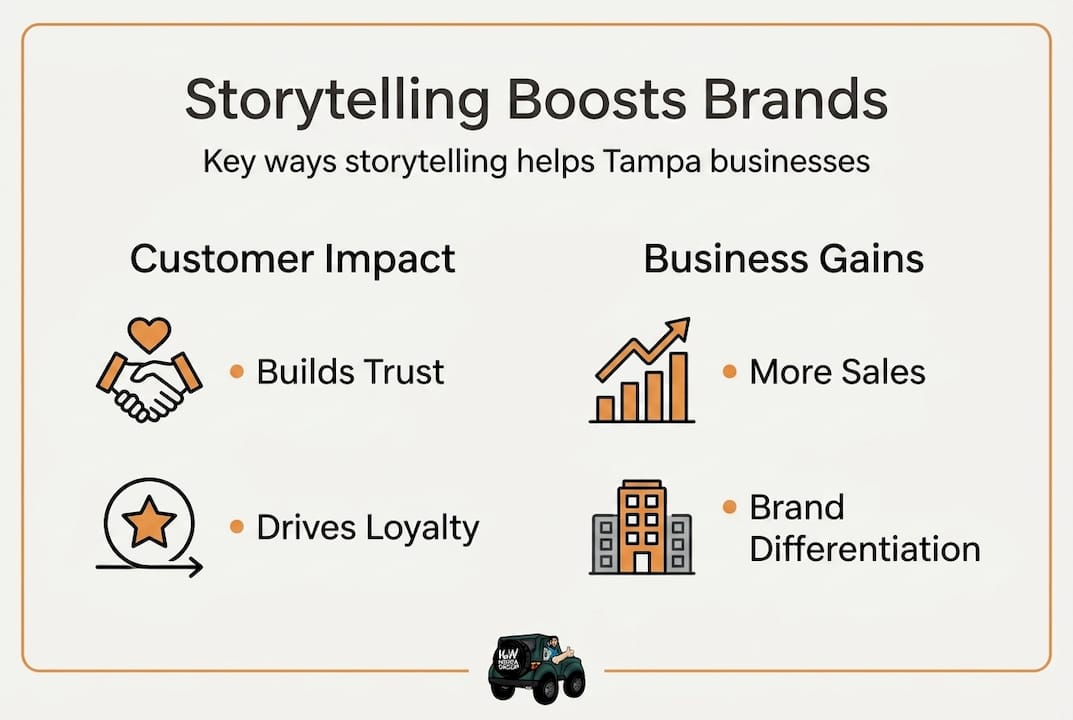
Research on brand image shows that storytelling affects purchase intention through credibility, resonance, and extensibility, with credibility having the strongest effect. In plain terms: when customers believe your story is real, they are more likely to buy and more likely to come back.
Key outcomes Tampa businesses can expect from consistent storytelling:
- Higher purchase intent. Credible brand stories make customers more confident in choosing you over a competitor.
- Stronger loyalty. Customers who connect with your story feel a relationship, not just a transaction.
- More referrals. People share stories, not product specs. A compelling brand story spreads organically.
- Better online engagement. Story-driven content consistently outperforms promotional content in social media reach and email open rates.
Track these metrics monthly: website session duration, social engagement rate, email click-through rate, repeat purchase frequency, and net promoter score. When your storytelling is working, you will see these numbers move together. For a deeper look at how to amplify these outcomes, revisit brand awareness strategies built for local markets.
The pitfalls: When storytelling misses the mark
With the benefits outlined, it is just as important to recognize where storytelling goes wrong. And it can go wrong in ways that actively damage your brand.
Storytelling can become bloat or lazy when it is not genuinely value-adding for the audience. A story that exists to make the business owner feel good, rather than to serve the customer, will fall flat. Worse, it can feel self-congratulatory and push customers away.
Ethical risks are real too. Exaggerating your origin story, using a customer testimonial without full context, or manufacturing a crisis that never happened are all shortcuts that destroy trust permanently when discovered. Tampa is a relationship-driven market. Word travels fast here.
The most common mistake we see is generic storytelling. A business says it was “founded on passion and community values” without ever explaining what that means in a specific, verifiable way. That kind of language is noise. It signals nothing because every business claims the same thing.
Authenticity requires specifics. Instead of “we care about our customers,” tell the story of the time you stayed open late during a storm because a regular needed supplies. Instead of “we are community-focused,” describe the youth sports team you have sponsored for seven years and why you started doing it.
When storytelling works best is when it is grounded in real, verifiable, locally resonant details that your audience can recognize and confirm. Test your stories with a small group of loyal customers before you launch them widely. Their honest reactions will save you from expensive missteps.
Pro Tip: If your story could belong to any business in any city, rewrite it. A great Tampa brand story should feel impossible to copy-paste to a business in Chicago or Phoenix.
Take your Tampa brand further with expert storytelling
Knowing the opportunities and pitfalls, you may decide it is time to get expert help bringing your local story to a wider audience.
Crafting and distributing a brand story that actually moves the needle takes more than good intentions. It takes the right channels, the right format, and a strategy built around your specific Tampa audience.
At 16W Media Group, we specialize in helping Tampa businesses find their authentic story and get it in front of the right people through community magazines, podcasts, digital campaigns, and localized advertising. Whether you are starting from scratch or refining a story that is not quite landing, our team builds localized branding strategies tailored to your market and your goals. We also offer hyperlocal digital advertising solutions designed to amplify your story to high-value consumers right here in Tampa. Reach out and let us help you turn your story into your strongest competitive asset.
Frequently asked questions
How does storytelling help small businesses compete with larger brands?
Storytelling builds differentiation with limited resources and attracts aligned clients, often leveling the playing field because authenticity is something large brands struggle to replicate at the local level.
What is the difference between strategic and tactical storytelling in branding?
Strategic and tactical storytelling serve different purposes: strategic storytelling expresses your core brand identity over time, while tactical storytelling uses specific stories to support short-term campaigns or promotions.
Which platforms should Tampa businesses use for brand storytelling?
Websites, social media, and emails are all effective channels, and in-store signage or printed community publications can extend your story to customers who are not yet following you online.
How can I tell if my brand story is effective?
Monitor engagement growth and retention metrics such as website session time, social shares, email open rates, and repeat purchase frequency to see whether your storytelling is creating lasting customer relationships.
Are there risks to using storytelling incorrectly?
Yes. Inauthentic or exaggerated stories can seriously damage trust and brand credibility, especially in tight-knit local markets like Tampa where reputation spreads quickly through word of mouth.
Recommended
- Tampa Marketing Agency: Accelerating Your Brand on The Branding Highway (2026) – 16W Media Group
- Hyperlocal Digital Advertising in Tampa: Accelerate Your Brand’s Local Authority – 16W Media Group
- Local Marketing Strategy for Tampa Businesses: The 2026 Growth Roadmap – 16W Media Group
- Top Advertising Companies in Tampa: How to Fast-Track Your Brand Growth in 2026 – 16W Media Group