

A strong brand is the single most reliable way a Tampa business can stand out in a crowded local market. Brand identity, the recognized industry term for what most owners call “branding,” covers every signal your business sends: your name, logo, colors, messaging, and the feeling customers get when they interact with you. The good news is that the core tampa business branding steps can be completed in a structured framework of under two hours, making this achievable for any owner, whether you run a Ybor City restaurant or a South Tampa law firm. This guide walks you through each step with the specificity Tampa’s competitive market demands.
What are the Tampa business branding steps every owner should follow?
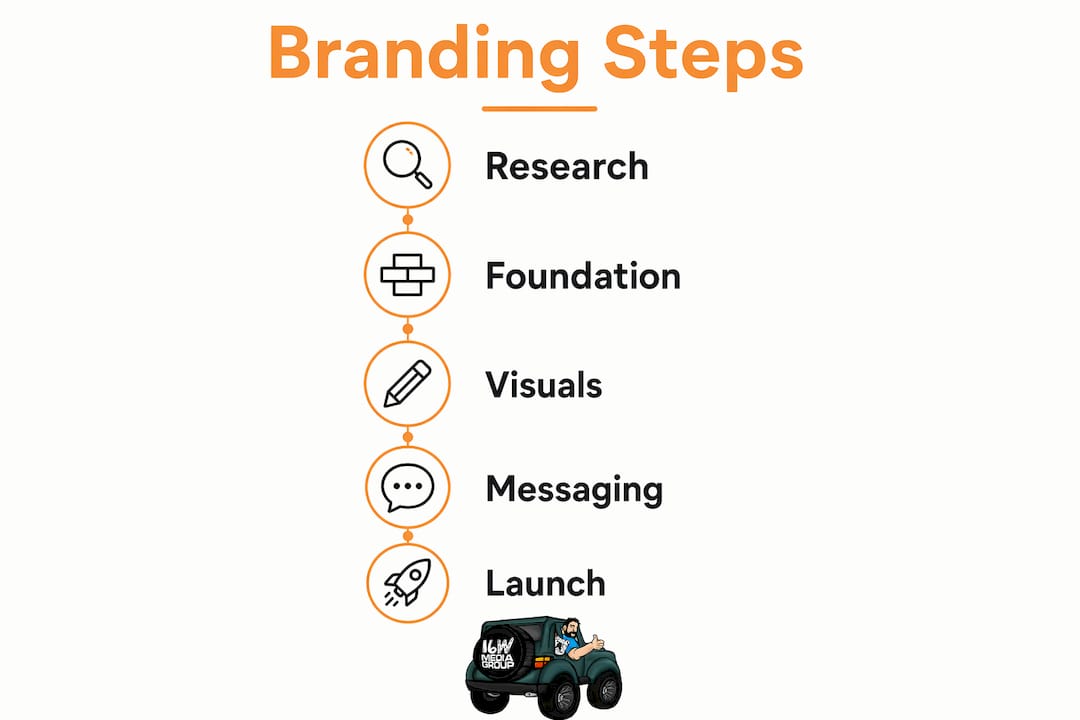
Tampa business branding steps follow a proven sequence: research first, then foundation, then visuals, then messaging, then launch. Skipping steps creates gaps that cost money to fix later. An accelerated 7-step brand strategy covers research, mission and values, positioning, personality, visual identity, messaging, and execution planning. Each step builds directly on the one before it.
The sequence matters because your visual identity should reflect your positioning, and your messaging should express your personality. Owners who design a logo before defining their positioning often rebrand within two years. Starting with research and strategy protects every dollar you spend on design and advertising.

What initial research should Tampa businesses do before branding?
A competitive audit of 3–5 local rivals is the required first step before creating any visual assets. That audit should cover competitor positioning, messaging tone, color choices, and the promises they make to customers. Your goal is not to copy what works but to find the gap they leave open.
Here is what to examine for each competitor:
- Positioning: What problem do they claim to solve, and for whom?
- Tone: Are they formal, casual, expert-driven, or community-focused?
- Visual signals: What colors and fonts dominate their website and signage?
- Gaps: What customer need goes unaddressed in their messaging?
After the audit, write a two-sentence positioning statement. The first sentence names your customer and the problem you solve. The second sentence states why you solve it better than anyone else in Tampa. Experts recommend spending about 20 minutes drafting this statement. That single document will guide every branding decision that follows.
Pro Tip: Use Google Maps, Yelp, and each competitor’s Instagram profile to complete your audit in one sitting. You do not need a paid research tool to gather enough information to find your gap.
How to define your brand foundation: mission, vision, values, and personality
Your brand foundation is the internal document that explains why your business exists and how it behaves. Without it, every employee and vendor makes brand decisions based on personal judgment instead of a shared standard.
Build your foundation in this order:
- Mission statement: One sentence. What you do, for whom, and why it matters today. Example: “We help Tampa homeowners find furniture that fits their space and their budget.”
- Vision statement: One sentence. Where you are headed in five to ten years. Example: “To become the most trusted home furnishings brand in Hillsborough County.”
- Brand values: Choose three to five values that reflect how you operate. Tie each one to a real business behavior. “Integrity” means nothing alone. “We never charge a diagnostic fee without written approval” means something.
- Brand personality: Select three to five specific traits. Avoid generic traits like “friendly” because every competitor claims the same thing. “Direct, neighborhood-rooted, and quietly confident” gives your team something to work with.
- Proof points: For each personality trait, write one example of how it shows up in real customer interactions.
“A brand that cannot articulate who it is for, what it stands for, and how it is different will always compete on price alone.” This is the core risk of skipping the foundation step.
Targeting specific market segments and tying brand values to customer beliefs is what separates brands that earn loyalty from those that earn only transactions. Tampa’s market includes distinct neighborhoods, income brackets, and cultural communities. A brand built for “everyone in Tampa” connects with no one.
Pro Tip: Read your mission statement aloud to a customer you trust. If they say “that sounds like you,” you have it right. If they look confused, rewrite it.
What are the essential visual identity components for Tampa brands?
Visual identity is the set of elements that makes your brand instantly recognizable. The four core components are your logo, color palette, typography, and the consistent style you apply across every surface.
Your competitive audit directly informs these choices. If every competitor in your Tampa category uses blue and gray, choosing a warm amber palette immediately differentiates you at a glance. That is not a creative decision. It is a strategic one.
| Element | DIY Approach | Professional Approach |
|---|---|---|
| Logo | Fast and low cost; often lacks scalability across print and digital | Higher upfront cost; built to work at any size and on any surface |
| Color palette | Free tools like Coolors or Adobe Color work well | Designer ensures colors meet accessibility standards and print accuracy |
| Typography | Google Fonts provides quality free options | Custom or licensed fonts create stronger differentiation |
| Brand guidelines | Owner-written document; may miss edge cases | Designer-built guide with correct and incorrect usage examples |
| Long-term cost | Rebranding risk is high if foundational choices are wrong | Lower long-term cost due to fewer fixes |
A DIY logo often creates constraints that are costly to fix once you scale into print advertising, signage, or merchandise. The logo is the one element worth professional investment from the start.
Brand guidelines must include practical examples of correct and incorrect usage to be useful. A rule that says “use the primary blue” fails when your team does not know what the primary blue looks like next to white versus on a dark background. Show both versions. Abstract rules do not survive contact with a deadline.
Pro Tip: Build your brand guidelines as a one-page reference card first. Your team will actually use a single page. A 40-page brand book sits in a folder and gets ignored.
How to develop brand messaging and launch consistently across Tampa channels
Brand messaging is the language layer of your identity. It translates your positioning statement into words that work on your website, social media, email, and in-person conversations. Consistent messaging is what makes a customer recognize your brand before they see your logo.
Start with three core messages. Each one should answer a question your Tampa customer is already asking:
- Why you: What makes your business the right choice in this market?
- Why now: What is the cost of waiting or choosing a competitor?
- Why trust you: What proof do you have that you deliver?
Adapt the tone of each message to the channel without changing the substance. Your Instagram caption can be casual and direct. Your website homepage needs to be clear and specific. Your email subject line needs to earn a click. The underlying claim stays the same. Only the delivery changes. Storytelling plays a central role in making those messages stick across channels.
| Branding step | Estimated time | Completion check |
|---|---|---|
| Competitive audit | 20 minutes | 3–5 competitors documented |
| Mission and values | 15 minutes | Written, reviewed by one trusted person |
| Positioning statement | 20 minutes | Two sentences, specific to Tampa market |
| Brand personality | 15 minutes | 3–5 traits with real examples |
| Visual identity brief | 30 minutes | Logo, colors, fonts decided or briefed to designer |
| Core messaging | 20 minutes | Three messages written for three channels |
| Launch checklist | 10 minutes | All channels updated, team briefed |
Small teams benefit from simple brand reference cards over large brand books. Build a one-page card that includes your logo, colors, fonts, three core messages, and one example of correct tone. Pin it where your team creates content.
Enforcement is the step most Tampa business owners skip. Before any post, ad, or email goes live, one person should check it against the reference card. That review takes 90 seconds and prevents months of inconsistent brand signals from accumulating. Explore Tampa branding strategies for loyalty to see how consistent application compounds over time.
Pro Tip: Write a “brand voice cheat sheet” with three phrases your brand would say and three it would never say. This is faster to train from than a tone-of-voice document.
Key Takeaways
Effective Tampa business branding requires a structured sequence: research and competitive audit first, brand foundation second, visual identity third, and consistent messaging last.
| Point | Details |
|---|---|
| Audit before designing | Analyze 3–5 Tampa competitors before creating any visual assets. |
| Foundation drives everything | Mission, values, and personality must be written before logo or color decisions. |
| Invest professionally in the logo | DIY logos create costly constraints; outsource the logo and build internally from there. |
| Messaging adapts, substance does not | Adjust tone by channel while keeping your three core messages consistent. |
| Enforce with a reference card | A one-page brand card beats a 40-page brand book for daily team use. |
What I have learned about DIY branding versus hiring professionals in Tampa
The debate over DIY versus professional branding misses the real question, which is: which parts of your brand can you afford to get wrong?
I have worked with Tampa business owners who spent $200 on a logo generator and then spent $4,000 fixing it two years later when they needed it on a billboard, an embroidered shirt, and a vehicle wrap at the same time. The logo was built as a JPEG. It fell apart at scale. That is not a design problem. It is a planning problem.
My honest position is this: outsource the foundational work. Your logo, color palette, and positioning statement are the load-bearing walls of your brand. Get them built right the first time. Business owners save real costs by outsourcing foundational branding while handling ongoing content creation internally. That split makes financial sense at every stage of growth.
What you can absolutely manage in-house: social media captions, email copy, blog posts, and community engagement. These are the living parts of your brand. They should sound like you, and you know your voice better than any agency does. The brand awareness tactics that move the needle in Tampa are often the ones executed consistently by the owner, not outsourced and forgotten.
The mistake I see most often is the reverse: owners spend heavily on a brand photoshoot and a Squarespace template, then never define their positioning or personality. The result looks polished and says nothing. Tampa customers are sharp. They notice when a brand cannot answer the question “why you?”
— Mike
How 16wmediagroup helps Tampa businesses build brands that last
16wmediagroup works with Tampa business owners who need more than a logo. The agency builds complete brand strategies that connect your positioning to the media channels your customers actually use, from community magazines and podcasts to regional advertising packages.
If you have completed your brand foundation and are ready to put it in front of the right Tampa audience, 16wmediagroup builds the media plan around your brand, not the other way around. The team specializes in local market exposure that builds recognition over time, not just impressions. Learn how branding drives competitive results in Tampa’s market, or visit 16wmediagroup.com/services to see the full range of branding and media services available for local businesses.
FAQ
What are the first steps in Tampa business branding?
Start with a competitive audit of 3–5 local rivals, then write a two-sentence positioning statement. These two steps inform every visual and messaging decision that follows.
How long does it take to build a brand strategy for a Tampa business?
A complete brand strategy can be built in under two hours using a structured 7-step framework that covers research, foundation, visuals, messaging, and launch planning.
Should Tampa business owners hire a designer or use DIY tools for their logo?
Professional logo design is worth the investment because DIY logos often lack the file formats and scalability needed for print, signage, and merchandise. Handle social media and email copy in-house instead.
How many brand personality traits should a Tampa business define?
Define 3–5 specific personality traits with real examples of how each one shows up in customer interactions. Avoid generic traits like “friendly” that every competitor already claims.
How do you keep branding consistent across multiple channels?
Build a one-page brand reference card with your logo, colors, fonts, and three core messages. Assign one person to check every piece of content against it before it goes live.