


The Tampa–St. Petersburg–Sarasota DMA is the 11th-largest television market in the United States for the 2024–2025 Nielsen season, with an estimated TV households count typical for a market of this size. That single figure tells you almost everything you need to know before you start planning: this is a market large enough to compete with Denver and Phoenix for national ad dollars, yet regional enough that a well-placed local buy still moves real numbers. For any brand or agency setting a budget for Tampa Bay, that rank is the starting line, not the whole story.
Key Takeaways
The Tampa–St. Petersburg–Sarasota DMA ranks 11th nationally with roughly 2.22 million TV households, making channel mix and county-level targeting more decisive than raw market size alone.
| Point | Details |
|---|---|
| Market rank and size | Tampa DMA is 11th nationally with about — TV households for 2024–2025. |
| Geography spans nine-plus counties | Hillsborough, Pinellas, Pasco, Sarasota, Manatee, Polk, Citrus, Hernando, Hardee, and Highlands make up the DMA. |
| Polk County needs dual planning | Eastern Polk pulls signal from Orlando too, so campaigns there should plan for both markets. |
| Mix channels for best reach | Broadcast and Bay News 9 build mass reach; radio, OOH, and digital retargeting add frequency and precision. |
| Work with a local agency | 16wmediagroup translates DMA data into scheduled campaigns across broadcast, print, podcast, and digital inventory. |
Where to Verify Tampa Media Market Data
- Use the FCC’s DTV market maps to confirm station call letters, channels, and city of license.
- Check the FCC TV Query tool for licensing and technical/coverage details on any specific station.
- Reference USTVDB’s Tampa market page for the current Nielsen DMA rank and TV-household count.
- Consult eMediaMonitor’s Tampa overview for digital adoption trends and broader market metrics.
- Read Wikipedia’s summary of Tampa Bay mass media for historical context on print and broadcast consolidation, then corroborate any specific claim against a primary source before using it in a media plan.
Table of Contents
- What the Tampa DMA Covers and How It Differs From an MSA
- How Big Is the Tampa Media Market, and Is It Growing?
- Which TV Stations Cover the Tampa DMA?
- How Large Is the Tampa Radio Market, and Who Owns It?
- What Print and Digital Outlets Shape Tampa Bay Coverage?
- What Does the Tampa Media Market Mean for Your Ad Strategy?
- What Actually Works for Tampa Bay Advertisers
- How 16wmediagroup Turns Tampa Market Data Into a Real Campaign
- Sources
What the Tampa DMA Covers and How It Differs From an MSA
A Nielsen Designated Market Area groups counties by shared television viewing habits, not by census or economic boundaries, which is why the Tampa DMA footprint is bigger than most people assume when they picture “Tampa Bay.” The Metropolitan Statistical Area (MSA) measures commuting and economic ties; the DMA measures who actually watches which local news at six o’clock. For media planners, that distinction matters because a county can sit outside the Tampa MSA and still fall squarely inside the Tampa DMA, or vice versa.
The Tampa DMA generally includes:
- Hillsborough County (Tampa)
- Pinellas County (St. Petersburg, Clearwater)
- Pasco County
- Sarasota County
- Manatee County (Bradenton)
- Polk County (partial coverage)
- Citrus County
- Hernando County
- Hardee and Highlands Counties
Eastern Polk County is the wrinkle every planner should know about. Because of signal geography, homes near Lakeland and points east sometimes pull viewership from the Orlando DMA as well as Tampa’s stations, which means a campaign meant to blanket “Central Florida” can quietly underdeliver in that seam if you plan for Tampa alone.
How Big Is the Tampa Media Market, and Is It Growing?
Tampa’s Nielsen rank has held steady in the low teens for several seasons, and the 11th-place ranking for 2024–2025 reflects a market that keeps adding TV households as the region’s population grows. Separate market-overview data from eMediaMonitor puts household estimates in a broader range depending on methodology and measurement year, which is normal across data providers and one reason planners should always confirm the current season’s figure before finalizing a media plan.
The trend line is modest but consistent growth, not a spike. Florida’s continued in-migration is the likely driver, and it means the Tampa Bay television market audience is expanding slightly every year rather than staying flat or shrinking like some legacy markets in the Northeast and Midwest. If you’re benchmarking Tampa against another market for a regional buy, always pull the current-season number directly from Nielsen or a verified aggregator rather than relying on a figure from an older campaign deck.
Which TV Stations Cover the Tampa DMA?
The Tampa television market runs on a full slate of major-network affiliates plus a handful of independent and Spanish-language players, and the FCC’s DTV market listings confirm call letters, channels, and city of license for each one.
- WFLA — NBC affiliate, licensed in Tampa, the market’s longtime news ratings leader
- WTSP — CBS affiliate, licensed in St. Petersburg
- WTVT — Fox affiliate, licensed in Tampa
- WFTS — ABC affiliate, licensed in Tampa
- WEDU — PBS member station, licensed in Tampa
- WUSF — public broadcasting, licensed in Tampa, tied to University of South Florida
- WTTA — The CW, licensed in Tampa
- WTOG — independent/CW-adjacent programming, licensed in St. Petersburg
- WMOR — independent station, licensed in Lakeland
- WWSB — ABC affiliate serving the Sarasota end of the market
- WVEA — Univision affiliate, serving the market’s Spanish-language audience
- WRMD — Telemundo affiliate
- WFTT — additional Spanish-language programming
- WXPX — Ion Television affiliate
A few of these carry history worth knowing. Sarasota has historically had its own ABC-affiliated presence through WWSB alongside WFTS’s Tampa signal, an overlap tied to how the market’s transmitter geography evolved. Anyone buying broadcast in the southern end of the DMA should check actual over-the-air and cable coverage in Sarasota and Manatee counties before assuming uniform reach, since terrain and transmitter placement create real gaps that a straight household number won’t show you. Cable systems and Spectrum Bay News 9, the region’s dedicated 24-hour local news channel, help fill some of those seams for advertisers who need consistent regional exposure regardless of over-the-air quirks.
How Large Is the Tampa Radio Market, and Who Owns It?
Tampa Bay’s radio market ranks among the larger metro audio markets in the Southeast, with several dozen commercial and non-commercial stations competing for listeners across news/talk, Top 40, country, Spanish-language, and Christian formats. Nielsen Audio (the successor to Arbitron) is the standard measurement source agencies use to verify ratings before committing budget to a station or daypart.
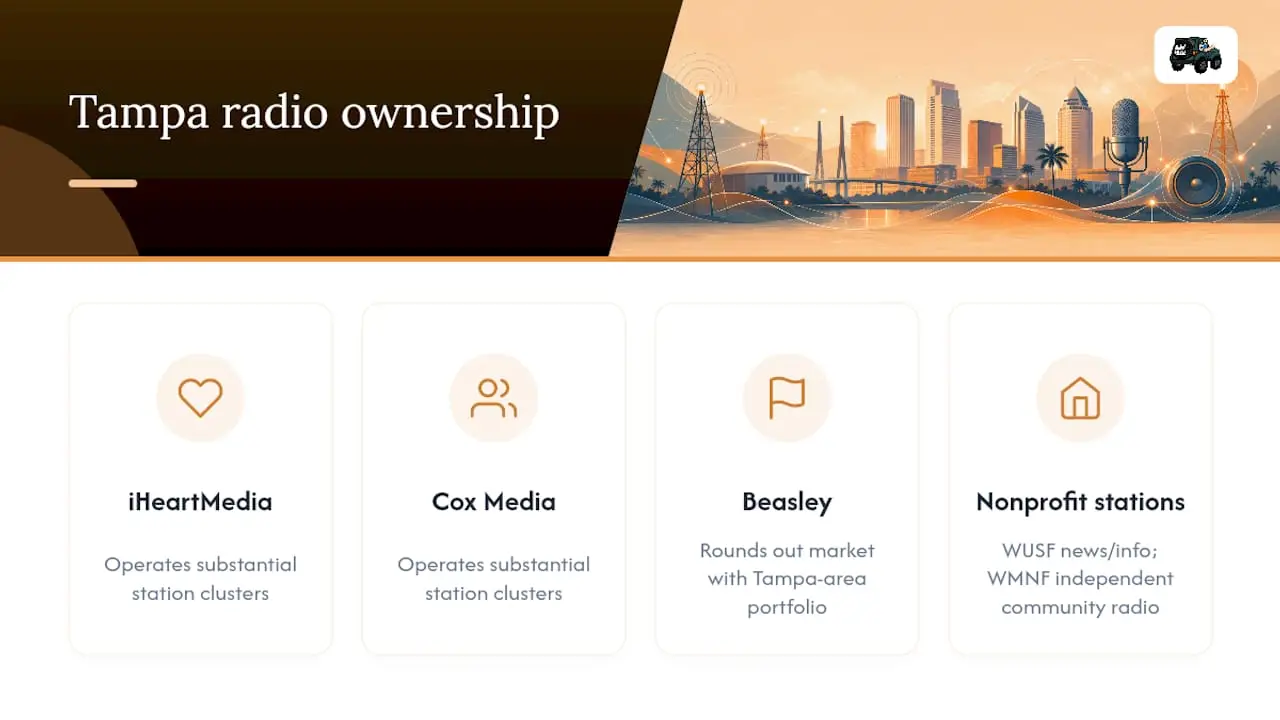
Ownership here is concentrated among three national groups. iHeartMedia and Cox Media Group each operate substantial station clusters spanning multiple formats, while Beasley Broadcasting rounds out the market with its own portfolio of Tampa-area signals. Non-profit and public stations, notably WUSF on the news and information side and WMNF as an independent community-radio outlet, give the market a genuinely local counterweight to the commercial groups. Radio buys tend to work best when you need frequency and daypart precision, like reaching commuters during morning drive, rather than broad one-shot awareness, which broadcast TV or OOH typically handles more efficiently.
What Print and Digital Outlets Shape Tampa Bay Coverage?
Print consolidation reshaped this market permanently when the Tampa Bay Times acquired and folded the Tampa Tribune in 2016, leaving the Times as the dominant daily voice across Hillsborough, Pinellas, and Pasco counties. That single deal collapsed what used to be a two-paper town into a one-paper market for civic and consumer advertising.
- Tampa Bay Times — the region’s largest daily, the default buy for civic and tourism-facing brand awareness
- Tampa Bay Business Journal — B2B-focused, strong for lead generation among executives and decision-makers
- La Gaceta — a historic trilingual (English, Spanish, Italian) weekly serving Tampa’s Ybor City heritage community, valuable for culturally specific reach
- Creative Loafing — alternative weekly, useful for event promotion and nightlife/entertainment advertisers
- Axios Tampa Bay and Florida Politics — digital newsletters read heavily by civic, government, and business audiences, good for B2B and policy-adjacent messaging
- Catalyst — local digital business news, similar audience profile to the Business Journal
Each outlet type answers a different question. Print dailies answer “how do I reach a broad local audience with credibility,” B2B outlets answer “how do I reach decision-makers,” and niche weeklies like La Gaceta answer “how do I reach a specific cultural community authentically” rather than broadly.
What Does the Tampa Media Market Mean for Your Ad Strategy?
Knowing the DMA rank is step one. Turning it into a working media plan means matching the channel to the job. Broadcast TV and Bay News 9 still deliver the broadest reach for mass-market brand campaigns, while cable and OTT let you target by ZIP code or interest without paying for the whole DMA. Radio wins on frequency for commuter and local-service messaging, out-of-home builds geographic dominance in specific corridors like Ybor City or downtown St. Petersburg, and local digital or newsletter placements close the gap for B2B and civic-minded buyers.
Before committing budget, run through a short checklist: define the audience precisely, decide whether you’re buying full-DMA or county-level targeting, set a frequency goal appropriate to the channel, and build in cross-platform measurement from day one rather than trying to reconcile siloed reports after the campaign ends. On measurement, lean on Nielsen’s local ratings for broadcast, each station’s own digital analytics for owned-and-operated apps and streaming, and independent third-party verification for anything running programmatically. Local industry analysis backs this layered approach, arguing that combining digital with traditional channels like radio and OOH drives stronger long-term recall than digital alone, particularly for Tampa’s smaller and mid-sized advertisers.
Pro Tip: If your campaign touches eastern Polk County, plan it as a dual-market buy from the start. Households there can pull signal from both Tampa and Orlando, so a Tampa-only media plan may quietly underdeliver on that eastern edge unless you account for the overlap in your targeting.
What Actually Works for Tampa Bay Advertisers
The biggest misconception about the Tampa media market is that size alone determines strategy. Plenty of national brands look at that 11th-place Nielsen rank and assume a big broadcast buy is automatically the right move. It isn’t, not by itself. A market this size rewards blending: a well-placed OOH presence in a specific neighborhood, paired with radio dayparts that hit commuters twice a day, paired with digital retargeting that catches the same households a third time on their phones.
Picture a mid-sized restaurant group opening a third location in St. Petersburg. Rather than spreading a modest budget thin across the entire DMA, the smarter play is transit-shelter posters in the Central Arts District, a two-week radio flight on a station with strong local-format loyalty, and geofenced digital ads retargeting anyone who walked past the physical billboard. That’s not a theory. It’s how neighborhood-level campaigns consistently outperform big, undifferentiated buys for advertisers who don’t need to own the whole market, just their corner of it.

What gets underestimated is how much Tampa’s growth is changing the math. As broadband and fiber infrastructure keep expanding across the Bay, streaming-first and hyperlocal digital targeting are becoming more reliable, not less, which means the old assumption that “you need broadcast to be credible here” is losing ground every season. The market’s still growing. The playbook for winning it is changing right along with it.
How 16wmediagroup Turns Tampa Market Data Into a Real Campaign
Knowing the Tampa DMA’s rank, station roster, and county footprint is only useful once it becomes a media plan with actual placements behind it. That’s the gap 16wmediagroup closes for local and regional businesses: turning market intelligence into a scheduled, budgeted campaign across broadcast, print, podcast, and digital inventory, without you having to negotiate directly with a dozen separate outlets.

We build personalized media plans that account for exactly the nuances covered here, like which stations reach Sarasota reliably, where Polk County needs dual-market treatment, and which local publishers deliver the audience your brand actually needs, whether that’s civic credibility through the Tampa Bay Times or hyperlocal loyalty through community storytelling. If you’re ready to move from market research to a working plan, check out our local advertising best practices and book a strategy conversation with our team to get your Tampa Bay campaign scheduled.
Sources
- Tampa-St_Petersburg-Sarasota_FL.pdf (FCC transition DTV markets)
- Tampa-St. Petersburg (Sarasota), Florida Media Landscape Overview — eMediaMonitor
- FCC — TV station query resources
- Mass media in the Tampa Bay area — Wikipedia