

Magazines are defined as one of the most effective trust-building platforms available to brands seeking lasting growth and visibility. The role of magazines in brand growth goes far beyond ad placement. Magazines transfer credibility, shape consumer perception, and create the kind of brand familiarity that drives purchase decisions long before a customer actively searches for a product. For business owners and marketing managers competing in local markets like Tampa, understanding how print media in brand development works is not optional. It is a competitive necessity.
How do magazines build consumer trust and brand credibility?
Editorial coverage in magazines is the most effective format for legitimacy and brand affinity growth. Editorial features in Tier-1 magazines generate 3.2 times more consumer trust than paid ads placed in the same publication. That gap exists because readers process editorial content differently. They treat it as a journalist’s judgment, not a brand’s claim.
The numbers behind this are striking. 89% of consumers perceive a brand as more legitimate after editorial coverage, representing a 45 percentage point increase in legitimacy perception. That is not a marginal lift. It is the difference between a brand that feels established and one that feels like it is still trying to prove itself.
The skepticism gap makes this even clearer:
- Only 18% of consumers think editorial features are paid for.
- 82% of consumers believe paid ads are sponsored content.
- That gap in perceived independence is exactly why editorial coverage carries so much more weight.
Tier-1 publications carry the most authority because their editorial standards are well known to readers. When a respected regional or national magazine features your brand, readers assume the publication vetted you. That assumption transfers directly to your credibility. Paid ads, no matter how well designed, cannot replicate that effect.
Pro Tip: Pitch your brand story to a magazine’s editorial team before buying ad space. A single editorial mention in the right publication outperforms a full-page ad in the same issue.
What is the halo effect, and how does it amplify brand growth?
The halo effect in magazine advertising is the transfer of a publication’s credibility to the brands that appear within it. When a consumer trusts a magazine, that trust extends to the brands they encounter on its pages. This is not a soft, theoretical concept. It produces measurable performance results.
“Brands advertising in high-trust magazine environments experience KPI uplifts between 64% and 94%.” That range covers metrics like brand consideration, purchase intent, and consumer affinity.
The mechanism behind this is what researchers call the “brand rub” effect. The magazine’s reputation rubs off on the advertiser. Readers who trust the publication extend that trust to the brands it features, whether through editorial or advertising. The result is a warmer, more receptive audience than any cold digital ad can reach.
The downstream effects of the halo effect include:
- Higher brand consideration among readers who have never actively searched for the product.
- Stronger brand preference when the consumer does reach a purchase decision.
- Better performance across other marketing channels, because trusted magazines improve brand message processing and increase consumer belief.
For local business owners, this means that appearing in a well-regarded community magazine does not just reach that magazine’s readers. It makes every other marketing channel you run perform better. The credibility you borrow from the publication follows your brand into search results, social feeds, and sales conversations.
How are magazines evolving into multi-touchpoint brand ecosystems?
Magazines are no longer just print products. The most successful magazine brands have built multi-channel ecosystems that include podcasts, live events, digital editions, and social communities. Successful magazines diversify into podcasts, events, and digital, forming networks of consumer touchpoints that extend the brand relationship far beyond a single issue.

This evolution matters for advertisers because it multiplies the surfaces where your brand can appear under the magazine’s trusted banner. A brand featured in a magazine’s print edition may also appear in its podcast, its newsletter, and its annual event. Each touchpoint reinforces the association.
Here is how to think about using a magazine’s full ecosystem:
- Secure editorial placement first. A feature story or brand profile establishes credibility and gives the publication’s audience a reason to pay attention to you.
- Extend into the podcast. Podcasts drive brand engagement and trust in a format that reaches audiences during commutes, workouts, and downtime. A magazine’s podcast audience is already primed to trust its recommendations.
- Participate in events. Sponsoring or appearing at a magazine’s community event puts your brand in a physical space with its most engaged readers.
- Maintain a digital presence. Magazine websites and newsletters carry the same editorial authority as print, often with better targeting and measurable click-through data.
Magazines also offer something social media cannot replicate. Magazines create a different temporality, giving readers a slower, more immersive experience. A reader who spends 20 minutes with a magazine article absorbs brand associations at a depth that a three-second social media scroll cannot match. That depth of engagement is where brand loyalty actually forms.
Pro Tip: When evaluating a magazine partnership, ask for their full channel inventory, not just print circulation. The podcast audience and event attendance numbers often reveal a larger, more engaged community than the print readership alone.
How can local businesses use magazines to accelerate brand growth?
Local businesses gain a specific advantage from community magazine advertising that national brands cannot easily replicate. A regional magazine’s readers are your neighbors, your potential customers, and your community. Appearing in that publication signals that your brand belongs in that community.
Brands using magazine placements achieve ambient brand presence, making themselves familiar and aspirational long before purchase intent forms. This is the strategic difference between chasing customers and attracting them. When a consumer has seen your brand in a trusted local publication three or four times, they arrive at a purchase decision already predisposed to choose you.
The table below compares two approaches local businesses use to enter magazine media.
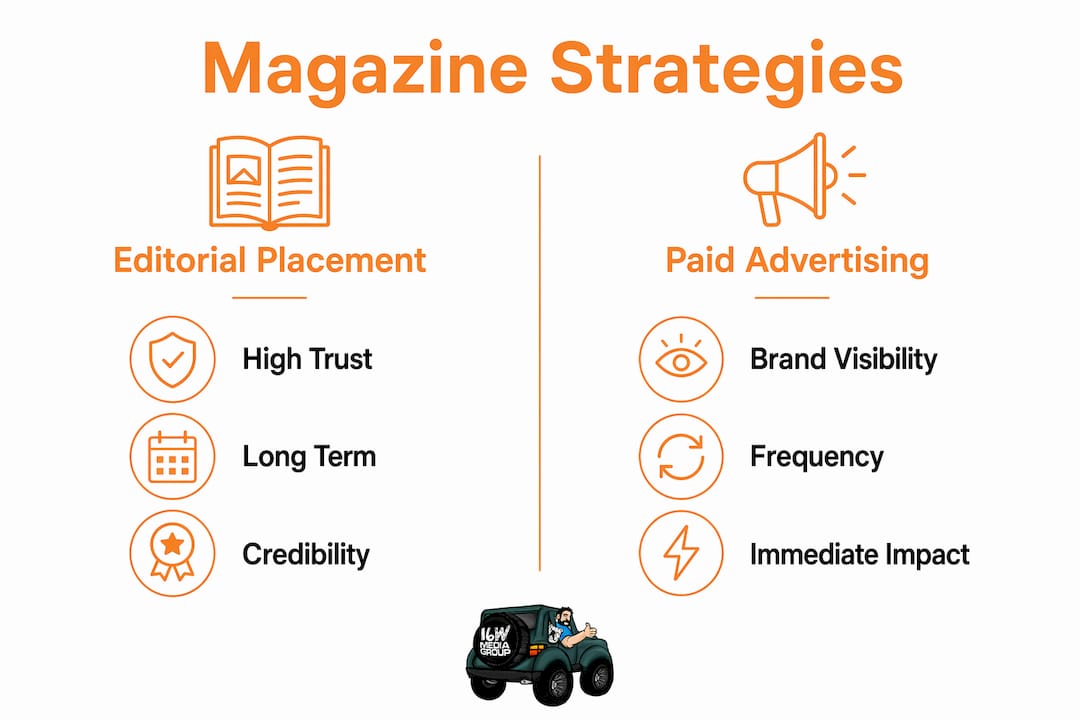
| Approach | Best for | Trust level | Timeline |
|---|---|---|---|
| Editorial placement | Brand credibility and legitimacy | Very high | 1–3 months to secure |
| Paid advertising | Reach and frequency | Moderate | Immediate |
The most effective local brand strategy combines both. Paid advertising builds frequency and keeps your brand visible. Editorial placement builds the credibility that makes that frequency meaningful. Running both in the same publication compounds the effect.
Aligning your magazine choice with your local audience is non-negotiable. A luxury home services brand belongs in a high-end lifestyle publication. A family-focused retailer belongs in a community parenting magazine. The fit between your brand and the publication’s editorial identity determines how much of the halo effect you actually capture. 16wmediagroup specializes in matching local brands with the right community magazine advertising opportunities to maximize that alignment.
Magazine media brands distributed over 412 million print and digital copies in 2025, and 88% of respondents trust service providers more when associated with authoritative editorial content. That scale and trust level make magazines one of the few media channels where local businesses can compete directly with national brands on credibility, even with a fraction of the budget.
Key takeaways
Magazines build brand credibility, consumer trust, and long-term loyalty through editorial authority, the halo effect, and multi-channel ecosystems that no single digital channel can replicate.
| Point | Details |
|---|---|
| Editorial beats paid ads | Editorial features generate 3.2x more trust than paid ads in the same publication. |
| The halo effect is real | Advertising in trusted magazines produces KPI uplifts of 64%–94% across brand metrics. |
| Magazines are multi-channel now | The strongest magazine brands extend into podcasts, events, and digital to multiply brand touchpoints. |
| Ambient presence drives loyalty | Consistent magazine placement makes brands familiar before purchase intent forms, reducing sales friction. |
| Local fit determines ROI | Matching your brand to the right community publication maximizes credibility transfer and audience relevance. |
Why I think most local brands are leaving magazine ROI on the table
Most business owners I talk to think of magazine advertising as a one-time experiment. They buy a single ad, see no immediate spike in phone calls, and write off the channel. That framing misses how magazine ROI actually works.
The return from magazine partnerships compounds over time through increased inbound inquiries, stronger retail partnerships, and even talent recruitment. The brands I have seen get this right are not measuring magazine placements against last-click conversions. They are measuring brand ease of choice, premium pricing capability, and the quality of inbound leads over a 12-month window.
The uncomfortable truth is that magazines build trust infrastructure. That infrastructure does not show up in a 30-day campaign report. It shows up when a prospect tells you they have seen your name around, when a retail partner takes your call because they recognize your brand, or when a top candidate applies because your company looks credible and established. Those outcomes are real and they are valuable. They are just slow enough that impatient marketers miss them entirely.
The brands that win with magazines treat them as a long-term media environment, not a short-term ad buy. They pursue editorial placement, maintain consistent presence, and let the publishing role in brand visibility do its work over time. That patience is the actual competitive advantage.
— Mike
How 16wmediagroup helps local brands grow through magazine partnerships
16wmediagroup works with local businesses across Tampa and beyond to build media strategies that put brands in front of the right audiences through the right channels.
Magazine placements, community publishing, and editorial features are core to what 16wmediagroup delivers for clients who want credibility, not just clicks. If you are ready to build the kind of brand presence that compounds over time, the 2026 local advertising guide is the right starting point. It covers how to plan, place, and measure magazine-driven campaigns in competitive local markets. You can also explore the full range of media strategies for local growth to see how magazines fit into a broader brand plan.
FAQ
How do magazines build brand credibility?
Magazines build brand credibility through editorial coverage, which consumers perceive as independent validation rather than paid promotion. Editorial features generate 3.2x more trust than paid ads in the same publication.
What is the halo effect in magazine advertising?
The halo effect occurs when a magazine’s credibility transfers to the brands that advertise within it. Brands in high-trust magazine environments see KPI uplifts of 64%–94% across metrics like brand consideration and purchase intent.
Is print media still relevant for brand development in 2026?
Print media remains highly relevant. Magazine media brands distributed over 412 million copies in 2025, and 88% of consumers trust brands more when associated with authoritative editorial content.
Should local businesses choose editorial placement or paid ads in magazines?
Local businesses benefit most from combining both formats. Editorial placement builds legitimacy, while paid advertising builds frequency. Running both in the same publication compounds the credibility and reach effects.
How long does it take to see ROI from magazine advertising?
Magazine ROI builds over time rather than producing immediate sales spikes. Returns show up through increased inbound inquiries, stronger business partnerships, and long-term brand advantage that compounds across a 12-month window.