

A media partnership is a structured collaboration between a business and a media entity designed to mutually expand brand visibility, audience reach, and community trust without relying solely on traditional paid advertising. For local business owners and marketers, understanding the role of media partnerships means recognizing that the most powerful marketing asset a media outlet holds is not its ad inventory. It is the trust its audience has built with it over years. When your brand aligns with that trust, you borrow credibility that no display ad can manufacture. Organizations like the UK Association of Online Publishers (AOP), Nielsen, and Wisconsin Watch have each documented how these collaborations produce measurable outcomes when structured correctly.
What is the role of media partnerships in local marketing?
Media partnerships differ from standard ad buys in one critical way: they create value through alignment rather than interruption. A traditional advertisement places your message in front of an audience. A media partnership places your brand inside content that audience already trusts.
The AOP highlights trust, alignment, transparency, and creative collaboration as the four non-negotiable elements of a successful media partnership. This matters because trust is not transferable through a banner ad. It is earned through consistent editorial association. When a respected local publication features your business as part of a co-produced story or sponsored series, readers extend a portion of their loyalty to your brand.
The impact of media collaborations also extends to content quality. Shared resources mean a local business can produce journalism-grade storytelling it could never afford independently. A neighborhood restaurant partnering with a regional food magazine gets professional photography, editorial distribution, and an audience that already cares about local dining. That combination outperforms a standalone social media campaign on nearly every engagement metric.
- Audience trust transfer: Readers associate your brand with the outlet’s credibility, not just its reach.
- Creative resource sharing: Media partners contribute editorial talent, production, and distribution infrastructure.
- Organic discovery: Branded content within editorial environments reaches readers who are actively consuming, not scrolling past.
- Long-term brand recall: Repeated editorial association builds recognition that outlasts any single campaign.
Pro Tip: Before approaching a media outlet, read six months of its content. If you cannot identify a clear editorial voice and audience, the partnership will lack the alignment that makes it work.
How to align your brand with the right media partner
Selecting a media partner based on audience size alone is the most common mistake local marketers make. The more important question is whether the outlet’s editorial values match what your brand stands for.
Effective partnerships require both parties to define shared goals and measurement frameworks before any content is produced. This upfront alignment prevents the most common failure mode: a partnership that generates impressions but no meaningful business outcome. Start by writing a one-paragraph statement of what success looks like for both parties, then agree on how you will measure it.
“Media partnerships work best when both parties treat the collaboration as a shared editorial project, not a transaction. The brand brings authenticity and local knowledge. The publisher brings audience and credibility. Neither works without the other.” — AOP Digital Publishing Awards guidance
Here is a practical framework for building alignment from the start:
- Define editorial fit. Review the outlet’s coverage areas, tone, and audience demographics. Your brand’s story must fit naturally within that context.
- Establish transparency early. Share your campaign goals, budget parameters, and content restrictions upfront. Surprises mid-campaign destroy trust faster than any creative disagreement.
- Set shared KPIs. Agree on whether success means newsletter signups, website visits, event attendance, or brand recall. Vague goals produce vague results.
- Build a communication cadence. Active participation and regular status updates signal accountability and keep both teams aligned as the campaign evolves.
- Plan for content review cycles. Agree on how many rounds of feedback are included and who has final approval on what. This protects both editorial integrity and brand standards.
The Journalism Trust Initiative (JTI) provides a useful benchmark here. Media outlets that disclose governance, ownership, and editorial practices under the JTI standard are signaling a commitment to independence. Partnering with JTI-compliant outlets reduces the risk that your brand becomes associated with editorial conflicts of interest down the road.
How do you measure success in a media partnership?

Attribution is the hardest problem in media partnership marketing, and most local businesses do not plan for it until after the campaign ends. That is too late.
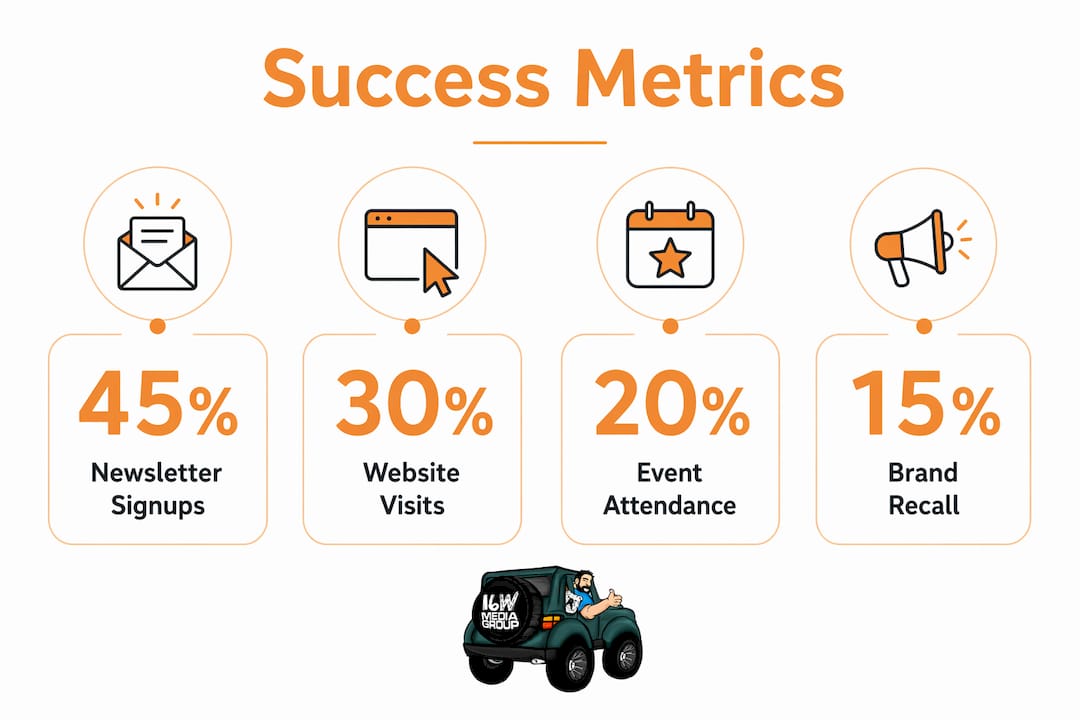
Pre-planned success metrics and regular reporting are what separate partnerships that optimize over time from those that produce a final report full of impressions and no conclusions. Before your first piece of content goes live, define which actions you are tracking and how.
| Metric | Tracking method | What it tells you |
|---|---|---|
| Newsletter signups | QR code on print, UTM link in digital | Direct audience conversion from partnership |
| Website visits | UTM-tagged URLs by placement | Which content placements drive traffic |
| Event attendance | Promo code or partner referral link | Offline impact of media partnership content |
| Brand recall | Post-campaign survey | Awareness lift beyond click-through behavior |
| Social engagement | Platform analytics by content type | Audience resonance with co-produced content |
A real-world example from the Reynolds Journalism Institute (RJI) illustrates this precisely. A local coffee shop tracked 37 newsletter signups and 13 page visits using QR codes and UTM parameters over six weeks of a newsletter partnership. Those numbers are modest, but they are concrete. The business knew exactly which partnership activity drove which outcome.
Nielsen’s research on media environments adds another layer. Ad-supported TV accounts for 74.2% of overall TV viewing, with linear, FAST, and AVOD platforms each attracting distinct audience profiles. This means your measurement framework must account for where your audience actually consumes media, not just where you placed content.
Pro Tip: Build a media planning checklist before every partnership launch. Include UTM parameters, QR code destinations, and reporting dates. Campaigns without pre-built tracking structures produce data you cannot act on.
Why ethics and editorial independence protect your brand
The benefits of media partnerships disappear the moment your audience suspects the editorial content they are reading is commercially compromised. This is not a theoretical risk. Digital-first media outlets derive 50 to 70% of their revenue from commercial partnerships, which creates constant pressure to blur the line between editorial and advertising.
Your brand’s credibility is directly tied to the credibility of your media partner. If that partner loses audience trust, you lose it with them.
- Require clear disclosure labels. Every piece of co-produced content should carry a “Sponsored” or “Paid Partnership” label. This is not just a legal protection. It is an audience trust signal.
- Respect editorial firewalls. Never ask a media partner to alter news coverage in exchange for advertising spend. This destroys the editorial independence that made the partnership valuable in the first place.
- Vet your partner’s transparency practices. JTI-compliant outlets publicly disclose their ownership and revenue sources, which tells you whether their editorial independence is structural or just claimed.
- Treat ethics as a competitive advantage. Brands that consistently partner with credible, transparent outlets build a reputation that compounds over time.
“Strong transparency and disclosure practices build audience trust, which correlates with higher consumer willingness to pay and improves long-term revenue stability.” — Ethics of Monetising Reach and Integrity
The media alliance strategies that hold up over years are built on this foundation. Shortcuts on disclosure or editorial independence produce short-term impressions and long-term brand damage.
Real examples of local media partnership success
The most instructive media collaboration examples come from local journalism, where resource constraints force creative partnership models that any local business can learn from.
Wisconsin Watch, an investigative news outlet, uses co-publishing and republishing partnerships to expand coverage and audience reach simultaneously. A story produced by one outlet gets republished by partner outlets, multiplying the audience without multiplying the production cost. Local businesses can apply the same logic: co-produce a piece of content with a local media partner and distribute it across both audiences.
Here are four practical partnership models local marketers can deploy today:
- Newsletter sponsorship with editorial integration. Sponsor a local newsletter and contribute one original piece of content per issue. The RJI coffee shop example proves this model produces trackable signups and visits at low cost.
- Co-produced podcast episodes. Partner with a local podcast to produce an episode that features your business’s expertise, not just your ad. Podcasts drive engagement and trust in ways that pre-roll ads cannot replicate.
- Community magazine features. Local publications with loyal subscriber bases offer editorial credibility that digital-only placements rarely match. A feature story reaches readers who have opted into that publication’s worldview.
- Event co-sponsorship with content rights. Partner with a media outlet on a community event and retain rights to the content produced. You get brand visibility at the event and editorial content for your own channels afterward.
The importance of media partnerships for local brands is clearest in these community-facing formats. They position your business as a contributor to local life, not just a vendor within it. For deeper context on how community-based advertising works in practice, the strategic frameworks translate directly to partnership planning.
Key takeaways
Media partnerships produce their strongest results when editorial alignment, pre-planned measurement, and transparent disclosure practices are built into the structure from day one.
| Point | Details |
|---|---|
| Trust is the core asset | Partner with outlets whose audience trust you want to borrow, not just their reach. |
| Align before you launch | Define shared goals, KPIs, and content review processes before production begins. |
| Measure from the start | Use UTM codes and QR tracking to connect partnership activity to specific business outcomes. |
| Ethics protect your brand | Require disclosure labels and respect editorial firewalls to preserve long-term credibility. |
| Community focus compounds | Local partnerships that serve the public build brand loyalty that outlasts any single campaign. |
What I have learned about media partnerships after years in local markets
Most local businesses approach media partnerships the way they approach advertising: they want to know the reach number and the price. That framing misses the entire point.
The outlets worth partnering with are the ones whose audiences would notice if the editorial quality dropped. Those readers are paying attention. They are the consumers who share stories, attend events, and recommend businesses to their neighbors. Reaching them through a trusted editorial context is categorically different from reaching them through a retargeted ad.
What I have found in practice is that the brands that get the most from media partnerships are the ones that show up as genuine contributors. They pitch story ideas. They share data the outlet’s audience would find useful. They treat the media partner’s editorial team as collaborators, not vendors. That posture produces content that neither party could have made alone.
The measurement conversation is where most partnerships fall apart. Brands want to see ROI immediately. Publishers want to show reach. Neither metric tells the full story. The most honest measurement framework I have seen combines a short-term conversion metric (signups, visits, promo code redemptions) with a longer-term brand recall check at 90 days. That combination separates real impact from noise.
One more thing: the role of publishing in brand visibility has shifted significantly. Audiences have become more selective about what they read and who they trust. That selectivity is your opportunity. A brand that consistently appears in content people choose to read earns a different kind of attention than one that interrupts content people are trying to get through.
— Mike
How 16wmediagroup helps local businesses build media partnerships that work
16wmediagroup works with local businesses across competitive markets like Tampa to build media partnerships grounded in editorial alignment, community relevance, and measurable outcomes. The agency’s approach combines community magazines, podcasts, and regional advertising packages into partnership structures that connect brands with high-value local audiences. Whether you are starting your first partnership or optimizing an existing one, the local advertising campaign planning guide walks through the exact frameworks covered in this article. For a custom strategy session tailored to your market and goals, explore the full range of media and publishing services 16wmediagroup offers local brands.
FAQ
What is a media partnership in local marketing?
A media partnership is a structured collaboration between a local business and a media outlet that exchanges brand visibility, content, or resources for audience access and editorial credibility. Unlike a standard ad buy, it involves co-produced content and shared goals.
How do media partnerships differ from traditional advertising?
Traditional advertising places a message in front of an audience. A media partnership places your brand inside content that audience actively trusts, which produces higher engagement and stronger brand recall than interruptive formats.
What metrics should I track in a media partnership?
Track newsletter signups, website visits via UTM-tagged links, event attendance through promo codes, and brand recall through post-campaign surveys. The RJI coffee shop example shows that even a six-week local partnership can produce clear, attributable results with the right tracking in place.
Why does editorial independence matter for my brand?
Your brand’s credibility is tied directly to your media partner’s credibility. Digital-first outlets derive 50 to 70% of revenue from commercial partnerships, so requiring disclosure labels and respecting editorial firewalls protects both the outlet’s audience trust and your brand’s reputation.
How do I find the right media partner for my local business?
Look for outlets whose editorial voice, audience demographics, and community focus align with your brand’s values. JTI-compliant outlets that publicly disclose their editorial practices offer the strongest foundation for a credible, long-term partnership.