

Brand loyalty is defined as a customer’s consistent preference for one brand over competitors, driven by emotional connection and trust rather than habit or discounts. It goes well beyond repeat purchasing. Loyal customers choose you when a cheaper option exists, defend you publicly when critics appear, and refer others without being asked. Research shows loyal customers spend 67% more than new customers, and a 5% improvement in retention can drive 25–95% higher profit depending on the industry. Those numbers make brand loyalty one of the highest-return investments a business can make.
What is brand loyalty and why does it matter for growth?
Brand loyalty is the measurable result of customers choosing your brand repeatedly because they trust it, identify with it, or feel it reflects their values. The industry also calls this attitudinal loyalty, which distinguishes it from simple repeat purchasing driven by convenience. Both matter, but attitudinal loyalty is far more durable.
The financial case is direct. Acquiring a new customer costs 5–7 times more than keeping an existing one. That gap alone makes retention the most cost-effective growth lever available to most businesses. Loyal customers also generate compounding returns because they refer others, resist competitor offers, and spend more per transaction over time.

68% of global consumers report loyalty to specific brands. The catch is that “True Loyalty,” the deepest form of commitment, dropped 5 percentage points between 2024 and 2025. That decline signals a real problem. Businesses that rely on surface-level tactics like discount programs are losing ground to brands that invest in genuine emotional connection.
What are the measurable benefits of brand loyalty for business growth?
The benefits of brand loyalty show up directly on the income statement. Here are the most significant ones, each backed by research:
- Lower acquisition costs. Retention costs 5–7 times less than acquisition. Every loyal customer you keep is a customer you do not have to pay to replace.
- Higher profit margins. A 5% retention increase can produce 25–95% more profit. The range depends on industry, but even the low end is significant.
- Greater lifetime value. Emotionally connected customers carry 306% higher lifetime value than customers who are merely satisfied. Satisfaction is not loyalty.
- First-party data advantages. Loyalty programs generate first-party data that competitors cannot replicate. That data powers personalized marketing that generic campaigns cannot match.
- Organic referrals. Brand loyalists refer friends and family at significantly higher rates than occasional buyers. Word-of-mouth from a true believer carries more weight than any paid ad.
The referral point deserves emphasis. A loyal customer who tells three friends about your brand delivers qualified leads at zero acquisition cost. Multiply that across hundreds of loyal customers and the compounding effect becomes one of your most powerful growth channels. Understanding audience engagement strategies helps businesses activate that referral potential systematically.
How does brand loyalty differ from customer loyalty?
Brand loyalty and customer loyalty are related but not the same concept. Customer loyalty describes repeat purchasing behavior. Brand loyalty describes the emotional and psychological commitment behind that behavior. A customer can be loyal to a grocery store because it is close to their house. That is behavioral loyalty. A customer who drives past three closer stores to reach your location is showing brand loyalty.
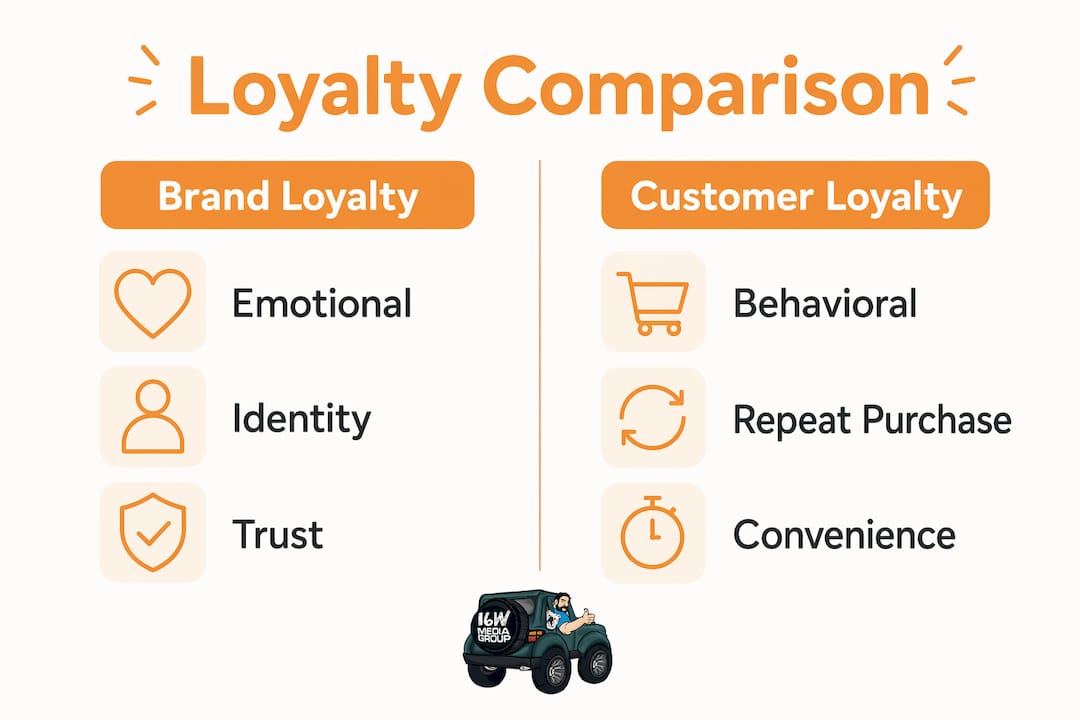
The distinction between behavioral and emotional loyalty is the most important one for marketers to understand. Behavioral loyalty driven by discounts or habit is fragile. The moment a competitor offers a better deal, that customer leaves. Emotional loyalty, built on trust and shared identity, survives price increases, product missteps, and competitive pressure.
Loyalty program members differ from brand loyalists in a critical way. Program members buy because of points. Brand loyalists buy because of who they are and what the brand represents to them. Both groups are valuable, but only brand loyalists stay when the points run out.
Pro Tip: Survey your repeat customers and ask why they keep coming back. If the top answers are “convenience” or “price,” you have behavioral loyalty. If they say “I trust you” or “you get me,” you have brand loyalty. The gap between those answers tells you exactly where to focus.
What trends are shaping brand loyalty strategies in 2026?
The most important shift in brand loyalty right now is the move away from transactional rewards toward values-based engagement. Discounts still work as acquisition tools, but they do not build the kind of loyalty that survives a competitor’s promotion. Emotional connection and storytelling create more resilient loyalty than points-based programs.
Three trends define the 2026 environment:
- Transparency as a baseline expectation. 96% of consumers consider brand transparency essential to earning their loyalty. This is not a differentiator anymore. It is table stakes. Brands that obscure pricing, hide sourcing, or dodge accountability lose trust fast.
- Community as a loyalty engine. Brands that build communities around shared interests or identities create switching costs that no competitor can undercut. When your brand is part of someone’s identity, leaving it feels personal.
- Ethical relevance. Consumers increasingly choose brands whose values align with their own. A brand that takes a clear position on issues its customers care about builds deeper loyalty than one that stays neutral to avoid controversy.
The risk of ignoring these trends is concrete. Brands that rely solely on discounts train customers to wait for sales. That behavior erodes margins and conditions customers to see your full price as a penalty. Storytelling that elevates local branding is one proven way to shift from transactional to emotional engagement.
Pro Tip: Audit your loyalty communications. If every message is about a deal, a point, or a discount, you are building behavioral loyalty at best. Add one values-driven or community-focused message per month and track whether engagement quality improves.
How can you build and maintain strong brand loyalty?
Building lasting brand loyalty requires a framework that goes beyond rewards. The Reward, Recognize, and Relate model gives marketers a practical structure:
- Reward customers for behavior you want to reinforce. Points, tiers, and exclusive access create structural switching costs. A customer with 800 points toward a reward thinks twice before switching to a competitor.
- Recognize customers as individuals. Use first-party data from your loyalty program to personalize communications. A birthday message with a relevant offer outperforms a generic blast every time.
- Relate to customers through shared values and storytelling. This is where emotional loyalty is built. Share the story behind your brand, highlight the people who make it, and connect your mission to something your customers care about.
Empathy is not a soft metric. Integrating customer support KPIs into loyalty assessments turns service recovery into a loyalty-building moment. A customer whose problem gets resolved quickly often becomes more loyal than one who never had a problem at all. That insight should change how you staff and measure your support team.
First-party data is the competitive moat that makes personalization possible at scale. Loyalty programs that collect purchase history, preference data, and engagement signals give marketers the ability to reach the right customer with the right message at the right time. Competitors who replicate your product cannot replicate that data. Exploring media channels for affluent audiences shows how targeted media placement amplifies the impact of that data.
Brand loyalty is not built in a campaign. It is built in every interaction a customer has with your brand, from the first ad they see to the last support call they make. The brands that win in 2026 treat every touchpoint as a loyalty moment, not just the ones inside the loyalty program.
The brand loyalty building process requires consistency across channels. A customer who sees a warm, values-driven message on social media and then hits a cold, scripted support response experiences a disconnect that erodes trust. Alignment between marketing, operations, and customer service is what separates brands with loyal customers from brands that just have repeat buyers.
Key Takeaways
Brand loyalty is the single most cost-effective growth lever available to business owners and marketers, because it reduces acquisition costs, increases lifetime value, and generates organic referrals simultaneously.
| Point | Details |
|---|---|
| Loyalty drives profit | A 5% retention increase can produce 25–95% more profit, making retention the highest-return investment. |
| Emotional beats behavioral | Emotionally connected customers carry 306% higher lifetime value than satisfied but non-loyal customers. |
| Transparency is non-negotiable | 96% of consumers say brand transparency is essential to earning their loyalty. |
| Data is the real moat | First-party data from loyalty programs creates personalization advantages competitors cannot copy. |
| Relate, not just reward | Values alignment and storytelling build loyalty that survives price increases and competitor promotions. |
The shift I keep seeing marketers miss
Most marketers I talk to treat brand loyalty as a program. They launch a points system, set up a referral code, and call it done. That is not brand loyalty. That is a retention tactic dressed up as a strategy.
The brands I have seen build genuine loyalty all share one trait. They treat every customer interaction as a data point in a longer relationship, not a transaction to close. When a customer complains, they do not just resolve the issue. They use it to understand what went wrong and fix the underlying cause. That kind of operational empathy is rare, and customers notice it.
The other thing I keep seeing underestimated is the power of first-party data. Marketers talk about personalization constantly, but most campaigns I review are still segmented by broad demographics. The brands pulling ahead are using loyalty program data to personalize at the individual level. That gap between “women 35–54” and “Maria, who buys organic skincare every six weeks and opened your last three emails” is where loyalty is actually built.
My honest advice for 2026 is to pick one values-driven story your brand can tell consistently and build your loyalty communications around it. Not a discount. Not a points multiplier. A story that makes customers feel like they are part of something. That is what creates the kind of loyalty that shows up in your revenue numbers year after year.
— Mike
How 16wmediagroup helps local businesses build lasting loyalty
Local businesses compete for attention in crowded markets every day. The brands that win are the ones that connect with their communities through consistent, values-driven messaging across multiple channels.
16wmediagroup builds personalized media plans that combine community publishing, podcasts, and regional advertising to put your brand in front of the right customers repeatedly. Repetition builds recognition. Recognition builds trust. Trust builds loyalty. The team at 16wmediagroup understands how to use local advertising best practices to create that cycle for businesses in competitive markets like Tampa. Whether you need a full multimedia strategy or a focused campaign to deepen community ties, 16wmediagroup has the channels and the expertise to make it work. Reach out to start building a media plan that turns customers into loyal advocates.
FAQ
What is the definition of brand loyalty?
Brand loyalty is a customer’s consistent preference for one brand over competitors, driven by emotional connection, trust, and shared values rather than habit or price. It results in repeat purchases even when cheaper or more convenient alternatives exist.
What causes brand loyalty to develop?
Brand loyalty develops through consistent positive experiences, transparent communication, and a sense of shared identity between the customer and the brand. Emotional connection and trust are stronger drivers than discounts or rewards programs.
What are the signs of brand loyalty in customers?
Signs of brand loyalty include repeat purchases without price comparison, unprompted referrals to friends and family, public defense of the brand on social media, and continued buying after a price increase.
How does brand loyalty differ from customer loyalty?
Customer loyalty describes repeat purchasing behavior, which can be driven by convenience or habit. Brand loyalty describes the emotional and psychological commitment behind that behavior, making it far more resistant to competitor offers.
Why should businesses invest in brand loyalty?
Loyal customers spend 67% more than new customers, cost 5–7 times less to retain than to acquire, and generate organic referrals that reduce overall marketing spend. The return on loyalty investment compounds over time in ways that acquisition spending cannot match.