
Targeted advertising is defined as the practice of delivering ads to specific audiences based on consumer data such as demographics, interests, purchase history, and online behavior. The industry standard term is “audience targeting,” and it sits at the core of every effective paid media campaign. More than 80% of U.S. consumers accept data-sharing as a fair trade-off for free online content, which signals that audiences are not just tolerating targeted ads. They expect them. For business owners and marketing professionals competing in local markets like Tampa, understanding how audience targeting works is the difference between ad spend that builds real revenue and budget that disappears into noise.
What is targeted advertising and how does it work?
Targeted advertising works by collecting consumer data, segmenting audiences into defined groups, and then serving each group ads matched to their profile. The data inputs fall into four main categories:
- Demographics: Age, gender, income level, education, and household size
- Behavioral signals: Browsing history, app usage, past purchases, and search queries
- Geographic data: City, ZIP code, neighborhood, or proximity to a physical location
- Psychographic data: Interests, values, lifestyle choices, and brand affinities
Once data is collected, audience segmentation techniques group consumers by shared characteristics. A local restaurant, for example, might segment by ZIP code plus dining-out frequency to reach high-value customers within a 5-mile radius.
The delivery mechanism for most digital campaigns is programmatic advertising. This is an automated process where software buys and places ads in real time through a process called real-time bidding (RTB). Programmatic media buying accounts for nearly 90% of digital display ad spend, with RTB representing about 55% of that activity as of 2026. That scale means the vast majority of digital ads you see today were placed by an algorithm, not a human buyer negotiating directly with a publisher.

AI and machine learning sit on top of this system. They analyze performance signals continuously and shift budget toward the audience segments and placements that convert best. The result is a self-improving campaign that gets more efficient over time.
Pro Tip: Start with your own customer data before buying any third-party audience segments. First-party data, meaning email lists, CRM records, and website visitor data, produces the most accurate targeting and costs nothing to collect.
What are the advantages of targeted advertising for local businesses?
Targeted advertising produces measurably better results than broad, untargeted media buys. Retargeted users are 70% more likely to convert, and 77% of marketers report stronger ROI from behavioral targeting. Those numbers reflect a simple truth: relevance drives response.
For local businesses, the advantages are especially pronounced. A neighborhood dental practice does not need to reach every adult in a metro area. It needs to reach adults within 10 miles who have dental insurance and have recently searched for a dentist. Targeted advertising makes that precision possible without a national brand’s budget.
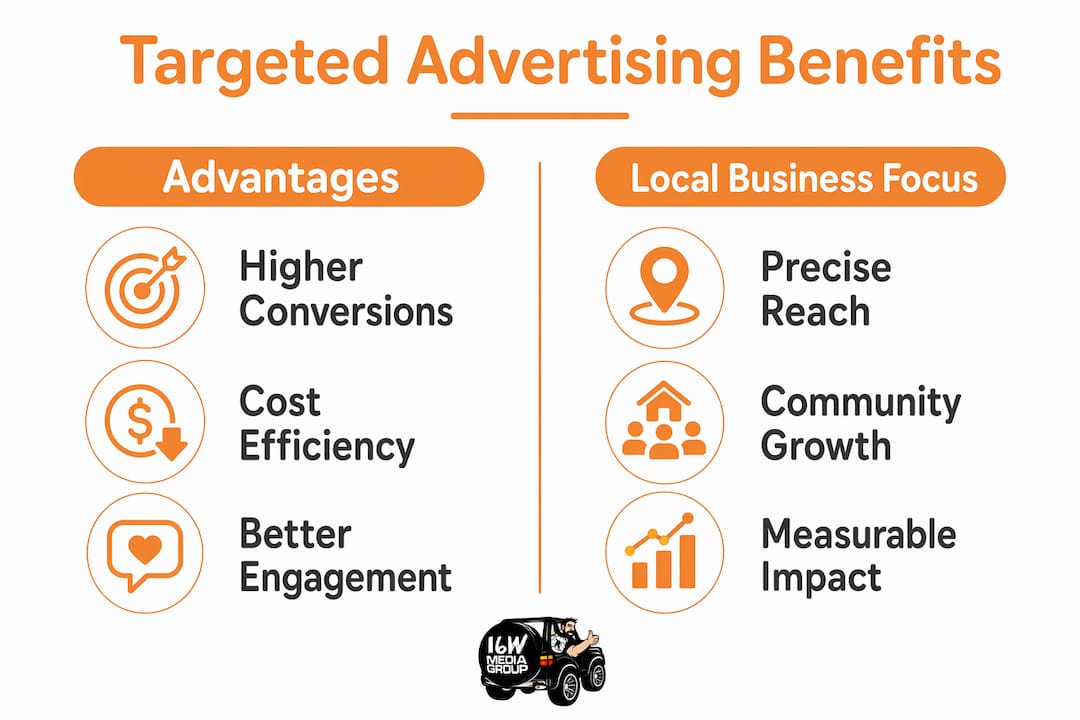
| Advantage | What it means for your business |
|---|---|
| Higher conversion rates | Ads reach people already likely to buy, reducing wasted impressions |
| Lower cost per acquisition | Budget concentrates on qualified audiences, not broad reach |
| Personalized customer experience | Relevant ads build brand familiarity and trust over time |
| Competitive parity for small businesses | Small businesses using tailored ads are 16 times more likely to report sales growth |
| Consumer cost savings | Targeted ads reduce search friction, saving consumers roughly $176 per person annually on online purchases |
The economic argument for audience targeting extends beyond the advertiser. Tailored advertising is the economic foundation of the open internet, funding free content and services that consumers rely on daily. When your ad budget works efficiently, it supports that ecosystem.
Pro Tip: Run a parallel test with one targeted campaign and one broad campaign using the same creative. Compare cost per lead after 30 days. The data will make the case for precision targeting better than any benchmark statistic.
What are the challenges and ethical considerations?
Privacy regulations have permanently changed how audience targeting operates. GDPR in Europe and CCPA in California both restrict how businesses collect and use consumer data. Privacy regulations like GDPR and CCPA push marketers toward first-party data and contextual targeting, reducing reliance on third-party tracking cookies. This shift is not temporary. It reflects a structural change in the advertising industry.
The practical challenges break down into three areas:
- Data quality: Poor audience data wastes budget even when the bidding algorithm is excellent. Garbage in, garbage out applies directly to programmatic campaigns.
- Over-targeting: Showing the same ad to the same person 40 times in a week destroys brand sentiment. Frequency caps are not optional. They are required for ethical ad delivery.
- Transparency: Consumers who feel surveilled rather than served will disengage. Brands that explain their data practices clearly earn more trust and face fewer opt-outs.
Successful targeted campaigns require balancing personalization to avoid negative brand sentiment while maintaining customer trust through transparency and data ownership. The Network Advertising Initiative (NAI) provides opt-out frameworks and industry standards that responsible advertisers follow. Aligning with NAI guidelines is both an ethical choice and a practical one, since it reduces regulatory risk.
How does targeted media buying fit into your campaign?
Targeted media buying is the execution layer of audience targeting strategy. Media planning defines who you want to reach and what you want to say. Media buying determines where, when, and at what price your ads actually appear. Media buying and planning are distinct but linked. Planning sets the goals. Buying delivers them.
A media buyer’s core responsibilities include:
- Channel selection: Choosing the right mix of digital, print, broadcast, and out-of-home placements based on where your audience spends time
- Rate negotiation: Securing inventory at favorable rates, whether through direct publisher deals or programmatic platforms
- Budget management: Allocating spend across channels to maximize return on ad spend (ROAS)
- Performance monitoring: Tracking delivery, click-through rates, and conversions in real time
- Optimization: Shifting budget away from underperforming placements and toward high-converting ones
For local market penetration, channel selection is the most consequential decision. A Tampa-based home services company might combine community magazine placements with geofenced digital display ads targeting homeowners within specific ZIP codes. That combination reaches the same audience through two different touchpoints, reinforcing the message without relying on a single channel.
| Media buying approach | Best suited for |
|---|---|
| Programmatic digital | Broad local reach with behavioral targeting at scale |
| Direct publisher deals | Premium placements in community publications with loyal readership |
| Multi-channel packages | Businesses needing both brand awareness and direct response |
The media planning checklist approach works well here: define your audience first, then select channels that index high for that audience, and set ROAS targets before you spend a dollar.
Practical tips for targeted advertising in local markets
Effective local targeting requires more than selecting a geographic radius in a campaign dashboard. The following practices separate campaigns that build real customer engagement from ones that simply spend budget.
- Build first-party data before you scale. Your email list, loyalty program, and website pixel data are more accurate than any purchased audience segment. Successful local advertisers prioritize building their own customer lists before expanding to third-party targeting.
- Use negative targeting aggressively. Excluding irrelevant groups such as existing customers from acquisition campaigns or filtering out ZIP codes outside your service area directly improves ROAS. Exclusion is as powerful as inclusion.
- Combine traditional and digital channels. Multi-channel approaches often reach ideal customers more completely. Retargeting radio ad audiences with digital display, for example, reinforces brand recall across different moments in the consumer’s day.
- Set frequency caps on every campaign. Overexposure is one of the fastest ways to generate negative brand sentiment. Cap impressions per user per week and monitor reach vs. frequency ratios.
- Analyze and act on performance data weekly. Monthly reporting cycles are too slow for programmatic campaigns. Weekly reviews let you catch underperforming segments before they drain significant budget.
Pro Tip: When targeting a local market, create separate ad sets for different neighborhoods or ZIP codes rather than one broad geographic campaign. This lets you identify which areas convert best and concentrate budget there.
For a deeper look at applying these strategies in a specific market, the targeted media campaigns in Tampa guide covers channel selection and audience segmentation for competitive local markets.
Key Takeaways
Targeted advertising delivers measurably better results than broad media buys because it matches ad messages to the specific consumers most likely to act on them.
| Point | Details |
|---|---|
| Core definition | Targeted advertising delivers ads using consumer data including demographics, behavior, and location to reach relevant audiences. |
| ROI advantage | Retargeted users are 70% more likely to convert, and 77% of marketers report stronger ROI from behavioral targeting. |
| Small business impact | Small businesses using tailored ads are 16 times more likely to report sales growth than those using untargeted approaches. |
| Privacy compliance | GDPR and CCPA require a shift to first-party data and contextual targeting. Build your own data assets now. |
| Media buying integration | Media planning sets audience goals while media buying executes them. Align both before spending any budget. |
Why I think most local businesses are targeting the wrong way
After working with local businesses across competitive markets, the pattern I see most often is this: a business owner sets up a campaign, selects a broad geographic radius, picks a few interest categories, and calls it targeted advertising. It is not. It is a broad campaign with a geographic filter.
Real audience targeting starts with your existing customers. Who are they? What do they have in common? What did they search before they found you? That data, pulled from your CRM, your website analytics, and your point-of-sale system, is worth more than any third-party audience segment you can buy.
The second mistake I see constantly is ignoring negative targeting. Businesses spend money showing acquisition ads to people who bought from them last week. That is not just wasteful. It signals to the customer that you do not know who they are, which undermines the personalization you are trying to create.
The third issue is the channel silo. Digital teams run digital campaigns. Traditional media buyers handle print and broadcast. Nobody coordinates the two. The result is a fragmented customer experience where the digital ad and the magazine ad feel like they come from different companies. The businesses that win in local markets treat every channel as part of one coordinated campaign, not separate line items in a budget.
The future of targeted advertising runs through first-party data, contextual relevance, and channel coordination. Privacy regulations will keep tightening. Third-party cookies will keep disappearing. The businesses building direct relationships with their audiences right now will have a structural advantage in three years that no amount of ad spend can replicate later.
— Mike
How 16wmediagroup helps local businesses run targeted campaigns
Local businesses that want to move from broad media buys to genuine audience targeting need more than a platform. They need a media strategy that connects the right channels to the right audiences in their specific market.
16wmediagroup builds personalized media plans for local businesses that combine community publishing, digital targeting, and podcast advertising into coordinated campaigns. The team works with business owners in competitive markets like Tampa to identify high-value audience segments, select the right channel mix, and manage budgets toward measurable results. For business owners ready to put these strategies into practice, the local advertising best practices guide covers the full process from audience definition to campaign optimization. You can also explore the full range of campaign planning services to see how 16wmediagroup structures campaigns for local market growth.
FAQ
What is the definition of targeted advertising?
Targeted advertising is the practice of delivering ads to specific audiences based on consumer data such as demographics, behavior, location, and purchase history. The goal is to show relevant ads to people most likely to respond, increasing conversion rates and reducing wasted spend.
How does targeted advertising work technically?
Advertisers collect first-party and third-party data, segment audiences by shared characteristics, and use programmatic platforms to bid for ad placements in real time. AI algorithms continuously adjust bids and placements based on which audience segments convert best.
What are the main advantages of targeted advertising for small businesses?
Small businesses using tailored ads are 16 times more likely to report sales growth, according to the Network Advertising Initiative. The primary advantages are higher conversion rates, lower cost per acquisition, and the ability to compete against larger brands without a national media budget.
What is targeted media buying?
Targeted media buying is the process of purchasing ad placements specifically chosen to reach a defined audience segment. It combines channel selection, rate negotiation, and budget management to execute the audience strategy defined during media planning.
How do privacy regulations affect targeted advertising?
GDPR and CCPA restrict third-party data collection and require advertiser transparency with consumers. Marketers are shifting toward first-party data, contextual targeting, and opt-in audience building to maintain effective targeting within legal boundaries.