

Most direct mail campaigns typically cost a moderate amount per piece at test scale, dropping to a lower cost once you hit rollout volume, depending on format and whether you go targeted or EDDM. Every quote you get should break down into four buckets: postage, printing, list or data costs, and processing.
TL;DR:
- Postage accounts for the largest cost driver, with USPS Automation discounts favoring presort depth and drop-ship entry points to lower expenses.
- Print costs increase significantly with format size, finish, and order volume, with campaigns over 25,000 pieces achieving the lowest per-piece rates.
- List and data expenses vary; EDDM eliminates these costs but sacrifices targeting precision, making it ideal for saturation campaigns.
- Proper data hygiene and address verification add 3 to 8 cents per piece but are essential to avoid undeliverable mail and inflated costs.
- Small campaigns typically start at around $1.10 to $1.50 per piece, while larger rollouts can reduce costs to roughly $0.31 to $0.45 per piece with volume discounts.
Table of Contents
- What Drives Direct Mail Cost: Postage, Print, List, and Processing
- How Much Does Each Direct Mail Format Cost Per Piece?
- USPS Postage Rules That Actually Change Your Bill
- The Data Hygiene Costs Marketers Forget to Budget
- Three Worked Budgets: Test, Local Campaign, and Rollout
- The Fees That Sneak Into a Direct Mail Quote
- What Actually Matters Once You Start Planning
- Get Direct Mail Handled as Part of a Full Local Media Plan
- Sources
What Drives Direct Mail Cost: Postage, Print, List, and Processing
Every direct mail budget breaks into the same four buckets, and knowing which one to negotiate on saves more money than haggling over the whole invoice.
Postage is the line item that moves the needle most. USPS Marketing Mail works for large, non-urgent batches and rewards presort depth with automation discounts. First-Class costs more per piece but delivers faster and forwards to a new address, which matters for time-sensitive offers. EDDM (Every Door Direct Mail) skips individual addressing entirely and mails to every household on a carrier route, which is why its postage runs cheaper than either alternative.
Print costs scale with size, stock weight, and finishing. A basic 4×6 postcard on standard stock costs pennies to print; a folded self-mailer with a gloss coating or variable data printing (VDP) for personalized names and offers costs several times more per piece. Quantity matters here almost as much as postage class: a 25,000-piece print run drops unit cost noticeably compared to a 1,000-piece test batch, simply because setup and plate costs get spread across more units.
List and data costs vary by source. A purchased consumer or business list from a data broker typically runs somewhere in the range of a few cents to over ten cents per record depending on how tightly you filter it (income band, homeownership, purchase history). EDDM eliminates this cost entirely since you are mailing to routes, not names, which is one reason small businesses without a CRM often start there.
Processing covers everything that happens between “final file” and “truck pickup”: address standardization, deduplication, and physical prep like folding, inserting, and tray sorting.
- Postage: choose the class that matches your urgency and volume, not the one that sounds cheapest on paper.
- Print: quantity and finish drive per-piece cost more than paper stock alone.
- List: purchased data adds precision but also adds cost; EDDM trades precision for a lower floor.
- Processing: automation discounts require clean, presorted data before the mail truck ever shows up.
How Much Does Each Direct Mail Format Cost Per Piece?
Format changes the math more than most marketers expect. A Mailing Services Pricing 2026 line-item breakdown puts a targeted 4×6 or 6×9 postcard mailed at Marketing Mail automation rates around $0.67 all in, once postage, print, list, and processing are added together. Larger or heavier formats push that number up fast.
A #10 letter package with an insert typically runs $0.70 to $1.40 per piece once you factor in the outer envelope, letter, reply device, and First-Class or Marketing Mail postage. Folded self-mailers land close to postcard pricing if they stay light enough for automation rates, but adding panels or a business reply envelope pushes them toward letter-package territory. Dimensional mail, the kind that includes a small object or thick packaging, can run several dollars per piece once you include specialty postage and hand-assembly labor.
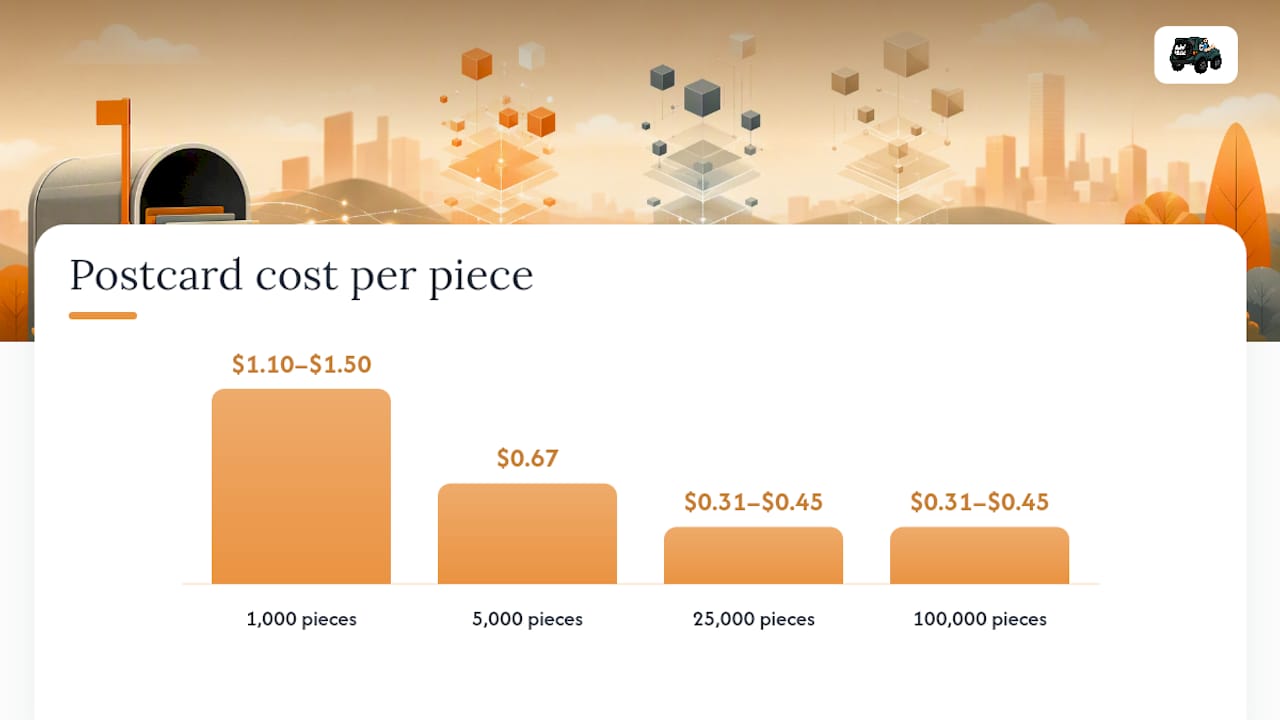
Volume changes everything else. Here is roughly what all-in per-piece cost looks like across common quantity tiers for a standard postcard campaign:
| Volume | Approx. all-in cost per piece | What changes at this tier |
|---|---|---|
| 1,000 pieces | $1.10–$1.50 | Setup, plates, and minimum print charges dominate |
| 5,000 pieces | $0.67 | Automation rates and modest print discounts kick in |
| 25,000 pieces | $0.31 to $0.45 | Presort depth improves; per-record list cost often drops |
| 100,000 pieces | $0.31–$0.45 | Drop-ship entry and negotiated list/print deals compress cost further |
These figures cover postage, print, list, and processing only. They exclude creative and design work, A/B test cell setup, and any companion channel costs like a landing page build or call-tracking number. Budget those separately, because they do not shrink with volume the way postage and print do.
USPS Postage Rules That Actually Change Your Bill
Postage is not a flat rate. It moves based on presort depth, entry point, and mail class, and the rules governing all of it live in Postal Explorer, USPS’s official reference for Marketing Mail rates, minimums, and automation requirements.
Presort depth matters because USPS rewards you for doing part of its sorting work upfront. A basic sort earns a modest discount; sorting down to the carrier route or destination delivery unit level earns a deeper one. Entry point matters just as much. Dropping mail directly at a Destination Delivery Unit or participating in a co-mingled drop-ship pool with other mailers lets small advertisers access automation pricing they could never qualify for alone, since scale compresses cost once presort and drop-ship mechanics kick in.
EDDM changes the equation entirely. Retail EDDM postage runs roughly $0.247 to $0.259 per piece, and because there is no list to buy, it often beats targeted mail on total cost for saturation campaigns where your offer works across most households on a route (a pizza shop, a home services company, a dental practice).
Practical entry points for SMBs:
- EDDM requires no mailing permit for retail quantities and can start at just a few thousand pieces per route.
- Marketing Mail generally requires a minimum of 200 pieces or 50 pounds to qualify for bulk rates, plus an annual mailing permit.
- A mailing house or agency can bundle your volume with other clients to hit drop-ship thresholds you could not reach solo.
The Data Hygiene Costs Marketers Forget to Budget
Clean data is not optional if you want your postage discount to hold. Address hygiene work, CASS certification, NCOA (National Change of Address) processing, DPV (Delivery Point Validation), and IMb (Intelligent Mail barcode) sequencing, typically adds 3 to 8 cents per piece for straightforward jobs and up to 18 cents for complex insertions or heavy variable data work.
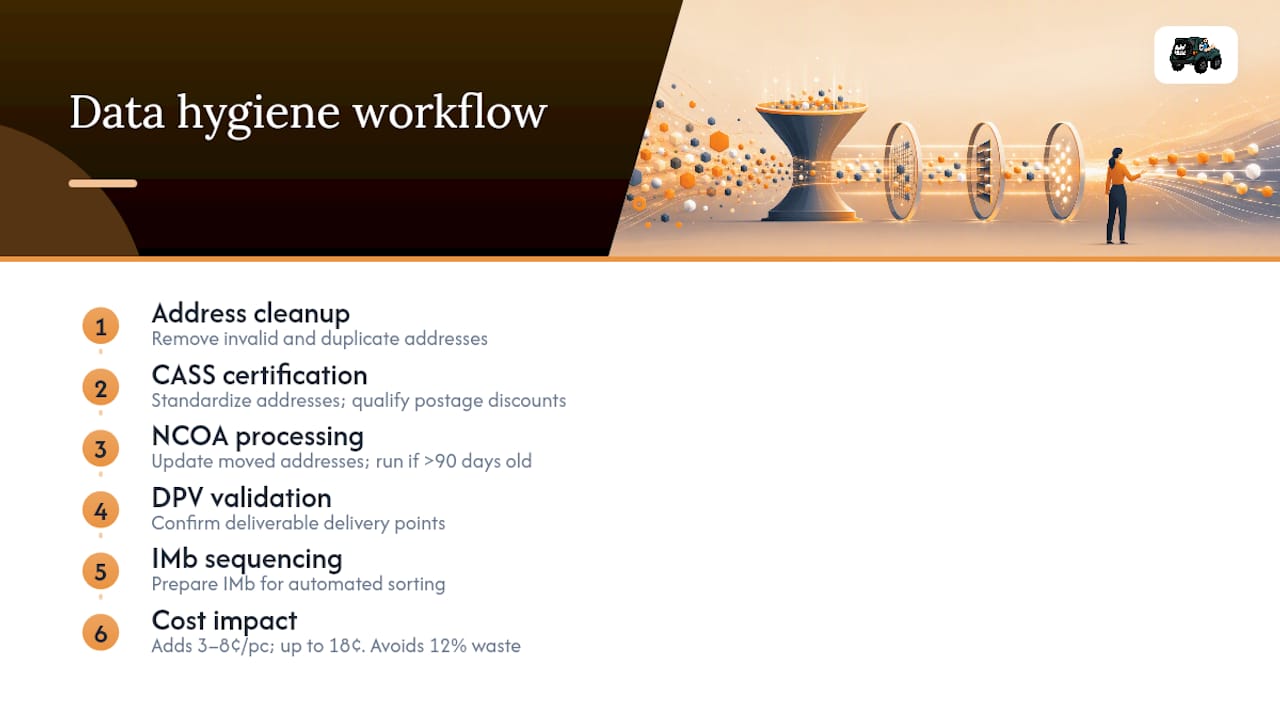
Skipping this step does not save money; it just moves the cost to a worse place. Practitioners consistently report that failing to run CASS/NCOA increases undeliverable mail, which wastes postage you already paid for and quietly inflates your real cost per response. A list with a 12% bad-address rate means you are effectively paying full postage plus processing on pieces that never had a chance to convert.
You have three paths here. In-house cleanup works if you already own list-management software and have someone trained to run it correctly. A dedicated mailing house handles hygiene and physical prep but usually leaves list strategy and creative to you. Full-service agency management folds hygiene into a broader campaign plan, which costs more per piece but removes the guesswork for teams without a dedicated ops person.
Pro Tip: Run NCOA and CASS on any list older than 90 days before you print, even if it worked fine last quarter. Address decay happens faster than most marketers expect, and a stale list quietly erodes your response rate before the first piece hits a mailbox.
Three Worked Budgets: Test, Local Campaign, and Rollout
Real numbers make this easier to plan around than percentages ever will.
-
1,000-piece test mailing. At this scale, setup and minimum print charges dominate. Expect roughly $1.10 to $1.50 per piece all in, for a total between $1,100 and $1,500. Most of that premium comes from spreading fixed costs (plate setup, minimum print run charges) across too few units, not from postage itself.
-
5,000-piece local postcard campaign. Using Marketing Mail automation rates, a worked line-item example comes to about $0.672 per piece: postage at $0.467, print at $0.085, list at $0.07, and processing at $0.05. That totals roughly $3,360, a realistic budget for a single-location business testing a new offer across a nearby ZIP code cluster.
-
100,000-piece regional rollout. At this volume, presort depth, drop-ship entry, and negotiated list or print deals start compressing unit cost meaningfully. Rollout-phase unit costs commonly drop 20% to 30% versus test-scale pricing, putting all-in cost in the $0.31 to $0.45 per-piece range and total spend between $31,000 and $45,000.
Direct mail also sits in a mailbox for an average of about 17 days, so build a longer attribution window into your budget conversations. A campaign that looks flat after 10 days may still be generating response marketing results two weeks later, and matchback reporting against your CRM will catch conversions that a short lookback window misses entirely.
The Fees That Sneak Into a Direct Mail Quote
The four core buckets rarely tell the whole story. Design work is the most common surprise: a basic template swap might be free from your printer, but a custom layout with copywriting and photo sourcing can add hundreds of dollars before a single piece prints. Ask upfront whether design is bundled or billed separately.
Setup fees show up next. Plate charges, file processing fees, and per-job minimums exist specifically to cover the fixed cost of running a small batch, and they hit hardest on test mailings where volume cannot absorb them. Proofing is another line item worth clarifying: a digital PDF proof is usually free, but a physical press proof or a full production sample costs extra and adds days to your timeline.
Watch for data-related add-ons too. List brokers sometimes charge a minimum order fee regardless of how few records you pull, and NCOA or CASS processing may be quoted separately from base list cost even when a provider bundles it into their standard rate elsewhere. Freight and delivery to a drop-ship location can also appear as a separate charge on large rollouts.
Before you sign off on a quote, ask for every fee itemized by name rather than folded into a single “production” line. A provider that resists breaking it down is usually hiding something in the markup.
What Actually Matters Once You Start Planning
Most direct mail cost guides stop at the per-piece number and leave you to figure out the timeline yourself. That gap causes more budget overruns than bad pricing ever does. Plan for data prep and list pulls to take a week, proofing and approval another few days, print production five to ten business days depending on format, and delivery to the post office or drop-ship point a few more days before pieces actually enter the mail stream. A local postcard campaign realistically needs three to four weeks from kickoff to delivery.
Before you finalize anything, lock the offer, choose between a targeted list or EDDM routes, confirm format and specs with your printer, validate every address, and decide on your entry point.
I have seen more campaigns blow their budget on rushed timelines than on postage rate surprises. Build in the extra week.
— Mike
Get Direct Mail Handled as Part of a Full Local Media Plan
Running the math yourself is doable, but coordinating list hygiene, print specs, presort logistics, and a mailing deadline on top of your regular job is where most SMB teams lose time, not money. A local media agency can handle that coordination as one piece of a broader local media plan, so your direct mail drop lines up with the rest of your advertising instead of running on its own disconnected schedule.
That means campaign planning, list and data prep, print and mail logistics, and integration with other local channels, magazine placements, podcast features, community publishing, are handled under one plan instead of juggled across separate vendors. If your list is complex, your piece needs multiple inserts, or you want direct mail timed alongside a broader regional push, an agency-managed approach removes the coordination headache that self-service platforms leave on your plate. Simple EDDM test drops can still make sense to run yourself.
Ready to see how direct mail fits into your local marketing plan? Reach out to 16wmediagroup and get a plan built around your market and your budget.
Sources
- Mailing Services Pricing 2026: Line-Itemized Cost Breakdown | MPA
- USPS Marketing Mail – Postal Explorer
- Direct Mail Cost Guide (Updated June 2026) | Catdi Printing
- Direct Mail Cost in 2026: $0.50–$1.50 Per Piece | Gundir