

Did you know that nearly 40% of manufacturer marketing dollars vanish every year because local businesses simply don’t claim them? For Tampa brands, this means leaving thousands in potential revenue sitting in a corporate vault while you struggle to fund your own growth. You’ve likely felt the friction of a tight budget while knowing your big-brand partners have deep pockets. It’s frustrating to leave cash on the table because you’re buried in complex compliance manuals or don’t have the hours to chase down a reimbursement.
We’re here to help you accelerate. This guide will show you how to master retailer co-op funds advertising expense sharing so you can stop spending your own cash and start using theirs. By following our strategic roadmap, you’ll learn how to navigate the manufacturer’s requirements and fast-track your way to a dominant local presence. We’ll preview the exact steps to unlock these hidden budgets, clear the compliance hurdles, and drive a high-speed campaign that puts your brand in the fast lane across the Tampa market.
Key Takeaways
- Stop leaving money on the pavement by identifying the unspent manufacturer dollars already waiting to fuel your local marketing efforts.
- Master the mechanics of retailer co-op funds advertising expense sharing to transform wholesale orders into a self-funding marketing engine.
- Navigate the manufacturer audit process to uncover your hidden balance and claim your rightful lane on the branding highway.
- Execute a high-speed Tampa campaign with a streamlined 5-step strategy that eliminates administrative friction and accelerates your market presence.
- Learn how to leverage a dedicated “pit crew” to manage complex paperwork, ensuring your brand stays in the fast lane toward growth.
Stop Leaving Money on the Tampa Pavement: The Reality of Retailer Co-op Funds
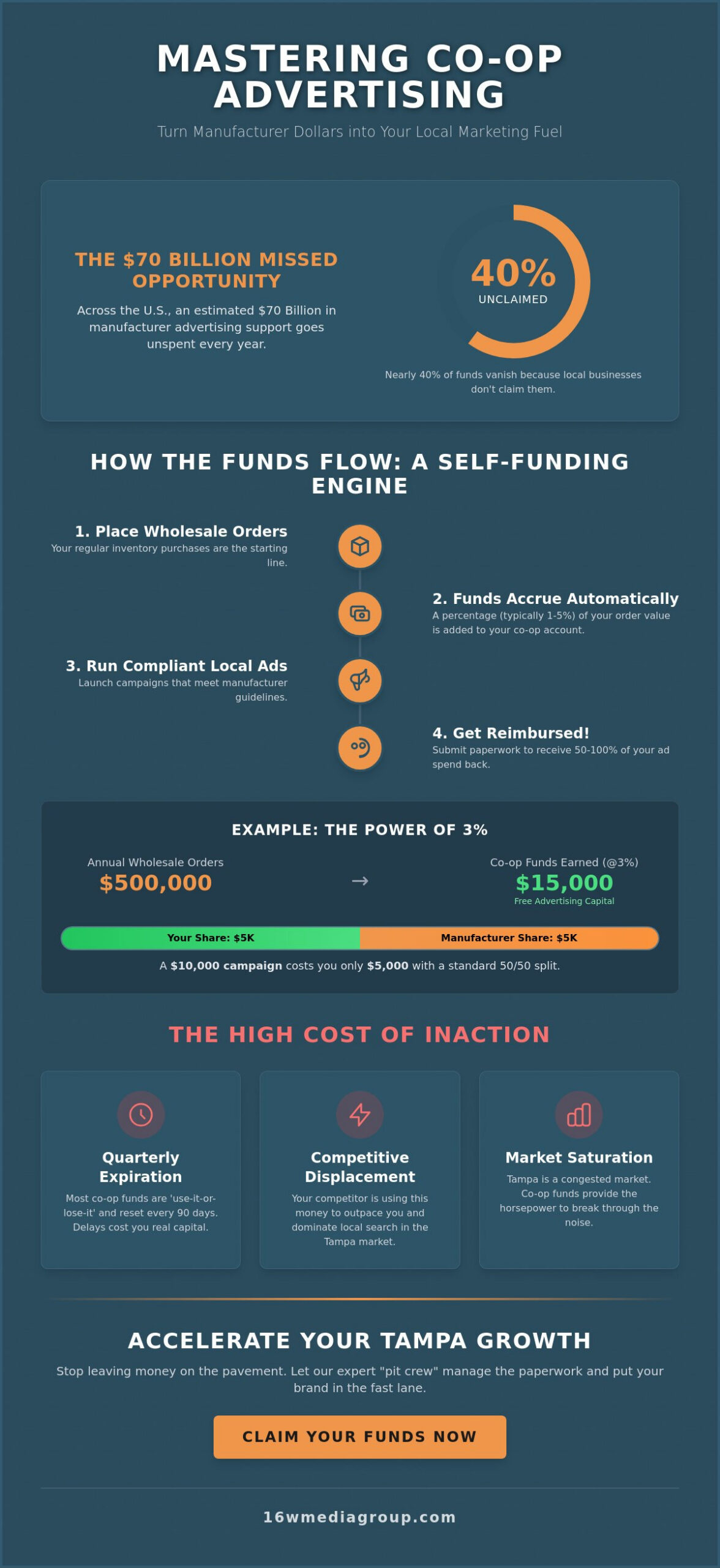
Every year, an estimated $70 billion in manufacturer advertising support goes unspent across the United States. In the high-stakes Tampa market, local business owners are literally leaving money on the pavement while their competitors accelerate into the fast lane. This isn’t just a missed opportunity; it’s a strategic failure. Your product purchases have already funded your next marketing campaign. Think of it as a hidden goldmine that’s waiting for you to pick up the shovel. By utilizing retailer co-op funds advertising expense sharing, you shift the financial burden of growth from your own pocket to the manufacturers who profit from your success.
National brands often move with the friction of a massive tanker, but your local business can move like a performance vehicle. While corporate offices debate global strategy, you can use their capital to dominate local airwaves and digital feeds. This capital is sitting in accrual accounts right now, tied to the inventory sitting on your shelves. If you don’t claim it, you aren’t just losing money; you’re handing a massive advantage to the shop down the street. It’s time to stop stalling and start driving your brand forward with money that’s already yours.
What is Retailer Co-op Advertising?
At its core, co-op advertising is a performance-driven partnership between a manufacturer and a local dealer. Historically, this meant slapping a logo on a t-shirt or a basic newspaper ad. Today, the game has changed. The modern Retailers’ cooperative model has evolved into high-impact digital campaigns, community media sponsorships, and targeted social media blitzes. Manufacturers want you to spend this money. They know that driving local Tampa sales is the only way to keep their production lines moving. They provide the fuel, but you have to be the one to turn the key and steer the strategy.
The Cost of Inaction in the Tampa Market
In the world of retailer co-op funds advertising expense sharing, speed is everything. Most of these funds operate on a use-it-or-lose-it basis. When the fiscal quarter ends, those dollars often expire and vanish from your ledger forever. If your balance sits at zero while your competitor uses manufacturer cash to buy up local search terms, you’re falling behind in a crowded market. Accrual-based funds are the engine of your local visibility, serving as a dedicated credit line built from a percentage of your total product purchases. Don’t let your hard-earned marketing power evaporate into thin air at the end of the month. If you’re unsure why so many Tampa businesses miss out on these dollars, our deep dive into retail co op advertising myths and missed opportunities breaks down the most common misconceptions holding local brands back.
- Quarterly Expiration: Funds often reset every 90 days, meaning delays cost you real capital and market share.
- Competitive Displacement: If you aren’t visible in the Tampa bay area, your competitor is, often using the same pool of manufacturer money to outpace you.
- Market Saturation: Tampa is a congested environment; co-op funds provide the extra horsepower needed to break through the noise without draining your primary operating budget.
Understanding Advertising Expense Sharing: How the Funds Flow
Think of retailer co-op funds advertising expense sharing as a high-octane fuel injection for your Tampa marketing engine. It’s a strategic partnership where manufacturers pay for a portion of your local advertising to drive sales of their products. This isn’t a discount or a rebate; it’s a powerful mechanism to double your reach without increasing your overhead. Most programs operate on a percentage-based reimbursement model. A 50/50 split is the industry standard, but aggressive brands often offer 75/25 or even 100% coverage for specific seasonal pushes. When you spend $5,000 on a localized campaign, the manufacturer cuts a check for $2,500, effectively cutting your customer acquisition cost in half.
These funds accumulate through accruals. Every wholesale order you place adds a specific percentage, often between 1% and 5%, into your dedicated marketing tank. If your store moves $500,000 in inventory annually, a 3% accrual rate generates $15,000 in “free” advertising capital. To stay compliant with the legal definition of cooperative advertising, you must follow specific documentation rules to prove the ads actually ran. Understanding the nuances between funding types is critical. Co-op funds are usually tied to specific product sales, while Market Development Funds (MDF) are often issued upfront for broader territory growth. Branding Allowances are even more flexible, focusing on long-term visibility rather than immediate inventory turns. If you want to accelerate your brand growth, you need to master these distinctions.
Formal vs. Negotiable Co-op Plans
Manufacturers typically place their support into two distinct buckets. Formal plans are rigid, with thick rulebooks detailing logo placement, font sizes, and approved media channels. Compliance is non-negotiable here; one missed disclaimer can stall your reimbursement for months. Negotiable funds, often called “discretionary spend,” are more flexible. These are often managed by regional reps who have the authority to bypass standard rules to help you dominate the Tampa market. Identifying which bucket your manufacturer uses allows you to pivot your strategy quickly and keep your momentum high.
Accrual Periods and Expiration Dates
Co-op is a pre-paid marketing asset that belongs on your balance sheet, not a simple discount. However, this asset has a shelf life. Most brands operate on a “use it or lose it” policy tied to the fiscal year. As you plan for the 2026 fiscal year, tracking your deadlines is vital to prevent thousands of dollars from evaporating. Check your manufacturer portals monthly or demand a balance statement from your rep. Leaving these funds on the table is like leaving the keys in a sports car and walking away. You’ve already paid for this visibility through your wholesale purchases; it’s time to put that capital to work on the branding highway. To avoid common administrative pitfalls that cause Tampa retailers to miss reimbursements, follow our retail co op advertising program administration checklist for Tampa brands and keep your claims process running at full speed.
Auditing Your Co-op Balance: Finding Your Lane on the Branding Highway
Every high-speed growth strategy begins with a pit stop to check the fuel levels. You can’t accelerate your marketing if you don’t know how much capital is sitting in your tank. The manufacturer audit is your first move. Industry data suggests that nearly 40% of co-op dollars go unspent every year. This happens because brands fail to track their accruals. For Tampa businesses, this isn’t just a missed opportunity; it’s leaving your own money in someone else’s pocket.
Start by cornering your brand representative. Ask them for a detailed accrual report covering the last 12 months. You need to know if your retailer co-op funds advertising expense sharing is based on a flat rate or a percentage of your total wholesale purchases. The SBDC Tampa Bay guide to co-op advertising confirms that these funds are essentially a rebate on your inventory. If you aren’t claiming them, you’re effectively paying a higher price for your products than your competitors are. Streamlining your retail co-op marketing program administration is the key to ensuring none of these accrued dollars slip through the cracks.
The 3-Point Co-op Audit Checklist
- Step 1: Gather wholesale purchase history. Pull your invoices from the last four quarters. Your available budget is directly tied to this volume.
- Step 2: Request the formal Co-op Policy Manual. Don’t rely on a verbal “yes” from a rep. Get the 2025 or 2026 guidelines in writing to see exactly what the manufacturer will reimburse.
- Step 3: Identify approved media channels. Check if the brand covers digital ads, podcasts, or print. Knowing your lane prevents you from swerving into non-compliant territory that won’t get paid.
Localization: Making National Budgets Work for Tampa
Generic national ads often hit a dead end when they reach the local market. A “one-size-fits-all” campaign designed in a corporate office in Chicago won’t resonate with a consumer in South Tampa or Ybor City. You need to bridge the gap between national requirements and local culture. This is where most brands stall out. They fear that changing the creative will violate compliance and void their reimbursement.
We use Strategic Brand Localization to ensure your content speaks the local language while staying 100% compliant. Mike and Norman have seen businesses unlock thousands in “unclaimed” funds from previous quarters just by submitting the right localized plan. By translating national guidelines into local wins, you ensure your retailer co-op funds advertising expense sharing actually drives traffic to your specific storefront. It’s about making sure all roads lead to your business, not just the brand’s website. If you’re ready to find your lane, call 813-72-BRAND and let’s get your audit started.
How to Claim and Execute Your Co-op Strategy in Tampa Bay
Stop letting your marketing budget idle in the breakdown lane. If you’ve identified your retailer co-op funds advertising expense sharing opportunities, it’s time to shift into high gear. Moving from “available funds” to an active, high-converting campaign requires a streamlined approach that eliminates friction. In the competitive Tampa market, speed and precision are your greatest assets. You don’t just want to run an ad; you want to run a campaign that the manufacturer is legally obligated to pay for.
Step-by-Step Execution Framework
Execution is where most brands lose momentum. Follow this 5-step roadmap to ensure your campaign drives results and your reimbursement checks arrive on time.
- 1. Secure Pre-Approval: Never spend a dime before getting the green light. Submit your creative assets and your Tampa media placement plan to the manufacturer. This step prevents the 15% of claim rejections that typically occur due to minor logo placement errors or font non-compliance.
- 2. Deploy Through Authoritative Local Channels: Leverage Community-Focused Print and Digital Publishing to ensure your brand resonates with the local 813 and 727 demographics. Manufacturers love seeing their products associated with high-authority local media.
- 3. Execute with Precision: Launch your campaign across the agreed-upon platforms. Whether it’s digital display or hyper-local print, ensure the execution matches the pre-approved plan exactly.
- 4. Gather Bulletproof Proof of Performance: Collect every piece of evidence. This includes physical tear sheets for print, timestamped digital screenshots for social media, and detailed invoices from your media partners.
- 5. Submit the Claim Immediately: Most manufacturers operate on a strict 30, 60, or 90-day window. Submit your documentation the moment the campaign concludes to keep your cash flow moving.
Maximizing ROI on Shared Expenses
The smartest brands in Tampa don’t just use co-op funds for generic ads. They use them to dominate “The Branding Highway” through high-value plays like podcast sponsorships. By integrating your brand into local conversations, you build a level of trust that standard banner ads can’t touch. Partnering with a specialized Tampa marketing agency allows you to offload the heavy lifting of compliance and creative strategy, ensuring every dollar of your retailer co-op funds advertising expense sharing is optimized for local impact.
Think of the reimbursement loop as a high-performance engine that funds continuous growth. Every dollar you recover from a manufacturer is fresh capital you can immediately reinvest into your next local campaign. This creates a self-sustaining cycle of brand awareness and sales growth that leaves your competitors in the rearview mirror.
Ready to accelerate your brand’s growth? Contact 16W Media Group today to start building your high-speed marketing roadmap.
Accelerate Your Growth with 16W Co-op Management
Most Tampa retailers leave a fortune on the table every single year. Industry data suggests that nearly 40% of available co-op marketing dollars go unspent because the administrative burden is simply too heavy for local business owners to manage alone. You’re focused on inventory, staffing, and daily operations; you don’t have time to chase down creative assets or argue with a manufacturer’s accounting department. That’s why 16W Media Group acts as your dedicated marketing pit crew. We handle the heavy lifting of retailer co-op funds advertising expense sharing, ensuring your brand stays in the fast lane without the technical headaches.
Our approach is built on speed and precision. We don’t just wait for things to happen; we drive the process from start to finish. By taking over the administrative coordination, we eliminate the friction that usually stalls these programs. We know the shortcuts to approval and the pitfalls that lead to denied claims. With 16W in your corner, you stop guessing and start growing. Our expertise in retail co-op marketing program administration means we turn complex compliance requirements into a streamlined engine for your Tampa brand’s growth.
The 16W Strategic Powerhouse Advantage
We provide the strategic coordination required to sync national manufacturer expectations with your specific Tampa storefront needs. Compliance is our primary directive. A single misplaced logo or an incorrect font choice can disqualify a claim, but our team ensures 100% adherence to brand standards so you never lose a dollar. We bridge the gap between corporate requirements and local market reality. Our step-by-step retail co op advertising program administration checklist gives your team a clear, actionable framework to stay compliant and maximize every reimbursement dollar.
- We manage the communication flow between you and the manufacturer to keep projects moving.
- Our team monitors changing brand guidelines to maintain total reimbursement eligibility.
- We leverage our local publishing network to put your brand in front of high-value Tampa consumers.
- Every campaign is tracked with data-driven metrics to prove your ROI.
By connecting your brand with our established media channels, we ensure that your localized national brand isn’t just visible; it’s dominant. We take the high-level assets provided by manufacturers and tailor them to resonate with the unique culture of the Tampa Bay area.
Ready to Fast-Track Your Marketing?
The Branding Highway is open, and it’s time to put your business in the lead. You can start your comprehensive co-op audit with Mike and Norman today to uncover exactly how much money you’ve been missing. We look at your current partnerships and identify every untapped revenue stream available through your suppliers. It’s a calculated, results-oriented process designed to maximize your reach while minimizing your personal expense.
You will quickly see the tangible impact of professional co-op marketing in Tampa. It isn’t just about saving money; it’s about scaling your presence in a crowded market. When you use 16W Media Group, you’re choosing a partner that understands the local terrain and the global standards of the brands you sell. Our strategic promise is simple: we build the roadmap, we manage the engine, and we ensure that all roads lead to your business. Contact 16W Media Group to unlock your co-op funds and start your engines today.
Fast-Track Your Brand Growth in Tampa Bay
Your brand’s growth shouldn’t be stalled by complex paperwork or missed opportunities. Leveraging retailer co-op funds advertising expense sharing represents a massive pool of untapped capital that belongs to your business. According to research from the Local Search Association, nearly 40 percent of these funds go unspent annually because brands lack a clear execution roadmap. By auditing your balance and claiming your lane, you stop leaving your marketing potential on the pavement and start dominating the local market.
16W Media Group acts as your Strategic Navigator on the branding highway. We provide specialized co-op management for Tampa retailers, offering exclusive access to community-focused publishing networks that connect you with high-value consumers. Our team handles the friction of the claims process so you can focus on driving sales. We’ve built the systems to ensure your shared expense budget translates into immediate momentum. It’s time to shift gears and accelerate your presence across the region. To understand why so many local businesses struggle to claim what’s rightfully theirs, explore our complete guide to retail co op advertising myths that cost Tampa businesses thousands.
Stop leaving money on the table—let 16W manage your Tampa co-op program
We’re ready to help you own the road and ensure all roads lead to your business.
Frequently Asked Questions
What is the standard percentage for advertising expense sharing?
Manufacturers typically cover 50% to 100% of your media costs through retailer co-op funds advertising expense sharing programs. This percentage is usually tied to 1% to 3% of your total annual purchase volume from that vendor. For example, if you buy $100,000 in inventory, you might have $3,000 available to accelerate your local marketing. Check your specific dealer agreement to see your exact accrual rate.
How do I find out if my manufacturer offers co-op advertising funds?
Contact your regional sales representative or log into your manufacturer’s dealer portal to locate their co-op policy manual. According to the Local Search Association, over 40% of available co-op funds go unused every year because brands don’t ask. You can also search the Co-op Advertising Programs database or ask Mike and Norman to audit your vendor list. This audit ensures you aren’t leaving money on the table.
Will my manufacturer pay for digital ads or just print?
Manufacturers now allocate 60% to 80% of their co-op budgets to digital channels like Google Search, social media, and OTT streaming. While print was the traditional standard, modern brands prioritize retailer co-op funds advertising expense sharing for high impact digital campaigns. You must ensure your digital ads include the manufacturer’s approved logo and meet their specific minimum advertised price requirements to qualify for the fast-track reimbursement.
What happens if my co-op claim is rejected by the brand?
You should review the rejection notice immediately to identify if the issue was a missing logo, incorrect font size, or a price violation. Most manufacturers allow a 30 day window to correct errors and resubmit the claim for processing. Common pitfalls include using unapproved imagery or failing to include the required call to action. We help you navigate these roadblocks to ensure your ads stay on the branding highway.
Can I use co-op funds for local Tampa events or podcast sponsorships?
You can often use funds for Tampa events or podcast sponsorships if the manufacturer’s guidelines allow for nontraditional media. For instance, a 15 second mid-roll spot on a local podcast may qualify if it features the required vendor mentions. Always get pre-approval from your brand manager before committing funds to local sponsorships. This strategy helps drive local awareness and connects your brand directly to the Tampa community.
How long does it typically take to get reimbursed for co-op expenses?
Expect a turnaround time of 30 to 90 days from the moment you submit your completed claim. Large manufacturers often use third party clearinghouses to verify documents, which can add 15 days to the process. To accelerate your payment, submit your claim within 15 days of the ad running. Prompt submissions keep your cash flow moving and your marketing engine running at full speed.
What is Proof of Performance in co-op advertising?
Proof of Performance is the collection of documents, such as invoices and tear sheets, that prove your advertisement actually reached the public. For digital ads, this includes screenshots of the live ad and a detailed performance report showing impressions and clicks. For radio or TV, you need a notarized Affidavit of Performance from the station. Providing these documents ensures all roads lead to your business getting paid back.