
Most local businesses spend money on advertising without a plan, and the results show it. Scattered placements, ignored demographics, offers that land flat. An effective guide to local media planning changes that picture entirely, giving you a structured way to reach the people in your community who are actually ready to buy. This guide walks you through every stage of the process, from setting objectives and building your media list to executing campaigns and tracking what matters. Whether you run a neighborhood service business or manage marketing for a multi-location brand, you will come away with a clearer, more confident approach to planning local advertising.
Table of Contents
- Key takeaways
- What you need before starting local media planning
- Steps for building your local media plan
- Executing and managing your local campaigns
- Common challenges in local media campaigns
- My take on local media planning
- How 16wmediagroup can help you plan smarter
- FAQ
Key takeaways
| Point | Details |
|---|---|
| Start with your audience | Map your local geography and customer profile before selecting any media channel. |
| Use a two-campaign structure | Split digital budgets with 70-80% on prospecting and 20-30% on retargeting for consistent local results. |
| Offer specificity beats production quality | A clear, specific offer outperforms polished creative every time in local campaigns. |
| Build a local media contact list | A targeted list of 8-12 reporters and 6-10 community bloggers fuels digital PR and earned media. |
| Track calls, not just clicks | Call tracking with dynamic number insertion captures up to 60% of conversions that form data misses. |
What you need before starting local media planning
Before you touch a single ad platform or call a local radio station, you need three things in place: a clear picture of your audience, measurable goals, and a working knowledge of the channels available to you.
Know your geography and your customer. Local advertising’s real advantage is its highly focused reach within a finite, high-intent local audience compared to broad national campaigns. That means wasting money is easier here, not harder, if you do not define your catchment area precisely. Draw a realistic radius around your location. For most service businesses, this is three to ten miles. Then build a basic profile of who lives and works there: age range, household income, commute patterns, and what problems they need solved.
Set objectives that you can actually measure. Vague goals like “get more awareness” are impossible to optimize against. Instead, commit to specific numbers: 50 new customer calls per month, a 15% increase in foot traffic over 90 days, or 200 new email subscribers in 60 days. Every media channel you choose later should connect directly to one of these numbers.
Build your local media contact list early. Effective local PR outreach targets a list of roughly 8-12 local news reporters, 5-10 trade writers, 6-10 neighborhood bloggers, and around 8 podcast hosts. This list is not a one-time tool. You will use it for press releases, event announcements, product launches, and story pitches throughout the year.
Here is a quick overview of the main local media channels and what each does best:
| Channel | Best use | Budget level |
|---|---|---|
| Community magazines | Brand trust, affluent neighborhood reach | Medium |
| Facebook/Instagram ads | Lead generation, retargeting | Low to Medium |
| Local podcasts | Thought leadership, audience loyalty | Low |
| Outdoor (billboards, transit) | High-frequency awareness near catchment | Medium to High |
| Local news/PR | Credibility, SEO signals | Low (earned) |
| Direct mail | Hyper-local household targeting | Medium |
Pro Tip: Before allocating budget, request media kits from local publications and radio stations in your area. The audience demographics and circulation numbers inside those kits will save you from expensive guesswork.
Steps for building your local media plan
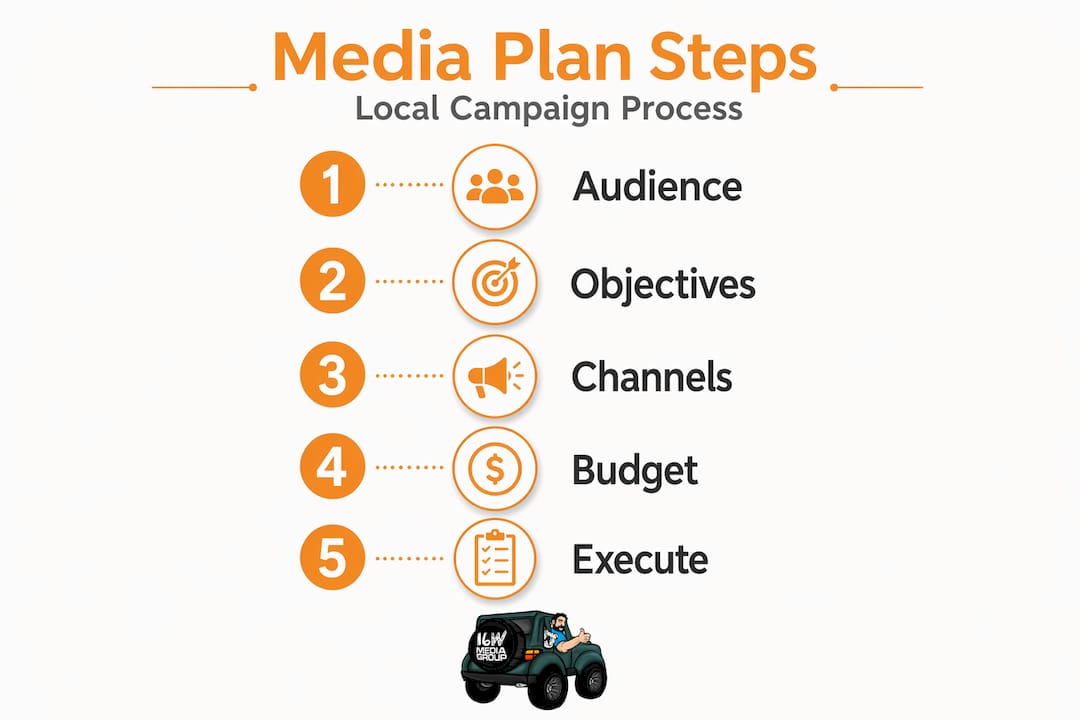
A solid plan follows a clear sequence. Skipping steps early creates confusion later when you are trying to diagnose why something is not working.
-
Conduct audience research and competitor analysis. Look at which channels your direct competitors are using. If three competitors run ads in the same community magazine and none run podcast sponsorships, that tells you something about both channel effectiveness and white space.
-
Choose your channel mix deliberately. Do not pick channels because they feel familiar. Pick them because they reach your defined audience at the right frequency. High-frequency repetition in localized catchment areas builds the brand familiarity that drives customer recall, especially near transit hubs, offices, and residential clusters.
-
Craft localized messaging. Generic offers do not perform locally. Your copy should name the neighborhood, reference a local landmark, or speak to a community-specific need. “Tampa families saving on AC repairs this summer” performs better than “Save on HVAC services.”
-
Plan your timing and frequency. Map your campaign calendar against local seasonality, community events, and school schedules. A roofing company in Florida, for example, needs heavier media presence in the spring before hurricane season, not during it.
-
Allocate your budget using a proven structure. For digital campaigns, a two-campaign Facebook structure works well: put 70-80% of your budget into an Advantage+ campaign for prospecting and 20-30% into manual retargeting of engaged users from the past 30 days. This keeps acquisition costs low while staying visible to warm prospects.
Pro Tip: Local newsletter subscribers acquired through Meta’s location targeting can cost as little as $0.25-$0.50 each when you lead with a genuinely useful, localized offer. This is one of the lowest-cost community building tactics available to local businesses.
For a deeper breakdown of channel-specific approaches, the step-by-step media planning guide from 16wmediagroup walks through local targeting decisions in detail.
Executing and managing your local campaigns
Planning is the foundation, but execution is where most local campaigns succeed or fail. A few specific practices separate businesses that get results from those that just spend money.
Set your digital campaigns up correctly from day one. The minimum budget recommendation for a stable Facebook local ad campaign is around 600 USD per month for a 10-mile radius. Going below this threshold means the algorithm never exits its learning phase. Also, avoid stacking excessive interest targeting on top of geographic signals. Facebook’s Advantage+ largely ignores interest stacks and instead responds to location specificity and creative quality.

Use the right creative format. Offer specificity drives performance more than creative polish in local lead generation. The most effective structure is one polished branded asset paired with five user-generated content style variants. The hero asset builds credibility. The UGC variants provide relatable social proof and give the algorithm options to test.
Leverage local digital PR for compounding returns. Geographic coverage in media outperforms national placements for local SEO, improving rankings and building trust with nearby customers. Pitch your local reporters with stories that tie your business to something the community already cares about. A new hire from the neighborhood, a community sponsorship, or a response to a local issue all make stronger pitches than a product announcement.
- Track inbound calls with dynamic number insertion. Call tracking captures 40-60% of conversions that form submissions alone will miss.
- Monitor Google Business Profile views, calls, and direction requests weekly.
- Ask customers at the point of sale how they heard about you. Low-tech, but it fills attribution gaps.
- Request reviews that include specific neighborhood references and service details. Detailed review responses with local language improve search visibility significantly.
Pro Tip: Rotate your ad creative every three to four weeks in small geographic markets. Local audiences see the same ads repeatedly, and fatigue sets in faster than it does in large-scale national campaigns.
For businesses targeting upscale communities specifically, 16wmediagroup’s resource on advertising in affluent neighborhoods covers the nuances of messaging and channel selection for high-income local audiences.
Common challenges in local media campaigns
Even a well-built plan runs into friction. Here are the most common places where local campaigns break down and what to do about each one.
Over-broad targeting wastes every dollar you put behind it. Running a 25-mile radius for a business that realistically serves a 5-mile area means you are paying to reach people who will never drive to you. Tighten your radius and accept the smaller audience size. A smaller, more relevant audience always outperforms a larger, irrelevant one.
Vague offers kill conversion rates. “Come visit us!” is not an offer. “Free roof inspection for homeowners in Westchase this month” is. The more specific you make the offer, the more the right people self-select and respond.
Ignoring seasonality creates uneven results. Every local market has predictable peaks and valleys. A restaurant near a university empties out in the summer. A pool service company in Florida slows down in January. Build your media calendar around these rhythms, not against them.
Limited budgets require tighter channel discipline. When resources are constrained, pick one or two channels you can fund properly instead of spreading thin across five.
“Local advertising works best when you become a familiar name in someone’s daily environment. That familiarity does not come from a single campaign. It comes from consistent, high-frequency presence in the specific places your best customers spend time.”
When a campaign underperforms, resist the instinct to change everything at once. Adjust one variable, wait two weeks, and read the data again. Changing the audience, the offer, the creative, and the placement simultaneously makes it impossible to learn what actually moved the needle.
My take on local media planning
I have spent years watching local businesses try to out-spend their way to results, and it almost never works the way they expect. What actually moves the needle is something simpler and harder to sell: showing up in the same places, with the same message, for long enough that your name starts to feel like a natural part of the neighborhood.
The businesses I have seen win consistently do not have the biggest budgets. They have the tightest focus. They know exactly which three blocks their best customers live on, which Facebook group those customers post in, and which local magazine they leave on their kitchen counter. That kind of local familiarity beats broad reach every single time.
The other thing I have learned is that creative formats matter far less than most business owners believe. I have watched simple, direct, even ugly ads outperform beautiful brand campaigns because the offer was specific and the placement was right. Stop polishing and start specifying.
Finally, do not treat traditional and digital media as competitors. A community magazine placement that builds neighborhood credibility makes your digital retargeting cheaper because the audience already recognizes your name. They work together. The businesses that learn to integrate both media types are the ones building something that lasts.
— Mike
How 16wmediagroup can help you plan smarter
If you are ready to stop guessing and start building a real local media strategy, 16wmediagroup works directly with local businesses to develop personalized plans that connect with the right community audiences. From community magazine placements and podcast sponsorships to targeted digital campaigns, every service is built around your specific market and goals. Explore the local advertising planning guide to see how the process works, or browse the full media services overview to find the right fit for your business and budget.
FAQ
What is the first step in local media planning?
Define your geographic catchment area and build a clear customer profile before selecting any channels. Every channel and budget decision depends on knowing exactly who you are trying to reach and where they are.
How much should a local business spend on Facebook ads?
A minimum of around 600 USD per month for a 10-mile radius is recommended to give the algorithm enough data to exit its learning phase and deliver stable results.
Why does offer specificity matter more than creative quality?
Specific offers help the right local customers self-select immediately, while polished but vague creative forces readers to interpret what you want them to do. In a local context, clarity converts faster than aesthetics.
How do I measure whether my local media campaign is working?
Use call tracking with dynamic number insertion alongside form submissions and Google Business Profile metrics. Call data alone can account for 40-60% of conversions that digital form tracking misses entirely.
How does local PR help with digital marketing results?
Local media coverage with geographic relevance improves your local search rankings and builds community trust faster than national press placements. Consistent story pitching to a focused list of local reporters compounds over time.