

Most marketers assume bigger reach equals better results. It doesn’t. The role of audience targeting is to flip that equation: instead of broadcasting to everyone and hoping someone bites, you direct your message to the people most likely to act on it. That precision changes everything, from your cost per acquisition to your conversion rate to how your brand is perceived over time. This guide breaks down what audience targeting actually means in 2026, where most campaigns go wrong, and how to apply modern tools and frameworks to get measurably better outcomes.
Table of Contents
- Key takeaways
- The role of audience targeting in modern marketing
- Modern tools and AI-driven targeting strategies
- Common pitfalls in audience targeting
- How to implement audience targeting step by step
- Benefits that compound over time
- My take on where audience targeting is actually heading
- Ready to put precision targeting to work?
- FAQ
Key takeaways
| Point | Details |
|---|---|
| Precision beats reach | Targeting the right audience consistently outperforms broad campaigns on both engagement and ROI. |
| AI has changed the rules | Modern platforms like Meta use AI delivery systems that treat audience inputs as suggestions, not hard walls. |
| Creative is now a qualifier | In AI-powered campaigns, your ad creative signals who should see it. Quality matters more than ever. |
| Static personas waste budget | Audience definitions must be reviewed at least twice yearly to reflect real buying behavior. |
| Data fuels smarter targeting | First-party data fed into AI models produces better prospecting results than interest stacks alone. |
The role of audience targeting in modern marketing
Audience targeting is the practice of selecting specific consumer groups so your advertising reaches the people most likely to value your message. That definition sounds simple. The execution is anything but.
Broad advertising, a TV spot or a generic banner ad, puts your message in front of everyone. Some of those people might buy. Most won’t. Targeted marketing flips the math by concentrating spend on segments defined by shared characteristics, whether that’s demographics, interests, purchase history, or online behavior. You stop paying to reach people who will never convert.
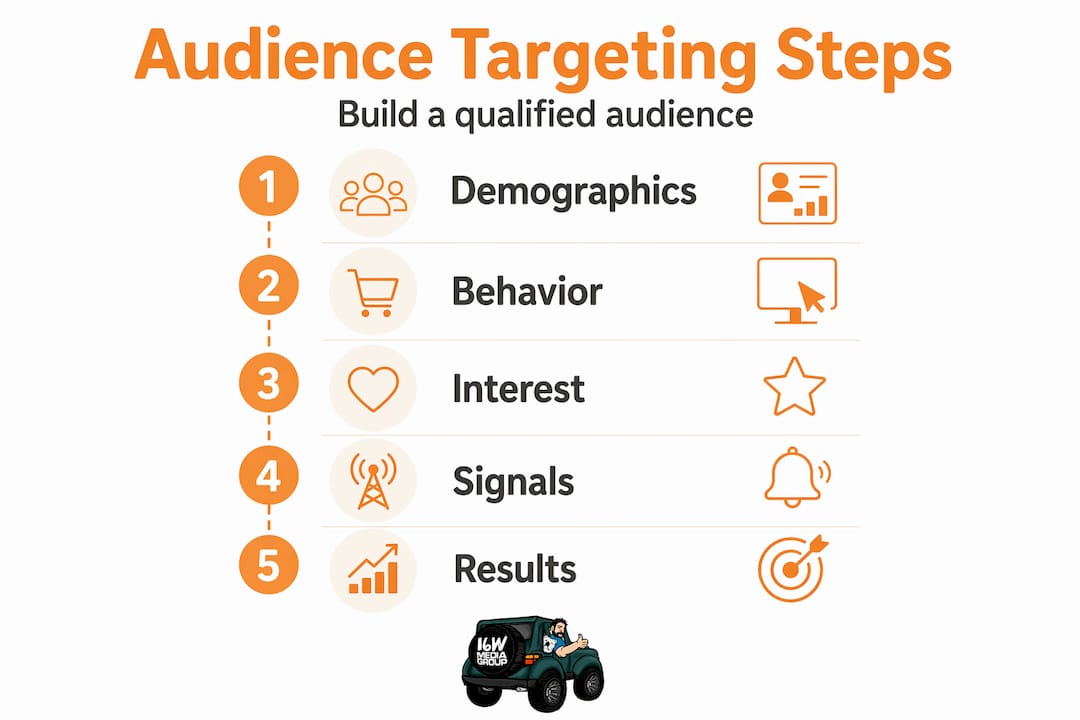
There are three core segmentation types you need to understand:
- Demographic targeting: Age, gender, income, education, location. These are the foundational filters. They tell you who your audience is.
- Interest and behavioral targeting: What people follow, search for, buy, and engage with online. These filters tell you what your audience cares about.
- Intent-based targeting: People actively researching or comparing products in your category. This is the highest-converting segment because they are already in the decision process.
When you combine these layers, you create a far more qualified audience. A 45-year-old homeowner in Tampa who has browsed home renovation content and visited competitor websites is a completely different prospect from a 22-year-old college student who clicked on a generic ad once. Treating them the same is a waste of your media budget.
The impact of audience demographics and behavioral data working together is what separates effective campaigns from expensive experiments. Understanding this distinction is the foundation for everything else in your strategy.
Modern tools and AI-driven targeting strategies
Audience targeting has changed significantly in the past two years. The frameworks that worked in 2022 are not the same ones producing results in 2026. If you’re still building rigid interest stacks and calling it a strategy, you’re working against the platforms, not with them.
Meta’s current system organizes audience inputs into two types: hard controls and soft suggestions. Hard controls include things like location targeting and audience exclusions. These are enforced. Soft suggestions, such as interest categories or demographic preferences, guide the AI’s delivery but do not strictly limit it. The algorithm can and will deliver outside your suggestions if it predicts better performance elsewhere.
This is a critical shift in how you should think about audience targeting strategies. The four main audience types on Meta break down like this:
| Audience type | Best use case | Key characteristic |
|---|---|---|
| Core audiences | Brand awareness, broad prospecting | Interest and demographic filters as suggestions |
| Custom audiences | Retargeting, warm leads | Built from your first-party data (email lists, site visitors) |
| Lookalike audiences | Cold prospecting at scale | Modeled from your best existing customers |
| Advantage+ AI audiences | Full-funnel prospecting | AI-driven delivery with minimal manual constraints |
Advantage+ AI targeting lowers cost per conversion by double digits compared to manual targeting in data-rich prospecting campaigns. The trade-off is control. You give the algorithm room to explore, and it rewards you with efficiency, but only if you feed it quality signals.

That means first-party data matters more now than it ever has. Upload your customer lists. Connect your pixel. Give the AI a clear picture of what a good customer looks like, and it will find more of them. Audience sizing also matters: Meta recommends audiences between 2 and 10 million for cost-effective delivery. Go smaller and your costs climb fast.
Pro Tip: When using Advantage+ audiences, add your custom audiences as engagement signals rather than strict inclusions. This tells the AI where your best customers cluster without artificially boxing in delivery.
The modern mindset is not about controlling every parameter. It’s about providing guardrails and high-quality signals to algorithms, then letting them work. That shift is uncomfortable for marketers trained on precision segmentation. But the data supports it.
Common pitfalls in audience targeting
Even experienced marketers make the same targeting mistakes repeatedly. Recognizing them early saves significant budget.
The most common problem is confusing traffic with qualified interest. Clicks do not equal sales. A campaign that generates thousands of visits from people who have no budget, no intent, or no fit for your offer is an expensive lesson in the difference between reach and relevance. Small businesses, in particular, often waste ad spend chasing broad engagement rather than targeting people with the right need, budget, location, and intent.
Here are the other pitfalls that consistently derail targeting performance:
- Too narrow targeting: Stacking five interest layers and two demographic filters creates audiences so small that your cost per result skyrockets. If your audience is under 500,000 on Meta, you’re likely over-targeting.
- Too broad targeting: Going fully open with no signals produces impressions without conversion because the algorithm has no frame of reference for what a good customer looks like.
- Static personas: Building audience profiles once and never revisiting them is one of the most expensive assumptions in marketing. Treating audience profiles as living documents and reviewing them at least twice yearly keeps campaigns aligned with actual buying behavior.
- Testing multiple variables simultaneously: If you change your audience, your creative, and your budget at the same time, you will never know what drove the result.
That last point deserves emphasis. Isolating one audience variable per ad set while holding everything else constant is the only way to understand true targeting impact. Meta’s reporting simply cannot tell you which element of a multi-variable test drove performance. You have to control for it yourself.
Pro Tip: Schedule a targeting review every six months. Pull your actual conversion data by audience segment and compare it to your original assumptions. You will almost always find at least one segment that is underperforming relative to what it looked like on paper.
How to implement audience targeting step by step
Knowing the theory is one thing. Applying step by step audience targeting in a real campaign requires a structured process.
Here’s the framework that consistently produces results:
- Research your audience. Start with your existing customers. What do they have in common? Look at age, location, income level, and the specific problems they hired you to solve. Survey them if you can.
- Collect and organize first-party data. Your email list, CRM records, and website visitor data are gold. These are the inputs that make AI targeting smarter. Upload them before you build any campaign.
- Segment by intent and stage. Cold prospects, warm leads, and existing customers need different messages. Build separate audience segments for each stage of the funnel.
- Select your platform and audience type. Match the audience type to your goal. Use Custom audiences for retargeting warm leads. Use Lookalike or Advantage+ for prospecting. Use a targeted media campaign approach for local brand awareness goals.
- Let creative do the qualifying. In AI-driven campaigns, creatives act as qualifiers for delivery. A specific, clear ad that speaks directly to your ideal customer’s problem will attract the right people even in broad delivery mode.
- Measure with holdout groups. To avoid over-attributing results to your targeting, continuous measurement with holdout groups gives you a clean read on actual incremental impact.
The table below summarizes key metrics to track at each stage:
| Campaign stage | Primary metric | Secondary metric |
|---|---|---|
| Awareness | Reach, frequency | Brand recall lift |
| Consideration | Click-through rate | Landing page engagement |
| Conversion | Cost per acquisition | Return on ad spend |
| Retention | Repeat purchase rate | Customer lifetime value |
This is where local advertising campaign planning becomes especially valuable. For businesses targeting specific regions, pairing digital audience segmentation with localized media placements amplifies both reach and relevance.
Benefits that compound over time
The benefits of targeted marketing are not just immediate. They build.
Personalization leaders generate about 40% more revenue from their marketing activities compared to average players. That gap widens over time because effective segmentation creates a feedback loop: better data produces better targeting, which produces better results, which generates more data. Companies that invest in this early build a durable competitive advantage.
Beyond revenue, precision targeting reduces wasted spend. When your ads reach qualified prospects, your cost per acquisition drops. Your budget stretches further. You stop funding impressions that will never convert.
There are also longer-term gains in customer retention and lifetime value. When your messaging matches where a person is in their journey, they feel understood rather than sold to. That feeling builds trust. Trust builds loyalty. And loyal customers spend more, refer more, and churn less. Every dollar invested in understanding your audience pays out across the entire customer relationship, not just the first transaction.
For businesses competing in local markets, the tailored marketing approaches that connect with specific community segments create a differentiation that generic campaigns simply cannot replicate.
My take on where audience targeting is actually heading
I’ve spent years watching marketers fight the algorithm instead of feeding it. The instinct to control every targeting variable makes sense. It feels like precision. But the data keeps showing that rigid manual segmentation underperforms AI delivery given sufficient signals.
What I’ve learned is that the real skill in 2026 is not building the perfect interest stack. It’s building the best possible first-party data pipeline and pairing it with creative that speaks so specifically to one type of person that the algorithm figures out who that person is. Creative has become the new targeting layer. I’ve seen campaigns with loose demographic settings outperform heavily segmented campaigns purely because the ad spoke directly to a specific problem. The AI read the signal and found the right people.
The uncomfortable truth is that most businesses are still treating audience targeting as a set-it-and-forget-it task. They build a persona in Q1, run it all year, and wonder why results decay in Q3. The market moves. Customer behavior shifts. What worked six months ago may be targeting a segment that no longer converts the way you expect.
My honest recommendation: spend less time perfecting your interest targeting and more time improving the quality of your first-party data and your creative. Those are the two inputs that matter most right now. And review your audience definitions on a real schedule, not when performance forces you to.
— Mike
Ready to put precision targeting to work?
At 16wmediagroup, we help businesses move beyond guesswork and build campaigns grounded in real audience data. Whether you’re advertising to specific Tampa neighborhoods or planning a multi-channel regional push, our team builds media plans that match your message to the right people at the right moment. From community magazine placements to digital and podcast campaigns, every channel we recommend is chosen based on where your audience actually spends their attention. If you want to stop paying for impressions that don’t convert, explore our campaign planning guide or browse our full suite of services to see how we approach audience-first advertising for local businesses.
FAQ
What exactly is the role of audience targeting in marketing?
Audience targeting determines who sees your advertising by selecting consumer segments most likely to value and act on your message. It improves ad relevance, reduces wasted spend, and increases conversion rates compared to broad-reach campaigns.
How do I identify the right target audience for my campaign?
Start with your existing customers. Analyze shared demographics, behaviors, and purchase intent, then build segments around those patterns. Use first-party data like email lists and website visitor records to sharpen your audience definition.
What is the difference between Custom and Advantage+ audiences?
Custom audiences are built from your own first-party data and work best for retargeting warm leads. Advantage+ audiences use AI-driven delivery with minimal manual constraints and are most effective for cold prospecting when the algorithm has sufficient conversion data to work from.
How often should I update my audience targeting?
Audience definitions should be reviewed at least twice yearly, using actual conversion data rather than assumptions. Static personas decay quickly as customer behavior and market conditions shift.
Does audience size really matter for ad performance?
Yes. For Meta campaigns, audiences between 2 and 10 million typically deliver the best cost efficiency. Audiences that are too small drive up cost per result and limit your ad’s reach in the auction system.