

Branding in competitive markets is defined as the strategic process of building a distinct, credible identity that drives awareness, trust, and loyalty when buyers have multiple alternatives. David Aaker’s brand equity model frames this as a four-part asset: awareness, perceived quality, associations, and loyalty. Apple and Coca-Cola demonstrate it at scale. Every business operating in a crowded market, whether a local Tampa service provider or a national retailer, faces the same core challenge: getting noticed, getting considered, and getting chosen again. The research is clear. Brands that align their identity with specific buying funnel stages consistently outperform competitors who treat branding as a one-time visual exercise.
How does branding impact each stage of the buying funnel?
Branding strategies are designed to outperform competitors at specific buying funnel stages: awareness, image, sales, and loyalty. Each stage requires a different brand investment, and confusing them is one of the most expensive mistakes a marketing team can make.
Here is how each stage works in practice:
- Awareness. A buyer cannot consider you if they do not know you exist. Brand awareness is the entry point to every purchase decision. Consistent visual identity, media presence, and community exposure build the mental availability that makes your brand the first name a buyer recalls.
- Image and consideration. Once aware, buyers evaluate. Brand image, the associations and emotions tied to your name, determines whether you make the shortlist. Positive associations built through consistent messaging and credible positioning move buyers from passive awareness to active consideration.
- Sales conversion. Strong brand positioning shortens sales evaluation cycles by creating familiarity and reducing friction before purchase conversations begin. A buyer who already trusts your brand needs less convincing at the point of sale.
- Loyalty. Repeat purchase and advocacy are the highest-value outcomes of brand investment. A 2025 empirical study with 528 consumers found that awareness and perceived quality drive loyalty, but loyalty lags other brand improvements. This means you must build equity before you can monetize it.
The practical implication is direct: identify which funnel stage your competitors outperform you at, then concentrate your brand investment there. Stage-mapped brand strategy with targeted performance dashboards prevents the common trap of measuring only aggregate brand scores, which obscure where the real gaps are.
Pro Tip: Build separate dashboards for each funnel stage. Tracking awareness, consideration, and loyalty as one combined score hides which stage is actually losing you market share.

What strategic management principles underpin brand positioning?
Brand positioning is not a marketing function. It is a strategic management capability that integrates internal organizational strengths with external market demands to create sustainable competitive advantage. Positioning is dynamic, requiring continuous review as technology shifts and customer expectations evolve.
Most businesses treat positioning as a tagline decision. The research treats it as an organizational competence. The distinction matters because branding failures in competitive markets most often stem from capability and coordination gaps, not messaging failures. Your brand promise is only as strong as your internal ability to deliver it consistently.
The strategic principles that separate durable brand positions from short-lived campaigns include:
- Internal capability alignment. Your brand identity must reflect what your organization can actually deliver. Promising speed when your operations are slow destroys trust faster than no brand at all.
- Market demand integration. Positioning must respond to real buyer needs, not internal assumptions. Regular customer research and competitor analysis keep your position relevant.
- Organizational culture as a brand driver. Employees who understand and believe in the brand communicate it authentically. Culture and brand are the same asset expressed in different directions: one inward, one outward.
- Strategic governance. Brand identity requires protection. Without clear governance, messaging drifts, visual identity fragments, and the coherence that builds recognition erodes over time.
- Long-term performance orientation. Brand positioning influences revenue, talent acquisition, and partnership credibility. Treating it as a quarterly marketing tactic undervalues its compounding returns.
The brands that sustain competitive advantage, think Nike or Patagonia, treat positioning as a living organizational commitment, not a campaign deliverable.
Which brand elements create the most memorable identities?
Not all brand elements are equal in their ability to create distinctiveness. A 2026 multi-country study across 26,755 people found that mascots, logos, and fonts produce over twice the correct brand association rate compared to colors. Colors are the least unique brand element because they are shared across entire categories.
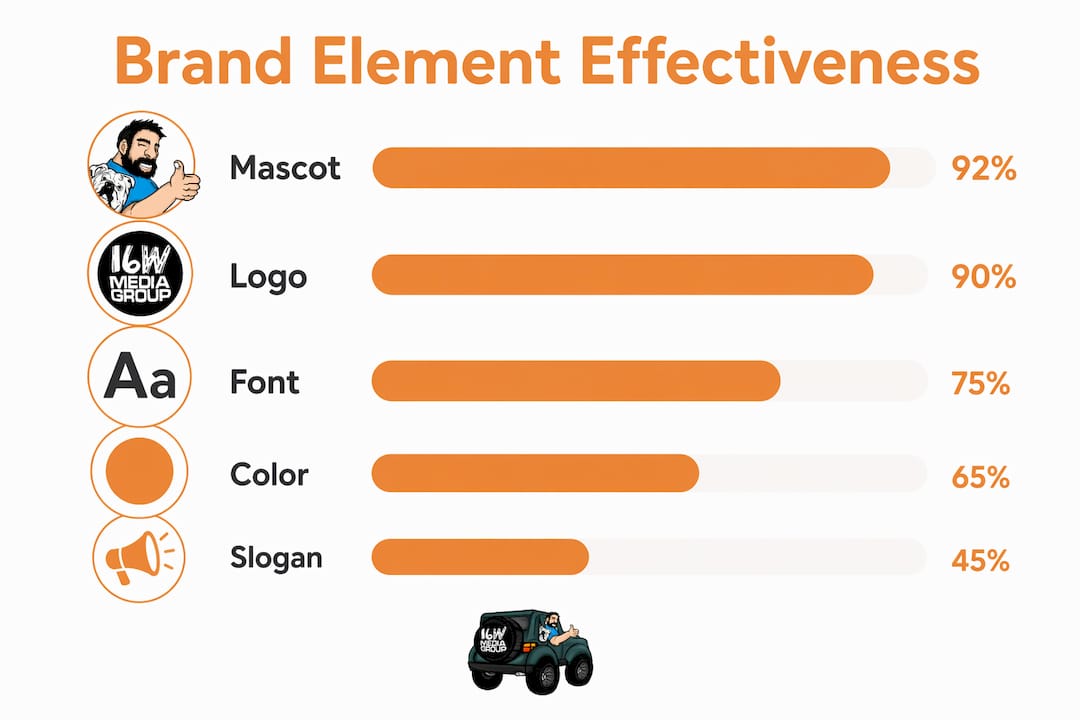
This finding has direct implications for how you allocate your brand design budget.
| Brand element | Association strength | Uniqueness level |
|---|---|---|
| Mascot (e.g., Geico Gecko) | Very high | High |
| Logo (e.g., McDonald’s golden arches) | Very high | High |
| Font (e.g., Coca-Cola script) | High | Medium-high |
| Color (e.g., red in fast food) | Low | Low |
McDonald’s golden arches and Coca-Cola’s script font are recognized globally without a single word of copy. Both are logos and fonts, not colors. The arches work in grayscale. The Coca-Cola font works on any background. Color alone, by contrast, is claimed by dozens of competitors in every category.
The practical takeaway is that uniqueness is an owned meaning problem. Invest in a distinctive logo, a recognizable character, or a proprietary font before spending on color systems. Combine multiple elements for compounding recognition. A mascot paired with a distinctive logo creates two separate memory hooks, doubling the chances a buyer recalls your brand at the moment of purchase.
Pro Tip: Test your brand elements in grayscale. If your identity collapses without color, you are over-relying on the least unique brand asset available.
How do consistency and values-led branding build trust?
Trust is now the second most powerful metric after product quality in driving profit, market share, and customer acquisition. That ranking comes from Financial Times research cited by the World Economic Forum. The business case for trust-led branding is not philosophical. It is financial.
The environment that makes trust so valuable is also the one making it harder to earn. A 2025 World Economic Forum report found that 70% of people feel misled by information they encounter, creating a credibility deficit that brands must actively close. In a market saturated with competing claims, a brand that consistently tells the truth and delivers on its promises becomes a cognitive shortcut for buyers who are exhausted by noise.
Communication theory’s principle of seven exposures is relevant here. A buyer typically needs multiple consistent encounters with a brand before trust registers. Each inconsistent message resets the counter. The brands that win in saturated markets are not necessarily the loudest. They are the most consistent.
“In the misinformation environment, branding’s role is to anchor truth and provide clarity, not just visual distinctiveness.” — World Economic Forum, 2025
The operational requirements for trust-building branding are specific:
- Embed brand values internally so every customer touchpoint reflects them, from sales calls to social media responses.
- Amplify your message through channels your audience already trusts, including community publications, local media, and credible industry voices.
- Maintain message clarity. Cognitive overload is real. A brand that communicates one clear idea repeatedly outperforms a brand that communicates ten ideas inconsistently.
- Protect your reputation proactively. A single high-profile inconsistency can undo years of trust accumulation. Governance matters as much as creativity.
For local businesses competing against national brands, values-driven brand messaging is often the most defensible competitive position. A national chain cannot authentically claim community roots. You can.
Key takeaways
Branding in competitive markets requires aligning distinct brand elements, funnel-stage strategy, and consistent values-led communication to build trust and convert awareness into lasting market share.
| Point | Details |
|---|---|
| Map branding to funnel stages | Identify which stage competitors outperform you at and concentrate brand investment there. |
| Separate equity building from monetization | Awareness and quality must be built before loyalty can be expected to follow. |
| Prioritize logos and mascots over color | Mascots and logos produce twice the brand association rate of colors in multi-country research. |
| Treat positioning as a strategic capability | Branding failures stem from internal capability gaps, not just messaging problems. |
| Anchor brand in truth and consistency | Trust ranks second only to product quality in driving profit and market share. |
Why most brands are solving the wrong branding problem
I have worked with enough business owners to recognize a pattern. When growth stalls, the instinct is to refresh the logo, update the color palette, or run a new ad campaign. Those moves feel like branding. They rarely fix the underlying problem.
The research on brand element uniqueness confirmed something I had observed for years: most businesses over-invest in color and under-invest in the elements that actually create memory. A new shade of blue does not give buyers a reason to choose you. A distinctive character or a logo with genuine visual personality does.
What I find more interesting is the strategic management dimension. The brands I have seen sustain competitive advantage over five or more years are not the ones with the best creative. They are the ones where the brand promise is backed by real organizational capability. The promise and the delivery are the same thing. When they diverge, no amount of advertising recovers the trust that erodes.
The funnel-stage framework is the most underused tool in local marketing. Most business owners measure brand performance as a single number, total sales or total leads, and cannot tell you whether their problem is awareness, consideration, or loyalty. Those are three different problems requiring three different solutions. Treating them as one is why so many brand investments produce disappointing returns.
My practical advice: audit your funnel before you spend another dollar on creative. Find the stage where buyers are dropping off. Then build your brand strategy around closing that specific gap. For local brand awareness specifically, the fastest returns come from consistent presence in the channels your community already trusts, not from chasing the newest platform.
— Mike
Build a brand that competes and wins with 16wmediagroup
16wmediagroup works with local businesses and marketing teams to design and execute brand strategies that perform at every stage of the buying funnel. From local advertising campaign planning to community magazine publishing, podcast production, and regional media placement, 16wmediagroup builds the consistent, credible presence that turns awareness into market share. If your brand is competing in a saturated market and you are not seeing the growth your investment deserves, the gap is almost always strategic, not creative. Explore the full range of brand-building services and find out how a tailored media plan can position your business to win.
FAQ
What is the role of branding in competitive markets?
Branding in competitive markets creates a distinct, credible identity that drives awareness, consideration, and loyalty when buyers have multiple alternatives. Research links brand strategy directly to buying funnel performance, with each stage requiring a different brand investment.
How does branding affect market share?
Trust ranks second only to product quality in driving profit and market share, according to Financial Times research cited by the World Economic Forum. Brands that build consistent awareness and perceived quality convert those assets into loyalty and repeat purchase over time.
Which brand elements are most effective for differentiation?
Mascots, logos, and fonts produce over twice the correct brand association rate compared to colors in a 2026 study of 26,755 people. Colors are the least unique element because they are shared across entire product categories.
Why does brand positioning go beyond marketing?
Brand positioning is a strategic management capability that integrates internal organizational strengths with external market demands. Branding failures most often stem from capability and coordination gaps inside the organization, not from messaging problems alone.
How many brand exposures does it take to build trust?
Communication theory identifies seven consistent exposures as the threshold for trust to register with a buyer. Each inconsistent message resets that process, which is why message clarity and channel consistency are more valuable than creative variety.