
Publishing is the most direct path a brand has to building trust, authority, and sustained visibility in its market. While paid advertising rents attention, publishing owns it. 87% of marketers report that content increased their brand awareness, and 64% of buyers trust brands that produce educational content. The role of publishing in brand visibility goes far beyond blog posts and social updates. It is a strategic discipline that shapes how buyers perceive, recall, and recommend your brand before they ever contact you. In 2026, that discipline now extends into AI-generated answers, where being cited by ChatGPT or Perplexity carries as much weight as ranking on page one of Google.
How publishing builds trust and authority for brands
Publishing is defined in content strategy circles as the practice of creating and distributing original, audience-led content on a consistent editorial schedule. This is distinct from content marketing, which is primarily campaign-led and optimized for lead generation. Brand publishing builds audience loyalty first. Lead generation follows as a byproduct.
The trust data is striking. Buyers who consume educational content from a brand show 64% trust levels, rising to 73% after one week of continued exposure. That one-week lift matters. It tells you that publishing is cumulative. A single article does not move the needle, but a week of consistent, credible content does. For marketing professionals, this means the cadence of publishing is as important as the quality of any individual piece.

Editorial discipline prevents audience fatigue and creates durable authority by avoiding short-term noise spikes. Brands that publish reactively, chasing trends without a coherent voice, produce content that confuses rather than builds. The brands that win are those with an editorial charter: a documented set of standards defining what they cover, how they write, and who they write for.
Here is what separates effective brand publishers from the rest:
- Audience-led editorial calendar: Content is planned around reader questions and market gaps, not internal product announcements.
- Consistent author voice: A recognizable tone and perspective make content identifiable even without a logo.
- Multi-format distribution: Articles, podcasts, community magazines, and video extend reach beyond a single channel.
- Documented editorial standards: A written charter keeps contributors aligned and maintains quality at scale.
Pro Tip: Build your editorial calendar around the questions your sales team hears most often. Those questions are the exact search queries your prospects type into Google and ask AI assistants.
What are the new metrics of brand visibility in 2026?
Brand visibility measurement has split into two distinct layers, and most marketing teams are only tracking one. Traditional SEO measures organic search rankings, click-through rates, and domain authority. AI citation visibility measures whether your content is referenced in answers generated by large language models like ChatGPT, Claude, and Perplexity.
AI citations act as strong signals of brand relevance and credibility, transferring trust before a user ever visits your website. This is a structural shift. A buyer who sees your brand cited in an AI-generated answer about your industry already perceives you as authoritative. The click comes later, or sometimes not at all. Either way, your brand has shaped their thinking.
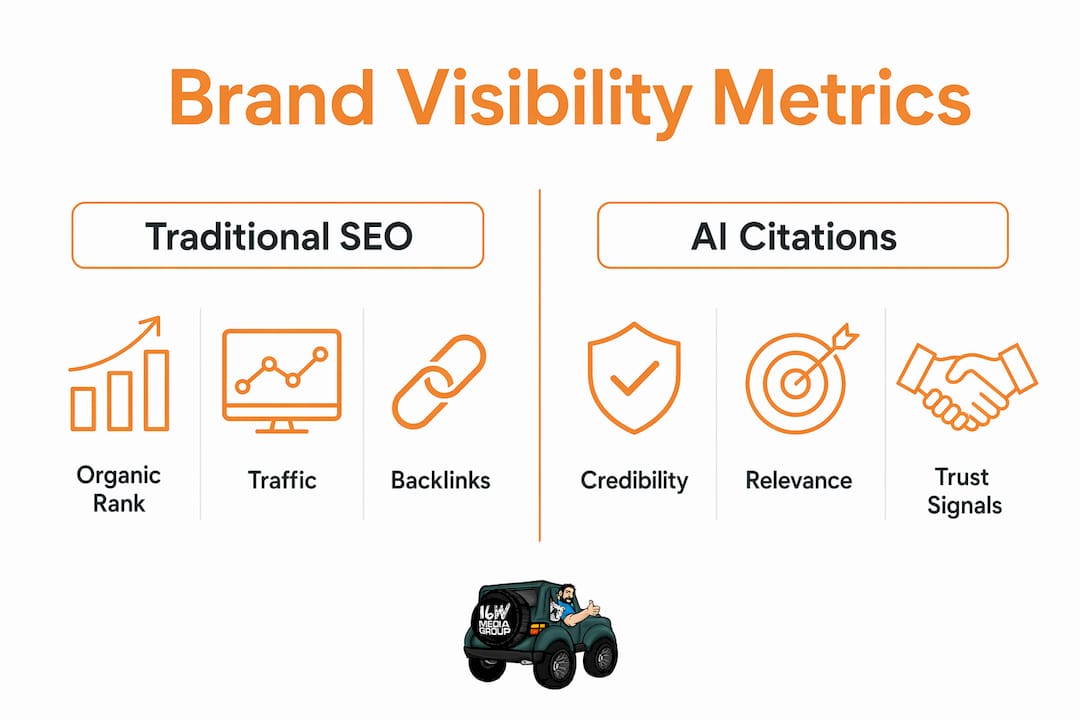
The challenge is that traditional SEO metrics and AI citation metrics do not always correlate. A page that ranks well on Google may never appear in an AI answer. A deeply researched white paper that gets minimal organic traffic may be cited repeatedly by AI engines. This disconnect demands a dual-layer measurement approach.
| Visibility layer | What it measures | Key content signals |
|---|---|---|
| Traditional SEO | Organic rankings, click-through rate, backlinks | Keyword optimization, page authority, internal linking |
| AI citation visibility | Brand mentions in LLM-generated answers | Topical depth, author credibility, structured evidence |
| Combined audit | Full content value and market presence | Both layers assessed together for investment decisions |
Dual-layer content audits that consider both Google rankings and LLM citations reveal the true visibility status of your content archive. Brands that run only one type of audit are making content investment decisions with incomplete data.
Pro Tip: Run a monthly test by asking ChatGPT and Perplexity the top five questions your buyers ask. If your brand is not cited in the answers, your publishing program has a topical depth problem, not a volume problem.
What publishing strategies drive sustained brand visibility?
Brand authority depends on three structural pillars: editorial cadence, a differentiated point of view, and owned distribution. If any one of these is zero, long-term visibility growth stalls. This is not a theory. It is an observable pattern across brands that publish consistently versus those that publish sporadically.
Editorial cadence means publishing at least one substantial piece per week. A lower frequency fails to maintain meaningful audience engagement or signal topical authority to AI engines. Differentiated point of view means your content takes positions. It interprets data, challenges assumptions, and offers analysis that a reader cannot find elsewhere. Owned distribution means you are not entirely dependent on social media algorithms or search engine updates to reach your audience.
Audience development strategy, including email list building, is the most underutilized publishing asset in most marketing programs. An email list is the only distribution channel you fully own. Platform algorithms change. Search rankings fluctuate. Your email list does not disappear because Google updated its core algorithm or Meta changed its feed logic.
The comparison between publishing and paid media is instructive. Paid media delivers immediate impressions that stop the moment the budget stops. Publishing builds a cumulative archive that competitors cannot replicate quickly, creating defensible intellectual leadership. A brand with three years of consistent, high-quality publishing has an asset that no competitor can buy overnight.
82% of B2B companies use content marketing, but only 29% rate their strategy as highly effective. The gap between participation and effectiveness is almost always a positioning problem. Brands that publish without a coherent identity produce content that blends into the noise. Brands that publish with a clear editorial charter and a defined audience produce content that compounds in value over time.
For local businesses competing in markets like Tampa, the channel mix matters as much as the content itself. Community magazines, podcasts, and regional digital publications reach audiences that national platforms miss. 16wmediagroup’s approach to local media strategies reflects this reality: visibility is built through the right channels, not just the most popular ones.
How does publishing build market authority and intellectual leadership?
Publishing signals three things simultaneously: product credibility, market authority, and intellectual leadership. These are not the same thing, and most brands only achieve one or two of them. Product credibility comes from case studies and technical content. Market authority comes from original research and trend analysis. Intellectual leadership comes from publishing positions that shape how an industry thinks about a problem.
Here is the sequence that turns a publishing program into a market authority asset:
- Establish topical ownership. Pick three to five topics where your brand has genuine expertise and publish deeply on each one. Shallow coverage of many topics builds nothing.
- Commission original research. Primary data, surveys, and proprietary analysis give other publishers a reason to cite you. AI engines require author credibility and primary research to cite content. Original data satisfies both requirements.
- Publish trend analysis on a regular schedule. Quarterly or annual reports position your brand as a reference point for your industry. Buyers and journalists return to these reports repeatedly.
- Build author credibility infrastructure. Named authors with bylines, LinkedIn profiles, and speaking credentials increase the likelihood of AI citation and press coverage.
- Distribute through multiple channels. A single blog is not a publishing program. Combine articles, podcasts, community publications, and email newsletters to build a trust portfolio across channels.
Publishing creates multiple trust signals across channels, building a portfolio of credibility rather than relying on a single branded channel. This matters because buyers rarely encounter your brand in just one place. The more channels where they find credible, consistent content from you, the stronger the brand impression becomes.
The quality of leads generated through publishing is also measurably different. Buyers who arrive through published content have already consumed your thinking. They come with context, alignment, and a higher baseline of trust. That translates directly into shorter sales cycles and higher close rates for businesses that commit to a serious publishing program.
Key takeaways
Publishing builds brand visibility through trust accumulation, not through a single campaign or content piece. Brands that combine editorial discipline, AI citation strategy, and owned distribution build a visibility advantage that paid media cannot replicate.
| Point | Details |
|---|---|
| Publishing builds cumulative trust | Educational content raises buyer trust from 64% to 73% within one week of consistent exposure. |
| AI citations are a new visibility layer | Being cited in AI-generated answers shapes buyer perception before any website visit occurs. |
| Three pillars drive brand authority | Editorial cadence, differentiated POV, and owned distribution must all be active to sustain visibility growth. |
| Original research earns citations | Primary data and expert bylines increase the likelihood of both press coverage and AI citation. |
| Owned distribution is non-negotiable | Email lists and community publications protect brand visibility from algorithm and platform changes. |
Why most publishing programs fail before they get interesting
I have worked with enough marketing teams to recognize the pattern. A brand launches a publishing program with genuine enthusiasm. They publish six articles in the first month, see modest traffic, and quietly reduce the cadence to one article per month by month three. By month six, the program is effectively dead. They call it a failed experiment. What actually failed was the timeline expectation, not the strategy.
Publishing is the only marketing channel where the results arrive significantly after the effort. The archive you build in year one pays dividends in year two. The original research you publish in Q1 gets cited by AI engines in Q3. The email list you build through consistent newsletters becomes your most valuable distribution asset when a social platform changes its algorithm. None of this is visible in a 90-day performance review.
The brands I have seen win with publishing share one characteristic: they treat it as infrastructure, not a campaign. They assign editorial ownership, document their standards, and publish on schedule regardless of whether last month’s piece went viral. They also measure both SEO performance and AI citation frequency, because they understand that visibility in 2026 is not a single number.
The other mistake I see constantly is publishing without a point of view. Generic how-to content and industry roundups do not build authority. They fill a content calendar. Real publishing means taking positions, naming trends before they become obvious, and writing content that makes a reader think differently about a problem. That is what gets cited. That is what gets remembered. That is what builds a brand.
— Mike
Build your brand’s visibility with 16wmediagroup
16wmediagroup works with local businesses and regional brands to build publishing programs that generate real visibility, not just content volume. From community magazines and podcast production to digital publishing and regional ad campaigns, the team at 16wmediagroup designs media plans around your audience and your market. If you are ready to move from sporadic content to a publishing program that compounds in value, explore the publishing and content marketing services at 16wmediagroup. You can also review the full media and publishing service offerings to find the right combination of channels for your brand’s visibility goals.
FAQ
What is the role of publishing in brand visibility?
Publishing builds brand visibility by establishing trust, authority, and consistent market presence through educational and original content. Brands that publish regularly are recognized as credible sources by both buyers and AI-generated answer engines.
How does publishing differ from content marketing?
Publishing is audience-led and focused on building long-term loyalty and authority, while content marketing is typically campaign-led and optimized for lead generation. The most effective brands use publishing as the foundation and content marketing as a tactical layer on top.
Why do AI citations matter for brand visibility?
AI citations signal brand credibility to users before they visit a website, shaping buying decisions at an earlier stage than traditional search clicks. Brands cited in AI-generated answers gain trust transfer that organic rankings alone cannot deliver.
How often should a brand publish to maintain visibility?
A cadence of at least one substantial piece per week is needed to maintain meaningful brand recognition and audience engagement. Lower frequency fails to build the topical depth that both search engines and AI citation engines require.
What makes a publishing strategy effective for local businesses?
Effective local publishing combines community-focused content, owned distribution channels like email newsletters, and multi-format reach through podcasts and regional publications. This approach builds visibility with the specific audiences that matter most to a local brand’s growth.