

Traditional media is defined as the set of pre-internet communication channels, including print newspapers, broadcast television, radio, and magazines, that deliver content through a structured, one-way model to mass audiences. Understanding how traditional media works matters more than ever in 2026, because these channels still command trust levels that digital platforms struggle to match. Publications like The Wall Street Journal, broadcasters like NPR, and regional TV news stations reach demographics that digital-only campaigns routinely miss. For business professionals and local advertisers, the mechanics behind these systems directly shape how, when, and where your message lands.
How traditional media works: production workflows explained
The production process behind traditional media is far more structured than most advertisers realize, and that structure is exactly what makes it credible.
Newspaper production follows a defined sequence. Reporters gather content, editors plan the layout using a budgeting system that accounts for every inch of available page space, designers build the layout, and press operators run the final plates. Full-color pages require four aluminum plates corresponding to the CMYK color model (cyan, magenta, yellow, black), while black-and-white pages use a single plate. Modern web presses print, assemble, and fold up to 70,000 copies per hour for overnight distribution. That speed is only possible because every decision upstream has already been locked in.
Television news production moves through five distinct phases:
- Concept development — producers identify story angles and assign reporters
- Pre-production — scripts are drafted, locations scouted, and interviews scheduled
- Field production — camera crews capture footage and conduct on-site interviews
- Post-production — video editors cut footage, graphics teams add lower-thirds and b-roll, and anchors record voiceovers
- Live broadcast — the final product airs at a fixed time, with no opportunity for post-air corrections
Radio operates on the tightest cycle of all three formats. News bulletins update every hour, scripts are written minutes before air, and live hosts deliver content in real time. The production team is lean, but the discipline is identical: accuracy before broadcast, because corrections after the fact reach a fraction of the original audience.
The critical constraint across all three formats is finality. Once print plates are etched and submitted, no corrections are possible until the next edition. Unlike a website where a typo disappears in seconds, a newspaper error runs in 70,000 copies.
Pro Tip: If you are placing a print ad, submit your creative at least 48 hours before the stated deadline. Press operators cannot hold a run for late materials, and missing the deadline means your ad moves to the next issue.

What are the key functions and impact of traditional media?
Traditional media serves five core functions in society: surveillance (reporting news and events), correlation (interpreting and contextualizing information), cultural transmission (passing shared values across generations), entertainment, and mobilization (motivating audiences toward action). Each function creates a distinct advertising environment, and smart advertisers align their message with the function of the channel they are buying.
The advertising benefits of traditional media cluster around three realities:
- Trust transfer. Traditional media carries editorial and legal scrutiny that creates a trust halo for advertisers. A full-page ad in a respected regional newspaper borrows credibility from the publication itself. That effect is difficult to replicate on a social media feed.
- Demographic precision. Traditional media reaches older and higher-income demographics that digital-only campaigns consistently underserve. If your product targets households earning above $150,000, a community magazine or drive-time radio spot often outperforms a Facebook campaign.
- Lower advertising clutter. A 30-second TV spot during a local news broadcast competes with far fewer messages than a banner ad on a news website, where a single page can carry a dozen simultaneous placements.
Local newspapers and radio stations carry a community engagement function that national digital platforms cannot replicate. A business featured in a neighborhood publication or mentioned by a local radio host gains social proof within a specific geography. That localized credibility is why traditional media in local marketing continues to outperform digital for service businesses targeting specific zip codes.
Live television events amplify all of these effects. Sports media rights payments reached $29.25 billion in 2025, projected to reach $37 billion by 2030. Those numbers reflect advertiser demand for the cultural moments that live sports create, moments where audiences are present, engaged, and not skipping ads.
Pro Tip: Add a QR code, vanity URL, or unique promo code to every traditional media placement. This gives you a direct measurement mechanism for a channel that does not natively produce click data.
How does traditional media compare to digital media in 2026?
The most useful frame is not competition but complementarity. Traditional and digital media operate on fundamentally different models, and each fills gaps the other leaves open.
| Dimension | Traditional media | Digital media |
|---|---|---|
| Communication model | One-way, scheduled broadcast | Interactive, on-demand |
| Credibility source | Editorial oversight, legal review | Algorithmic ranking, user reviews |
| Primary strength | Trust building, broad reach | Targeting precision, real-time tracking |
| Demographic sweet spot | 45+ and high-income audiences | 18-44, digitally active audiences |
| Content flexibility | Fixed after production | Editable in real time |
| Ad clutter level | Low to moderate | High |
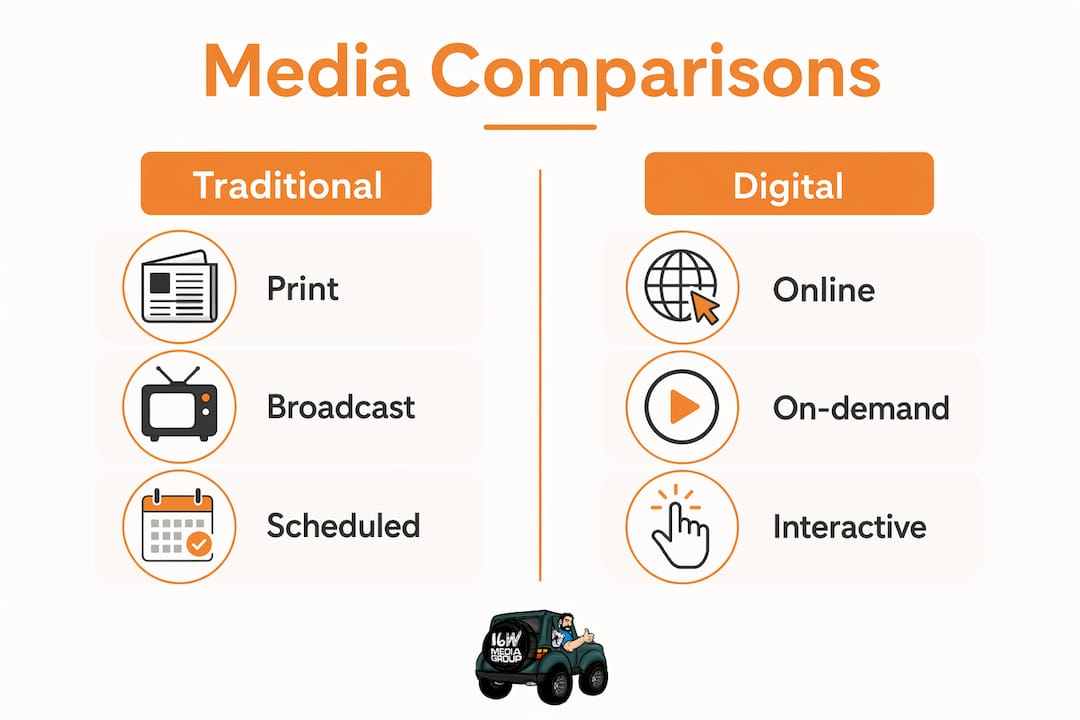
Hybrid marketing strategies that combine traditional and digital media outperform single-channel approaches in 2026. The practical model works like this: traditional media builds awareness and authority at scale, while digital media captures that interest and converts it. A radio endorsement drives listeners to search for your brand. A newspaper ad with a QR code sends readers to a landing page. The traditional channel does the trust work; the digital channel does the conversion tracking.
One area where traditional media is evolving rather than declining is out-of-home advertising. Digital billboards now serve dynamic content that changes by time of day, weather, or local event, combining the physical presence of traditional OOH with the flexibility of digital creative. This is not a replacement for print or broadcast. It is an extension of the same one-way, high-visibility model that traditional media has always used.
The challenge worth acknowledging is linear television. US pay-TV households dropped from 86 million in 2014 to 68 million in Q1 2026, and streaming now accounts for 44.8% of total TV time. Broadcast TV is not dead, but the audience is fragmenting. Advertisers who rely solely on linear TV buys are reaching a shrinking pool. The answer is cross-promotion: use broadcast to build brand recognition, then retarget those same audiences on streaming platforms.
For a detailed breakdown of how these channels compare from a buying perspective, the local media buying guide from 16wmediagroup covers the practical differences in cost, reach, and ROI measurement.
How to buy advertising in traditional media
Buying traditional media advertising is a process with hard deadlines and specific creative requirements. Understanding the workflow prevents costly mistakes.
The buying process follows this sequence for most traditional formats:
- Identify your format and market. Decide whether you are buying print, radio, TV, or outdoor, and define the geographic market. A Tampa-area community magazine and a national newspaper require entirely different budgets and creative approaches.
- Contact the sales representative. Every traditional media outlet has a dedicated sales team. They will provide a rate card, audience demographics, and available placements. For radio and TV, they will also specify spot lengths (typically 15, 30, or 60 seconds).
- Reserve your space or time slot. Print outlets use a strict space budgeting system where ad space is allocated against editorial content. Reserving early secures better placement, such as front section or right-hand page for print, or drive time for radio.
- Submit creative before the deadline. Print requires press-ready files in the correct dimensions and color profile. Broadcast requires finished audio or video files. Missing the creative deadline has the same result as missing the booking deadline: your ad moves to the next available slot.
- Track response with embedded mechanisms. Use unique promo codes, vanity URLs, or QR codes to attribute conversions to specific placements. This is the only way to generate ROI data from a channel that does not produce native analytics.
For businesses targeting affluent neighborhoods, traditional media placement in community publications and local radio programs consistently delivers higher-quality leads than broad digital targeting. The advertising to affluent neighborhoods guide from 16wmediagroup covers specific channel selection and creative strategies for that demographic.
Common pitfalls include submitting incorrect file formats for print, underestimating production lead times for TV commercials, and booking spots without confirming the audience demographic data behind the rate card. Always ask for verified circulation or listenership figures before committing budget.
Pro Tip: For radio, request a live host endorsement rather than a produced spot when your budget allows. Host-read ads carry the same trust halo as editorial content and consistently outperform pre-recorded spots in recall studies.
Key takeaways
Traditional media works because its structured production workflows, editorial credibility, and one-way broadcast model create a trust environment that digital channels cannot replicate at scale.
| Point | Details |
|---|---|
| One-way communication model | Traditional media broadcasts to mass audiences without real-time interaction, creating lower ad clutter and higher message clarity. |
| Production finality drives accuracy | Once print plates are set or broadcast content is live, corrections are impossible, making pre-production accuracy non-negotiable. |
| Trust halo benefits advertisers | Editorial and legal oversight in traditional formats transfers credibility to adjacent advertising, a benefit difficult to replicate digitally. |
| Hybrid strategies outperform single-channel | Combining traditional media’s trust-building reach with digital’s targeting and tracking delivers stronger results than either channel alone. |
| Buying requires hard deadline discipline | Missing print or broadcast creative deadlines delays placement to the next edition or time slot, directly affecting campaign timing and ROI. |
Why traditional media still earns its place in the mix
I have worked with enough local businesses to know that traditional media gets dismissed too quickly. The conversation usually goes the same way: a business owner sees the declining cable subscriber numbers, hears that younger audiences are all on TikTok, and concludes that print and radio are relics. That conclusion is wrong, and it costs them.
What those numbers miss is the trust asymmetry. Digital advertising has an attention problem. Consumers have developed genuine resistance to online ads, and that resistance is not going away. Traditional media, precisely because it is slower and more structured, carries a weight that a sponsored post simply does not. When a local business appears in a community magazine or gets a mention from a trusted radio host, that placement signals permanence and legitimacy in a way that a Facebook ad cannot.
The businesses I have seen succeed in 2026 are not choosing between traditional and digital. They are using traditional media to establish authority and community presence, then using digital to capture and convert the interest that authority generates. That is not a compromise. That is the actual strategy.
Local media deserves particular attention here. A regional publication or a neighborhood radio program knows its audience at a level that no algorithm can match. That specificity is an asset for any business trying to build genuine community relationships rather than just impressions.
Traditional media is not a fallback for businesses that cannot afford digital. It is a distinct tool with distinct strengths. The professionals who understand that distinction are the ones building durable brands.
— Mike
How 16wmediagroup supports your traditional media campaigns
16wmediagroup specializes in helping local businesses plan and execute traditional media campaigns that actually move the needle. Whether you are buying your first print placement, coordinating a radio endorsement, or building a full local advertising campaign that integrates print, broadcast, and community publishing, the team at 16wmediagroup handles the strategy, creative coordination, and deadline management. The agency’s work spans community magazines, regional radio, and podcast production, giving clients a single partner for the full traditional and hybrid media mix. If you are ready to put your brand in front of high-value local audiences, start with the media planning checklist or reach out directly to discuss a custom campaign.
FAQ
What is traditional media?
Traditional media refers to pre-internet communication channels including print newspapers, broadcast television, radio, and magazines. These formats deliver content through a one-way model to mass audiences, distinguished from digital media by their structured production workflows and editorial oversight.
How does traditional media differ from digital media?
Traditional media uses a scheduled, one-way broadcast model with fixed content after production, while digital media is interactive, on-demand, and editable in real time. Traditional formats carry higher editorial credibility; digital formats offer precise targeting and native analytics.
Why does traditional media still work for advertising?
Traditional media creates a trust halo for advertisers through editorial and legal scrutiny, reaches older and higher-income demographics underserved by digital campaigns, and operates in lower-clutter environments where individual ads receive more attention.
How do you measure ROI from traditional media ads?
ROI from traditional media is tracked using embedded mechanisms like unique promo codes, vanity URLs, and QR codes, since traditional channels do not produce native click or impression data. These tools attribute conversions directly to specific placements.
What are the biggest mistakes when buying traditional media?
The most common mistakes are missing creative submission deadlines, submitting files in incorrect formats for print or broadcast, and booking placements without verifying the outlet’s audience demographic data. Missing a print deadline moves your ad to the next edition with no refund on reserved space.