
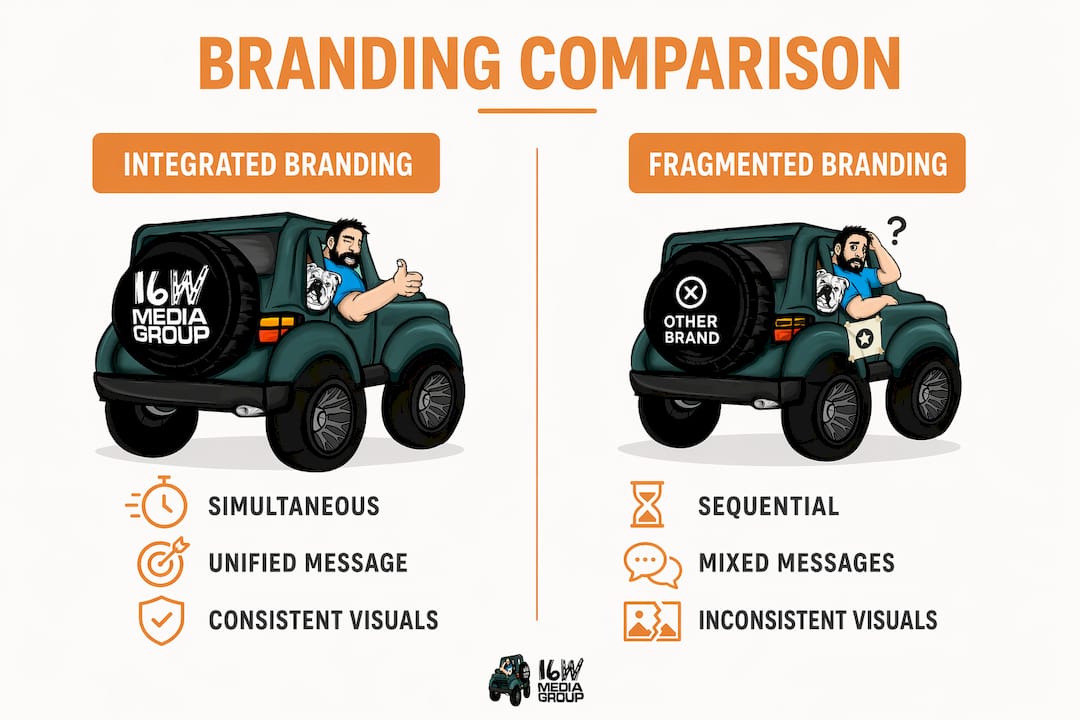
Integrated branding is the simultaneous alignment of a brand’s name, visual identity, messaging, and marketing efforts to deliver a unified, coherent customer experience across every channel. Unlike fragmented approaches where design, naming, and communications develop in isolation, integrated branding treats all brand elements as one interconnected system. The result is stronger recognition, deeper customer trust, and measurably better marketing performance. This guide breaks down the core components, proven benefits, and practical steps to build an integrated branding strategy that works.
What is integrated branding and why does it matter?
Integrated branding is defined as the strategic unification of a brand’s verbal identity, visual identity, messaging, and marketing tactics under a single, shared strategic framework. The industry also refers to this practice as integrated marketing, though integrated branding specifically emphasizes the simultaneous development of brand identity elements rather than just campaign coordination.
The distinction matters. Many businesses build their logo first, name the company second, and write their messaging last. That sequential process creates disconnects that are expensive to fix later. Integrated naming and design projects show higher long-term brand consistency because verbal and visual elements emerge from a shared strategic core. The brand feels coherent because it was built that way from the start.

The importance of integrated branding also shows up in revenue. Integrated approaches increase marketing effectiveness by customizing messages to customer journey stages rather than broadcasting one-size-fits-all content, growing both top and bottom-line revenue. Customers who encounter a consistent brand across multiple touchpoints are more likely to trust it, return to it, and recommend it.
What are the core components of integrated branding?
Integrated branding rests on six foundational elements: brand purpose, naming, visual identity, messaging, digital presence, and a communication framework. Each element must be developed with the others in mind, not in sequence.
The most critical structural tool is the shared strategic brief. This document defines the brand’s positioning, audience, tone, and values before any naming or design work begins. When naming teams and visual identity teams work from the same brief simultaneously, the brand’s verbal and visual languages reinforce each other naturally.
Here is how integrated and fragmented branding approaches compare:
| Element | Integrated Branding | Fragmented Branding |
|---|---|---|
| Development process | Simultaneous, brief-driven | Sequential, siloed |
| Naming and design | Developed together | Developed independently |
| Messaging | Unified across all channels | Varies by team or platform |
| Brand consistency | High, built-in from inception | Low, patched over time |
| Revision cycles | Fewer, faster to market | More, costly to fix |
| Customer experience | Coherent across touchpoints | Inconsistent, confusing |
Fragmented storytelling and design working in isolation weakens brand growth. A structured integrated brand strategy connects positioning directly to tactical activation, so every ad, post, and product page reinforces the same core identity.
Pro Tip: Before any naming or design work begins, write a one-page strategic brief that defines your brand’s purpose, audience, and tone. Share it with every team member working on the brand simultaneously. This single document prevents the most common and costly brand inconsistencies.
How does integrated branding improve marketing effectiveness?
Integrated campaigns leveraging multiple channels outperform single or dual-channel efforts by up to 300%, increasing visibility, trust, and conversion likelihood. That is not a marginal improvement. It reflects what happens when customers encounter a brand that looks, sounds, and feels the same everywhere they find it.
The mechanism behind this performance gain is customer-centric communication. Integrated marketing centers on shifting from internal sales goals to an external customer focus, tailoring communications to each stage of the customer journey. A prospect seeing your brand for the first time needs awareness messaging. A returning customer needs loyalty reinforcement. Integrated branding makes both possible without contradiction.
The benefits of integrated branding extend beyond awareness:
- Brand trust: Consistency across messaging, visuals, and channels builds trust and lasting recognition, which reduces the friction customers feel before making a purchase decision.
- Efficiency: Businesses that use integrated marketing unify assets such as images, videos, and copy for reuse across platforms, cutting production costs and improving message consistency.
- Customer loyalty: Building deeper relationships at scale by tailoring communications to customer goals rather than internal sales objectives increases brand loyalty and long-term revenue.
- Reduced confusion: Integrated campaigns leverage shareable assets to increase visibility and audience trust while reducing the customer confusion that comes from inconsistent messaging.
“Brand consistency achieved through integrated branding transforms isolated marketing activities into a continuous, cohesive brand experience that builds lasting relationships.” — Integrated Brand Strategy for Modern Brands
The role of storytelling in this process is significant. When your brand tells the same story across a community magazine, a podcast, and a social media post, each channel amplifies the others. That compounding effect is what separates brands that grow from brands that simply spend.
How to achieve integrated branding: practical steps
Achieving integrated branding requires deliberate process design, not just good intentions. The following steps give marketing professionals and business owners a clear path forward.
-
Start with shared research. Conduct audience research, competitive analysis, and positioning work before any creative development begins. Every team member, from naming to design to content, should work from the same data set.
-
Write a joint strategic brief. Collaborative brand development includes shared research, joint strategic briefs, and simultaneous iteration of naming and design. This approach reduces knowledge loss and limits revision cycles.
-
Develop naming and visual identity simultaneously. Do not finalize a name and then hand it to a designer. Run both workstreams in parallel so verbal and visual choices inform each other in real time.
-
Build a dynamic brand center. A brand center is a living document or platform that houses your logo files, color palettes, typography, tone guidelines, messaging frameworks, and approved copy. It replaces static style guides that become outdated within months.
-
Map messaging to the customer journey. Define what your brand says at the awareness, consideration, and decision stages. Assign specific messages to specific channels so every touchpoint serves a clear purpose.
-
Audit all channels quarterly. Review your website, social profiles, print materials, and advertising for consistency. Assign one person or team ownership of brand standards to prevent drift.
-
Train every customer-facing team. Sales, customer service, and marketing must all understand and use the same brand language. Internal alignment is the foundation of external consistency.
Pro Tip: Use a platform like Frontify, Bynder, or Canva for Teams as your dynamic brand center. These tools give every team member access to approved assets and guidelines in one place, which eliminates the “which logo version is current?” problem that plagues growing businesses.
What are the common challenges in integrated branding?
Integrated branding fails most often not because of bad creative work, but because of structural problems inside the organization. Recognizing these challenges before they occur is the fastest way to avoid them.
The most common obstacles include:
- Team silos: When marketing, design, and communications teams operate independently, each develops its own interpretation of the brand. The customer sees three different versions of the same company.
- Sequential development: Building naming, then design, then messaging in separate phases means each team inherits constraints from the previous one. The result is a brand that feels assembled rather than designed.
- Lack of strategic alignment: Without a shared brief, teams optimize for their own objectives. The designer optimizes for visual impact. The copywriter optimizes for search. Neither optimizes for brand coherence.
- Static style guides: A PDF style guide updated every three years cannot keep pace with a brand operating across digital, print, podcast, and community channels simultaneously.
- Inconsistent messaging across platforms: A brand that sounds formal on its website and casual on social media creates cognitive dissonance. Customers notice, even if they cannot articulate why.
The solution to most of these challenges is process, not talent. Maintaining an evolving brand center ensures sustained alignment with audience needs and long-term brand consistency. Assign clear ownership of brand standards, schedule regular cross-team reviews, and treat your brand system as a product that requires ongoing maintenance.
Understanding the role of branding in competitive markets also helps teams prioritize integration work when resources are limited. Brands that invest in consistency early spend less on corrections later.
How does integrated branding complement other marketing strategies?
Integrated branding is the foundation that makes every other marketing strategy more effective. Omnichannel marketing, local advertising, media planning, and content marketing all perform better when the brand underneath them is coherent.
Here is how integrated branding supports specific marketing approaches:
| Marketing Strategy | How Integrated Branding Helps |
|---|---|
| Omnichannel marketing | Unified brand identity ensures consistent experience across digital and physical channels |
| Local advertising | Consistent visuals and messaging build recognition in specific geographic markets |
| Content marketing | Shared tone and messaging framework keeps all content on-brand regardless of format |
| Media planning | Clear brand positioning guides channel selection and budget allocation |
| Community publishing | Coherent brand story strengthens local relationships and audience trust |
| Podcast and audio | Consistent verbal identity reinforces brand recognition in non-visual formats |
For local businesses, this synergy is especially powerful. A brand that appears in a community magazine, runs a local podcast, and places digital ads in the same market benefits from each channel reinforcing the others. Local brand storytelling works precisely because a unified narrative makes every touchpoint feel familiar rather than intrusive.
Brand-led media strategies take this further by positioning the brand itself as a content source, not just an advertiser. When your brand produces content that audiences seek out, the integrated branding strategy shifts from push to pull. That shift reduces advertising costs and builds the kind of loyalty that paid media alone cannot buy.
Integrated branding also supports media strategies for local brand growth by giving media planners a clear, consistent brand to place across channels. Without integration, media spending fragments. With it, every dollar placed reinforces the same identity.
Key takeaways
Integrated branding works because it builds every brand element simultaneously from a shared strategic foundation, creating consistency that compounds across channels and customer touchpoints.
| Point | Details |
|---|---|
| Definition is foundational | Integrated branding unifies naming, design, messaging, and marketing under one shared strategic brief. |
| Simultaneous development wins | Building naming and visual identity in parallel reduces revisions and accelerates time to market. |
| Multi-channel performance | Integrated campaigns outperform single-channel efforts by up to 300% in visibility and conversions. |
| Dynamic brand systems | Replace static style guides with living brand centers updated regularly to stay aligned with audience needs. |
| Process prevents fragmentation | Team silos and sequential workflows are the primary causes of brand inconsistency, not creative quality. |
Why i think most brands get integration backwards
After working with local businesses across competitive markets, I have seen the same pattern repeat. A business owner hires a designer, gets a logo, then hires a copywriter, gets a tagline, and then wonders why the brand feels disconnected. The problem is not the talent. The problem is the order of operations.
Integrated branding must begin at brand inception. Simultaneous development of naming and visual identity prevents fragmentation and supports internal consistency in ways that retrofitting never can. You cannot bolt coherence onto a brand that was built in pieces.
The other mistake I see constantly is treating brand work as a project rather than a system. A rebrand is not a finish line. The strongest integrated brands maintain a dynamic brand system, regularly updated to reflect how their audience evolves. The brands that win long-term are the ones that treat their brand identity the way a software company treats its product: always in development, always improving.
My honest advice is this. If your brand looks different on your website than it does in your ads, or sounds different in your emails than it does in your social posts, you do not have a creative problem. You have a process problem. Fix the process first. The creative work will follow.
— Mike
How 16wmediagroup builds integrated brands for local businesses
16wmediagroup applies integrated branding principles across every service it offers, from community magazine publishing to podcast production to regional advertising campaigns. The agency builds media plans that treat your brand as a single, coherent identity across print, digital, and audio channels simultaneously.
If your brand is showing up inconsistently across channels, or if you are starting from scratch and want to build it right the first time, 16wmediagroup’s local advertising campaign planning resources are a strong starting point. The agency’s approach connects brand strategy directly to media placement, so every channel you invest in reinforces the same identity. Explore the full range of branding and media services to see how 16wmediagroup can support your brand’s growth in competitive local markets.
FAQ
What is the integrated branding definition in simple terms?
Integrated branding is the practice of developing a brand’s name, visual identity, messaging, and marketing tactics simultaneously from a single strategic framework. The goal is a consistent brand experience across every channel a customer encounters.
How does integrated branding differ from integrated marketing?
Integrated marketing focuses on coordinating campaigns across channels. Integrated branding goes deeper by aligning the brand’s core identity elements, including naming, design, and tone, before any campaign work begins.
What are the main benefits of integrated branding?
The primary benefits include stronger brand recognition, higher customer trust, improved marketing ROI, and reduced production costs through asset reuse. Integrated campaigns outperform single-channel efforts by up to 300% in visibility and conversions.
How long does it take to achieve integrated branding?
The foundation, including a shared strategic brief, naming, and visual identity, can be established in 6–12 weeks for most small to mid-size businesses. Maintaining and evolving the brand system is an ongoing process with no defined endpoint.
Why do so many brands struggle with brand consistency?
The most common cause is sequential development, where naming, design, and messaging are built by separate teams at separate times. Without a shared brief and simultaneous workstreams, inconsistency is the predictable outcome.