
Step by step local advertising is the structured process of planning, launching, and refining campaigns designed to reach customers in your specific geographic area with measurable results. The local search ad market has reached $182 billion in 2026, and 76% of consumers who search locally on their phone visit a related business within 24 hours. That number tells you one thing: local intent converts fast. Channels like Google Local Services Ads, Facebook, Instagram, and traditional media each play a distinct role in a complete local advertising guide. The businesses that win are the ones that follow a deliberate setup process rather than guessing.
What is step by step local advertising setup?
Step by step local advertising setup is the industry practice of building campaigns in a defined sequence, from goal setting through optimization, rather than launching ads without a plan. Marketers also call this structured local marketing or geo-targeted campaign management. Both terms describe the same discipline: matching your message to the right audience in the right place at the right time.
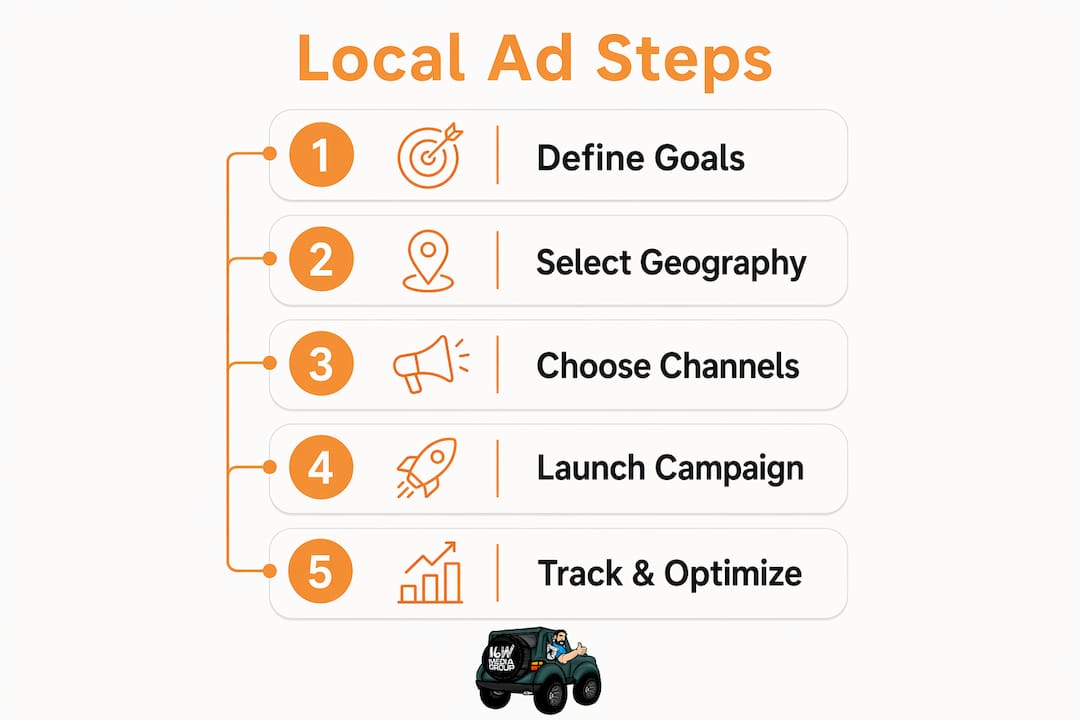
Before you spend a dollar, you need three things in place: a clear goal, a defined geography, and an honest read of your market.

Set a specific goal first. Vague goals produce vague results. Decide whether you want phone calls, in-store visits, online bookings, or form submissions. Each goal shapes which channel you choose and how you measure success.
Define your geographic radius. The recommended targeting radius is 5–15 miles in metropolitan areas and 30–50 miles in rural areas. Adjust based on how far your customers realistically travel to reach you.
Run a market diagnostic. This is the step most local businesses skip, and it costs them. Classify your market as either a Demand market (people are already searching for what you sell) or an Awareness market (people do not yet know they need your product). Treating an Awareness market like a Demand market burns budget on search ads that nobody is running. A plumber in a dense city operates in a Demand market. A boutique wellness studio launching a new service operates in an Awareness market. The advertising approach for each is completely different.
Essential tools to have ready:
- Google Business Profile (verified and complete)
- Google Local Services Ads account
- Facebook and Instagram business pages
- A basic analytics platform such as Google Analytics 4
- A landing page focused on local contact details, your address, and relevant service content
Pro Tip: Complete your Google Business Profile before launching any paid campaign. Profiles with photos, hours, and reviews consistently outperform bare-bones listings in local search results.
How do you launch local digital ad campaigns step by step?
Google Local Services Ads and social media platforms are the two highest-priority digital channels for most local businesses. Each has a distinct setup process.
Setting up google local services ads
Google Local Services Ads operate on a pay-per-lead model, meaning you pay only when a customer contacts you directly. That model reduces wasted spend compared to traditional pay-per-click. It works especially well for legal, home services, and medical businesses.
Follow these steps to get live:
- Check eligibility. Google Local Services Ads are available for specific business categories. Confirm your category qualifies before investing time in setup.
- Complete your business profile. Add your service area, hours, business license, and insurance documentation. Google verifies this information before your ads run.
- Pass the background check. Google requires a background check for the business owner or primary contact. This step builds consumer trust and earns the Google Guaranteed badge.
- Set your weekly budget. Google recommends a budget based on your service area and category. Start at the minimum recommended level and scale up after reviewing lead quality.
- Manage leads in real time. Google’s app sends lead notifications immediately. Respond within minutes. Timely follow-up on inbound leads is the single biggest factor in converting paid advertising into actual customers.
Running social media ads for local reach
Social platforms like Meta and TikTok allow zip code-level targeting for awareness campaigns using localized offers and visual formats. This makes them ideal for Awareness market businesses that need to build recognition before search intent exists.
| Platform | Best Use | Minimum Daily Budget |
|---|---|---|
| Facebook/Instagram | Awareness + retargeting | $5–$10 per day |
| TikTok | Video-first awareness | $20 per day |
| Google LSAs | High-intent lead capture | Weekly budget varies |
| Nextdoor | Neighborhood-level trust | Cost per impression |
Write ad copy that names your city or neighborhood. “Tampa’s top HVAC repair” outperforms “Fast, affordable HVAC” every time because it signals local relevance immediately. Use ad extensions in Google Ads to add your phone number, address, and service links directly to the ad unit.
Pro Tip: Your landing page must be simple and locally focused. Include your address, phone number, and a single clear call to action. A local-focused landing page converts significantly better than sending ad traffic to your homepage.
Should you use traditional media in your local ad strategy?
Traditional media still delivers real results for local businesses, especially when combined with digital campaigns. The combination builds top-of-mind recall that digital alone cannot achieve.
Direct mail targets specific zip codes with physical pieces that land in the hands of verified residents. Response rates for direct mail in local markets consistently outperform display advertising for service-based businesses. Use it to promote seasonal offers or new service launches.
Local radio reaches commuters during drive time, a window when purchase decisions are actively forming. A 30-second spot on a local station with a memorable phone number or URL can drive calls within hours of airing.
Connected TV (CTV) is the most underused channel in local advertising. CTV ads deliver video with zip code precision to streaming platforms at a fraction of traditional broadcast TV costs. A local dentist in Tampa can run a 15-second video ad exclusively to households within a 10-mile radius. That level of targeting was impossible on traditional TV.
Nextdoor is the platform most local advertisers overlook. It connects businesses with verified neighborhood residents who are actively discussing local services. A single post or sponsored listing on Nextdoor reaches people who are already primed to buy locally.
Community-based advertising builds the kind of brand recall that makes your business the first name a neighbor mentions when someone asks for a recommendation. That zero-cost word-of-mouth is the compounding return on your paid media investment.
Local sponsorships and community events extend your advertising presence beyond screens. Sponsoring a youth sports team, a neighborhood festival, or a charity run puts your brand in front of hundreds of engaged local residents. Pair the sponsorship with a social media campaign to multiply the reach. You can explore a community-based advertising strategy to see how these tactics work together in practice.
How do you measure and optimize local ad campaigns?
Measurement is where most local advertising guides stop short. Tracking the right metrics from day one separates businesses that grow from businesses that guess.
The four metrics that matter most:
- Contact leads. Count every call, form submission, and message generated by your ads. This is your primary output metric.
- Store visits. Google Ads and Meta both offer store visit tracking for businesses with physical locations. Use it.
- Cost per lead. Divide total ad spend by total leads. This number tells you whether your channel mix is efficient.
- Conversion rate. Track what percentage of leads become paying customers. A low conversion rate often signals a lead quality problem, not a volume problem.
Set up conversion tracking in Google Analytics 4 before your first campaign goes live. Connect it to your Google Ads account so every lead is attributed to the correct campaign and keyword.
Lead management is not optional. Responding quickly to inbound leads via calls, messages, or emails directly determines your conversion rate. A lead that waits 24 hours for a response is often a lost customer. Build a response protocol before you launch.
Common mistakes to fix immediately:
- Targeting too broad a radius and paying for clicks from people who will never drive to your location.
- Skipping the market diagnostic and running search ads in an Awareness market with near-zero search volume.
- Sending ad traffic to a homepage instead of a locally optimized landing page.
- Ignoring lead status tracking inside Google Local Services Ads, which causes duplicate follow-ups and missed opportunities.
Pro Tip: Run A/B tests on your ad headlines every 30 days. Test one variable at a time, either the headline, the offer, or the call to action. Small copy changes regularly produce 20–40% swings in click-through rates for local campaigns.
Use the media planning checklist from 16wmediagroup to keep your campaign review process structured and consistent across channels.
Key takeaways
Effective local advertising requires a structured sequence: market diagnostic first, channel selection second, and continuous measurement throughout.
| Point | Details |
|---|---|
| Run a market diagnostic first | Classify your market as Demand or Awareness before selecting any advertising channel. |
| Match radius to your market type | Use 5–15 miles in metro areas and 30–50 miles in rural areas to avoid wasted spend. |
| Use Google LSAs for high-intent leads | The pay-per-lead model connects you with customers who are actively ready to buy. |
| Combine digital and traditional media | CTV, direct mail, and Nextdoor build recall that search ads alone cannot deliver. |
| Measure cost per lead from day one | Track contact leads, store visits, and conversion rates to know what is actually working. |
Why most local advertisers fail before they even launch
I have watched hundreds of local business owners pour money into Google Ads or Facebook campaigns and walk away convinced that advertising does not work. In almost every case, the problem was not the platform. The problem was the sequence.
They skipped the market diagnostic. They assumed that because their competitor was running search ads, search ads were the right move for them too. But building a recognizable presence in an Awareness market requires community activation first, not search capture. You cannot capture demand that does not exist yet.
The businesses I have seen succeed consistently do two things differently. First, they invest in top-of-funnel awareness before they chase bottom-of-funnel leads. A community magazine feature, a Nextdoor sponsorship, or a CTV campaign that runs for 60 days before a Google LSA launch produces dramatically better lead quality than cold search ads alone. Second, they treat lead management as part of the advertising strategy, not an afterthought. The pay-per-lead model only works if someone actually picks up the phone.
My honest recommendation: spend the first two weeks of any new local campaign on setup and diagnostics. Do not rush to launch. The businesses that take that time consistently outperform the ones that go live in 48 hours with no plan. Patience at the start is the cheapest investment you will make.
— Mike
How 16wmediagroup helps you build a winning local campaign
Local advertising works best when strategy, media buying, and creative execution all move together. 16wmediagroup specializes in exactly that combination for local businesses competing in markets like Tampa and beyond.
Whether you are starting from scratch or refining an existing campaign, the local advertising campaign planning guide from 16wmediagroup gives you a structured framework to follow from goal setting through optimization. The team works across traditional media, digital platforms, podcasts, and community publishing to build campaigns that reach high-value consumers where they actually spend time. If you are ready to stop guessing and start growing, explore the full range of media and publishing services that 16wmediagroup offers to local brands.
FAQ
What is step by step local advertising?
Step by step local advertising is the structured practice of planning, launching, and optimizing geo-targeted campaigns in a defined sequence. It starts with a market diagnostic and goal setting, then moves through channel setup, ad creation, and performance measurement.
How much should a local business spend on advertising?
Budget depends on your market type and channel mix. Google Local Services Ads let you set a weekly cap and pay only per lead, making them a lower-risk starting point for businesses with limited budgets.
What is the difference between a demand and awareness market?
A Demand market has active search volume for your service. An Awareness market does not. Running search ads in an Awareness market wastes budget because no one is searching for what you offer yet.
Which local advertising channel produces the fastest results?
Google Local Services Ads typically produce the fastest leads because they capture customers with immediate purchase intent. Social media and CTV build awareness over weeks, which improves the quality of those leads over time.
How do i know if my local ads are working?
Track cost per lead, contact lead volume, and conversion rate from day one. Connect Google Analytics 4 to your ad accounts so every lead is attributed to the correct campaign before you start spending.