


Traditional media is defined as any mass communication channel produced through established editorial and broadcast infrastructure, including television, radio, print newspapers, community magazines, and outdoor advertising. Business owners who ask why use traditional media in 2026 often discover the answer in one word: credibility. Digital platforms deliver volume, but traditional outlets deliver trust. NPR, local TV affiliates, and community print publications carry an editorial authority that no social feed can replicate. That authority transfers directly to the brands that advertise alongside them, creating a credibility lift that shapes how consumers perceive your business before they ever click a link.
What are the main benefits of traditional media for businesses?
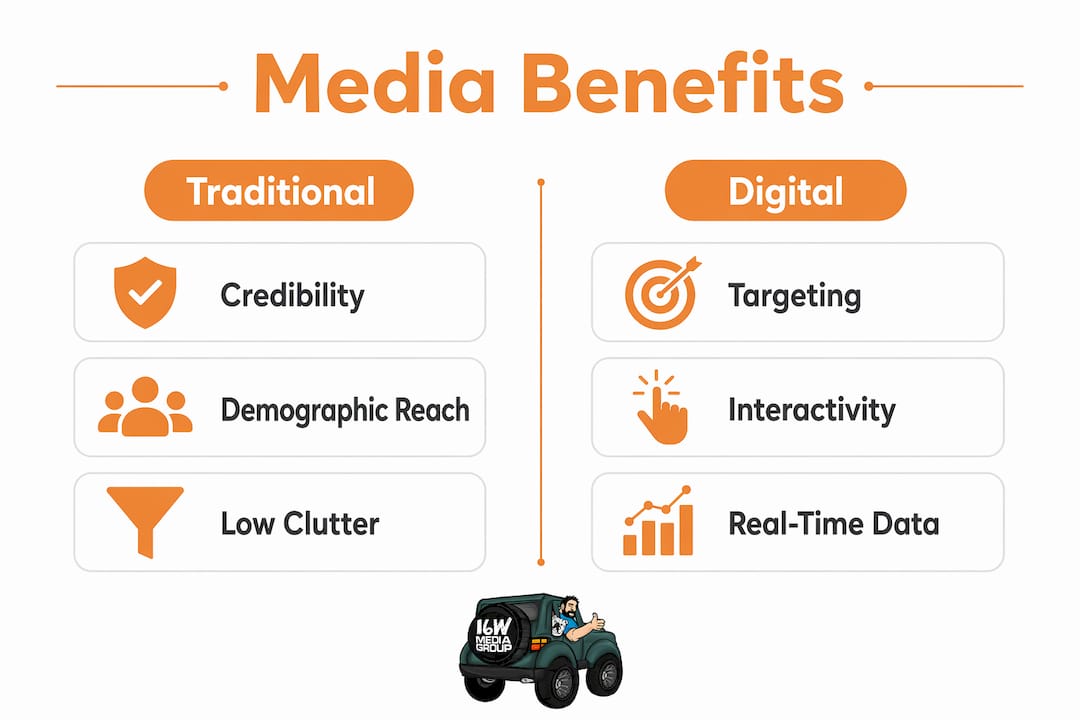
Traditional media delivers three advantages that digital channels consistently struggle to match: broad demographic reach, editorial credibility, and reduced ad clutter. Understanding each one helps you decide where traditional fits in your marketing mix.
Audience reach across high-value demographics
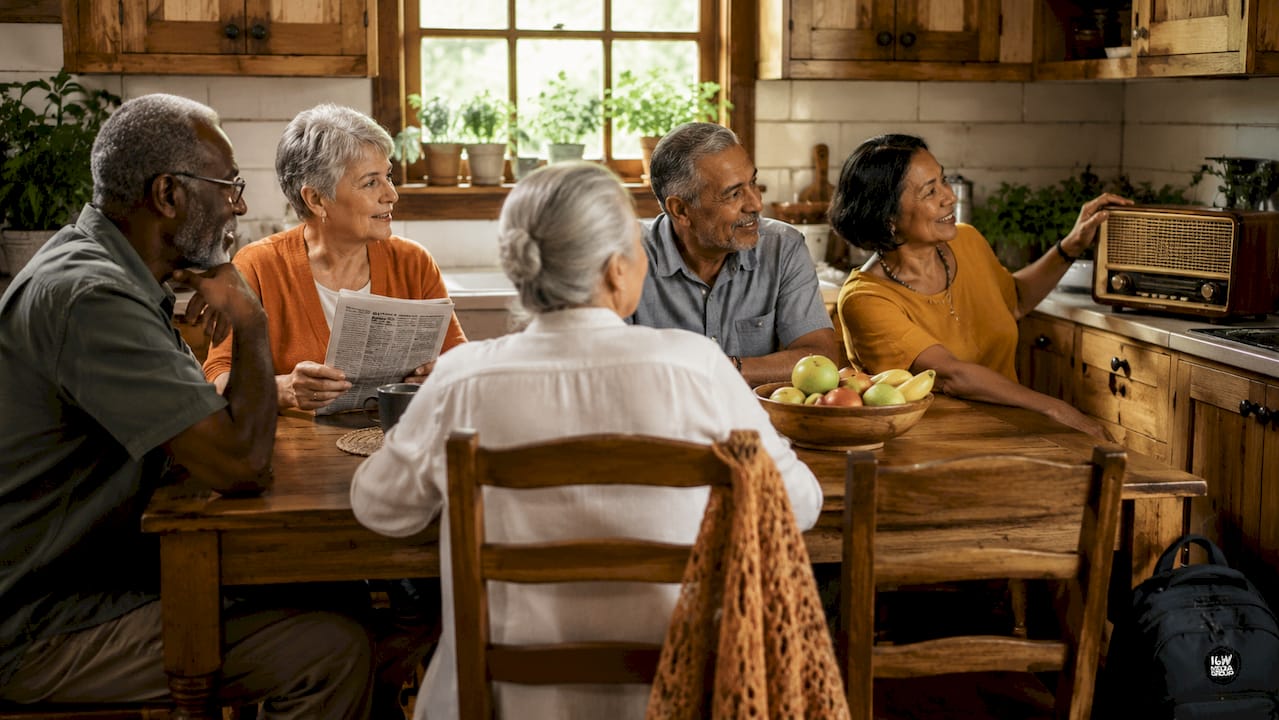
Traditional media reaches audiences that digital campaigns routinely miss. Consumers aged 55 and older rely heavily on television, radio, and print for news and purchasing decisions. That demographic controls a disproportionate share of household spending. A local TV spot or a full-page ad in a community magazine reaches them in an environment where they are paying attention, not scrolling past.
Editorial credibility and the halo effect
Traditional outlets apply editorial gatekeeping and fact-checking that lend legitimacy to the brands advertising alongside them. This is the halo effect: your brand borrows trust from the publication or broadcast it appears in. A healthcare practice or financial advisory firm advertising in a respected regional magazine signals professionalism in a way that a Facebook ad simply cannot. Healthcare, finance, and other trust-sensitive industries benefit most from this credibility advantage when building brand awareness.
Reduced ad clutter and scheduled interruption
The average digital user encounters hundreds of ads per day. Traditional media environments are far less saturated. A 30-second radio spot during a morning drive competes with two or three other ads, not thirty. Television and radio use scheduled interruption, meaning your message reaches consumers at a predictable moment when they are engaged with content they chose. That attention quality is measurable and repeatable.
Pro Tip: Run a traditional media campaign for 60–90 days before launching a digital retargeting push. The brand recognition built through TV or radio makes your digital ads significantly more effective because consumers already recognize your name.
Traditional media also acts as a top-of-funnel brand builder that digital alone cannot sustain. Removing traditional media from a marketing mix often reduces overall campaign performance because it eliminates the brand demand that feeds digital conversions downstream.
Traditional media vs digital: how do they compare in 2026?
The honest comparison is not about which channel wins. It is about what each channel does best.
| Factor | Traditional media | Digital media |
|---|---|---|
| Credibility and trust | High, backed by editorial standards | Variable, dependent on platform and creator |
| Audience age skew | Strongest with 55+ consumers | Strongest with 18–44 consumers |
| Ad clutter | Low to moderate | Very high |
| Targeting precision | Geographic and demographic | Behavioral and interest-based |
| Measurability | Improving with digital tools | Strong, real-time data |
| Cost per impression | Higher for national, competitive locally | Lower on average |
| Community connection | Strong, especially in local markets | Moderate, algorithm-dependent |
As of june 2026, social media and video networks have surpassed traditional websites and apps as the primary news source globally, used by 54% of consumers versus 51% for newspaper-linked digital platforms. That shift in consumption does not erase traditional media’s authority. It actually sharpens it.
Individual content creators dominate new media for convenience and relatability, but traditional journalism maintains strong epistemic authority. Consumers trust traditional outlets more when they need accurate, consequential information. That trust gap matters enormously for brands in regulated or high-consideration categories.
Monetization data reinforces this point. Only 17% of audiences pay for digital news as of june 2026. That stagnation signals that digital news consumption is wide but shallow. Traditional media audiences, by contrast, often pay for subscriptions and demonstrate deeper engagement with content.
Which traditional media channels work best for community engagement?
Each traditional channel serves a distinct purpose. Matching the channel to your goal is what separates effective campaigns from wasted spend.
- Television delivers the broadest awareness and works best for brands targeting older demographics or building recognition across a wide geographic area. Local TV affiliates in markets like Tampa reach households that no digital platform can aggregate as efficiently.
- Radio is the most cost-effective traditional channel for local businesses. Radio’s affordability and wide local reach make it ideal for community engagement, especially during commute hours when listeners are captive and attentive.
- Print newspapers and community magazines serve audiences who actively seek in-depth local information. Readers of community publications are highly engaged with neighborhood news, local business profiles, and service recommendations. Advertising in these formats places your brand inside a trusted, locally relevant context.
- Outdoor advertising including billboards and transit signage offers high visibility with minimal competition. A well-placed billboard on a commuter route generates thousands of daily impressions with no algorithm limiting your reach.
Pro Tip: Community magazines outperform general newspapers for local brand campaigns because their readers are specifically interested in the neighborhood businesses and services featured inside. Ask publishers about editorial features, not just ad placements.
Traditional media meets legal and editorial standards that enhance public trust compared to user-generated digital content. That standard is the foundation of every channel listed above. When your brand appears in a professionally produced environment, it inherits that professionalism by association.
How can businesses integrate traditional media into their 2026 marketing mix?
A practical integration strategy follows a clear sequence. Skipping steps wastes budget and produces results that are hard to interpret.
- Start with brand building, not conversion. Use television, radio, or print to establish name recognition and credibility before asking consumers to act. Traditional media builds the demand that digital campaigns then harvest.
- Schedule for attention, not just reach. Radio morning drive slots, prime-time TV, and monthly magazine issues all deliver audiences at predictable, high-attention moments. Plan your traditional buys around those windows.
- Measure with modern tools. Precision measurement in traditional media has improved significantly. Digital analytics tools now integrate with traditional campaign data, enabling local businesses to track call volume, foot traffic, and web visits tied to specific broadcast or print schedules.
- Use editorial credibility to amplify social media. A feature in a respected community magazine gives you shareable, credible content. Post it across your digital channels. The traditional placement validates the digital share.
- Build community ties through local campaigns. Sponsoring a local radio program or advertising in a neighborhood magazine does more than generate impressions. It signals that your business is invested in the community, which builds loyalty that digital retargeting cannot replicate.
An effective full-funnel marketing mix blends scheduled interruption from traditional media with responsive digital engagement. The two channels are not competitors. They are sequential stages in the same consumer journey.
Key takeaways
Traditional media builds brand credibility, reaches high-value older demographics, and creates the top-of-funnel demand that makes digital campaigns perform better.
| Point | Details |
|---|---|
| Credibility halo effect | Advertising in traditional outlets transfers editorial trust directly to your brand. |
| Older demographic reach | Consumers aged 55+ rely on TV, radio, and print, and control significant household spending. |
| Reduced ad clutter | Traditional media environments carry far fewer competing ads than digital platforms. |
| Top-of-funnel demand | Removing traditional media from a mix reduces overall campaign performance, including digital ROI. |
| Community connection | Local radio, print, and outdoor placements build neighborhood loyalty that algorithms cannot replicate. |
Traditional media’s staying power: a frank assessment
I have watched brands pull their traditional media budgets to chase digital metrics, and I have watched most of them regret it within two years. The pattern is consistent. Digital campaigns perform well initially because the brand already has recognition built by years of TV, radio, or print. Once that reservoir drains, digital performance drops and the team cannot figure out why.
The uncomfortable truth is that traditional media’s value is often underestimated because its top-of-funnel effects are indirect. You cannot always draw a straight line from a radio spot to a sale. But you can measure what happens to your digital conversion rates when you stop running radio. They fall.
I also think the credibility argument is underused by most marketing teams. Brands in healthcare, financial services, real estate, and professional services are leaving serious trust equity on the table by ignoring community magazines and local broadcast. A well-placed print feature in a respected neighborhood publication does more for perceived authority than six months of Instagram ads.
The businesses I have seen succeed with traditional media treat it as a long-term investment, not a short-term activation. They show up consistently in the same local channels, season after season. That consistency is what builds the kind of brand recognition that makes every other marketing dollar work harder.
— Mike
How 16wmediagroup helps you build a traditional media presence
16wmediagroup works with local businesses across Tampa and beyond to build media plans that combine traditional and digital channels into one cohesive strategy. The team specializes in community-focused placements, including regional print, local broadcast, and outdoor advertising, designed to put your brand in front of high-value consumers in the right context.
If you are ready to build brand visibility through channels your competitors have abandoned, 16wmediagroup offers local advertising campaign planning tailored to your market and budget. The agency also publishes community content that positions your brand as a trusted local voice. Explore the full range of media and publishing services or start a conversation about your next campaign at 16wmediagroup.com/contact.
FAQ
Why use traditional media when digital is cheaper?
Traditional media delivers credibility and demographic reach that digital cannot replicate at any price. The brand trust built through established outlets directly improves the performance of digital campaigns running alongside them.
What traditional media channel works best for local businesses?
Radio and community magazines are the most cost-effective traditional channels for local brand visibility. Radio reaches wide local audiences affordably, while community magazines deliver engaged readers who are actively seeking local business recommendations.
How does traditional media build community engagement?
Traditional media places your brand inside locally trusted content environments, including neighborhood magazines, local radio programs, and regional TV broadcasts. That context signals community investment and builds loyalty that digital advertising cannot generate on its own.
Is traditional media still effective for reaching younger audiences?
Television, newspapers, and radio are most effective with audiences aged 55 and older. For younger demographics, traditional media works best as a brand-building layer that supports and amplifies digital campaigns targeting those groups.
How do I measure the impact of a traditional media campaign?
Modern analytics tools now connect traditional campaign schedules to measurable outcomes like call volume, website traffic spikes, and foot traffic patterns. Tracking these metrics before, during, and after a campaign reveals the true impact of traditional media on your business results.