

Advertising ROI is defined as the profit your campaigns generate relative to every dollar you spend to run them. The standard 2026 formula is ((Incremental Revenue − Fully-Loaded Ad Cost) ÷ Fully-Loaded Ad Cost) × 100, and it is the definitive metric for evaluating campaign effectiveness. Understanding advertising ROI separates businesses that grow their budgets with confidence from those that cut spending at the first sign of pressure. Avinash Kaushik, one of the most cited voices in marketing analytics, argues that Incremental Net Profit ROI is the minimum standard any marketer must meet to defend spending at the executive level. 16wmediagroup builds every client campaign around this standard.
What is the correct formula for understanding advertising ROI?
The correct 2026 ROI formula is ((Incremental Revenue − Fully-Loaded Ad Cost) ÷ Fully-Loaded Ad Cost) × 100. Two terms inside that formula carry most of the weight: incremental revenue and fully-loaded cost.

Incremental revenue
Incremental revenue is the sales your advertising actually caused. It excludes purchases customers would have made anyway, without ever seeing your ad. This distinction matters because attribution models routinely credit organic sales to paid campaigns, making your numbers look better than they are.
Fully-loaded cost
Fully-loaded cost includes every dollar tied to running the campaign. That means media spend, creative production, platform fees, agency retainers, and operational overhead. Most business owners only count media spend. That habit inflates ROI and leads to bad budget decisions.
Here is how the two concepts work together in practice:
- Identify your baseline. Measure sales in a comparable period or geography where no advertising ran. That baseline represents what would have happened without the campaign.
- Subtract baseline from total sales. The difference is your incremental revenue figure.
- Add every cost. Pull media invoices, creative hours, tool subscriptions, and any agency fees into one total.
- Apply the formula. Divide the difference between incremental revenue and fully-loaded cost by fully-loaded cost, then multiply by 100.
- Interpret the result. A result above zero means the campaign returned more than it cost. A commonly cited benchmark is 5:1, or 500%, though that target varies by industry and business stage.
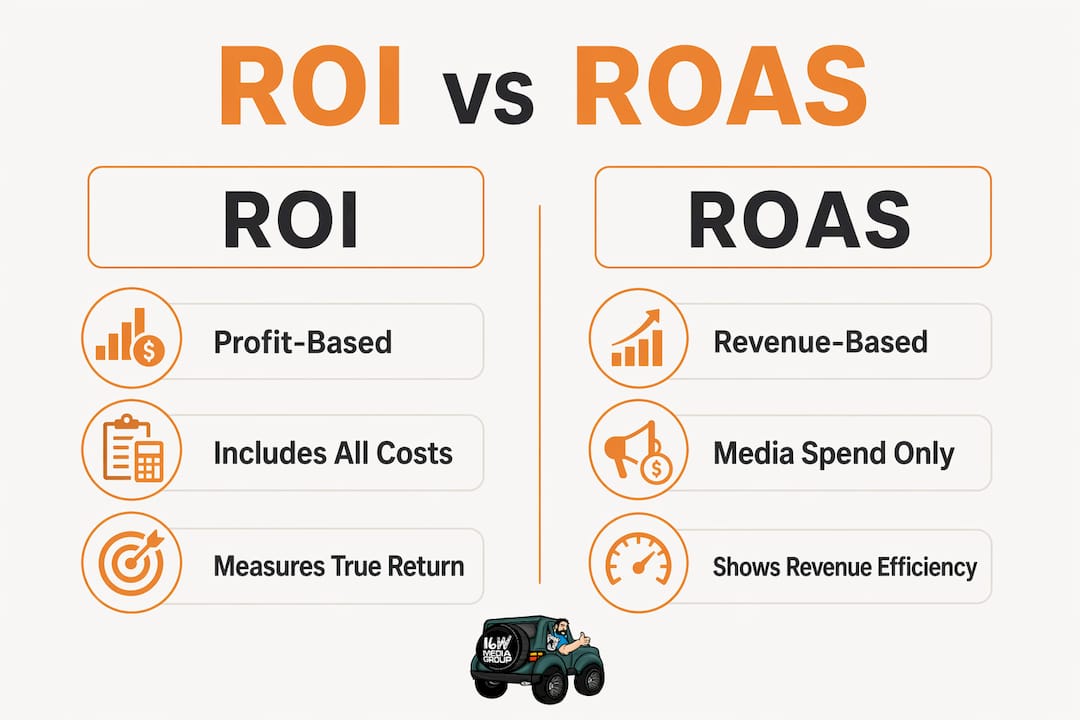
ROI vs. ROAS
Marketing ROI and ROAS are not the same metric. ROAS compares revenue only to direct media spend. ROI compares profit to all costs. A campaign can show a strong ROAS and still lose money once production, fees, and overhead enter the calculation. Always use ROI for profitability decisions and ROAS only as a channel efficiency signal.
Pro Tip: If your ROI calculation does not include creative production time and software tool costs, your number is wrong. Build a simple cost sheet before every campaign launch and update it weekly.
What mistakes do marketers make when measuring advertising ROI?
The most common measurement mistake is using total attributed revenue instead of incremental revenue. Attribution models over-credit marketing by including sales that would have happened without any advertising at all. That error makes campaigns look profitable when they are not.
The five mistakes that most consistently distort advertising return on investment are:
- Using attributed revenue as a proxy for incremental revenue. Last-click and even multi-touch models assign credit to ads that had no causal role in the sale.
- Ignoring non-media costs. Many advertisers exclude creative production time and software tool costs, which skews ROI calculations upward.
- Confusing ROAS with ROI. A high ROAS can coexist with a negative ROI when total costs exceed total profit.
- Measuring only short-term returns. Brand campaigns often generate revenue months after the initial exposure. Cutting them based on 30-day ROI destroys long-term value.
- Skipping incrementality testing. Without a control group, you cannot separate ad-driven sales from organic ones.
Pro Tip: Run a holdout test on your next campaign. Withhold ads from 10–15% of your audience and compare their purchase rate to the exposed group. The gap is your true incremental lift.
The media planning checklist from 16wmediagroup walks through each of these pitfalls with specific checkpoints before a campaign goes live.
How can businesses measure incremental revenue from advertising?
Incrementality testing is the most reliable method for isolating sales caused by advertising. The core structure is a test group that sees the ad and a control group that does not. The difference in purchase behavior between the two groups is the incremental lift.
Three practical approaches work well for most business owners:
- Geographic holdout tests. Run your campaign in one city or region and withhold it from a comparable one. Compare sales across both areas over the same period. This method works for both digital and traditional media.
- Media Mix Modeling (MMM). MMM uses statistical regression to estimate each channel’s incremental contribution to revenue. It works across walled gardens where traditional pixel-based attribution fails, making it the preferred method after iOS privacy changes reduced cookie-based tracking.
- Customer surveys and CRM analysis. Ask new customers how they heard about you. Cross-reference survey responses with CRM data to identify which campaigns drove first contact. This approach is low-cost and practical for smaller businesses.
Each method has trade-offs. Geographic holdouts require comparable markets. MMM requires at least 12–18 months of historical data to produce reliable models. Surveys rely on customer recall, which is imperfect. The best practice is to combine at least two methods and look for consistent signals across both.
For subscription and service businesses, the payback period formula adds another layer: Payback Period = Fully-Loaded Customer Acquisition Cost ÷ (Average Monthly Revenue per Customer × Gross Margin %). This tells you how long a campaign takes to break even, which matters more than a single-period ROI number when customer lifetime value is high.
Learning how to get measurable results from local advertising campaigns is a practical starting point for businesses building their first incrementality framework.
What strategies improve advertising ROI through cost control and targeting?
Improving advertising return on investment requires working both sides of the formula. You can raise the numerator by generating more incremental revenue, and you can lower the denominator by reducing fully-loaded costs. Most campaigns have room to move on both.
Practical strategies that shift the ROI line in the right direction include:
- Build a full cost sheet before launch. List every expense: media, creative, tools, agency time, and internal staff hours. Knowing your true cost baseline prevents post-campaign surprises.
- Test creative continuously. Campaigns with fresh creative outperform static ones over time. Rotate offers, headlines, and formats on a regular cycle rather than waiting for performance to drop.
- Consolidate your audience targeting. Broad targeting wastes spend on people unlikely to convert. Tighter audience segments reduce cost per incremental sale and improve ROI without changing media spend.
- Set a reporting cadence. Weekly ROI reviews catch underperforming placements before they drain the budget. Monthly reviews are too slow to course-correct in real time.
- Audit your fully-loaded advertising costs quarterly. Fees and tool subscriptions accumulate over time. A quarterly audit often reveals costs that no longer justify their place in the budget.
Audience consolidation deserves special attention. Spreading a fixed budget across too many segments dilutes frequency below the threshold needed to drive action. Concentrating spend on two or three high-value segments typically produces stronger incremental results than spreading the same dollars across ten.
The partner resource from Webby Website Optimisation offers a practical framework for small businesses building their first measurement system, covering both cost tracking and incremental sales attribution.
How does advertising ROI support budget decisions and strategic planning?
ROI data is the most credible language you can bring to a budget conversation. Marketing is often the first budget cut in economic downturns because other departments can show clearer financial returns. Marketers who present Incremental Net Profit ROI change that dynamic. They speak the same language as the CFO.
“Incremental Net Profit ROI is the minimum standard for proving marketing’s actual contribution. Without it, marketing is always a cost center, never an investment. With it, you have a seat at the financial table.”
Avinash Kaushik, Occam’s Razor
ROI analysis also guides channel allocation. When you know which campaigns generate the highest incremental return, you can shift budget toward them with confidence. That reallocation compounds over time. Campaigns that consistently outperform their cost benchmarks earn larger budgets in the next cycle, while underperformers get cut or restructured.
For business owners evaluating new channels, ROI provides a consistent evaluation framework. A new podcast sponsorship, a community magazine placement, or a regional digital campaign all get measured against the same formula. That consistency removes guesswork from channel decisions and builds a track record that supports future budget requests. The local marketing ROI roadmap from 16wmediagroup shows how Florida businesses apply this framework across multiple channels simultaneously.
Key Takeaways
Advertising ROI is only accurate when it uses incremental revenue and fully-loaded costs. Every other approach overstates performance and leads to poor budget decisions.
| Point | Details |
|---|---|
| Use the correct formula | Apply ((Incremental Revenue − Fully-Loaded Cost) ÷ Fully-Loaded Cost) × 100 for accurate ROI. |
| Incremental revenue is not total revenue | Only count sales your advertising caused, not organic purchases that would have happened anyway. |
| Fully-loaded cost includes more than media spend | Add creative production, platform fees, agency retainers, and tool costs to every calculation. |
| ROI and ROAS measure different things | ROAS measures channel efficiency; ROI measures profitability. Use both, but never confuse them. |
| Incrementality testing is the gold standard | Holdout tests and Media Mix Modeling isolate true ad-driven sales from organic baseline activity. |
Why most ROI numbers I see are quietly wrong
After working with local businesses across multiple media channels, one pattern stands out: the ROI numbers that show up in campaign reports are almost always too high. Not because anyone is being dishonest. Because the formula most people use is incomplete.
The two gaps I see most often are missing cost categories and missing incrementality. A business owner sees $40,000 in revenue traced back to a campaign that cost $8,000 in media spend and concludes the ROI is 400%. But when you add the creative agency fee, the graphic designer’s hours, the attribution tool subscription, and the internal staff time spent managing the campaign, the real cost is closer to $14,000. The ROI drops to around 185%. That is still a good result. But the decisions you make at 400% and the decisions you make at 185% are very different.
The incrementality gap is even more consequential. If $15,000 of that $40,000 in revenue would have come in anyway through organic search and repeat customers, the incremental revenue is only $25,000. Now the ROI is closer to 79%. That number tells a completely different story about whether to scale the campaign.
The fix is not complicated. Build a full cost sheet. Run a holdout test. Compare the result to your baseline. Do that consistently and your ROI numbers will start reflecting reality instead of optimism. That is when the metric becomes genuinely useful for planning.
— Mike
How 16wmediagroup helps businesses build accurate ROI frameworks
Measuring advertising return on investment correctly requires the right campaign structure from the start, not a fix applied after the budget is spent.

16wmediagroup works with local businesses to build media plans that account for fully-loaded costs, define clear incrementality benchmarks, and set up the reporting structure needed to track real results. The local advertising campaign planning guide covers the full process, from cost accounting to channel selection to performance review cadence. For businesses ready to put ROI measurement into practice across traditional media, digital, and podcast channels, the 2026 local advertising best practices guide is the right next step.
FAQ
What is the advertising ROI formula?
The standard formula is ((Incremental Revenue − Fully-Loaded Ad Cost) ÷ Fully-Loaded Ad Cost) × 100. Fully-loaded cost includes media spend, creative production, platform fees, and agency retainers.
What is a good advertising ROI benchmark?
A commonly cited benchmark is 5:1, or 500%, but the right target depends on your industry, margins, and campaign goals. Context-specific targets are more useful than universal benchmarks.
What is the difference between ROI and ROAS?
ROAS compares revenue only to direct media spend. ROI compares profit to all campaign costs. A campaign can show strong ROAS and still produce a negative ROI once full costs are included.
How do I measure incremental revenue from advertising?
Use a holdout test by withholding ads from a control group and comparing their purchase rate to the exposed group. The difference in purchase behavior is your incremental lift.
Why does marketing get cut first during budget reviews?
Marketing is often the first budget cut because other departments show clearer financial returns. Presenting Incremental Net Profit ROI gives marketers a credible financial metric that holds up under CFO scrutiny.