

A marketing strategy is a high-level, long-term plan that defines who you’re trying to reach, what you’re offering them, and how your brand will stand out in the market. It’s the compass that points every campaign, budget decision, and channel choice in the same direction.
TL;DR:
- A marketing strategy sets your competitive direction (think 3–10 years); a marketing plan is the quarterly roadmap that executes it
- It answers three questions: Who needs this? What makes us different? How will we win their business?
- Frameworks like the 4 Ps, STP (Segmentation, Targeting, Positioning), and SWOT give it structure; 16wmediagroup uses these same pillars to build localized strategies for businesses ready to grow
Table of Contents
- Why a marketing strategy matters more than you think
- What every marketing strategy must include
- Which strategic approach fits your business?
- How to build a marketing strategy step by step
- Frameworks and tools that make strategy easier
- How to measure whether your strategy is working
- Common strategy mistakes and how to fix them
- Real-world strategy examples you can learn from
- How local businesses should adapt their marketing strategy
- Key Takeaways
- Why strategy-first marketing is the only kind that works
- Ready to put your local marketing strategy to work?
- Useful sources and further reading
Why a marketing strategy matters more than you think
Most businesses don’t fail because they lack marketing activity. They fail because that activity pulls in six different directions at once. A documented marketing strategy solves that by aligning every dollar and decision to a single competitive goal.
Here’s what a solid strategy actually delivers:
- Goal alignment: Every team member knows what success looks like and why certain channels get priority
- Smarter budget use: Resources flow toward the audiences and messages most likely to convert, not toward whatever felt urgent last Tuesday
- Competitive positioning: You define how you’re different before a competitor defines it for you
- Measurability: Clear objectives make it possible to track ROI and cut what isn’t working
- Long-term brand equity: Consistent positioning builds recognition that compounds over time
Pro Tip: Don’t let channel selection drive your strategy. Strategy dictates channel choice, not the other way around. If you’re choosing Instagram before you’ve defined your audience and value proposition, you’re building the house from the roof down.
A strategy also protects you from short-term thinking. Businesses that chase leads without a strategic foundation tend to overspend on promotions, underinvest in brand, and wake up two years later with no lasting market position. The role of media strategy in long-term business growth is exactly this: it turns scattered activity into a compounding asset.
What every marketing strategy must include
Think of these components as the load-bearing walls of your strategy. Remove any one of them and the structure gets shaky.
Core components checklist:
- Business objectives: What does the company need to achieve in the next 1–3 years? Revenue targets, market share, customer retention?
- Target audience and segmentation: Who are you serving? Broken into demographic, psychographic, behavioral, and geographic segments
- Value proposition: The specific reason a customer chooses you over every alternative
- Positioning: Where you sit in the market relative to competitors, and how you want to be perceived
- Objectives and KPIs: Measurable goals tied to business outcomes (not just vanity metrics)
- Marketing mix (4 Ps): Product, Price, Place, Promotion — the tactical levers aligned to your strategic position
- Budget and resource allocation: How much, to whom, and over what timeline
- Governance and timeline: Who owns what, review cadence, and decision rights
The 4 Ps of the marketing mix are tactical tools, but they only work when they’re anchored to a clear strategic position. Price a product wrong relative to your positioning and the whole strategy sends mixed signals.
Positioning statement mini-template:
Use this template to stress-test your positioning before you write a single ad. If you can’t fill in every blank with something specific and defensible, the strategy needs more work. Brand positioning is the anchor that keeps every message consistent across every channel.
Quick verification checklist — does your strategy cover:
- A written business objective with a measurable target?
- At least one defined audience segment with a persona?
- A clear, one-sentence value proposition?
- A documented positioning statement?
- KPIs tied to each objective?
- A channel plan aligned to the 4 Ps?
- A budget with allocated owners?
- A scheduled review date?
Which strategic approach fits your business?
Not every strategy looks the same. The right archetype depends on your competitive position, growth stage, and risk appetite. Here are the most common approaches and when each one earns its place.
- Market penetration: Grow share in an existing market with existing products. Works when the market is underpenetrated and you have a cost or distribution advantage.
- Product development: Launch new offerings to your current customer base. Best when you have strong brand loyalty and clear unmet needs from existing buyers.
- Market development: Take existing products into new markets or geographies. Fits businesses with proven products looking for new revenue without product R&D costs.
- Differentiation: Win on uniqueness rather than price. Requires a genuinely distinct value proposition and the ability to communicate it clearly.
- Cost leadership: Compete on price by achieving lower operating costs than rivals. Demands operational discipline and scale; risky for small businesses without volume.
- Focus/niche: Dominate a narrow segment rather than compete broadly. Powerful for local businesses and specialists who can own a specific audience deeply.
- Digital-first/channel-first: Lead with owned digital channels (SEO, social, email) to build audience before scaling paid. Works well for startups and content-driven brands with limited budgets.
- Community-centered: Build brand through local relationships, storytelling, and trust. Especially effective for brick-and-mortar businesses and service providers embedded in a specific geography.
| Business situation | Recommended strategy archetype |
|---|---|
| New business, limited budget | Focus/niche or digital-first |
| Established brand, loyal customers | Product development or differentiation |
| Growing market, strong distribution | Market penetration |
| Saturated local market | Community-centered or differentiation |
| Price-sensitive commodity market | Cost leadership |
| Expanding to new cities or regions | Market development |
| Local service business | Focus/niche + community-centered |
A multimedia strategy often combines two of these archetypes — for example, a local business might use a focus strategy to define its niche and a community-centered approach to build the relationships that make that niche sticky.
How to build a marketing strategy step by step
Building a strategy isn’t a one-afternoon exercise, but it doesn’t have to take months either. Small businesses can work from a one-page format that combines strategy and plan into a single living document. Here’s the ordered process.
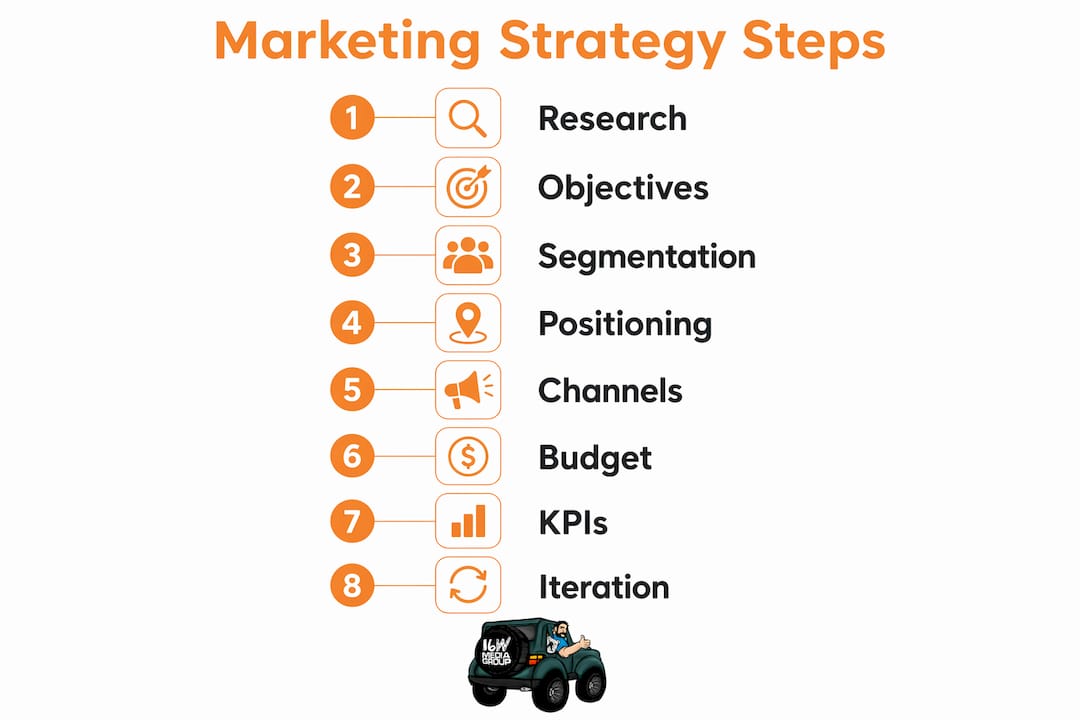
Step 1: Research and insight
Audit your current market position, customer base, and competitive environment. Use SWOT analysis to surface strengths, weaknesses, opportunities, and threats. Don’t skip the competitive scan — a 360° review of your operating environment is what separates a deliberate strategy from one built on assumptions.
Step 2: Define objectives
Set specific, measurable business goals. “Grow revenue” is not an objective. “Increase monthly recurring revenue by 20% in 12 months” is. Effective strategy development starts here — objectives anchor every decision that follows.
Step 3: Audience segmentation and personas
Break your market into segments and build at least one detailed persona per primary segment. Include demographics, motivations, pain points, and where they consume information. Audience segmentation is the step most businesses rush — and the one that most directly determines whether your messaging lands.
Step 4: Positioning and messaging
Use the STP framework (Segment, Target, Position) to define where you’ll compete and how you’ll be perceived. Write your positioning statement using the template from the components section above.
Step 5: Channel selection and the marketing mix
Choose channels based on where your audience actually is, not where you’re most comfortable. Align your 4 Ps to the strategic position you’ve defined. A media planning checklist helps ensure you’re not leaving obvious channels off the table.

Step 6: Resource plan and budget
Allocate budget by channel and objective. Assign ownership for each tactic. Be specific about who approves spend, who reports results, and what the escalation path is when something underperforms.
Step 7: KPI selection
Pick 3–5 primary KPIs that directly measure progress toward your objectives. Avoid tracking everything — measurement sprawl is as dangerous as no measurement at all.
Step 8: Monitoring and iteration
Schedule monthly check-ins and a full quarterly review. Treat the strategy as a living framework — real-time performance data should trigger recalibration, not just documentation.
Example timeline:
| Milestone | Target |
|---|---|
| 90 days | Research complete, strategy documented, pilot channel live |
| 90 days | First KPI review, messaging refined, second channel added |
| — | Full annual review, strategy updated, budget reallocated by performance |
Pro Tip: Build in a “kill switch” for each tactic at the 90-day mark. If a channel hasn’t shown directional improvement by then, reallocate that budget rather than waiting for the annual review.
Pro Tip: Document your strategy in writing, even if it’s one page. A documented, measurable strategy is what separates deliberate growth from reactive spending.
Frameworks and tools that make strategy easier
You don’t have to build your strategy from scratch. These frameworks give you a proven structure to work from, and the tools below map to each stage.
Strategic frameworks:
- STP (Segmentation, Targeting, Positioning): The go-to framework for defining who you serve and how you’ll win them. Use it to move from broad market to specific positioning statement.
- SWOT Analysis: Surfaces internal strengths and weaknesses alongside external opportunities and threats. Best used at the research stage before objectives are set.
- 4 Ps (Marketing Mix): Translates strategic positioning into tactical decisions across Product, Price, Place, and Promotion.
- Porter’s Five Forces: Evaluates competitive intensity, supplier power, buyer power, threat of substitutes, and barriers to entry. Use it when entering a new market or reassessing competitive position.
- RACE Framework (Reach, Act, Convert, Engage): A digital-first planning model that maps customer journey stages to specific tactics and KPIs.
STP in action: A local restaurant uses STP to identify its primary segment (working professionals within a 3-mile radius who value speed and quality), targets that segment specifically, and positions itself as “the fastest sit-down lunch in the neighborhood.” That positioning statement then drives menu design, pricing, hours, and ad creative — all four Ps aligned to one strategic anchor.
| Framework | Best used for | Stage |
|---|---|---|
| STP | Defining audience and positioning | Research + Planning |
| SWOT | Situational audit | Research |
| 4 Ps | Tactical alignment | Planning + Execution |
| Porter’s Five Forces | Competitive landscape analysis | Research |
| RACE | Digital campaign planning | Execution + Measurement |
Tool suggestions by stage:
- Research: Google Trends, SparkToro, SEMrush (for competitive keyword data), customer surveys
- Persona building: HubSpot’s Make My Persona, Xtensio
- Planning: Notion, Airtable, or a simple one-page Google Doc template
- KPI dashboards: Google Looker Studio, HubSpot dashboards, or a shared spreadsheet with weekly inputs
- Content and creative: Canva for visual assets; video brand repositioning work pairs well with a specialist partner like Puritano when the strategy calls for a visual identity refresh
Pro Tip: Don’t let framework selection become the project. Pick one (STP is the most practical starting point for most businesses) and move. You can layer in Porter’s Five Forces or RACE once the core strategy is documented.
How to measure whether your strategy is working
A strategy without measurement is a wish list. These KPIs tell you whether the strategy is actually moving the needle.
Primary strategic KPIs by goal:
- Revenue growth: Total revenue change period over period; tracks whether the strategy is delivering business results
- Market share: Your revenue as a percentage of total addressable market; harder to measure for small businesses but worth estimating annually
- Customer Acquisition Cost (CAC): Total marketing and sales spend divided by new customers acquired in the same period
- Customer Lifetime Value (CLTV): Average purchase value × purchase frequency × average customer lifespan
- Conversion rate: Leads or visitors who complete a target action; ties channel performance to business outcomes
- Customer retention rate: Percentage of customers who return; a leading indicator of brand strength
- Brand awareness metrics: Aided/unaided recall, share of voice, branded search volume
Example calculations:
CAC: If you spend $10,000 on marketing in a month and acquire 50 new customers, your CAC is $200.

CLTV: If a customer spends $150 per visit, visits 8 times per year, and stays a customer for 3 years, their CLTV is $3,600.
A healthy business targets a CLTV-to-CAC ratio of at least 3:1. If your CLTV is $3,600 and your CAC is $200, that’s an 18:1 ratio — strong. If CAC climbs to $1,500, the strategy needs adjustment.
| KPI | Formula | Review cadence |
|---|---|---|
| CAC | Total spend ÷ new customers | Monthly |
| CLTV | Avg. value × frequency × lifespan | Quarterly |
| Conversion rate | Conversions ÷ total visitors | Weekly |
| Retention rate | (End customers − new) ÷ start customers | Monthly |
| Revenue growth | (Current − prior) ÷ prior | Monthly |
Assign one person to own the measurement dashboard. Shared ownership usually means no ownership. Weekly data pulls, monthly analysis, and quarterly strategy reviews keep the process from becoming a once-a-year scramble.
Common strategy mistakes and how to fix them
Most marketing strategies don’t fail because the ideas were bad. They fail because of execution habits that quietly undermine the plan.
- Letting channels drive strategy: Choosing TikTok or billboards before defining your audience and positioning is the single most common error. Fix: define your value proposition and target segment first, then select channels.
- Vague objectives: “Increase brand awareness” is not a goal. Fix: attach a number, a timeline, and a measurement method to every objective.
- Treating strategy as static: Markets shift, competitors enter, and customer needs evolve. A strategy written once and filed away is an inadvertent strategy — what you do by default, not by design. Fix: schedule quarterly reviews as non-negotiable calendar events.
- Skipping competitive analysis: Ignoring what substitutes and new entrants are doing leaves you reactive. Fix: run a Porter’s Five Forces review annually.
- Confusing strategy with tactics: A social media calendar is a tactic. A positioning decision is strategy. Fix: ask “does this decision define where we compete and how we win?” If yes, it’s strategic. If it’s about execution, it belongs in the plan.
- No documented positioning: If your team can’t recite your positioning statement from memory, it doesn’t exist in practice. Fix: write it, post it, and reference it in every creative brief.
- Ignoring retention in favor of acquisition: Chasing new customers while existing ones churn is expensive. Fix: include a retention KPI alongside acquisition metrics from day one.
- No review cadence: Strategy without a scheduled check-in becomes irrelevant within six months. Fix: block a 90-minute quarterly strategy review on the calendar before the quarter starts.
Pro Tip: If your business has never documented a strategy, start by writing down what you currently do and why. That’s your inadvertent strategy. Then ask: is this the position we’d choose deliberately? The gap between those two answers is where the real strategic work begins.
Real-world strategy examples you can learn from
Example 1: Local brick-and-mortar coffee shop
Core objective: Increase weekday foot traffic by 30% in 12 months without discounting.
Strategic archetype: Community-centered + focus/niche.
Tactics:
- Partner with three local employers to offer a corporate loyalty card, driving repeat weekday visits from office workers within a half-mile radius
- Sponsor a monthly neighborhood event and publish a free local newsletter featuring community stories, positioning the shop as a neighborhood hub rather than just a coffee stop
Lesson: Owning a specific community role (neighborhood hub) creates loyalty that price promotions can’t buy. Local brand storytelling is a strategy, not just a content tactic.
Example 2: Small SaaS startup
Core objective: Reach $50,000 in monthly recurring revenue within 18 months by targeting a single vertical (independent real estate agents).
Strategic archetype: Focus/niche + digital-first.
Tactics:
- Build a content library of SEO-optimized guides answering the specific questions real estate agents search for, generating inbound leads without paid acquisition costs
- Use a free trial with a structured onboarding email sequence to convert trial users, measuring activation rate as the primary leading KPI
Lesson: Narrow focus beats broad reach at the early stage. Defining one vertical deeply — its language, pain points, and buying triggers — lets a small team compete against larger, less-focused products.
How local businesses should adapt their marketing strategy
Local businesses operate in a different competitive reality than national brands. Your advantage isn’t scale — it’s proximity, authenticity, and community trust. A strategy that ignores those assets and copies a generic national playbook will underperform every time.
Local strategy checklist:
- Define your geographic service area precisely (neighborhood, city, radius)
- Identify 2–3 community stories or local angles that only your business can tell authentically
- Choose a media mix that reaches your specific local audience (community magazines, local radio, direct mail, neighborhood social groups, podcasts)
- Set local-specific KPIs: foot traffic, phone calls, local search rankings, event attendance
- Build relationships with complementary local businesses for co-marketing opportunities
- Track local review volume and sentiment as a brand health proxy
90-day local strategy action plan:
- Days 1–30 (Research): Map your current customers by zip code, survey your top 10 for why they chose you, and audit your local search presence (Google Business Profile, local citations, review count)
- Days 31–60 (Pilot): Launch one primary local channel (community magazine feature, podcast appearance, or targeted direct mail campaign) with a clear offer tied to a trackable response mechanism
- Days 61–90 (Measure and iterate): Review foot traffic, call volume, and offer redemption rate. Double down on what moved the needle; pause what didn’t
Localized media planning works best when the channel choice reflects where your specific community actually pays attention — not where the national marketing playbook says you should be.
Pro Tip: Traditional media channels — community magazines, local radio, direct mail — often outperform digital for local businesses because the audience is geographically pre-qualified. Traditional media examples show that print and broadcast still drive measurable local response when the creative is community-relevant.
When the research is done and the 90-day plan is drafted, that’s often the right moment to bring in an agency. 16wmediagroup specializes in exactly this transition — from strategy document to live local campaign — with media mixes that include community publishing, podcasts, traditional placements, and digital channels working together.
Key Takeaways
A marketing strategy is the documented plan that defines who you serve, how you’re different, and which resources you’ll deploy to win — without it, every tactic is just expensive guessing.
| Point | Details |
|---|---|
| Strategy vs. plan | Strategy sets direction over several years; a marketing plan executes it quarter by quarter. |
| Core components | Every strategy needs a target audience, value proposition, positioning, 4 Ps, KPIs, and a review cadence. |
| Build it in 8 steps | Research → objectives → segmentation → positioning → channel mix → budget → KPIs → iterate. |
| Measure what matters | Track CAC, CLTV, conversion rate, and retention; review monthly and recalibrate quarterly. |
| 16wmediagroup | Helps local businesses move from strategy document to live, measurable local campaigns across traditional and digital media. |
Why strategy-first marketing is the only kind that works
Most businesses I talk to have plenty of marketing activity and very little marketing strategy. They’re running ads, posting on social, maybe sending an email newsletter — but none of it is anchored to a deliberate competitive position. The result is a lot of spend and a lot of noise, with no compounding effect.
The conventional wisdom says “just start marketing and optimize as you go.” That advice works if you have unlimited budget and time. Most local businesses have neither. What they do have is a genuine story, a real community, and a specific audience that national brands can’t reach with the same authenticity. That’s a strategic advantage — but only if it’s named, documented, and deployed deliberately.
The businesses that grow consistently aren’t the ones with the biggest budgets. They’re the ones who know exactly who they’re talking to, what they’re promising, and why that promise is credible. Strategy is what makes that clarity possible. Tactics without strategy are just expensive experiments.
If your marketing feels scattered, the fix isn’t a new channel. It’s a documented strategy that tells every channel what job it’s supposed to do.
Ready to put your local marketing strategy to work?
16wmediagroup builds strategy-first media campaigns for local businesses that want real results — not just more activity. A strategy audit with 16wmediagroup starts with your 90-day plan: we map your audience, define your positioning, and recommend a media mix across community publishing, podcasts, traditional placements, and digital channels that fits your market and your budget.
No generic playbooks. No national templates dropped into a local market. Just a focused, documented strategy built around your community and your goals. Check out the local advertising best practices guide to see how the process works, or browse the full agency services to find the right starting point. When you’re ready to move from strategy to campaign, reach out directly and we’ll get started.
Useful sources and further reading
- Marketing Strategy — Wikipedia: The most thorough overview of marketing strategy theory, covering the distinction between strategy and management, strategic planning cycles, and the concept of inadvertent vs. deliberate strategy.
- What Is a Marketing Strategy? — MarketingProfs: A practitioner-focused definition that emphasizes why strategy must precede channel selection — essential reading for anyone building a strategy from scratch.
- Marketing Strategy: What It Is and How to Create One — Coursera: Covers the strategy-vs.-plan distinction clearly and includes practical guidance on one-page strategy formats for small businesses.
- Marketing Strategy — Corporate Finance Institute: Strong on the structured development process — objectives, research, segmentation, positioning, and the marketing mix — with a finance-literate perspective on resource allocation.
- How to Create a Complete Marketing Strategy — HubSpot: Data-backed guide with expert commentary on documentation, measurability, and the strategy-vs.-tactics distinction; includes templates and examples.
- Marketing Strategy — Investopedia: Concise, business-oriented definition with clear coverage of the 4 Ps and the importance of treating strategy as a living, regularly reviewed framework.