

The most effective event sponsorship strategy starts with one move: build a tiered package around measurable sponsor outcomes, not logo placements. Sponsors renew when they can point to leads generated, pipeline influenced, and brand impressions delivered. Your job is to make that proof easy to produce.
Here is your quick-start checklist to get moving today:
- Define sponsor goals — ask what a sponsor needs (leads, access to decision-makers, content, or brand visibility) before you build anything.
- Audit your inventory — list every asset you control: pre-event email, on-site signage, speaking slots, post-event content, and social reach.
- Set one anchor package — price your flagship tier first, then build supporting tiers around it.
- Prepare three immediate deliverables: a one-page audience summary, a benefits inventory, and a one-page proposal template.
Pro Tip: Write your anchor package before you talk to a single prospect. Walking into a conversation without a priced offer puts the sponsor in control of the negotiation.
Key Takeaways
A winning event sponsorship strategy is built on measurable outcomes, tiered packages priced at a 3x–4x ratio, and a fulfillment process that delivers proof before the sponsor has to ask.
| Point | Details |
|---|---|
| Lead with outcomes, not logos | Every package tier must include at least one structured lead-gen or interaction deliverable. |
| Price tiers at a 3x–4x ratio | Keep your top-to-bottom tier ratio between 3x and 4x to avoid decision friction and protect margin. |
| Disclose total activation costs | Sponsors underestimate activation costs by roughly 30%–50%; transparency prevents fulfillment disputes. |
| Deliver proof within 72 hours | Send a post-event fulfillment package with screenshots, lead exports, and analytics before sponsors ask. |
| 16wmediagroup for local activation | 16wmediagroup packages community publishing, podcasts, and media placement into sponsor-ready deliverables. |
Table of Contents
- What is event sponsorship, and what does this guide cover?
- Who sponsors events, and what are the four main sponsorship types?
- Why sponsorship matters for organizers and sponsors alike
- How to build your event sponsorship strategy step by step
- How to create sponsorship packages and price them
- How to deliver sponsor value without losing a renewal
- How to measure sponsorship ROI and which KPIs sponsors care about
- Sponsorship outreach and negotiation: how to find and close sponsors
- Activation ideas that actually move the needle
- Why local media and community partnerships multiply sponsor value
- Legal and compliance checklist for U.S. event sponsorships
- What actually drives renewals in local and regional sponsorships
- How 16wmediagroup helps you build and activate sponsorships
- Sources
What is event sponsorship, and what does this guide cover?
Event sponsorship is a structured exchange: an organizer provides a sponsor with access to a defined audience, platform, or content opportunity, and the sponsor provides financial support, in-kind resources, or media amplification in return. The relationship is commercial and measurable, not charitable.
The working definition that matters: Event sponsorship succeeds when both parties can point to a specific, pre-agreed outcome — a lead count, a content asset, a room full of decision-makers — and confirm it was delivered.
This guide covers live, hybrid, virtual, and community-based events, including local media integrations such as podcast sponsorships and community magazine placements. It is written for organizers who need to sell packages, not just describe them.
Three sponsor outcomes you should be selling in every conversation:
- Qualified leads — captured attendee data with opt-in consent, segmented by interest or role.
- Access to decision-makers — speaking slots, hosted roundtables, or invitation-only dinners that put a sponsor in the room with buyers.
- Content and brand positioning — co-branded editorial, sponsored sessions, and post-event content that extends the sponsor’s message beyond event day.
Who sponsors events, and what are the four main sponsorship types?
Understanding who your sponsors are shapes everything from package design to outreach tone. Sponsors are not a monolith.
The four primary sponsorship types
- Financial sponsorship — cash in exchange for defined deliverables. The most common type. Organizers deliver signage, speaking access, lead data, and content placement.
- In-kind sponsorship — goods or services instead of cash (catering, AV equipment, printing, software licenses). Useful for offsetting production costs; price it at fair market value in your proposal.
- Media and promotional sponsorship — a media outlet or publisher promotes the event in exchange for a co-branded presence. Think local radio, community magazines, or regional digital outlets.
- Technical or virtual sponsorship — a platform or technology vendor provides tools (event apps, streaming infrastructure, lead-capture hardware) in exchange for branding and data access.
Common sponsor profiles and what each values most
Different organizations sponsor events for different reasons. Matching your pitch to their actual motivation shortens the sales cycle.
- Local SMBs — value community visibility, foot traffic, and brand recognition among neighbors. Lead with audience demographics and local reach.
- Regional brands — want market penetration and competitive differentiation. Offer exclusivity within their category and measurable impressions.
- National B2B companies — prioritize qualified leads, pipeline influence, and access to decision-makers. Lead with your attendee job-title data.
- Non-profit foundations — seek mission alignment and community goodwill. Offer co-branded cause messaging and community storytelling.
- Media partners — want content and audience growth. Offer co-produced editorial, podcast segments, and cross-promotion.
Pro Tip: Before prospecting, rank your event assets against each sponsor profile. If your event draws 400 CFOs, a national B2B software company is a stronger prospect than a local restaurant. Match assets to needs, then build the outreach list.
Why sponsorship matters for organizers and sponsors alike
Sponsorship is not a budget line. It is a revenue engine and a programming tool at the same time.
For organizers, the benefits stack quickly:
- Revenue and budget offset — sponsorship income can cover venue, production, and marketing costs, reducing ticket-price pressure.
- Programming enhancement — sponsors often bring speakers, workshops, or activations that improve the attendee experience at no additional cost to the organizer.
- Marketing amplification — a sponsor’s own channels (email lists, social audiences, PR reach) extend your event’s promotional footprint before you spend a dollar.
- Credibility transfer — a recognized brand on your sponsor roster signals quality to prospective attendees and future sponsors.
For sponsors, the calculus is equally direct. Direct lead generation, brand positioning among a pre-qualified audience, real-time market research through attendee interactions, and content creation opportunities (session recordings, co-branded assets) all justify the investment. Event sponsorship ROI is strongest when it is tied to business outcomes like qualified leads, pipeline influenced, and closed revenue rather than visibility metrics alone.
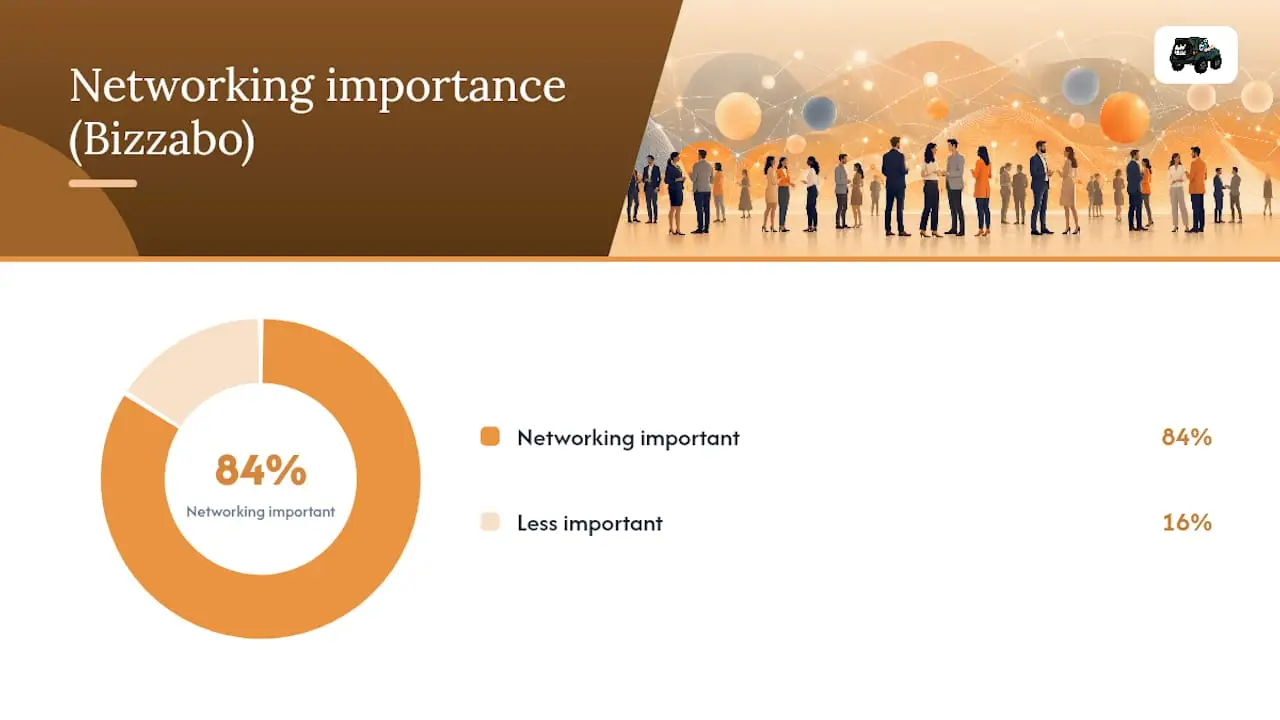
Statistic to know: According to Bizzabo’s enterprise event research, 84% of sponsors rate structured attendee networking as important to achieving their event goals — which means passive logo placements alone will not satisfy most sponsors.
The practical implication: every package tier you build should include at least one structured interaction opportunity (a hosted session, a roundtable, a lead-capture activation) alongside any branding deliverables. That combination is what converts a one-time sponsor into a multi-year partner.
How to build your event sponsorship strategy step by step
A repeatable process beats improvisation every time. The framework below draws on the Segment, Prepare, Activate, Nurture (SPAN) method documented by Bizzabo for enterprise event teams, adapted here for organizers at every scale.
Step 1: Define goals and align them to your event
Start with two questions: What does the sponsor need to achieve? What can your event actually deliver? Map your audience demographics, job titles, purchase authority, and geographic concentration into a one-page audience summary. That document becomes the foundation of every proposal you send.
Step 2: Inventory every sponsor asset
List every touchpoint you control, organized by phase:
- Pre-event: email inclusions, social posts, press releases, website logo placement, registration confirmation inserts.
- On-site: signage, speaking slots, hosted sessions, booth space, badge/lanyard branding, sponsored meals or breaks.
- Digital: live-stream bumpers, app push notifications, sponsored polls, lead-capture stations.
- Post-event: recap email, session recordings, co-branded content, attendee data export.
Assign a measurable deliverable to each asset. “Logo on website” is not a deliverable. “Logo on website homepage with 2,000 monthly unique visitors, tracked via UTM link” is.
Step 3: Build your anchor package and supporting tiers
Price your top tier first. Set it at a level that covers a meaningful share of your event budget and reflects the full value of your premium assets. Then build two or three supporting tiers below it. Industry guidance recommends keeping the price ratio between your top and bottom tiers at roughly 3x–4x to avoid decision friction.
Step 4: Build your proposal and deck
A strong sponsorship proposal has five components:
- One-page executive summary (event overview, audience snapshot, top-line package options).
- Benefits matrix (each tier, each deliverable, each measurable outcome).
- Audience data page (demographics, job titles, purchase authority, geographic reach).
- Measurement plan (what you will track, how you will report it, and when).
- Logistical summary (event dates, venue, production timeline, contact information).
Step 5: Execute your outreach cadence
Start prospecting 90–120 days before the event. Most corporate sponsors need 4–8 weeks to approve a budget line, so early outreach gives you room to negotiate without pressure. Send an initial email, follow up at day 7, request a decision at day 14, and close or move on by day 21.
Step 6: Manage fulfillment and delivery
Assign a named owner to every deliverable in your contract. Run a pre-event production checklist two weeks out, a day-of checklist on-site, and a post-event asset handoff within 72 hours of the event closing.
Pro Tip: Build a simple sponsorship flowchart with three columns: deliverable, owner, and deadline. Share it with your sponsor contact at signing. It sets expectations, reduces last-minute surprises, and gives you a paper trail if a dispute arises.
How to create sponsorship packages and price them
Pricing is where most organizers leave money on the table. The fix is a structured tier model with defensible valuations.
Recommended tier structure
Three to four tiers give sponsors enough choice to self-select without creating decision paralysis. A four-tier model works well for mid-to-large events:
| Tier | Label | Core Deliverables | Pricing Range |
|---|---|---|---|
| 1 | Presenting / Title | All assets, exclusivity, keynote intro, full data export | $10,000–$25,000+ |
| 2 | Gold | Speaking slot, lead capture, email inclusion, premium signage | $5,000–$9,999 |
| 3 | Silver | Session sponsorship, standard signage, social mention, logo on site | $2,000–$4,999 |
| 4 | Bronze | Logo placement, one social post, event program listing | $500–$2,000 |
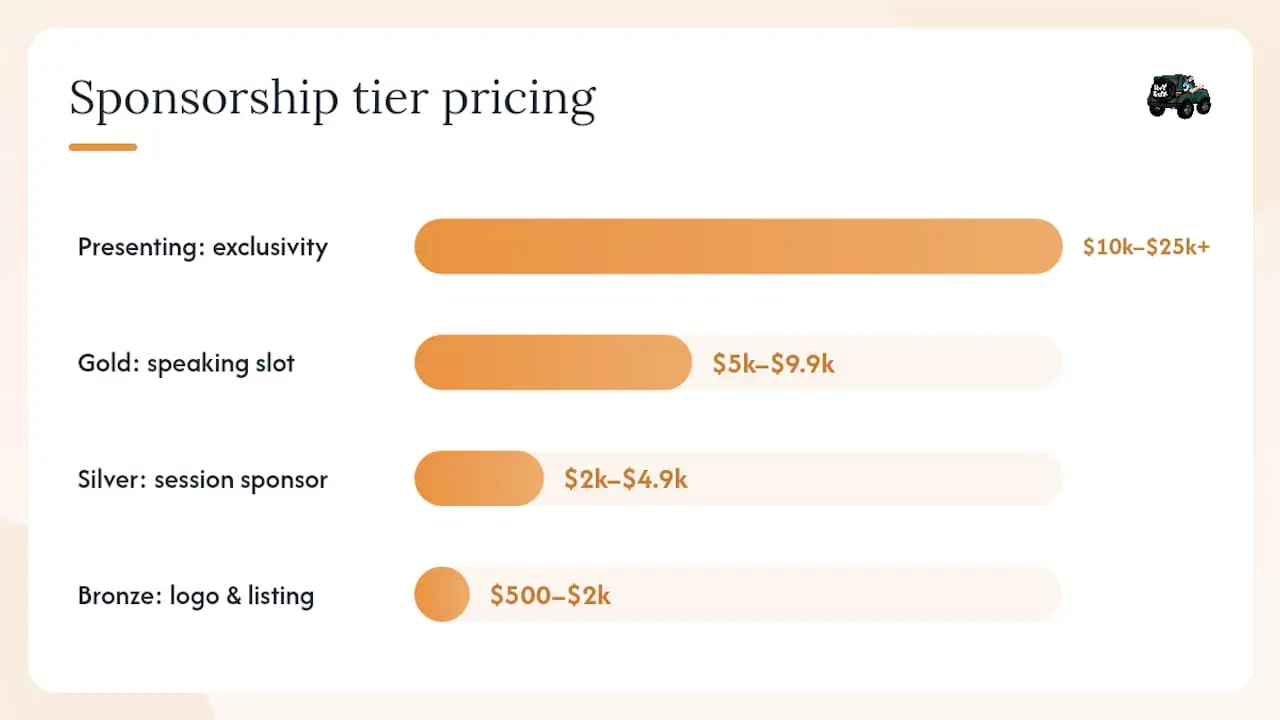
Pricing ranges vary by event scale, audience size, and market. Adjust the numbers to your event, but keep the ratio logic intact.
Pricing rules that protect your margin
- Anchor at the top. Set your Presenting tier first. Every other tier is priced relative to it, which makes the lower tiers feel like accessible entry points rather than cheap options.
- Keep ratios at 3x–4x. A $500 Bronze and a $25,000 Presenting tier create a 50x gap that confuses buyers. A $2,500 Bronze and a $10,000 Gold is a 4x ratio that feels proportional.
- Price add-ons separately. Podcast segments, direct mail inserts, and co-branded content work better as line-item add-ons than as bundled surprises. Sponsors can then customize their package without forcing you to rebuild your tier structure.
- Offer early-commitment discounts of 10–15% for sponsors who sign 60 or more days before the event. This improves cash flow and locks in revenue before production costs hit.
- Build-your-own options work well for sponsors with specific needs. Offer a base package plus a menu of add-ons priced individually.
Sponsors routinely underestimate their total activation costs. Industry cost analyses show sponsors commonly underbudget by roughly 30%–50% when they fail to account for travel, booth setup, drayage, and hospitality. Be transparent about these costs in your proposal. Sponsors who are surprised by hidden expenses do not renew.
Pro Tip: Set your top tier just below a common internal approval threshold — $4,999 instead of $5,000, or $9,999 instead of $10,000. Many corporate sponsors need a second signature above round-number thresholds. Staying just below them speeds up the approval cycle without sacrificing meaningful revenue.
How to deliver sponsor value without losing a renewal
Fulfillment is where sponsorship programs succeed or fail. A sponsor who receives everything promised on time will renew. One who chases you for deliverables will not.
Contract checklist: clauses you must include
- Deliverables list with specific quantities, formats, and deadlines for each item.
- Exclusivity terms — define the category (e.g., “exclusive financial services sponsor”) and the geographic scope.
- Indemnity and liability caps — protect both parties from third-party claims arising from activations.
- Force majeure clause — covers event cancellation or postponement due to circumstances outside your control.
- Cancellation and refund policy — specify the refund schedule (e.g., 100% refund if canceled 90+ days out, 50% within 30–89 days, no refund within 30 days).
- Data rights — specify what attendee data the sponsor receives, in what format, and under what opt-in conditions.
- Termination clause — define the conditions under which either party can exit the agreement.
For secure review and approval of contract drafts and sponsored content, a workflow tool that handles sharing sponsored content drafts securely reduces version-control errors and protects both parties during the approval process.
On-site fulfillment checklist
- Confirm all signage is installed and correctly branded 24 hours before doors open.
- Brief sponsor representatives on the run-of-show, check-in process, and lead-capture setup.
- Assign a staff liaison to each Presenting and Gold sponsor for the duration of the event.
- Run a mid-event check-in with each sponsor contact to address any issues in real time.
- Collect all sponsor-hosted activity attendance counts and lead-capture totals before the venue closes.
Post-event fulfillment timeline
Deliver a fulfillment package within 72 hours of the event: screenshots of all digital placements, signage photos, session attendance counts, lead-capture exports, and social post analytics. Follow up with a full sponsor report within two weeks. Packages that include data deliverables and conversion tools are significantly easier to renew and justify higher prices than visibility-only packages.
Pro Tip: Send a “proof of placement” email the morning after the event — just a few photos and a quick summary. It takes 10 minutes and signals professionalism before the full report is ready. Sponsors notice.
How to measure sponsorship ROI and which KPIs sponsors care about
Most sponsors fail to measure ROI properly because they track the wrong things. A four-category measurement framework gives you a defensible ROI calculation and a report sponsors can take to their CFO.
The four value categories
| Category | KPIs to Track | Attribution Window |
|---|---|---|
| Direct leads | Lead count by capture point, opt-in rate, lead quality score | 30 days post-event |
| Brand impressions | Estimated reach, equivalent media value, social mentions | Event window + 7 days |
| Relationship value | Decision-maker meetings held, pipeline influenced, closed revenue | 90 days post-event |
| Content value | Session views, co-branded content downloads, podcast listens | 12 months post-event |
For advertising ROI benchmarking, use the equivalent media value calculation: take the total impressions delivered (email opens, social reach, session attendance) and multiply by a comparable CPM for your market. This gives sponsors a number they can compare against paid media spend.
Reporting template components
A complete sponsor report includes four sections:
- Fulfillment audit — every contracted deliverable, confirmed delivered or flagged as missed with a make-good offer.
- Engagement metrics — attendance by session, lead counts by capture point, digital asset performance.
- Outcomes summary — pipeline influenced, meetings held, content assets delivered.
- Recommendation — a specific renewal proposal with pricing, updated audience data, and a suggested package for the next event.
Platform reviews on G2 consistently show that sponsors prioritize lead-retrieval features, easy data exports, and reporting dashboards when evaluating event platforms. Build your tech stack around those requirements, not your own production convenience.
Set measurement commitments in the contract. Specify what data you will collect, how it will be shared, and within what timeframe. Sponsors who know what to expect are easier to manage and more likely to renew.
Sponsorship outreach and negotiation: how to find and close sponsors
Prospecting is faster than most organizers expect when you start with the right lists.
Where to find prospects quickly
- Existing advertisers and media partners — any brand already spending money to reach your audience is a warm prospect.
- Past exhibitors and vendors — they have already paid to be in the room. A sponsorship upgrade is a natural conversation.
- Speaker and panelist companies — their employers have a direct interest in the event’s success.
- Local business associations — chambers of commerce, BIDs, and industry groups are full of brands looking for community visibility.
- Competitor event sponsor lists — public sponsor pages from similar events in your market show you exactly who is buying in your category.
Outreach sequence and timing
- Day 1 — Initial outreach: Short email (under 150 words). Name the event, state the audience, and offer one specific package. End with a single question: “Is this the right fit for your Q3 goals?”
- Day 7 — Follow-up: Reference the first email, add one new data point (attendee count, a notable speaker), and ask for a 15-minute call.
- Day 14 — Decision request: Be direct. “I have one Gold sponsorship remaining at this price. Are you in a position to move forward this week?”
- Day 21 — Close or move on: If no response, send a final note and archive the contact for the next event cycle.
Sample email templates
Cold outreach:
Subject: [Event Name] — [Sponsor’s Industry] sponsorship opportunity
Hi [Name], [Event Name] brings together [X attendees / job titles] in [city/market] on [date]. We have one [Tier Name] sponsorship available that includes [top 2 deliverables]. Given [Sponsor Company]’s focus on [relevant goal], I think this is worth a quick conversation. Are you open to a 15-minute call this week?
Warm outreach (past sponsor or advertiser):
Subject: [Event Name] — early access for past partners
Hi [Name], we wanted to give [Sponsor Company] first access to [Event Name] sponsorships before we open them publicly. Based on last year’s results — [specific outcome if available] — we have updated the [Tier Name] package to include [new deliverable]. Early commitment pricing is available through [date]. Want me to send the updated proposal?
Renewal outreach:
Subject: [Event Name] — your renewal window is open
Hi [Name], [Event Name] is confirmed for [date]. As a returning sponsor, you have access to [price protection / same tier at last year’s rate] through [early renewal deadline]. I have attached the updated audience data and the 2026 package options. Let me know if you want to lock in your spot.
Common objections and how to handle them
- “Our budget is already allocated.” Reframe: “Many of our sponsors fund this through their marketing or events budget rather than a dedicated sponsorship line. Would it help if I sent a one-page summary you could share with your marketing director?”
- “We can’t measure the ROI.” Reframe: “That’s exactly why we built the measurement plan into the package. You’ll receive a lead export, an engagement report, and an equivalent media value calculation within two weeks of the event.”
- “The timing doesn’t work.” Reframe: “We have a post-event content package that delivers value over 90 days, not just on event day. Would that extend the window enough to work for your cycle?”
Pro Tip: Offer data access as a negotiation lever before you discount price. A sponsor who wants more leads can get a lead-capture upgrade. A sponsor who wants more visibility can get an additional email inclusion. Trading deliverables protects your margin better than cutting the package price.
Activation ideas that actually move the needle
Not all activations are created equal. The ones that drive renewals are the ones sponsors can point to in a board meeting.
High-ROI activations worth pricing at a premium
- Keynote or session speaking slots — direct access to a captive, pre-qualified audience. Price these as standalone add-ons or include them only in top tiers.
- Hosted roundtables — 10–20 decision-makers in a room with a sponsor facilitator. High perceived value, low production cost.
- Invitation-only dinners or receptions — curated guest lists create exclusivity. Sponsors pay for the curation, not just the food.
- Sponsored workshops — hands-on sessions where the sponsor’s product or expertise is the curriculum. Attendees leave with a tangible outcome; sponsors leave with qualified contacts.
- Lead-capture stations — badge scans, QR code interactions, or digital sign-ups tied to a sponsor’s CRM. Measurable and repeatable.
Low-ROI items to price carefully
Lanyards, water bottle branding, and passive logo placements on a wall have their place, but only when bundled with measurable deliverables. Selling them as standalone packages trains sponsors to expect low value for low price, which makes upselling harder.
Digital activations that extend reach beyond event day
Sponsored email inclusions, podcast segments, social media takeovers, and co-branded recap content all extend a sponsor’s reach into the weeks before and after the event. Branded content strategies packaged as sponsor deliverables give organizers a content asset and give sponsors a measurable impression count outside the event window.
The activation principle that drives renewals: Sponsors remember the conversations they had, the leads they captured, and the content they walked away with. They do not remember the logo on the banner. Build every package around the first three, and use the fourth as a bonus.
Event-specific examples
Small community fair: A local bank sponsors a “Financial Wellness” booth with a free credit-check kiosk. Deliverables: 200+ lead captures, co-branded social posts, and a sponsored segment in the event recap email. Total package value: $1,500–$2,500.
Regional B2B conference: A SaaS company sponsors a hosted roundtable for 15 VPs of Operations. Deliverables: facilitated session, attendee contact list (opt-in), post-event co-branded summary report. Total package value: $7,500–$12,000.
Fundraising gala: A wealth management firm sponsors the VIP reception. Deliverables: exclusive branding in the VIP space, introduction by the emcee, one-page insert in the program, and a post-event donor list segment (with consent). Total package value: $5,000–$10,000.
Why local media and community partnerships multiply sponsor value
Local media is not a consolation prize for organizers who can’t land national sponsors. It is a distinct channel with measurable advantages: trusted audiences, higher conversion rates, and storytelling contexts that national platforms can’t replicate.
The local media advantage: A community magazine or regional podcast reaches an audience that already trusts the publication. That trust transfers to the sponsor’s message in a way that a programmatic ad impression never does.
Media partnerships in local brand growth work because the publisher’s credibility becomes part of the sponsor’s deliverable. When you integrate a local media partner into your sponsorship package, you are selling access to an audience that has already opted in to that publisher’s voice.
Practical local-media activations you can build into packages
- Co-branded editorial — a feature article in a community magazine that covers the event and profiles the sponsor’s community contribution. Deliverable: print and digital placement with tracked URL.
- Podcast sponsorship segment — a 60–90 second sponsor message in a pre-event or post-event podcast episode. Deliverable: listen count, download data, and a shareable audio asset.
- Targeted direct mail insert — a sponsor-branded insert in a community publication’s mailing to a defined zip code or demographic segment. Deliverable: verified circulation count and response tracking.
- Social amplification from the publisher’s account — a co-branded post from the publisher’s social channels, not just the event’s. Deliverable: reach and engagement metrics from the publisher’s audience.
Deployment timeline for a local-media activation
A typical local-media integration runs on a six-week production cycle: week one for brief and content approval, weeks two and three for production and editorial review, week four for final approval, and weeks five and six for distribution and live placement. Build this timeline into your sponsor contract so both parties know when assets are due.
Pricing and proof for local-media deliverables
Price local-media inclusions at or above their standalone advertising rate, then add a premium for the co-branded event context. Proof of placement for sponsor reporting includes: a PDF tear sheet or screenshot of the print/digital placement, podcast download analytics, direct mail postal verification, and social post analytics exported within 48 hours of publication.
Pro Tip: When you pitch a local-media activation to a sponsor, lead with the publisher’s audience data, not the event’s. A sponsor who is already spending on local advertising will immediately recognize the value of a co-branded placement in a trusted community publication.
Legal and compliance checklist for U.S. event sponsorships
Sponsorship agreements are contracts. Treat them that way from the first conversation.
Key contract clauses
- Deliverables list — specific, quantified, and dated. Vague language (“prominent signage”) creates disputes. “Two 6-foot retractable banners in the main hall, installed by 8 AM on event day” does not.
- Indemnity clause — each party indemnifies the other for claims arising from their own actions or materials.
- Liability cap — limit each party’s total liability to the value of the sponsorship fee. Without a cap, a minor incident can become a major legal exposure.
- Force majeure — define triggering events (natural disaster, government order, venue closure) and specify whether the result is a refund, a credit, or a rescheduled event.
- Cancellation and refund schedule — tiered by how far in advance the cancellation occurs.
- Data rights clause — specify exactly what attendee data transfers to the sponsor, in what format, under what opt-in conditions, and whether the sponsor may use it for purposes beyond the event.
- Exclusivity terms — define the category, the geographic scope, and the duration (event day only, or the full promotional window).
- Termination clause — conditions, notice period, and consequences for each party.
FTC disclosure requirements
If a sponsor’s involvement is presented as editorial content (a “sponsored post,” a “partner feature,” or a “presented by” segment), the FTC requires clear and conspicuous disclosure. “Sponsored by [Brand]” or “Paid partnership with [Brand]” placed prominently at the top of the content satisfies the requirement. Burying disclosure in fine print or using ambiguous language like “in association with” does not.
The FTC standard in plain terms: If a reasonable person could mistake sponsored content for independent editorial, the disclosure is not clear enough. When in doubt, make it more obvious, not less.
Sponsor data handling
Under U.S. privacy frameworks, attendee data transferred to a sponsor requires explicit opt-in consent at the point of collection. Your registration form must clearly state that attendees’ contact information may be shared with event sponsors, and attendees must affirmatively check a box, not opt out of a pre-checked one. Do not transfer data to sponsors who are not named in the consent language.
Risk mitigation steps
- Carry event liability insurance with a minimum of $1 million per occurrence; require sponsors with physical activations to carry their own coverage and name you as an additional insured.
- Confirm all sponsor-installed signage and structures meet venue safety requirements and local building codes.
- Verify that all sponsor activations are ADA-accessible, including booth layouts, interactive kiosks, and any hosted activities.
- Define an escalation procedure in writing: who the sponsor contacts if something goes wrong on-site, and what the response timeline is.
What actually drives renewals in local and regional sponsorships
The conventional wisdom says sponsors renew because the event went well. That is only half the story.
Sponsors renew because they received proof that the event went well for them. The organizers who consistently build multi-year sponsor relationships are the ones who deliver a measurement report before the sponsor has to ask for it, who send a renewal proposal with updated audience data within 30 days of the event, and who stay in contact between events with something of value: a market insight, a content asset, a community update.
Local and regional sponsorships have a structural advantage here. A national brand sponsoring a trade show is one of fifty logos. A regional brand sponsoring a community event is a named partner in a story their customers are already reading. That positioning is worth more than the impression count suggests, and it is the argument that closes renewals.
The practical tip for the next 90 days: send every current or past sponsor a one-page “audience update” — new demographic data, a notable attendee milestone, or a preview of next year’s programming. It costs nothing to produce and signals that you are managing their investment year-round, not just on event day. Annual event sponsorship programs that include renewal mechanics like price protection and early renewal windows consistently outperform programs that treat each year as a fresh sale.
How 16wmediagroup helps you build and activate sponsorships
Putting a sponsorship strategy on paper is one thing. Executing it across local media, podcasts, and community publishing channels is where most organizers need a partner.
16wmediagroup brings together local advertising expertise, community publishing, podcast production, and traditional media placement under one roof. For event organizers, that means you can offer sponsors a co-branded editorial feature in a community magazine, a sponsored podcast segment with verified download data, a targeted direct mail insert, and a digital campaign — all as part of a single, priced sponsorship package. We handle package design, local media placement, fulfillment tracking, and post-event reporting so you can focus on running the event.
Our services are built for organizers who want to offer sponsors something beyond a banner and a logo. If you are ready to build a sponsorship program that sponsors actually want to renew, reach out to 16wmediagroup and let’s build your media plan together.
Sources
The sources below back the key claims in this guide and are worth bookmarking for ongoing reference.
- How to Measure Event Sponsorship ROI (With Formulas and Benchmarks) — Attendir Blog
- Event Sponsorship Packages: Tiers, Pricing & Examples (2026)
- Event Sponsorship Packages: Tiers, Pricing & ROI 2026
- Event Sponsorship Guide for Enterprise Event Leaders
- Conference sponsorship costs analysis — KeynoteData
- G2
- Building A Sponsorship Strategy For Annual Events
Short on time? Start with the Attendir ROI guide for measurement and the i4a pricing guide for package structure. Those two cover the decisions most organizers get wrong first.