

Local programmatic advertising uses automated ad buying to place ads in front of specific audiences inside a defined geography, whether that’s a five-mile radius around your storefront or a whole DMA. Businesses use it to drive store visits, generate local leads, or fill seats at an event. Under the hood, it runs on the same programmatic buying for local markets that powers national campaigns, just aimed with a much tighter lens. The sections ahead cover the mechanics, the targeting options, the creative rules, and a checklist you can hand to a partner.
TL;DR:
- Accurate measurement of conversions, such as store visits or online actions, must be prioritized before selecting targeting options or defining radius size.
- Creative localization should go beyond just adding city names, incorporating regional offers, local imagery, and culturally relevant messaging, ideally automated via AI tools.
- Selecting channels and targeting methods must align with campaign goals; for example, mobile geo-fencing for immediate actions or CTV for broad DMA awareness.
- Regional or hybrid campaigns often outperform national ones in ROI when targeting specific customer behaviors and market relevance, especially for local storefronts.
- Strong agency experience in local branding and measurement is crucial to ensure campaign success and accurate reporting on outcomes like store visits and local leads.
Table of Contents
- How Local Programmatic Advertising Actually Works
- Local vs. National: Which Approach Actually Fits Your Goals?
- Targeting Methods That Actually Reach Local Customers
- Creative and Localization: What Actually Moves the Needle
- Measuring What Local Programmatic Actually Delivers
- Your 7-Step Local Programmatic Launch Checklist
- Why Local Campaign Experience Actually Matters Here
- The Local-First Playbook Most Advertisers Skip
- Let 16wmediagroup Build Your Local Campaign
- Where to Go Deeper on Local Programmatic
- Sources
How Local Programmatic Advertising Actually Works
Programmatic buying runs through a handful of connected systems, and understanding each one helps you brief a vendor without getting talked over. An advertiser sets goals and budget inside a demand-side platform, or DSP, which bids on ad space in real time through an exchange. On the other side sits the supply-side platform, or SSP, representing the publisher’s inventory, whether that’s a local news site, a streaming app, or a digital billboard. This whole exchange happens through real-time bidding, and it happens in the milliseconds it takes a page to load.
Locality gets applied at the bidding stage, using signals like:
- Device GPS or app location data for real-time positioning
- IP address ranges tied to a business or residential area
- ZIP code and DMA (designated market area) boundaries
- Deterministic audience matches from loyalty programs or first-party visit data
Modern platforms can layer these signals to deliver ads through CTV, OTT, display, audio, and native formats, all through the same bidding infrastructure. That range matters because it means local advertising trends now favor a channel mix rather than one dominant format, a shift covered in the inventory section below.
Local vs. National: Which Approach Actually Fits Your Goals?
Local programmatic wins on relevance and cost efficiency. It limits ad delivery to specific geographic units like cities, ZIP codes, or a defined radius, which cuts the waste of showing ads to people who will never walk through your door. National campaigns win on scale and brand-building reach, useful when awareness across many markets matters more than any single location’s foot traffic.
Regional buys can cost far less than national buys while still delivering strong ROI — some brands run regional TV spots during major national events specifically because a targeted market with high affinity outperforms a broad national spend on cost per result.
Here’s how to think through the decision:
- Choose local-first if your revenue depends on people physically visiting a location, like a restaurant, a car dealership, or a medical practice.
- Choose national if you’re building brand recognition across markets you don’t yet have a footprint in.
- Choose hybrid if you want to test creative and targeting in one or two markets, then scale whatever wins to more markets, a path that lets smaller regional brands grow without national-level budgets.
Multi-location retailers, regional healthcare groups, franchise operators, and event venues tend to see the clearest results from a local-first structure. National advertisers with local storefronts often land on hybrid, running an always-on national brand layer with local geo-fenced bursts around specific stores.
Targeting Methods That Actually Reach Local Customers
Your targeting method should match your campaign goal, not the other way around. Radius targeting and geo-fencing draw a boundary around a specific point, like your storefront or a competitor’s, and serve ads to devices inside it. ZIP and DMA targeting work at a broader level, useful when you’re covering a whole trade area rather than a single address. Place-based lists take it further, targeting specific venues like stadiums, malls, or medical campuses.
Channel choice should follow the same logic:
- CTV and OTT work best for awareness across a full DMA, since connected TV inventory now combines premium video with better DMA-level targeting than older national TV buys allowed.
- Mobile geo-fencing drives immediate action, like a lunch-hour push to people within walking distance.
- Place-based DOOH (digital out-of-home) reaches people already moving through a neighborhood, reinforcing a message right before a purchase decision.
- Display and native fill the gaps, useful for retargeting anyone who has already engaged with your other local touchpoints.
A targeting methods primer is worth a look if you want a deeper technical breakdown of how these methods rank by use case before you brief a partner.
Creative and Localization: What Actually Moves the Needle
Swapping in a city name is not localization. A real localized advertising strategy adapts creative, messaging, and media planning to regional audience behaviors and cultural nuances, not just a geo-filter slapped on generic copy. That means local store hours, current inventory, region-specific offers, and imagery that actually looks like the neighborhood you’re targeting.
Dynamic creative optimization, or DCO, is what makes this practical at scale. Instead of building fifteen separate ads for fifteen markets, DCO assembles variants automatically from a set of creative components, swapping headlines, images, and calls to action based on the viewer’s location.
- Insert store-specific details: address, hours, current promotions
- Build creative around local moments: a home team’s playoff run, a seasonal weather event, a community festival
- Test at least two visual directions per market before locking a single creative
Pro Tip: Localizing beyond the city name is where AI-assisted creative tools genuinely earn their keep. A handful of core templates can generate dozens of local variants overnight, which used to take a design team a full week.
Measuring What Local Programmatic Actually Delivers
The KPI that matters most depends entirely on what you’re paying for the campaign to do. If the goal is foot traffic, track store visits and visit rate against impressions served. If the goal is online conversion, track geo-conversions and cost per acquisition inside the targeted boundary. If the goal is brand awareness in a new market, track brand lift and view-through rate instead of chasing a hard conversion number.
Track these regardless of campaign type:
- ROAS (return on ad spend), calculated against actual sales tied to the campaign window
- Store visit rate, using deterministic visitation data where available rather than modeled estimates
- Brand lift, surveyed before and after exposure in the target market
- Frequency and pacing, to catch ad fatigue before it drags down performance
Nearly half of all Google searches carry local intent, and local searchers tend to convert faster than broad national ones, which is part of why local campaigns often show measurable results sooner than a national brand push. Budget mainly scales with inventory type (CTV and DOOH cost more than standard display), market competition, and how tightly you cap frequency at the ZIP level to avoid burning out a small audience.
Your 7-Step Local Programmatic Launch Checklist
- Define the objective and footprint. Decide if you’re chasing visits, leads, or awareness, and draw the exact geography you’re targeting.
- Pick channels and targeting methods. Match CTV, mobile, DOOH, or display to the objective from step one.
- Prepare localized creative. Build DCO-ready templates with swappable local details.
- Set KPIs and budget. Attach a number to every KPI before launch, not after.
- Vet your partner or DSP. Ask specifically about ZIP-level frequency caps and geo-conversion definitions before signing anything, a detail covered in more depth in this local campaign planning guide.
- Launch with a clean baseline. Confirm tracking and pixel placement work before spending a dollar.
- Optimize weekly. Adjust bids and creative based on early signals.
In the first 14 to 30 days, watch pacing, frequency, and early conversion signals closely. That window tells you whether your targeting radius is too wide, too narrow, or dead on.
Why Local Campaign Experience Actually Matters Here
An experienced agency has spent years building localized advertising and branding strategies across traditional and digital media, including local publishing, podcasts, and co-op advertising programs for regional brands. That experience shapes how a local programmatic campaign gets briefed. Campaigns get measured against outcomes clients actually care about: local visibility, community engagement, and qualified local leads, not vanity impressions.
Vendors briefed correctly should be asked for explicit geo-conversion definitions and ZIP-level frequency caps up front. That single request separates a campaign that reports real store visits from one that reports modeled guesses dressed up as data.
The Local-First Playbook Most Advertisers Skip
Most advice on local programmatic advertising treats targeting as the whole game. Draw a tighter radius, pick the right ZIP codes, and results follow. That’s backwards. The businesses getting real results are the ones treating measurement as the starting point, not an afterthought bolted on after launch.
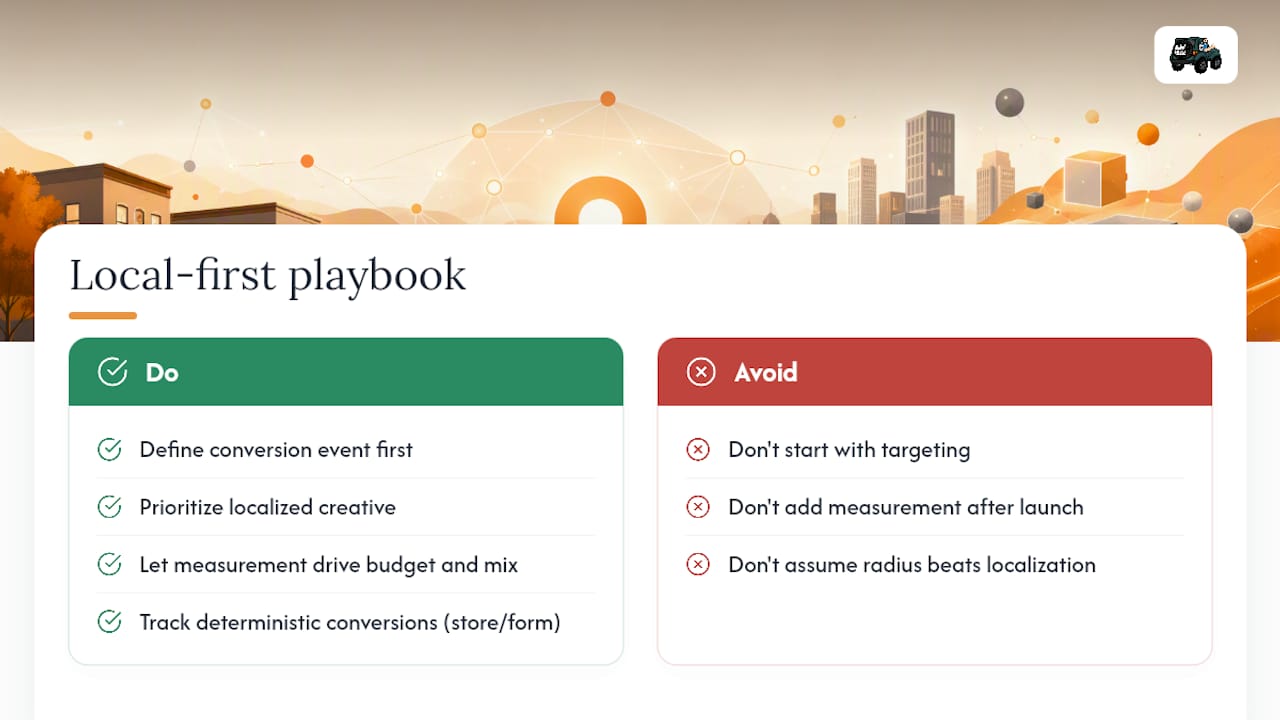
Here’s what gets underweighted: a campaign with perfect geo-fencing and generic creative will still underperform a wider radius with genuinely local messaging. Localization is not a nice add on top of targeting precision. It’s the half of the equation most vendors gloss over because creative work is harder to automate than a bidding algorithm.
If you take one thing from this, prioritize defining your conversion event before you touch targeting settings. Decide what a “win” looks like, whether that’s a deterministic store visit or a form fill, before you argue about radius size or DMA boundaries. Everything else, including budget and channel mix, should flow from that definition, not the other way around.
— Mike
Let 16wmediagroup Build Your Local Campaign
Running local programmatic advertising well means juggling media planning, creative production, buying, and measurement at the same time, which is exactly where most in-house teams get stuck. Some agencies handle that full stack: localized media planning built around your actual trade area, creative that reflects your community instead of generic stock templates, hands-on buying across display, CTV, and audio, and measurement tied to outcomes like foot traffic and local leads, not just impressions.
Small and regional business owners who want a managed local campaign, without hiring a full in-house programmatic team, tend to benefit most. Expect a media plan built around your specific market, not a repurposed national template. Start with a regional advertising expansion strategy built around your footprint, or reach out through 16wmediagroup’s contact page to get a plan started this week.
Where to Go Deeper on Local Programmatic
- The Amazon Ads localized marketing strategy guide breaks down regional audience insights and culturally relevant creative in more depth.
- IAB’s industry outlook tracks CTV growth and measurement shifts shaping local advertising trends.
- The HubSpot programmatic glossary is a solid plain-English primer on DSPs, exchanges, and RTB.
- Ai Media Group’s local versus national comparison covers strategy tradeoffs in more detail.
Sources
- A Complete Guide to Localized Marketing Strategy | Amazon Ads
- Local vs. National Programmatic Campaigns: What’s the Best Strategy? | Ai Media Group
- Why some brands opt for regional ads during the Super Bowl
- Programmatic advertising glossary and plain-English playbook | HubSpot