

Featuring your business in regional media is one of the fastest ways to build immediate credibility, targeted visibility, and measurable local traction. Editorial coverage in community outlets delivers something paid ads simply can’t manufacture: third-party trust. Local news features drive immediate awareness and strengthen local SEO through brand mentions and backlinks, making regional press a foundational channel, not an afterthought.
Here’s the short version of what you need to do:
- Prepare a media kit with a one-paragraph business overview, high-res photos, and a current bio.
- Pick one or two local channels that match your audience (community newspaper, local podcast, neighborhood newsletter).
- Pitch with a local hook — a community angle, a founder story, or a timely local event tie-in.
The rest of this guide shows you exactly how to execute each step, measure results, and turn a single mention into an ongoing stream of coverage.
Table of Contents
- Why regional media coverage delivers real business results
- Regional vs. national media: how do you choose?
- Which regional channels should you target?
- How to get featured: a step-by-step pitching playbook
- How do you measure the impact of regional coverage?
- How a regional media campaign works in practice
- How to make regional coverage work long-term
- Key Takeaways
- Why 16wmediagroup recommends regional media for local brands
- Ready to get your business featured in regional media?
- Sources and further reading
Why regional media coverage delivers real business results
The core benefit is trust, and trust is hard to buy. Earned editorial coverage is trusted by a large majority of consumers compared with paid advertising. When a local editor writes about your business, readers treat it as a neighbor’s recommendation, not a sales pitch.
Beyond trust, regional coverage produces concrete business outcomes:
- Targeted reach with buying intent. Local news readers are habitual, engaged audiences who act on local stories. They are already in your market, often looking for exactly what you offer.
- SEO and local search signals. A feature in a community publication typically generates a backlink and a brand mention, both of which signal local relevance to Google. For a business competing in a specific city or neighborhood, that signal compounds over time.
- Earned media multiplies paid spend. A feature story can be repurposed into social content, email campaigns, and sales collateral, stretching a single placement across your entire marketing mix. The localized media benefits extend well past the original publish date.
- Proof points for partnerships and grants. Media mentions carry weight in business development conversations. A press clip in a respected local outlet can open doors with sponsors, investors, and grant committees in ways a paid ad never will.
Stat to know: Communications professionals consistently note that regional outlets have captive, engaged local audiences that drive foot traffic and conversions more predictably than equivalent national placements for location-based goals.
Regional vs. national media: how do you choose?
The honest answer is that most small and regional businesses should start local and earn their way outward. Regional media often produces higher engagement and stronger local trust than national outlets for driving in-market behavior. National coverage looks impressive on a press page, but if your customers are in Tampa or Tucson, a feature in a city magazine or a segment on a local morning show will move the needle faster.
Choose regional first when you want to:
- Drive foot traffic or same-week bookings.
- Build community trust and local brand recognition.
- Promote a neighborhood event, seasonal offer, or local partnership.
- Test a story angle before pitching it to a larger outlet.
National coverage makes sense when:
- Your product ships or scales nationally and the story is genuinely broad.
- You are raising capital and need investor-facing credibility.
- A trend story positions your brand as a national voice in your category.
The cost and timeline tradeoffs are real. A regional pitch can land a feature in days; a national outlet may take months and still pass. Editorial freedom also differs. Smaller outlets have more creative latitude and actively look for community-focused founder stories, which increases your placement odds considerably.
Quick decision rule: If your revenue depends on customers within a 30-mile radius, regional media is your primary channel. National is a bonus, not a strategy.
Which regional channels should you target?
Not every local channel serves the same goal. Match the channel to what you actually need, and you’ll spend less time pitching and get better results.

Community newspapers and local news websites remain the most credible format for a formal business feature. A profile in a local paper carries editorial weight and generates a backlink. Best for: credibility, SEO, and reaching older, established community members.
Local radio is one of the most trusted broadcast formats in any region. Its companion relationship with listeners, people who tune in during commutes and routines, produces loyalty and recommendation behavior that benefits featured businesses. Best for: behavior change, event promotion, and reaching commuters.
Regional TV segments (morning shows, local news features) offer the broadest reach of any local channel. A two-minute segment can generate more awareness than weeks of social posts. Best for: product launches, grand openings, and visual storytelling.
Local podcasts are growing fast and often have highly engaged niche audiences. A 30-minute interview on a city-focused business podcast reaches listeners who are already interested in local entrepreneurship. Community magazine advertising and podcast placements together create a strong one-two punch for brand storytelling.
Neighborhood newsletters and community magazines reach hyper-local audiences with high open rates and strong reader loyalty. They are often overlooked, which means less competition for placement. Best for: long-form profiles, seasonal campaigns, and reaching specific zip codes.
Hyperlocal social groups and event listings (Nextdoor, local Facebook groups, community calendars) round out the mix. They are free, fast, and surprisingly effective for driving immediate foot traffic.
Pro Tip: Strong visuals are the difference between a brief mention and a full feature. Editors need print-ready images and short video clips. Investing in professional photography before you pitch pays off every time — visual storytelling is what turns a story idea into a story editors actually run.
How to get featured: a step-by-step pitching playbook
Getting featured is a process, not a lottery. Follow these steps and your odds improve dramatically.
Step 1: Build your media kit first
Journalists rely on media kits when researching stories, and businesses that can provide ready assets are far more likely to convert a possible mention into a full feature. Your kit should include:
- A one-paragraph business overview (facts a reporter can quote verbatim).
- A 50–100-word founder or spokesperson bio.
- Two to three high-resolution images (storefront, product, team).
- One or two recent press clips or notable milestones.
- A direct media contact name, phone, and email.
Step 2: Research and shortlist outlets
Spend 30 minutes reading the last month of coverage in your target outlets. Note which reporters cover local business, what angles they favor, and how long their features typically run. Personalization at this stage is what separates a pitch that gets opened from one that gets deleted.
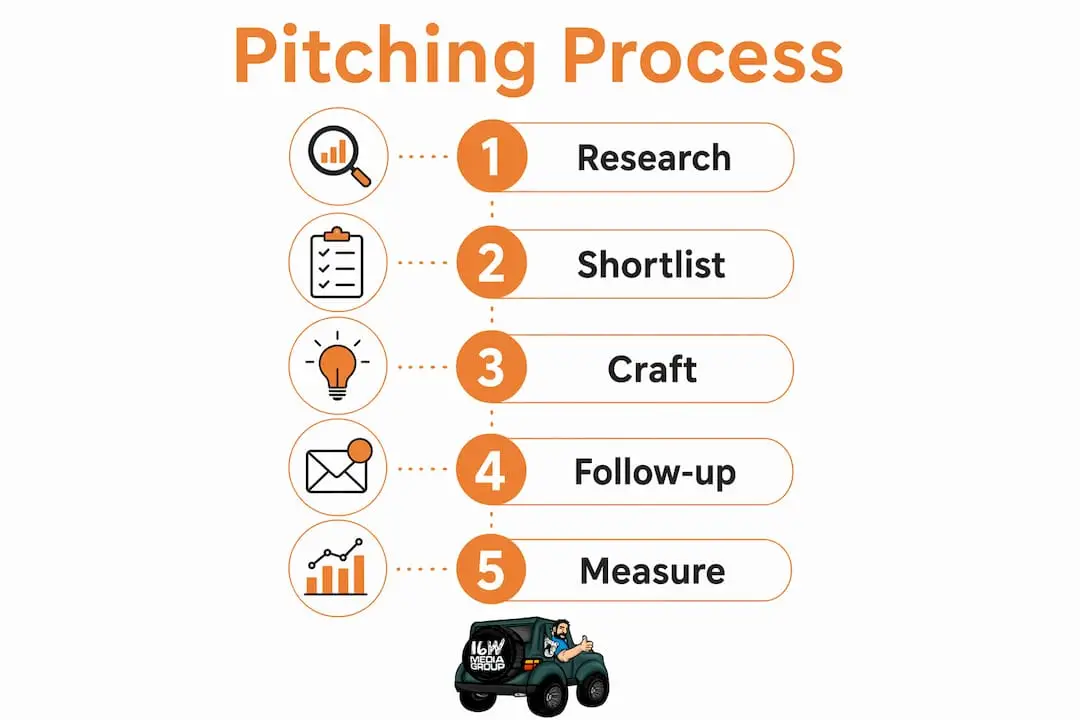
Step 3: Craft a pitch with a local hook
Your pitch should be three short paragraphs: the local angle, why it matters to their readers right now, and what you can offer (interview, access, data, event tie-in). Keep it under 200 words.
Three subject lines that work for local editors:
- “[City] founder turns [local problem] into a thriving business — story idea”
- “Exclusive: [Business name] is hiring 20 local residents this spring”
- “[Neighborhood] business marks 10 years — community impact numbers inside”
Step 4: Follow up on a predictable cadence
Send your initial pitch, then follow up once after five business days. If there’s no response after a second follow-up, move to the next outlet. Editors are busy; a polite nudge often makes the difference.
Pro Tip: The strongest pitches offer a human-interest element the editor can build around. A founding backstory tied to a local challenge, a community milestone, or a surprising local data point gives editors a narrative spine. Elevating your brand story with a clear visual and emotional arc is what turns a pitch into a feature.
How do you measure the impact of regional coverage?
Measurement is where most businesses drop the ball. They get a feature, share it on social media, and never track what actually happened. Here’s how to do it right.
| Metric | Where to track | Reasonable target |
|---|---|---|
| Referral traffic | Google Analytics (source/medium) | Noticeable spike within 48 hours of publish |
| Local search ranking | Google Search Console | Gradual improvement over 30–90 days |
| Foot traffic or bookings | POS data, booking software | Measurable lift in the week following coverage |
| Earned backlinks | Ahrefs, Moz, or Google Search Console | At least one quality link per feature |
| Conversion rate from feature CTA | UTM-tagged landing page | Varies by offer; track against your baseline |
Timeline expectations: A well-placed pitch can land a feature within one to two weeks. Referral traffic spikes quickly, often within 48 hours of publication. Local search improvements take longer, typically 30–90 days, as Google processes new signals. Business impact (bookings, partnerships, revenue) can appear within days for event-driven stories or take several months for brand-building campaigns.
Typical cost buckets: Internal time to build a media kit and pitch (the biggest investment), optional professional photography, and any small paid promotion to amplify the feature on social media after it runs. A media planning checklist helps you budget these inputs before you start.
Stat to know: Local readers show trust, relevance, and routine that makes editorial content more actionable than generic digital impressions, which is why conversion rates from local editorial features tend to outperform equivalent paid placements for location-based businesses.
How a regional media campaign works in practice
Here’s how a regional media campaign plays out when it’s executed well, using 16wmediagroup’s approach as the model.
A local Tampa-area business came to 16wmediagroup with a clear objective: increase brand awareness in a specific neighborhood and drive bookings during a slow season. The team selected three channels: a community magazine feature, a local podcast interview, and a neighborhood newsletter placement. The pitch angle centered on the founder’s local roots and a community initiative the business had quietly been running for two years.
What converted the pitch from a brief mention to a full feature:
- A complete, current media kit delivered within 24 hours of the editor’s request.
- High-resolution photography that the magazine could use without additional production.
- A community data point (number of local residents served) that gave the editor a concrete news hook.
- An offer of in-person access for a photo shoot, which the publication accepted.
The outcomes, based on client-reported data: referral traffic from the magazine’s website spiked in the days following publication, the podcast episode drove a measurable increase in booking inquiries over the following two weeks, and the newsletter placement generated partnership outreach from two complementary local businesses.
This model maps directly to most small business types. Whether you run a restaurant, a service firm, or a retail shop, the formula is the same: a strong local angle, ready assets, and the right channel mix. 16wmediagroup’s localized media planning approach is built around exactly this sequence.
Key result: Businesses that lead with a community impact story and arrive with a complete media kit consistently convert pitches into features at a higher rate than those who pitch without prepared assets.
How to make regional coverage work long-term
One feature is a win. An ongoing stream of coverage is a competitive advantage. The difference is a simple editorial calendar and a few relationship habits.
Story ideas that keep editors coming back:
- Seasonal angles (holiday hiring, summer programs, back-to-school offers).
- Customer spotlights that highlight local residents your business has helped.
- Local data you collect (foot traffic trends, service demand shifts, community survey results).
- Business milestones (anniversaries, expansions, new hires with local ties).
Relationship habits that matter:
- Send editors a brief update when something newsworthy happens, even if you’re not pitching a full story.
- Offer exclusive local data or early access to announcements before they go public.
- Respond quickly when an editor reaches out. Speed signals reliability, and reliable sources get called again.
- Review your media kit at least twice a year. Stale bios and outdated photos reduce your placement odds.
Pro Tip: Every time you earn a feature, repurpose it immediately. Post it to your website’s press page, share it in your email newsletter, and clip the best quote for social media. This keeps the story alive for your owned audience and signals to the next editor that you’re a business worth covering. Maximizing media exposure means treating every placement as a content asset, not a one-day event.
Key Takeaways
Regional media coverage builds credibility, drives local search signals, and converts community audiences into customers faster than most paid channels for location-based businesses.
| Point | Details |
|---|---|
| Trust drives conversions | Earned editorial coverage is trusted by a large majority of consumers, far outperforming paid ads for credibility. |
| Media kit is your first move | Journalists rely on ready assets; a complete, current media kit is the single biggest factor in converting a mention into a feature. |
| Match channels to goals | Community newspapers build SEO and credibility; local radio and podcasts drive behavior change; newsletters reach hyper-local audiences. |
| Measure the right metrics | Track referral traffic, local search rankings, earned backlinks, and booking lift, not just impressions. |
| 16wmediagroup as your partner | 16wmediagroup offers media planning, community publishing, podcast placement, and campaign execution to help local businesses earn and sustain regional coverage. |
Why 16wmediagroup recommends regional media for local brands
Regional media has always been the most direct path to community trust, and that’s exactly why 16wmediagroup builds it into every local brand strategy we recommend. When we work with a business in a competitive market like Tampa, the first question we ask is: does your community know your story? National impressions are great for vanity metrics, but a feature in a trusted local outlet, a segment on a regional podcast, or a profile in a neighborhood magazine puts your brand in front of people who are already primed to buy locally.
What we’ve seen consistently is that businesses integrating regional features with a broader media plan, combining earned coverage with community publishing and targeted paid amplification, achieve visibility that compounds over time. A single feature becomes a press clip. A press clip becomes a pitch asset. A pitch asset opens doors to partnerships, sponsorships, and the next feature. That cycle is what we help clients build, and it starts with getting the first placement right.
Ready to get your business featured in regional media?
16wmediagroup takes the friction out of local media placement. Instead of spending weeks figuring out which outlets to pitch and how to package your story, you get a team that already knows the channels, the editors, and the angles that convert in your market.
Services include media kit development, localized pitching, community magazine publishing, podcast and radio placement, and full campaign measurement so you know exactly what your coverage is producing. Whether you’re starting from scratch or looking to build on a single mention, 16wmediagroup puts your brand in front of the right local audience with a plan that’s built to last.
The clearest next step: review the local advertising best practices guide to see how regional coverage fits into a complete local media plan, then reach out to start building yours. You can also explore the full range of local advertising options to find the right mix for your goals and budget.
Sources and further reading
- The Role of Local News in Small Business Growth — explains how local features drive awareness and local SEO signals.
- Before the Next Feature Story: Why Uptown Businesses Need a Media Kit — practical checklist for building and maintaining a media kit that editors actually use.
- The Press Opportunity Most Tri-Town Businesses Aren’t Ready For — covers consumer trust in earned editorial coverage vs. paid advertising.
- Do We Overlook the Benefits of Regional Media? — communications professionals on why regional outlets outperform national for in-market behavior.
- Small but Mighty: Why Local Media — editorial freedom and human-interest angles at regional outlets.
- How to Turn Local News Readers Into Paying Customers — habit and intent signals in local news audiences.
- 16wmediagroup Services: Podcast, Publishing, Traditional Media — overview of 16wmediagroup’s local media planning and community publishing capabilities.
- Local Advertising Campaign Planning Guide — step-by-step resource for businesses ready to build a regional media plan.